Showing posts with label Next. Show all posts

Friday, September 12, 2014

SpaceX Dragon V2: Next ISS cargo launch set for Sept 20

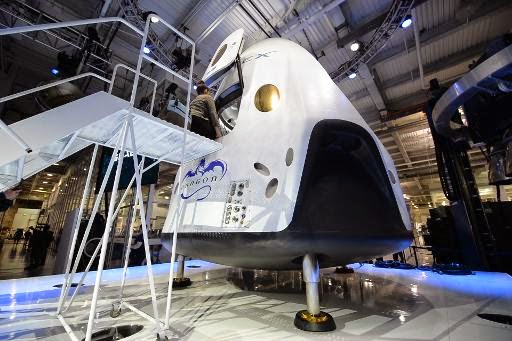
SpaceX's new seven-seat Dragon V2 spacecraft is seen at a press conference to unveil the new spaceship, in Hawthorne, California, May 29, 2014

SpaceX's next unmanned cargo trip to restock supplies at the International Space Station is scheduled for September 20, the US space agency said Friday.

The Dragon spacecraft will launch atop a Falcon 9 rocket at 2:16 am (0616 GMT) on September 20 from Cape Canaveral Air Force Station in Florida, NASA said.

"If for any reason the launch is postponed, the next launch opportunity is Sunday, Sept. 21 at approximately 1:53 am," it said in a statement.

The cargo ship will be loaded with more than 5,000 pounds (2,300 kilograms) of supplies and scientific experiments, including an ocean surface wind speed monitor, equipment for studying rodents in microgravity and cabbage-like plants to see how their growth adapts in space.

The mission, called SpaceX CRS-4, "is the fourth of 12 SpaceX flights NASA contracted with the company to resupply the space station," the space agency said.

The trip marks the fifth Dragon journey to the orbiting outpost, including its initial demonstration mission.

SpaceX and Orbital Sciences Corporation each have billion-dollar contracts with NASA to supply the space station over the coming years.

The retirement of the space shuttle program in 2011 has left the United States without a government spacecraft to transport cargo or crew to the space station.

Tuesday, April 8, 2014

NASA Curiosity Rover: Next Science Destination - The Kimberley

NASA's Curiosity Mars rover recorded this view of various rock types at waypoint called "the Kimberley" shortly after arriving at the location on April 2, 2014. 

The site offers a diversity of rock types exposed close together in a decipherable geological relationship to each other.

Credit: NASA/JPL-Caltech

NASA's Mars rover Curiosity has reached its next study area and is now scoping out rocks that it will take an up-close look at over the next few weeks.

The Curiosity rover snapped new photos of Mars after driving 98 feet (30 meters) on Wednesday (April 2) and topping a small hill that affords a good view of the surrounding area, which NASA scientists have dubbed "the Kimberley," officials said.

"This is the spot on the map we've been headed for, on a little rise that gives us a great view for context imaging of the outcrops at the Kimberley," Melissa Rice of the California Institute of Technology in Pasadena, the science team lead for Curiosity's work at the site, said in a statement.

This view from NASA's Curiosity Mars rover was taken the day before the rover's final approach drive to "the Kimberley" waypoint, selected months ago as the location for the mission's next major investigations. 

It combines several frames taken by the Navigation Camera on April 1, 2014.

Credit: NASA/JPL-Caltech

Four different types of rock intersect at the Kimberley, providing Curiosity with a wealth of material to study.

The rover is expected to do a great deal of work at the site, conducting its most extensive analyses since leaving a spot called "Yellowknife Bay" last year, NASA officials said.

Curiosity found evidence of an ancient stream-and-lake system at Yellowknife Bay, suggesting that the area could have supported microbial life billions of years ago.

Wednesday, September 11, 2013

NASA Evolutionary Xenon Thruster (NEXT) uses ION propulsion


NASA’s Evolutionary Xenon Thruster (NEXT) project has completed the longest duration test for a Space propulsion system (48,000 hours/5 1/2 years). This look inside the thrusters discharge chamber shows how it works.

Credit: NASA / Eric S. Mindek (Wyle Information Systems, LLC)

Thursday, August 1, 2013

Post Higgs breakthrough, CERN readies for next cosmic quest

A view of the detector in the 12,500-ton Compact Muon Solenoid experiment (CMS). Image courtesy of CERN

A year ago, the world's largest particle collider made one of the greatest discoveries in the history of science, identifying what is believed to be the Higgs Boson—the long-sought maker of mass.

Today, its computer screens are dark, the control desks unstaffed and the giant, supercooled tunnel empty of the crashing proton beams whose snapshots of the Big Bang helped flush out the elusive particle.

But the silence is an illusion.

Behind the scenes, work is pushing ahead to give the vast machine a mighty upgrade, enabling it to advance the frontiers of knowledge even farther.

The 27-kilometre (17-mile) circular lab, straddling the French-Swiss border 100 metres (325 feet) underground, went offline in February for an 18-month overhaul.

When experiments resume in 2015, scientists at the European Organisation for Nuclear Research (CERN) will use its enhanced power to probe dark matter, dark energy and supersymmetry—ideas considered as wild as the Higgs Boson was, half a century ago.

As engineers focus on the technical mission, physicists are sifting through the mountains of data that the Large Hadron Collider (LHC) has churned out since 2010, for there could be more nuggets to find.

"The things that are easy to spot have already been exploited, and now we're taking another look," said Tiziano Camporesi of CERN, noting wryly that dealing with the unknown was, well, unknowable.

"We always say that astronomers have an easier task, because they can actually see what they're looking for!"

The LHC's particle collisions transform energy into mass, the goal being to find fundamental particles in the sub-atomic debris that help us to understand the Universe. At peak capacity, the "old" LHC managed a mind-boggling 550 million collisions per second.

"We give the guys as many collisions as we can," said Mike Lamont, head of its operating team. "That's our bread and butter."

"Most of that stuff is not very interesting, so there are real challenges sorting out and throwing most of that away, and picking out the interesting stuff," he explained in the tunnel, which mixes installations fit for a starship with the low-tech practicality of bicycles for inspection tours.

Wednesday, July 10, 2013

NASA Mars Rover 2020: Next Mars Rover to Seek Signs of Life

A sketch of the design for NASA's 2020 Mars rover. 

Planning for NASA's 2020 Mars rover envisions a basic structure that capitalises on re-using the design and engineering work done for the NASA rover Curiosity.

NASA rover Curiosity landed on Mars in 2012, but with MSL, the new science instruments selected through competition for accomplishing different science objectives with the 2020 mission.

CREDIT: NASA/JPL-Caltech

NASA's next Mars rover should hunt for signs of past Red Planet life and collect samples for eventual return to Earth, a team of mission planners has determined.

The new Mars rover — slated to launch in 2020 — should explore a site that once was habitable, make its own observations and snag material for scientists here on Earth to study in unprecedented detail at some point in the future, according to a new report compiled by the mission's "science definition team" (SDT).

"The SDT-preferred mission concept employs new in situ scientific instrumentation in order to seek signs of past life (had it been there), select and store a compelling suite of samples in a returnable cache and demonstrate technology for future robotic and human exploration of Mars," states the report, which was released to the public today (July 9).

The 2020 Mars rover will be based heavily on NASA's Curiosity rover, which touched down last August on a mission to determine if Mars could ever have supported microbial life.

For example, the new robot will use a similar chassis and "sky crane" landing system, NASA officials have said. But the 2020 rover will take the science to a whole new level.

"The 2020 rover as proposed by the Science Definition Team would carry a different and more advanced set of science instruments than Curiosity carries, its drill would extract cores rather than blended powder from rocks and it would collect and package samples for possible future return to Earth," NASA officials wrote today in an FAQ about the SDT's report.

Just what those instruments will be is unclear at the moment; they will be selected through a competitive process but the science gear will search for visual, mineralogical and chemical signs of past life if the SDT recommendations are adopted.

"The capability for examining the mineralogic composition of samples at microscopic scale would be unprecedented for a mission to Mars," NASA officials wrote in the FAQ.

"The search for potential signs of past life could use assessments of textures, shapes, mineralogy, organic-matter content, and possibly elemental chemistry at the scale of individual grains within a sample."

The rover would also gather and store samples for potential return to Earth by a future mission (the timing and details of which are yet to be determined).

Sample-return is viewed by most scientists as the best way to look for signs of Red Planet life.

The new rover's landing site has not been selected yet, officials said, and its power source similarly has not been confirmed.

The Mars Science Laboratory rover, Curiosity, took this self portrait, which shows its Radioisotope Thermoelectric Generator (RTG) at center

Curiosity is powered by a radioisotope thermoelectric generator (RTG), which converts the heat generated by radioactive decay into electricity.

The 2020 rover may follow suit, but it's also possible that it could run on solar power, like NASA's smaller Spirit and Opportunity rovers, which landed on Mars in 2004.

"No final decision on a power source for the 2020 rover would be made until the mission completes a review through the National Environmental Policy Act process, which considers the environmental impacts of launching and conducting the mission," NASA officials wrote in the FAQ.

Curiosity's mission cost a total of $2.5 billion. The 2020 rover is expected to be significantly cheaper, with a total price tag estimated at around $1.5 billion.

Sunday, June 9, 2013

NASA IRIS: Preparation for Launch of Next Solar Satellite

This is a photo of the complete IRIS observatory with the solar arrays deployed. 

This is taken in a large clean tent at Lockheed Martin prior to vibration testing and prior to installation of the flight MLI blankets. 

The solar arrays have just been deployed using flight commands. 

Image credit: LM Photo

NASA's next scientific satellite, which is scheduled for launch June 26, will provide the most detailed look ever at the sun's lower atmosphere or interface region.

The Interface Region Imaging Spectrograph (IRIS) mission will observe how solar material moves, gathers energy, and heats up as it travels through this largely unexplored region of the solar atmosphere.

The interface region, located between the sun's visible surface and upper atmosphere, is where most of the sun's ultraviolet emission is generated. These emissions impact the near-Earth space environment and Earth's climate.

The IRIS spacecraft was designed and built by Lockheed Martin's Advanced Technology Center. It will launch aboard a Pegasus XL rocket deployed by an Orbital Sciences L-1011 aircraft from Vandenberg Air Force Base on the central California coast.

"IRIS data will fill a crucial gap in our understanding of the solar interface region upon joining our fleet of heliophysics spacecraft," said Jeffrey Newmark, NASA's IRIS program scientist in Washington.

"For the first time we will have the necessary observations for understanding how energy is delivered to the million-degree outer solar corona and how the base of the solar wind is driven."

IRIS carries an ultraviolet telescope that feeds a multi-channel imaging spectrograph. The satellite is the first mission designed to use an ultraviolet telescope to obtain high-resolution images and spectra every few seconds and provide observations of areas as small as 150 miles across the sun.

"Previous observations suggest there are structures in this region of the solar atmosphere 100 to 150 miles wide, but 100,000 miles long," said Alan Title, IRIS principal investigator at Lockheed Martin.

"Imagine giant jets like huge fountains that have a footprint the size of Los Angeles and are long enough and fast enough to circle Earth in 20 seconds.

IRIS will provide our first high-resolution views of these structures along with information about their velocity, temperature and density."

After launch, IRIS will travel in a polar, sun-synchronous orbit around Earth, crossing nearly directly over the poles in such a way that it moves over the equator at the same local time each day.

The spacecraft will orbit at an altitude range of 390 miles to 420 miles. This orbit allows for almost continuous solar observations on IRIS' two-year mission.

IRIS' unique capabilities will be coupled with state of the art 3-D numerical modeling on supercomputers, such as Pleiades, housed at NASA’s Ames Research Center in Moffett Field, Calif.

Recent improvements in the power of supercomputers, such as Pleiades, to analyze large amounts of data will enable IRIS to provide better information about the region than ever before.

Monday, April 8, 2013

CAN Revolutionary laser system produce the next LHC

An international team of physicists has proposed a revolutionary laser system, inspired by the telecommunications technology, to produce the next generation of particle accelerators, such as the Large Hadron Collider (LHC) in CERN.

The International Coherent Amplification Network (ICAN) sets out a new laser system composed of massive arrays of thousands of fibre lasers, for both fundamental research at laboratories such as CERN and more applied tasks such as proton therapy and nuclear transmutation.

Lasers can provide, in a very short time measured in femto-seconds, bursts of energy of great power counted in peta-watts or a thousand times the power of all the power plants in the world.

Compact accelerators are also of great societal importance for applied tasks in medicine, such as a unique way to democratise proton therapy for cancer treatment, or the environment where it offers the prospect to reduce the lifetime of dangerous nuclear waste by, in some cases, from 100 thousand years to tens of years or even less.

Major Difficulties
However, there are two major hurdles that prevent the high-intensity laser from becoming a viable and widely used technology in the future.
  • First, a high-intensity laser often only operates at a rate of one laser pulse per second, when for practical applications it would need to operate tens of thousands of times per second.
  • The second is ultra-intense lasers are notorious for being very inefficient, producing output powers that are a fraction of a percent of the input power. As practical applications would require output powers in the range of tens of kilowatts to megawatts, it is economically not feasible to produce this power with such a poor efficiency.
Technological Consortium
To bridge this technology divide, the ICAN consortium, an EU-funded project initiated and coordinated by the Ecole polytechnique and composed of the University of Southampton Optical Research Centre (ORC), Jena and CERN, as well as 12 other prestigious laboratories around the world, aims to harness the efficiency, controllability, and high average power capability of fibre lasers to produce high energy, high repetition rate pulse sources.

The aim is to replace the conventional single monolithic rod amplifier that typically equips lasers with a network of fibre amplifiers and telecommunication components.

Gerard Mourou
Gerard Mourou of Ecole polytechnique who leads the consortium says: "One important application demonstrated has been the possibility to accelerate particles to high energy over very short distances measured in centimetres rather than kilometres as it is the case today with conventional technology."

"This feature is of paramount importance when we know that today high energy physics is limited by the prohibitive size of accelerators, of the size of tens of kilometres, and cost billions of euros."

"Reducing the size and cost by a large amount is of critical importance for the future of high energy physics."

Dr Bill Brocklesby
Dr Bill Brocklesby from the ORC adds: "A typical CAN laser for high-energy physics may use thousands of fibres, each carrying a small amount of laser energy."

"It offers the advantage of relying on well tested telecommunication elements, such as fibre lasers and other components."

"The fibre laser offers an excellent efficiency due to laser diode pumping. It also provides a much larger surface cooling area and therefore makes possible high repetition rate operation."

"The most stringent difficulty is to phase the lasers within a fraction of a wavelength."

"This difficulty seemed insurmountable but a major roadblock has in fact been solved: preliminary proof of concept suggests that thousands of fibres can be controlled to provide a laser output powerful enough to accelerate electrons to energies of several GeV at 10 kHz repetition rate - an improvement of at least ten thousand times over today's state of the art lasers."

Such a combined fibre-laser system should provide the necessary power and efficiency that could make economical the production of a large flux of relativistic protons over millimetre lengths as opposed to a few hundred metres.

Societal Application
One important societal application of such a source is to transmute the waste products of nuclear reactors, which at present have half-lives of hundreds of thousands of years, into materials with much shorter lives, on the scale of tens of years, thus transforming dramatically the problem of nuclear waste management.

CAN technology could also find important applications in areas of medicine, such as proton therapy, where reliability and robustness of fibre technology could be decisive features.

Thursday, December 27, 2012

NASA Evolutionary Xenon Thruster (NEXT) Project sets new record

While the Dawn spacecraft is visiting the asteroids Vesta and Ceres, NASA Glenn has been developing the next generation of ion thrusters for future missions.

NASA's Evolutionary Xenon Thruster (NEXT) Project has developed a 7-kilowatt ion thruster that can provide the capabilities needed in the future.
Schematic of a Hall effect thruster electric propulsion device
An ion thruster produces small levels of thrust relative to chemical thrusters, but does so at higher specific impulse (or higher exhaust velocities), which means that an ion thruster has a fuel efficiency of 10-12 times greater than a chemical thruster.

The higher the rocket's specific impulse (fuel efficiency), the farther the spacecraft can go with a given amount of fuel.

Given that an ion thruster produces small levels of thrust relative to chemical thrusters, it needs to operate in excess of 10,000 hours to slowly accelerate the spacecraft to speeds necessary to reach the asteroid belt or beyond.


Diagram of how a gridded electrostatic ion engine (Kaufman type)
The NEXT ion thruster has been operated for over 43,000 hours, which for rocket scientists means that the thruster has processed over 770 kilograms of xenon propellant and can provide 30 million-newton-seconds of total impulse to the spacecraft.

This demonstrated performance permits future science spacecraft to travel to varied destinations, such as extended tours of multi-asteroids, comets, and outer planets and their moons.

Image Credit: NASA

Thursday, January 28, 2010

Route 66: Cassini's Next Look at Titan

Route 66: Cassini's Next Look At Titan

Cassini's Next Look At Titan

Sixteen days after last visiting Saturn's largest moon, NASA's Cassini spacecraft returns for another look-see of the cloud-shrouded moon - this time from on high.
The flyby on Thursday, Jan. 28, referred to as "T-66" in the hollowed halls of Cassini operations, will place the spacecraft within 7,490 kilometers (4,654 miles) above the surface during time of closest approach.

While this latest close approach places Cassini more than 6,400 kilometers (3,970 miles) higher above Titan's surface than the Jan. 12 flyby, it should not considered of lesser scientific value. Instead, this high-altitude encounter will provide an opportunity for some of the spacecraft's instruments to gain another unique perspective on this crepuscular world.

During T-66, the Imaging Science Subsystem is set to acquire high-resolution observations during and after closest-approach, covering territory from the trailing hemisphere at high southern latitudes northeast to near-equatorial Adiri.

On the inbound leg, the Visual and Infrared Mapping Spectrometer will have the opportunity to do one stellar occultation. (A stellar occultation occurs when an intervening body - in this case Titan - blocks the light from a star).

Thursday's stellar occultation should allow the Cassini science team to further constrain the composition and the spectral properties of Titan's atmosphere.

Although this latest flyby is dubbed "T66," planning changes early in the orbital tour made this the 67th targeted flyby of Titan. T66 is the 22nd Titan encounter in Cassini's Solstice Mission.