Showing posts with label Planetary Nebula. Show all posts

Friday, April 26, 2013

Planetary Nebula NGC 2438 shares the skies with the Calabash Nebula

Thursday, April 25, 2013: Planetary nebula NGC 2438 stands out brightly at top left, while at lower right the Calabash Nebula glows very faintly as a kind of upright light-bulb shape. 

The Calabash Nebula is also named the "Rotten Egg Nebula" owing to a relatively large amount of sulphur. 

Image obtained Dec. 2012-Jan 2013.

Credit: Adam Block /Mount Lemmon SkyCenter /University of Arizona

The Calabash Nebula

Sunday, April 21, 2013

our Sun won't terminate as the typical planetary nebula

An artist’s illustration of a planetary nebula engulfing its orbiting planets. 

Credit: Regulus36/deviantart

Textbooks often cite that planetary nebulae (PNe, plural) represent an endstate for lower-mass single stars.

But conversely, recent research suggests that most PNe stem from binary systems.

The lowest mass star theorized to form the typical PN is near 1 solar mass, and thus without a companion the Sun may not surpass the mass limit required to generate the hot glowing (ionized) nebula typically tied to PNe.

New research continues to question our original understanding of how the Sun's life may end.

A new study spearheaded by G. Jacoby aimed in part to test that binary hypothesis by searching for PNe in star clusters occupying M31.

The team remarked that, "while the binary interaction model explains some of the anomalies associated with the observed planetary nebula population, this theory awaits final confirmation."

"The traditional theory states that the progenitors of PNe are low- to intermediate-mass single stars …

However, this theory does not provide a natural explanation for the non-spherical morphologies observed for the great majority of PNe, nor their low rate of formation.

For these and other inconsistencies, a new paradigm has been developed, wherein most PNe are shaped via the interaction … with a binary companion," said Jacoby et al. 2013.

The advantage of finding a PN in a star cluster is that its fundamental parameters (e.g., progenitor mass, age, chemical composition) can be inferred from cluster membership.

"It is difficult to probe the different PN formation scenarios using field stars, since one has almost no prior information about the properties of the PN progenitors. However, within star clusters, the situation is different, as both the age and metallicity of the progenitor can be accessed," said the Jacoby team.

The problem with using PNe in the field is that their parameters are poorly constrained, in part because distances to the objects are notoriously uncertain. "… the situation in distance determinations for Galactic PNe is not very satisfactory.

It is estimated that this distance scale can be accurate on average to 35-50%," said Zhang 1995.

In recent years parallax measurements from the Hubble Space Telescope (Benedict et al. 2009) and the US Naval Observatory (Harris et al. 2007) have provided improved distances for some of the nearest PNe, and certain refined methods for estimating PNe distances may yield uncertainties as good as 20 to 30% (Frew and Parker 2006, Frew 2008, Stanghellini et al. 2008).

Tuesday, March 12, 2013

ESA /NASA Hubble Image: Planetary Nebula NGC 5189

The NASA/ESA Hubble Space Telescope took this striking space wallpaper of the planetary nebula NGC 5189. 

The intricate structure of the stellar eruption looks like a giant and brightly coloured ribbon in space. This image was released Dec. 18, 2012.

Credit: NASA, ESA and the Hubble Heritage Team (STScI/AURA)

Tuesday, December 25, 2012

NASA Hubble Image: Planetary Nebula NGC 5189

This object is an expanding cloud of gas rushing away from a dying star. Right in the very center you can see the star itself, a tiny blue dot whose appearance belies its power.

Once a star like the Sun, the central star of NGC 5189 is now a dense, extremely hot cinder called a white dwarf.

It’s probably only the size of the Earth but is 100,000 times denser than our planet.

A few thousand years ago this star was dying.

It had swollen into a red giant, a huge, bloated thing that was expelling a strong, thick wind of gas into space.

Over time the star shrank and heated up, turning bluish and starting to blow a thinner but much faster wind.

The fast wind caught up with and slammed into the older, slower, thicker wind, carving out a cavity in it.

We call these kinds of clouds planetary nebulae, becasue through small telescopes some of them look round and green, like planets.

Thursday, December 20, 2012

NASA ESA Hubble Image: Xmas Bauble!

Credit: NASA, ESA, and the Hubble Heritage Team (STScI/AURA) 

NASA's Hubble Space Telescope have photographed a festive-looking nearby planetary nebula called NGC 5189.

The intricate structure of this bright gaseous nebula resembles a glass-blown holiday ornament with a glowing ribbon entwined.

Planetary nebulae represent the final brief stage in the life of a medium-sized star like our Sun. While consuming the last of the fuel in its core, the dying star expels a large portion of its outer envelope.

This material then becomes heated by the radiation from the stellar remnant and radiates, producing glowing clouds of gas that can show complex structures, as the ejection of mass from the star is uneven in both time and direction.

A spectacular example of this beautiful complexity is seen in the bluish lobes of NGC 5189. Most of the nebula is knotty and filamentary in its structure.

As a result of the mass-loss process, the planetary nebula has been created with two nested structures, tilted with respect to each other, that expand away from the center in different directions. 

Sunday, June 10, 2012

Hoag's Object

Hoag's Object, a ring galaxy 600,000 light yrs away, with another ring galaxy visible through the gap.

Hoag's Object is a non-typical galaxy of the type known as a ring galaxy.

The appearance of this object has interested amateur astronomers as much as its uncommon structure has fascinated professionals.

The galaxy is named after Arthur Allen Hoag who discovered it in 1950 and identified it as either a planetary nebula or a peculiar galaxy with 8 billion stars.

Monday, May 28, 2012

ESA Hubble Image: The Swan and the Butterfly


Credit: ESA/Hubble & NASA

This image from the NASA/ESA Hubble Space Telescope shows NGC 7026, a planetary nebula. Located just beyond the tip of the tail of the constellation of Cygnus (The Swan), this butterfly-shaped cloud of glowing gas and dust is the wreckage of a star similar to the Sun.

Planetary nebulae, despite their name, have nothing to do with planets. They are in fact a relatively short-lived phenomenon that occurs at the end of the life of mid-sized stars.

As a star’s source of nuclear fuel runs out, its outer layers are puffed out, leaving only the hot core of the star behind. As the gaseous envelope heats up, the atoms in it are excited, and it lights up like a fluorescent sign.

Fluorescent lights on Earth get their bright colours from the gases they are filled with. Neon signs, famously, produce a bright red colour, while ultraviolet lights (black lights) typically contain mercury. The same goes for nebulae: their vivid colours are produced by the mix of gases present in them.

This image of NGC 7026 shows starlight in green, light from glowing nitrogen gas in red, and light from oxygen in blue (in reality, this appears green, but the colour in this image has been shifted to increase the contrast).

As well as visible light, NGC 7026 emits X-ray radiation, and has been studied by ESA’s XMM-Newton space telescope. X-rays are a result of the extremely high temperatures of the gas in NGC 7026.

This image was produced by the Wide Field and Planetary Camera 2 aboard the Hubble Space Telescope. The image is 35 by 35 arcseconds.

A version of this image was entered into the Hubble’s Hidden Treasures Competition by contestant Linda Morgan-O'Connor. Hidden Treasures is an initiative to invite astronomy enthusiasts to search the Hubble archive for stunning images that have never been seen by the general public.

Friday, April 27, 2012

NASA/ESA Hubble Image: Egg Nebula - the Realm of a Dying Star


Image Credit: ESA/Hubble, NASA


The NASA/ESA Hubble Space Telescope has been on the forefront of research into the lives of stars like our sun.

At the ends of their lives, these stars run out of nuclear fuel in a phase that is called the preplanetary or protoplanetary nebula stage.

This Hubble image of the Egg Nebula shows one of the best views to date of this brief, but dramatic, phase in a star’s life.

During the preplanetary nebula phase, the hot remains of an aging star in the center of the nebula heat it up, excite the gas and make it glow over several thousand years.

The short lifespan of preplanetary nebulae means there are relatively few of them in existence at any one time.

Moreover, they are very dim, requiring powerful telescopes to be seen. This combination of rarity and faintness means they were only discovered comparatively recently.

The Egg Nebula, the first to be discovered, was first spotted less than 40 years ago, and many aspects of this class of object remain shrouded in mystery.

At the center of this image, and hidden in a thick cloud of dust, is the nebula’s central star. While scientists can’t see the star directly, four searchlight beams of light coming from it shine out through the nebula.

Researchers hypothesize that ring-shaped holes in the thick cocoon of dust, carved by jets coming from the star, let the beams of light emerge through the otherwise opaque cloud.

The precise mechanism by which stellar jets produce these holes is not known, but one explanation is that a binary star system, rather than a single star, exists at the center of the nebula.

The onion-like layered structure of the more diffuse cloud surrounding the central cocoon is caused by periodic bursts of material being ejected from the dying star. The bursts typically occur every few hundred years.

This image is produced from exposures in visible and infrared light from Hubble’s Wide Field Camera 3.

Tuesday, July 26, 2011

Planetary Nebula Discovered By Amateur Astronomer


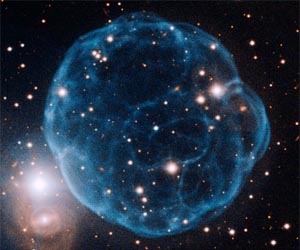
Gemini Observatory image of Kronberger 61 showing the ionized shell of expelled gas resembling a soccer ball.

The light of the nebula here is primarily due to emission from twice-ionized oxygen, and its central star can be seen as the slightly bluer star very close to the center of the nebula.

The field of view is 2.2 x 3.4 arcminutes with north up (rotated 22 degrees west of north). Image processing by Travis Rector, University of Alaska Anchorage.

A colour composite image, it consists of two narrow-band images ([O III] and hydrogen alpha with three, 500-second integrations each) obtained with the Gemini Multi-Object Spectrograph (GMOS) on the Gemini North telescope on Mauna Kea in Hawai'i.

Below the bright star at left is a barred spiral galaxy in the distant background, careful inspection will reveal several additional distant galaxies in the image.

Monday, April 4, 2011

ESA Hubble Image: The Beauty of Asymmetry inside Lupus

The NASA/ESA Hubble Space Telescope has captured a planetary nebula with unconventional good looks.

Planetary nebulae signal the demise of mid-sized stars (up to about eight times the mass of the Sun); when the star’s hydrogen fuel supply is exhausted, its outer layers expand and cool, creating a cocoon of gas and dust.

This gas then glows as it is bathed in the strong ultraviolet radiation from the central star. NGC 5882 is a quite bright, but small, example of a planetary nebula that lies deep in the southern Milky Way in the constellation of Lupus (The Wolf).

Planetary nebulae sometimes have a perfectly symmetrical appearance, with gas being bellowed out from the dying star evenly in every direction.

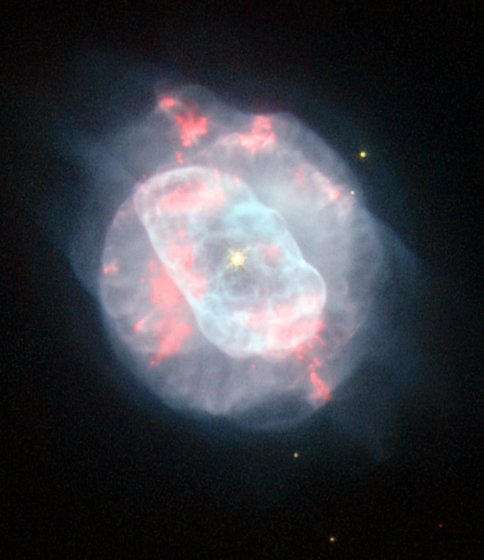
However, this isn’t the case for NGC 5882, as this Hubble image shows. It appears to have two distinct, but non-uniform regions: an elongated inner shell of gas and a fainter aspherical shell that surrounds it.

Hubble’s sharp view reveals the intricate knots, filaments and bubbles within these shells. But it’s the dying star at the heart of the planetary nebula that dominates the image, shining brightly with an incredible surface temperature of about 70 000 degrees Celsius. For comparison, the surface temperature of the Sun is only about 5500 degrees Celsius.

The high surface temperature of this white dwarf is a result of the star’s struggle for survival, finding new ways to prevent itself from collapsing under its own gravity.


This picture comes from images taken with Hubble’s Wide Field Planetary Camera 2. Light that comes from glowing ionised oxygen is coloured blue (through the F502N filter), yellow/green light (through the broad F555W filter) is shown as green, the light from glowing hydrogen (through the F656N filter) is shown as dark red and light from glowing nitrogen is shown as bright red (through the F658N filter). The exposure times were 320 s, 104 s, 140 s and 1200 s, respectively and the field of view is just 29 arcseconds across.

Credit: ESA/Hubble & NASA

Thursday, July 23, 2009

Giant Soap bubble found floating in Space: New Planetary Nebula

The "Cygnus Bubble" nebula may actually be a cylinder that is being seen from one of its ends. This image was taken with the Kitt Peak Mayall 4-metre telescope in Arizona (Image: Travis A. Rector/U of Alaska Anchorage/Heidi Schweiker/NOAO)

The "Cygnus Bubble" nebula may actually be a cylinder that is being seen from one of its ends. This image was taken with the Kitt Peak Mayall 4-metre telescope in Arizona (Image: Travis A. Rector/U of Alaska Anchorage/Heidi Schweiker/NOAO)

IT LOOKS like a soap bubble or perhaps even a camera fault, but the image at right is a newly discovered planetary nebula.

Planetary nebulae, which got their name after being misidentified by early astronomers, are formed when an ageing star weighing up to eight times the mass of the sun ejects its outer layers as clouds of luminous gas (see Why stars go out in a blaze of glory). Most are elliptical, double-lobed or cigar-shaped, evolving after stars eject gas from each pole (see a gallery of the nebulae).

Dave Jurasevich of the Mount Wilson Observatory in California spotted the "Cygnus Bubble" while recording images of the region on 6 July 2008. A few days later, amateur astronomers Mel Helm and Keith Quattrocchi also found it.

The bubble, which was officially named PN G75.5+1.7 last week, has been there a while. A closer look at images from the second Palomar Sky Survey revealed it had the same size and brightness 16 years ago. Jurasevich thinks it was overlooked because it is very faint.

"It's a beautiful example," says Adam Frank of the University of Rochester, New York. "Spherical ones are very rare." One explanation is that the image is looking down the throat of a typical cylindrical nebula. However, it is still remarkably symmetrical, Frank says.