Showing posts with label Space probe. Show all posts

Sunday, November 17, 2013

ESA Space probe Gaia searches for Galaxy's dark energy

Gaia will map the galaxy with incredible accuracy. 

Photograph: D Ducros/ESA/B. Fugate (FASORtronics)/ESO

European scientists are preparing to launch a probe that will transform our understanding of our galaxy.

The ESA spacecraft Gaia, will carry the world's biggest, most accurate camera which it will use to pinpoint more than a billion stars with unprecedented precision and create a 3D map of the Milky Way.

The vast amounts of data generated by the £2bn robot spacecraft – built by the European Space Agency – will reveal how the Milky Way formed and how it will evolve over the next few billion years.


In addition, Gaia will locate hundreds of thousands of distant planets in orbit around other stars; survey asteroids that orbit close to our own Sun, giving warnings of any on a collision course with Earth; and provide clues about dark energy, the mysterious force that is thought to permeate space and which is pushing the universe apart.

"We are going to rewrite every star chart and every astronomy book that we have written over the centuries," said Professor Mark McCaughrean, ESA's senior scientific adviser.

"Thanks to Gaia, we will find out how the Milky Way was put together. And for good measure it will provide us with an early warning system for asteroids heading towards Earth."

The two-tonne Gaia probe, which has taken more than a decade to build, is set for a 20 December launch on a Russian Soyuz rocket from ESA's spaceport in French Guiana and, once in orbit, will take several months to prepare its delicate instruments for use. The probe will then take five years to complete surveys of the galaxy.

"During its lifetime, Gaia will log the position, the brightness and the temperature of every visible celestial object that falls within its field of view," said Gaia project scientist Jos de Bruijne. "We will do that for about one billion stars in the Milky Way."

The one billion pixel camera on board Gaia contains more than 100 separate electronic detectors and can make measurements of stunning precision.

"It can measure star positions with an accuracy of 10 micro-arc seconds," said Professor Gerry Gilmore, a lead scientist for the mission.

"That means it can locate stars with an accuracy equivalent to the pinpointing of a shirt button on the Moon. Once Gaia has completed its five-year survey, we will know where everything is inside our galaxy – for the first time – and that will help us answer one critical set of questions: when, how and out of what did the Milky Way form?"

Gaia will orbit round the Sun every year, allowing it to take photographs of stars from slightly different positions in space. In this way it will be able to create a 3D map of the Milky Way.

Its instruments will also be able to detect how these stars are moving in space as they revolve round the centre of our galaxy.

Once we have plotted how stars are moving around the Milky Way, we will start to understand how our galaxy formed.

We believe it did so partly by condensing out of an ancient dust cloud and partly by absorbing other, smaller galaxies in our part of the universe," added McCaughrean.

"And the lessons we learn about our own galaxy's birth will be crucial in helping us understand how other galaxies formed. This is one of the big issues that concerns modern astronomy and Gaia is going to help solve it."

Friday, January 7, 2011

JAXA Akatsuki Space Probe to be re-assigned

A Japanese spacecraft that overshot Venus last month may get a chance to redeem itself one year earlier than scientists had originally thought.

Click on the picture to view the JAXA video
The Japan Aerospace Exploration Agency (JAXA) is now considering trying to send the Akatsuki spacecraft into orbit around Venus five years from now, Japan's Mainichi Daily News newspaper reports.
Previously, JAXA officials had said a second try could be attempted sometime between December 2016 and January 2017 after Akatsuki missed its Venus arrival. An earlier attempt to swing back on course would be welcome news for the Akatsuki spacecraft and mission team.
Lost Venus spacecraft
The $300 million Akatsuki spacecraft — whose name means "dawn" in Japanese — got within 342 miles (550 kilometers) of Venus the night of Dec. 6, after more than six months of interplanetary travel. It began firing its thrusters in an orbital-insertion burn, a maneuver designed to slow the craft enough to allow the planet's gravity snag it.
The thrusters were supposed to fire for 12 minutes, but they conked out after only 2 1/2 minutes, JAXA officials have said. An unexpected pressure drop in the spacecraft's fuel line — or possibly damage to the probe's engine nozzle — are the likely causes, they added.
As a result, the Akatsuki probe sailed right past Venus, scuttling its mission to study the planet's hellish climate and weather in unprecedented detail.

Thursday, June 10, 2010

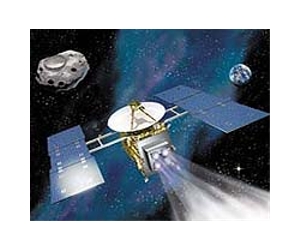
JAXA Space probe Hayabusa heads home


Japan is counting down to the homecoming of a space hero next week: not an astronaut but a battered machine limping back from a seven-year odyssey to a distant space rock.

It is hoped the small probe Hayabusa ("Falcon") may have beaten bigger US and European projects to become the first spacecraft to bring home raw material from an asteroid, part of the primeval rubble left over from the making of the solar system.

Hayabusa, which cost 12.7 billion yen (138 million dollars) to develop, is approaching the end of a five-billion-kilometre (three-billion-mile) trek with broken engines, failed posture-adjusting devices and disfunctional batteries.

The spacecraft is due to release a canister expected to contain asteroid dust as it approaches Earth, aiming to land it at the Woomera Test Range in the Australian outback on June 13 -- if all goes well.

Hayabusa itself will be incinerated as it smashes into the atmosphere, prompting devout fans to declare that the falcon will be reborn as a "Phoenix" -- a mythical firebird.

The journey has captured the public imagination, with a computer-graphics movie "Hayabusa back to the Earth" drawing some 150,000 people at planetariums across the nation and proposals that the spacecraft be given a National Honour Award.

The Japan Aerospace Exploration Agency (JAXA), on a special website (http://hayabusa.jaxa.jp/), has received nearly 1,000 messages treating the probe as a human boy and cheering him on in the lonely, difficult journey.

"What's special to Hayabusa is it has enthusiastic fans. I believe ordinary people love it because it tried what is unprecedented," JAXA associate professor Makoto Yoshikawa, told AFP.

The car-size probe with solar paddles has already become the world's first spacecraft to land on and lift off a celestial body other than the moon after it made a rendezvous with the potato-shaped asteroid Itokawa.