Showing posts with label Spy Satellite. Show all posts

Wednesday, August 28, 2013

ULA Delta 4: US Largest Rocket Launches Top-Secret Spy Satellite

A United Launch Alliance (ULA) Delta 4 Heavy rocket carrying a payload for the National Reconnaissance Office (NRO) lifted off from Space Launch Complex-6 here at 11:03 a.m. PDT today. 

Designated NROL-65, the mission is in support of national defense. This is ULA’s eighth launch in 2013, the 24th Delta 4 mission and the second Delta 4 Heavy launch from Vandenberg Air Force Base.

Credit: Pat Corkery/United Launch Alliance

The United States' largest rocket launched a spy satellite on a hush-hush mission Wednesday (Aug. 28).

An unmanned Delta 4-Heavy rocket lifted off the pad at California's Vandenberg Air Force Base at 2:03 p.m. EDT (1803 GMT) Wednesday, carrying a classified payload to a polar orbit for the U.S. National Reconnaissance Office (NRO).

"Today's launch is dedicated to the men and women who serve for our nation's freedom," a commentator said a few minutes into the liftoff.

It's unclear what intelligence the spacecraft, which is known as NROL-65, will collect as it zips around our planet. Because of the clandestine nature of the mission, it entered a planned media blackout about seven minutes after liftoff.

"We are truly honored to deliver this critical asset to orbit," said Jim Sponnick, United Launch Alliance vice president for the Atlas and Delta Programs. "The ULA Delta 4 Heavy is currently the world's largest rocket, providing the nation with reliable, proven, heavy lift capability for our country’s national security payloads from both the east and west coasts."

The Delta 4 Heavy, which is built by ULA and first flew in 2004, is the biggest and most powerful American rocket in operation today. The 235-foot-tall (72 meters) launcher generates about 2 million pounds of thrust at liftoff, according to ULA officials.

Friday, May 3, 2013

NASA Considers Missions for 2 Donated Spy Satellite Telescopes

The Hubble Space Telescope got one last overhaul in May 2009 by NASA astronauts on the space shuttle Atlantis and has been sending home stunning new photos ever since. 

Seen here, the iconic space telescope orbits high above the Earth, after it was released at the close of the STS-125 servicing mission to once more gaze deep into the universe.

CREDIT: NASA

NASA is sorting through a variety of possible uses for a pair of powerful spy satellite telescopes that fell into the agency's lap last year.

In November, NASA asked scientists to suggest missions for the telescopes, which were donated by the U.S. National Reconnaissance Office (NRO) and are comparable in size and appearance to the famous Hubble Space Telescope.

More than 60 serious proposals came flooding in, the most promising of which were presented in early February at the Study on Applications of Large Space Optics (SALSO) workshop in Huntsville, Ala.

"There was a lot of excitement in the scientific community when these were transferred to NASA, because they are world-class, Hubble-class telescopes, optics," said SALSO project manager George Fletcher, of NASA's Marshall Space Flight Center in Huntsville.

The two scopes were originally built to carry out surveillance missions under a multibillion-dollar NRO program called Future Imagery Architecture, but cost overruns and delays killed the program in 2005, and NASA announced in June 2012 that the NRO had bequeathed the instruments to the space agency.

While the telescopes' 8-foot-wide (2.4 meters) main mirrors are comparable to that of Hubble, the NRO instruments are designed to have a much wider field of view, NASA officials have said.

Seven big ideas
The ideas presented at the SALSO workshop fall into seven broad categories, meeting organizers and a technical review team determined:
  • Mars-orbiting space telescope
  • Exoplanet observatory
  • General-purpose faint object explorer
  • Advanced, Hubble-like visible light/ultraviolet telescope
  • Optical communications node in space (which would aid transmissions to and from deep-space assets)
  • Geospace dynamic observatory (which would study space weather and the sun-Earth system)
  • Research of Earth's upper atmosphere (from a spot aboard the International Space Station)
  • The SALSO workshop did not look into another possible use — incorporating one of the NRO scopes into NASA's proposed $1.5 billion Wide-Field Infrared Survey
  • Telescope, a high-priority mission that would hunt for exoplanets and probe the mysteries of dark energy — because a separate research team is already investigating this possibility.
The SALSO workshop did not look into another possible use — incorporating one of the NRO scopes into NASA's proposed $1.5 billion Wide-Field Infrared Survey Telescope (WFIST), a high-priority mission that would hunt for exoplanets and probe the mysteries of dark energy — because a separate research team is already investigating this possibility.

The results of that second study, known as AFTA (Astrophysics Focused Telescope Assets), are downloadable. A more serious examination of the ideas presented at SALSO can now begin.

Thursday, June 7, 2012

Former Spy Satellites Transferred to NASA

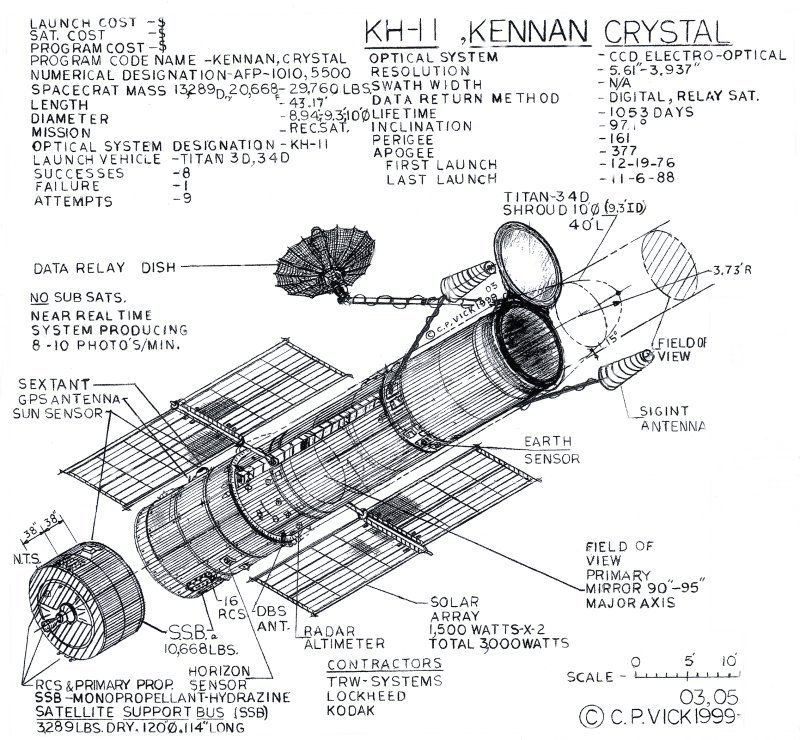
Diagram of the KH-11 Kennan telescope 

(Credits: Global Security.Org)

The National Reconnaissance Office has transferred two photo reconnaissance satellites to NASA.

The satellites, which could be KH-11 KENNON satellites, are similar in design to the Hubble Space telescope, but are designed to photograph features on the surface of the Earth rather than outer space.

The two satellites could be considered as replacements for the Hubble Space Telescope, which was serviced five times in orbit.

There are no further plans to service the Hubble, which means as the telescope ages it will eventually fail.

The two reconnaissance satellites transferred to NASA could provide a viable replacement for the Hubble once they have undergone modifications.  However, it is likely that the final use of the two gifts from the NRO will not be finalized for some time.

Although composed of flight ready parts, neither of the two telescopes have been launched before. Launch arrangements would be left up to NASA, something that isn’t projected to occur before 2020.

The United States has two launch options from United Launch Alliance, including the Atlas V and the Delta IV Heavy; however, with the recent success of the SpaceX COTS demonstration and the plans for a heavy-lift derivative of the Falcon 9 rocket, SpaceX could be a contender for launching the two refurbished space telescopes.

More importantly than launch, however, is instrumentation. Neither of the telescopes currently have the proper instrumentation to perform outer space observations, thus requiring modifications before they could be utilized by NASA.

The KH-11 program, like other reconnaissance satellites, is highly classified and its full capabilities will probably never be revealed regardless of the transfer of the hardware to NASA.

The transfer of hardware from sensitive intelligence/military programs from one agency to another is not unheard of.

Two U.S. Air Force SR-71s were transferred to NASA after the fleet was retired from active service.  The SR-71 itself is a descendant of a highly classified program called OXCART, which was run by the Central Intelligence Agency out of Groom Lake, Nevada.

Friday, April 20, 2012

US Spy Satellite for Military and Intelligence Commanders

The US nation’s spies and its military commanders are at odds over the future of America’s spy satellites, a divide that could determine whether the United States government will increasingly rely on its own eyes in the sky or on less costly commercial technology.

The fight is shaping up into the intelligence world’s version of the United States Postal Service versus FedEx — a traditional government institution that must provide comprehensive services versus a more nimble private sector that is cherry-picking the most lucrative business opportunities.

In recent years, advances in commercially available technology have allowed private companies to develop satellites carrying high-resolution sensors and perform many of the surveillance tasks that were once the sole preserve of classified satellites owned and operated by the intelligence community.

Two private companies already provide some of America’s spy satellite imagery, at far lower costs than government-owned satellites, according to current and former government and industry officials and outside analysts.

But at the urging of senior intelligence officials, the Obama administration has proposed cutting the contracts for commercial satellite imagery in half next year — to about $250 million from $540 million — to help meet deficit reduction requirements, while bringing back more of the work inside the government, according to administration and Congressional officials and industry experts.

Both Republican and Democratic leaders on the Congressional intelligence committees are resisting the budget cuts and siding with the private companies and the military, which argues that it could not get as much imagery as it needs for combat operations without turning to the less expensive commercial technology.

“The debate is really between the military, which needs a lot of imagery but doesn’t need the highly classified imagery, and the intelligence community, which wants to keep the capability to produce its own imagery,” said Bill Wilt, a senior official with GeoEye, one of the private satellite companies.

In the midst of what observers in and out of government describe as an increasingly bitter turf war, the director of the National Reconnaissance Office, the secret agency that manages the nation’s spy satellites, resigned Wednesday.

Bruce Carlson, the director, issued a statement saying that he is leaving the reconnaissance office, which is part of the Department of Defense and the intelligence community, a spokeswoman for the office said.

Administration officials said his resignation was not related to the satellite fight. But Mr. Carlson was said to be an advocate for cutting the budget for the commercial satellite companies, and his departure occurred as the satellite industry and its supporters on the Congressional intelligence committees were gearing up to oppose the budget cuts.

Spy satellites are among the most expensive tools used by the intelligence community, dwarfing most other elements of the classified intelligence budget.

When the commercial satellite industry developed in the 1990s, it could not compete with the highly sophisticated sensing equipment flown by the government’s spy satellites. But gradually, the gap between commercial satellites and the intelligence community’s has narrowed.

American commercial satellite companies now produce images of higher resolution than they are permitted to sell publicly, and their only customers are United States government agencies or foreign governments, with American approval.

Commercial satellites can show, for example, an image of a specific vehicle type or spare tire on a truck, while the more sensitive government-owned satellites can detect gun mounts or vehicle identification numbers.

The intelligence community uses even higher resolution imagery for tasks like monitoring the North Korean and Iranian nuclear programs, but the commercial satellites are adequate for almost all of the needs of the military.

Military commanders, who need access to large volumes of satellite imagery for mapping and other daily uses in combat zones, have become big advocates of the expanded use of commercial satellite imagery.

Read more of this article in the NY Times

Friday, March 16, 2012

George Clooney And The New Ethics Of Satellite Surveillance

George Clooney believes that he has found evidence of the Sudanese government murdering its own citizens.

Using images from space satellites, the Hollywood actor, with help from the Satellite Sentinel Project (SSP), documented crimes against humanity taking place in sub-Saharan Africa.

"It is absolutely without question a war crime that we saw firsthand," the actor told the Senate Foreign Relations Committee while presenting his findings on Wednesday.

While Clooney's efforts are patently good, are they ethical?

No project like this has ever been done before, and so Clooney and his partners are making the rules as they go, albeit rules within the strictures of international law.

SSP is a collaboration between the non-profit Enough Project, the Harvard Humanitarian Initiative and DigitalGlobe Inc. (NYSE: DG), a publicly-traded space imagery company. The whole enterprise is funded by Clooney and his Not on Our Watch organization.

"This is a collaboration that in itself is revolutionary. No one could do it alone," said Nathaniel Raymond, the Director of Operations for the SSP.

Using field reporting from the Enough Project and DigitalGlobe's satellite images, which are directed and interpreted by Harvard, SSP monitors what it sees as an ongoing humanitarian crisis in Sudan that started with the Second Civil War in 1983, bred the genocide in Darfur and essentially continued uninterrupted as it developed into the ethnic conflict surrounding South Sudan's independence.

Thursday, December 22, 2011

DARPA's New Spy Satellite

DARPA, Pentagon's research arm, has described its dream military space telescope that could gather intelligence anywhere in the world, doing away with the need for spy planes or drones.

The Defense Advanced Research Projects Agency (DARPA) is an agency of the United States Department of Defense that handles the development of new technology for use by the military.

It is also responsible for funding the development of many technologies which have had a major effect on the world, including surveillance equipments like space telescopes.

As envisioned by DARPA, the military telescope will be a lightweight optics array made of flexible membrae that could deploy in space. The dream telescope should be able to hover in geosynchronous orbit that could take real-time images or videos of any spot on Earth.

For this purpose, DARPA has commissioned Ball Aerospace which had completed a proof-of-concept review as part of $37 million contract for the telescope. The research agency's requirement is a space telescope with a collection aperture or light-collecting power of almost 20 meters in diameter.

DARPA said that the telescope, which image resolution should see objects less than 10 feet (3 m) long within a single image pixel, should be able to spot missile launcher vehicles moving at speeds of up to 60 mph on the ground.

With the completion of the project, U.S. military commanders and intelligence agents should be able to get live streaming video and up-to-date images of battlefields or trouble spots around the world. Such capability could complement the present drones that provides battlefield surveillance to the military.

DARPA's mission has been to assure that the U.S. maintains a lead in applying state-of-the-art technology for military capabilities and to prevent technological surprise from her adversaries.

Wednesday, October 12, 2011

Iran to launch NAVID research /spy satellite

Iran is going to launch domestically- built Navid satellite by Safir satellite launcher by the end of March 2012, the semi-official Mehr news agency reported on Sunday.

Navid (promise) is a research satellite and is currently undergoing pre-launch tests, said the report without further details.

In June, Iran put the Rasad (surveillance) satellite in the orbit to render images to the country.

Iran put a satellite into orbit in 2009 and sent some small animals into space in 2010. It plans to send man into space by 2020.

Wednesday, August 10, 2011

Rassad-1: Iran to send new satellite into space

Rassad-1 (Observation-1) could revolve 15 times around the Earth every 24 hours with a two-month life cycle.

Chancellor of Iran's Sharif University Reza Roustazad said Monday that Iran plans to launch a new domestically-manufactured satellite dubbed Sharif in the near future, the semi-official Mehr news agency reported.

"Industrial Sharif University's satellite will be the last satellite designed by university students, which will be launched into space," Roustazad was quoted as saying.

The Sharif satellite, described by officials as the country's best, will be sent into space when it is capable of orbiting 36, 000 kilometers above the Earth's surface, he said.

The reason why Iran's satellites cannot stay in space for a long time is that they cannot orbit the Earth in an altitude upper than 36,000 kilometers above the Earth's surface, he said according to the report.

Efforts should be made to increase the launch power of satellites in order to let it stay longer in space, he added.

In July, Iran announced that it successfully launched its Rassad-1 satellite into space by the Safir rocket and put into orbit 260 kilometers above the Earth.

Rassad-1 (Observation-1) could revolve 15 times around the Earth every 24 hours with a two-month life cycle.

Iran, which has outlined an ambitious space programme in the face of Western concerns, put a satellite into orbit in 2009 and sent small animals into space in 2010.

Western powers fear that Tehran could develop a missile capability under cover of its space programme which could be used to deliver nuclear warheads.

Iran denied that it has any ambition to develop an atomic bomb and insisted that both its space and nuclear programmes are entirely peaceful.

Originally scheduled to launch in August 2010, Rassad was constructed by Malek Ashtar University in Tehran, which is linked to Iran's elite Revolutionary Guards.

Tuesday, August 2, 2011

Global Hawk UAV: Smart Drone Set to Replace U-2 Spy Plane

The Air Force's Global Hawk surveillance plane at Northrop Grumman in Palmdale, Calif. Five will be built this year.

Work tables surround a handful of fuselages, and an unusually long wing, needed to slip through the thin air at 60,000 feet, is ready to be bolted into place.

Open panels await controls for cameras and eavesdropping gear, and bright blue tool bins and parts vats are scattered around the concrete floor.

Just 50 people work in the factory and a test hangar, and only five of the drones will be built this year. But despite a spate of delays, second-guessing and cost overruns, the Global Hawk is once again on track to replace one of America’s most noted aircraft: the U-2 spy plane, famed for its role in the cold war and more recently Afghanistan.

The Air Force decided last month to stick with its $12 billion Global Hawk program, betting that the unmanned drone can replicate the aging U-2’s ability to sweep up a broad mix of intelligence from commanding heights, and do it more safely and for much longer stretches than the piloted U-2.

The Navy is also onboard, with plans to spend $11 billion on a version that could patrol vast ocean areas.

The continued push for the Global Hawk reflects how drones are changing warfare and how critical high-altitude spying can be in any type of fight.

Still, the program remains ensnared in military politics and budget battles, and the aircraft itself awaits some important technical changes that could slow its unveiling.

In particular, creating the new models and their high-tech sensors, which can cost more than the planes, has been difficult.

And in an era in which remotely piloted planes are seen as relatively cheap and easy solutions, the Global Hawk has become the Escalade of drones, the gold-plated one that nearly broke the bank.

“The Global Hawk is a very impressive product, but it is also a very expensive product,” said Richard L. Aboulafia, an aviation analyst at the Teal Group, a consultancy in Fairfax, Va. “Those U-2s were paid for a long time ago.”

Tuesday, January 4, 2011

US, Germany developing secret spy satellites


The satellites will have the capacity to take infrared images at night. HiROS PDF Backgrounder - DLR.
Germany and the United States are jointly developing secret spy satellites under the guise of a commercial programme despite opposition from France, leaked US diplomatic cables showed Monday.

The project, named HiROS, envisions the construction of an undetermined number of high-resolution observation satellites capable of spotting any object on the planet down to a size of just 50 centimetres (about 1.5 feet), according to classified cables from US embassy in Berlin leaked to WikiLeaks and obtained by Norwegian daily Aftenposten.

The satellites will have the capacity to take infrared images at night and to send images much quicker back to earth than the satellites currently in service, the cables showed.
Due to the controversial nature of the programme, US and German officials have decided it should be presented as a civilian project with environmental aims, run by commercial entities.

But in reality it is "under the total control" of the German intelligence service BND and the German aerospace centre DLR, the cables showed.

A DLR spokesman on Monday denied HiROS, which stands for High Resolution Optical Satellite System, was a spy satellite.

"The purpose of HiRos will be to transmit data for public services, for example for crisis management in natural catastrophes," Andreas Schuetz told AFP in an email.

"HiROS is not a spy satellite nor a secret project," he said.

The US embassy cables quoted in Norwegian by Aftenposten cover a period from February 2009 to February 2010.
US, Germany developing secret spy satellites: cables

Friday, December 4, 2009

JAXA: Japan Launches Spy Satellite Under Veil of Secrecy

In an unpublicised launch lacking fanfare, an H-2A rocket successfully boosted Japan's most advanced spy satellite to orbit on Saturday from the country's island space center.

The 174-foot-tall launcher lifted off at 0121 GMT Saturday (8:21 p.m. EST Friday) from Launch Pad No. 1 at the Yoshinobu complex on the southern shore of Tanegashima Island. The rocket's launch occurred at 10:21 a.m. local time.

The two-stage rocket turned south from Tanegashima and jettisoned a pair of solid fuel-burning boosters two minutes into the flight. The hydrogen-fueled first and second stages propelled the top secret Information Gathering Satellite into a polar orbit about 15 minutes after leaving Earth.

Japanese government officials declared the launch a success, according to news reports.

The mission was shrouded in secrecy at the space center, which is operated by the Japan Aerospace Exploration Agency. The space agency released no information on the launch, and a JAXA web camera was turned away from the launch complex after the H-2A rocket rolled to the pad.

The supposed payload was a more than $500 million satellite outfitted with an optical camera and telescope to supply imagery to the Japanese government for intelligence, defense and civilian remote sensing applications. The spacecraft will become the fifth operational member of Japan's spy satellite fleet.

Two optical reconnaissance craft and two satellites with ground-mapping radars were deployed on previous launches. Radars in orbit can collect all-weather imagery during day and night passes.

Another set of spy satellites were lost in an H-2A launch failure in 2003, the only blemish in 16 flights of Japan's workhorse launcher.

Japan established the space-based reconnaissance program after North Korea fired a test missile over Japanese territory in 1998. The country's spy satellites have become increasingly more advanced since then, but officials have provided no official specifications on the satellite launched Saturday.

Another North Korean missile test over Japan in April prompted further consideration of an early warning satellite with an infrared sensor dedicated to detecting missile launches.

Saturday's flight was the third Japanese space launch of the year, including the maiden launch of the beefed up H-2B rocket with the HTV cargo ship for the International Space Station.