Showing posts with label Svetlana Savitskaya. Show all posts

Wednesday, September 24, 2014

Anatoly Berezovoy Salyut Space Station Commander, Dies at 72

Cosmonaut Anatoly Berezovoy, who in 1982 spent 211 days working aboard the Russian space station Salyut 7, died Sept. 20, 2014. He was 72.

Credit: Roscosmos (Russian Federal Space Agency)

Soviet-era cosmonaut Anatoly Berezovoy, who led the first expedition on board Russia's final Salyut space station, died Saturday (Sept. 20). He was 72.

"[Anatoly Berezovoy] was a member of a legendary generation of cosmonauts, a man of great will and courage, [and] a top-class professional who did so much for the development of cosmonautics and major research projects," said Oleg Ostapenko, the chief of the Russian federal space agency Roscosmos.

"His memory will live on forever in the hearts of those who knew and loved [him]."

Chosen to be a cosmonaut in April 1970, Anatoly Berezovoy made his first and only spaceflight 12 years later as commander of the Soyuz T-5 mission to the Salyut 7 space station.

Launched on May 13, 1982, Anatoly Berezovoy and flight engineer Valentin Lebedev spent a then-record 211 days aboard the orbiting outpost, which was the last of its type before the launch of the Mir space station in 1986.
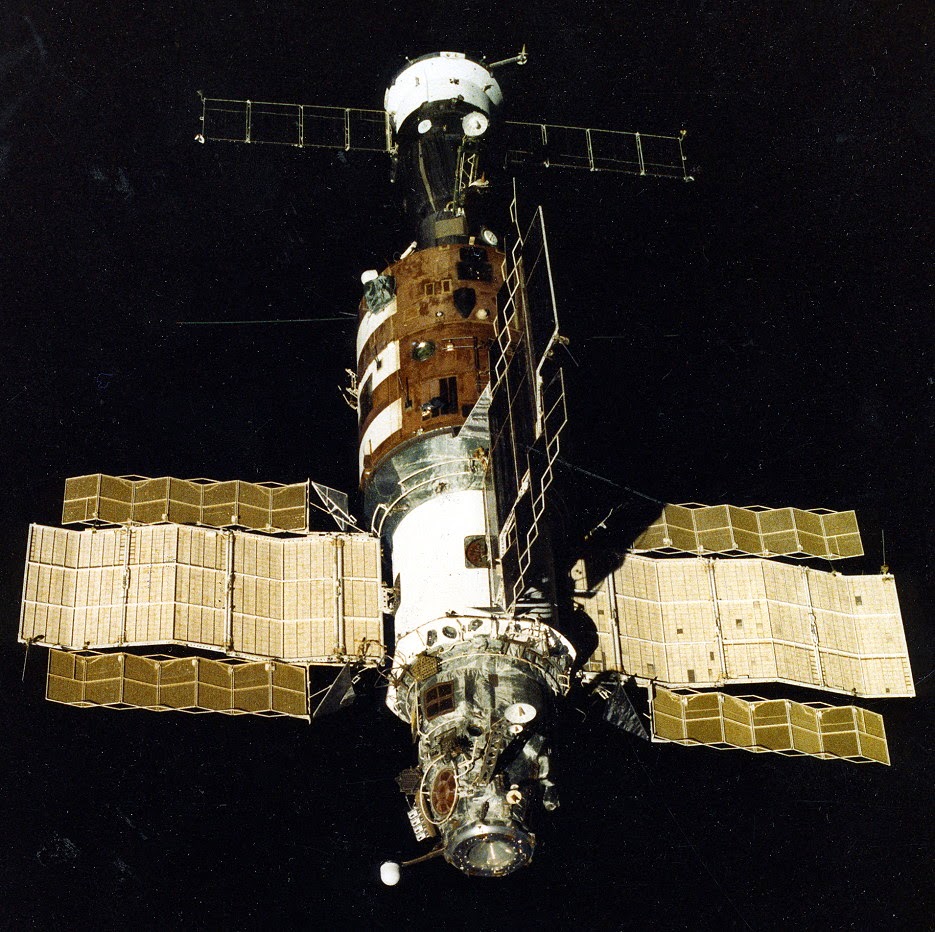
The Soviet-era Salyut 7 space station is seen in this photo by cosmonauts aboard the Soyuz T-13 mission in 1985.

Credit: Roscosmos (Russian Federal Space Agency)

During his expedition, which was flown under the call sign "Elbrus," Anatoly Berezovoy and Valentin Lebedev operated cameras and a telescope, materials processing furnace, and plant growth chamber.

The two crewmates also deployed a small radio communications satellite, which the Soviet Union claimed as the world's first satellite to be deployed from a manned spacecraft (NASA's space shuttle Columbia would launch with two communication satellites on the STS-5 mission later that same year).

Anatoly Berezovoy and Valentin Lebedev also made a two-hour, 33-minute spacewalk on July 30, 1982, to retrieve material exposure samples and replace equipment.

The two cosmonauts were visited by four robotic resupply ships and two crews.

Among Anatoly Berezovoy's and Valentin Lebedev's temporary crew members were the first French citizen to fly in space, Jean-Loup Chrétien, and the second woman in space, Soviet cosmonaut Svetlana Savitskaya, as well as Vladimir Dzhanibekov, Alexander Ivanchenkov, Leonid Popov and Alexander Serebrov.

Anatoly Berezovoy and Lebedev returned to Earth from the Salyut 7 space station on Dec. 10, 1972 on board the Soyuz T-7 spacecraft.

Touching down in heavy snow and on uneven land, which caused their capsule to roll down a slope, the two cosmonauts, already weak from being in space for so long, spent the night with recovery personnel, waiting for a helicopter to come the next day.

In total, Anatoly Berezovoy logged 211 days, 9 hours, 4 minutes in space.

Although he served as a back-up commander for several other Soyuz flights, Anatoly Berezovoy did not fly again. He retired from the cosmonaut corps in October 1992 after suffering injuries in an armed robbery.

Anatoly Nikolayevich Berezovoy was born April 11, 1942, to a Ukrainian family in the Russian village of Enem. He attended the A.F. Masnikovin military flying school, where he graduated in 1965.

During his time on Salyut 7, Berezovoy penned a 92-page diary, in which he recorded his space experiences for his wife, Lidia Grigorievna, and their two children, Sergei and Tatiana (then 13 and 8 years old, respectively).

"For a long time I've been trying to write about everything that has moved me during these days passed in flight," Berezovoy wrote to begin the journal on June 22, 1982, a month into his seven-month stay, according to spacediary.info, which has offered the original hand-written diary for sale. "There is a lot of work to be done."

After leaving the cosmonaut corps, Anatoly Berezovoy served as vice president of the Cosmonautics Federation of Russia from 1992 to 1999.

In 1995, he campaigned for a seat in Russia's parliament representing the Republic of Adygea, but lost in the election.

Anatoly Berezovoy was honored as a Hero of the Soviet Union and bestowed the Order of Lenin for his service to his country as a cosmonaut.

Wednesday, June 18, 2014

Putin appoints all-male cosmonauts for Spaceflight Training

The six newly-appointed members of Russia's cosmonaut corps pose with the chief of the Gagarin Cosmonaut Training Center in Star City. 

From left to right: Oleg Blinov, Nikolai Chub, Sergei Korsakov, Yuri Lonchakov, Dimitri Petelin, Andrei Fedyaev, Pyotr Dubrov.

Credit: Gagarin Cosmonaut Training Center

Six new cosmonauts joined the ranks of Russia's space agency on Monday (June 16), two short of the eight candidates who started basic training for the job two years ago.

Among the two who did not make the cut was the group's only woman. By coincidence, the announcement came 51 years to day after Russia launched the world's first female cosmonaut into space.

Since then, only two more Russian women have flown into orbit, with the fourth set to launch later this year.

An interagency commission including representatives from Russia's federal space agency Roscosmos, as well as the Yuri Gagarin Cosmonaut Training Center in Star City and from the Russian aerospace companies RSC Energia and Khrunichev approved the six men to be the 2012 class of test-cosmonauts.

As a group, they will next begin training for spaceflights to become eligible for crew assignments.

"I congratulate your successfully passing the cosmonaut training course and passing the state [final] exam," former cosmonaut Yuri Lonchakov, the chief of the Yuri Gagarin Cosmonaut Training Center, told the graduates.

The six include Oleg Blinov, Nikolai Chub, Pyotr Dubrov, Andrei Fedyaev, Sergei Korsakov and Dimitri Petelin. The group ranges in age from 30 to 36.

They're all mechanical or software engineers, with the exception of Fedyaev, who is a military pilot.

Five of the cosmonauts hail from Russia. Petelin was born in Kustanai, Kazakhstan, where landing ceremonies have been held for crews returning from the International Space Station.

Among the two candidates who did not qualify was Ignat Ignatov, a 32 year old engineer who had previously worked for eight years as a neutral buoyancy spacewalk instructor at the cosmonaut training center.

In April, it was reported that Ignatov had failed a medical exam and as such, was considered unfit for further training.

Anna Kikina is seen taking part in water survival training as one of the eight cosmonaut candidates selected in 2012. 

In June 2014, Kikina was not among the group’s six members to advance to spaceflight training.

Credit: Gagarin Cosmonaut Training Center

Anna Kikina, 29, was also absent from the graduation for reasons that were not stated.

An engineer and economist, she was working at a radio station in Siberia at the time of her selection for basic training.

Had she qualified to continue her training, Kikina stood the chance to join Valentina Tereshkova, Svetlana Savitskaya and Yelena Kondakova as among the few Russian woman to fly in space.

Yelena Serova, who was selected in 2006, is scheduled to launch on her first mission in September.

Serova's flight to the International Space Station will make her only the 58th women in history to leave the Earth out of the more than 500 worldwide space explorers.

Roscosmos began recruiting for this cosmonaut class in January 2012, opening the process to the general Russian public for the first time in the country's history.

Out of the total of 304 applications received, 51 were deemed eligible from which the eight were selected.

The addition of the six new cosmonauts on Monday brings the Russian corps to a total of 46 active members.