Showing posts with label Tars. Show all posts

Friday, September 12, 2014

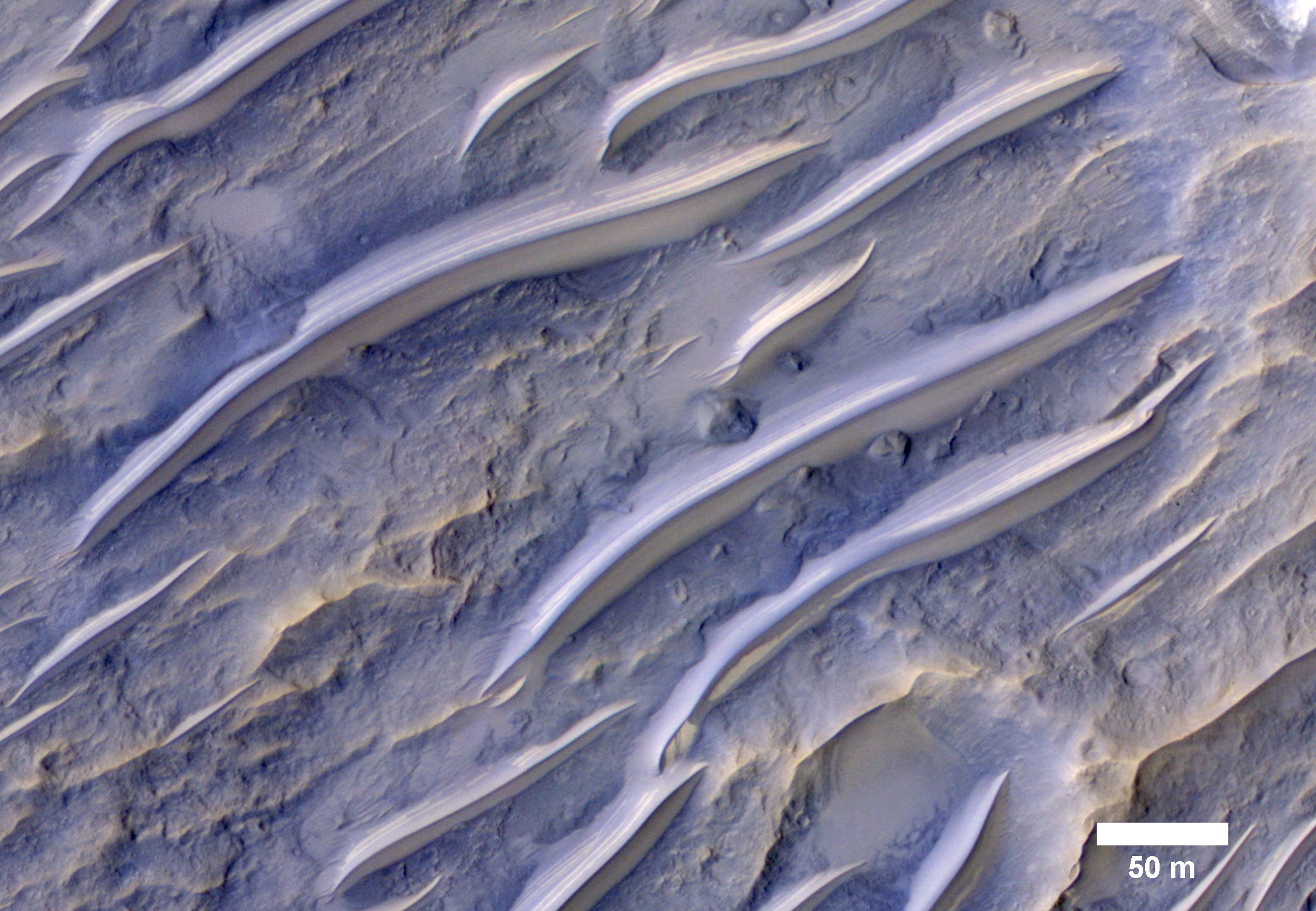
NASA Cassini HiRise Image: Transverse aeolian ridges (TARs) - Windblown dunes

A NASA Cassini HiRise image of the tropics of Mars showing the "Transverse aeolian ridges," or TARs, consisting of small ripples shaped by the wind. 

Credit: Nasa Cassini HiRise / University of Arizona

The tropics of Mars are commonly littered with small bright ripples that were somehow shaped by the wind.

Called "transverse aeolian ridges", or TARs, the features stand up to 6 meters tall and are spaced a few tens of meters apart.

They are typically oriented transverse to modern day wind directions, and often found in channels and crater interiors.

The physical process that produces these features is still mysterious. Most TARs display no evidence of internal structure, so it is difficult to discern exactly how they were formed.

While validating a HiRISE digital terrain model of the area, Sarah Mattson of the University of Arizona discovered these rare banded TARs in Iapygia, south of Syrtis Major.

These features resemble TARs elsewhere on Mars, except that they show bands or layers on their northwest faces but fewer or none on the southeast sides.

One possible interpretation of this strange layering is that these particular TARs are made up of wedge-shaped layers, as shown in the schematic cross-section illustrating the inferred structure of the TARs.

If this hypothesis is correct, it implies that the ripples grew vertically over time, as material accreted at the crests of the ridges. It also suggests that the banded slopes faced upwind.

This observation might provide a valuable clue to the formation of TARs elsewhere on Mars, if they have a similar internal structure but that structure cannot be seen because they are made up of homogeneous materials that are uniform in colour.

Written by: Paul Geissler

Friday, June 6, 2014

MRO HiRISE: Giant Sandy Draa Landform on Mars

Sandy landforms formed by the wind, or aeolian bedforms, are classified by the wavelength--or length--between crests. 

Image Credit: NASA /JPL /University of Arizona

On Mars, we can observe four classes of bedforms (in order of increasing wavelengths): ripples, transverse aeolian ridges (known as TARs), dunes, and what are called “draa.” All of these are visible in this Juventae Chasma image.

Ripples are the smallest bedforms (less than 20 meters) and can only be observed in high-resolution images commonly superposed on many surfaces.

TARs are slightly larger bedforms (wavelengths approximately 20 to 70 meters), which are often light in tone relative to their surroundings.

Dark-toned dunes (wavelengths 100 meters to 1 kilometer) are a common landform and many are active today.

What geologists call “draa” is the highest-order bedform with largest wavelengths (greater than 1 kilometer), and is relatively uncommon on Mars.

Here, this giant draa possesses steep faces or slip faces several hundreds of meters tall and has lower-order superposed bedforms, such as ripples and dunes.

A bedform this size likely formed over thousands of Mars years, probably longer.

This image was acquired by the HiRISE camera on board NASA's Mars Reconnaissance Orbiter on Jan. 6, 2014.

The University of Arizona, Tucson, operates the HiRISE camera, which was built by Ball Aerospace & Technologies Corp., Boulder, Colo.

NASA's Jet Propulsion Laboratory, a division of the California Institute of Technology in Pasadena, manages the Mars Reconnaissance Orbiter Project for the NASA Science Mission Directorate, Washington.

Tuesday, September 24, 2013

Two Generations of Windblown Sediments on Mars

This colorful scene is situated in the Noctis Labyrinthus region of Mars, perched high on the Tharsis rise in the upper reaches of the Valles Marineris canyon system.

Targeting the bright rimmed bedrock knobs, the image also captures the interaction of two distinct types of windblown sediments.

Surrounding the bedrock knobs is a network of pale reddish ridges with a complex interlinked morphology.

These pale ridges resemble the simpler “transverse aeolian ridges” (called TARs) that are common in the equatorial regions of Mars.

The TARs are still poorly understood, and are variously ascribed to dunes produced by reversing winds, coarse grained ripples, or indurated dust deposits.

The Mars HiRISE observations of TARs have so far shown that these bedforms are stable over time, suggesting either that they form slowly over much longer time scales than the duration of Mars Reconaissance Orbiter MRO's mission, or that they formed in the past during periods of very different atmospheric conditions than the present.

Dark sand dunes comprise the second type of windblown sediment visible in this image. The dark sand dune seen just below the center of the cutout displays features that are common to active sand dunes observed by HiRISE elsewhere on Mars, including sets of small ripples crisscrossing the top of the dune.

In many cases, it is the motion of these smaller ripples that drives the advance of Martian sand dunes. The dark dunes are made up of grains composed of iron-rich minerals derived from volcanic rocks on Mars, unlike the pale quartz-rich dunes typical of Earth.

This image clearly shows the dark sand situated on top of the pale TAR network, indicating that the sand dunes are younger than the TARs.

Moreover, the fresh appearance of the sand dunes suggest that they are currently active, and may help shape the unusual TAR morphology by sandblasting the TARs in the present day environment.

Caption Credit: Paul Geissler

Image Credit: NASA/JPL/University of Arizona