Showing posts with label Type Ia supernovas. Show all posts

Friday, August 15, 2014

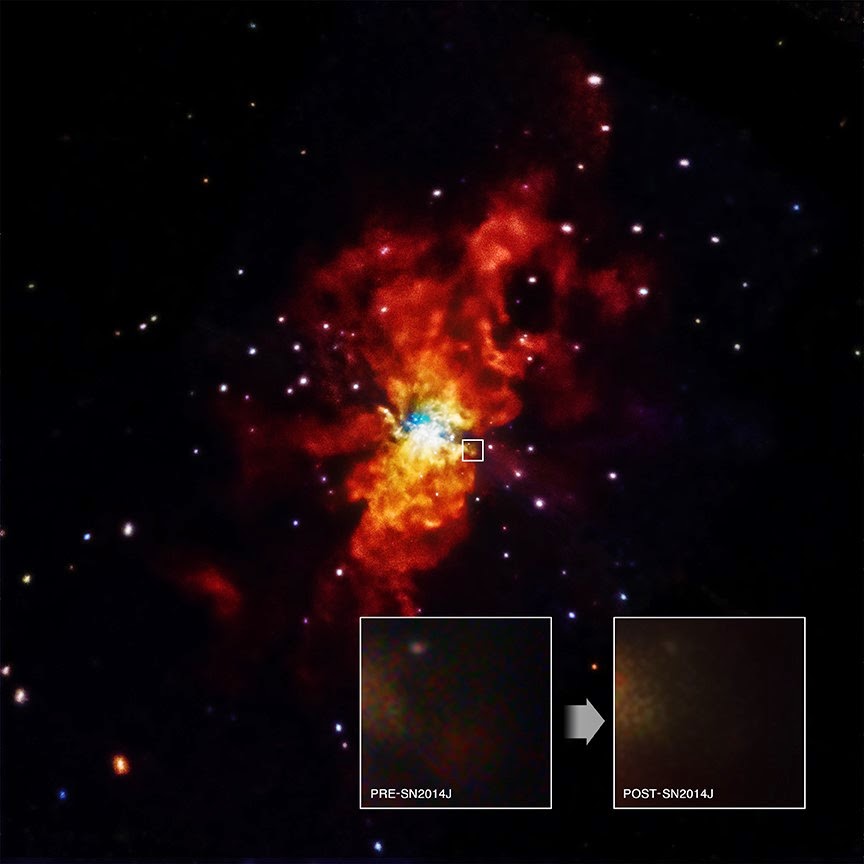
NASA Chandra: Supernova SN 2014J Explosion

Image Credit: NASA/CXC/SAO/R.Margutti et al

New data from NASA’s Chandra X-ray Observatory has provided stringent constraints on the environment around one of the closest supernovas discovered in decades.

The Chandra results provide insight into possible cause of the explosion, as described in our press release.

On January 21, 2014, astronomers witnessed a supernova soon after it exploded in the Messier 82, or M82, galaxy.

Telescopes across the globe and in space turned their attention to study this newly exploded star, including Chandra.

Astronomers determined that this supernova, dubbed SN 2014J, belongs to a class of explosions called “Type Ia” supernovas.

These supernovas are used as cosmic distance-markers and played a key role in the discovery of the Universe’s accelerated expansion, which has been attributed to the effects of dark energy.

Scientists think that all Type Ia supernovas involve the detonation of a white dwarf.

One important question is whether the fuse on the explosion is lit when the white dwarf pulls too much material from a companion star like the Sun, or when two white dwarf stars merge.

This image contains Chandra data, where low, medium, and high-energy X-rays are red, green, and blue respectively.

Raffaella Margutti
The boxes in the bottom of the image show close-up views of the region around the supernova in data taken prior to the explosion (left), as well as data gathered on February 3, 2014, after the supernova went off (right).

The lack of the detection of X-rays detected by Chandra is an important clue for astronomers looking for the exact mechanism of how this star exploded.

The non-detection of X-rays reveals that the region around the site of the supernova explosion is relatively devoid of material.

This finding is a critical clue to the origin of the explosion. Astronomers expect that if a white dwarf exploded because it had been steadily collecting matter from a companion star prior to exploding, the mass transfer process would not be 100% efficient, and the white dwarf would be immersed in a cloud of gas.

If a significant amount of material were surrounding the doomed star, the blast wave generated by the supernova would have struck it by the time of the Chandra observation, producing a bright X-ray source.

Since they do not detect any X-rays, the researchers determined that the region around SN 2014J is exceptionally clean.

A viable candidate for the cause of SN 2014J must explain the relatively gas-free environment around the star prior to the explosion.

One possibility is the merger of two white dwarf stars, in which case there might have been little mass transfer and pollution of the environment before the explosion.

Another is that several smaller eruptions on the surface of the white dwarf cleared the region prior to the supernova.

Further observations a few hundred days after the explosion could shed light on the amount of gas in a larger volume, and help decide between these and other scenarios.

A paper describing these results was published in the July 20 issue of The Astrophysical Journal and is available online.

More Information: "No X-rays from the very nearby Type Ia SN2014J: constraints on its environment" The first author is Raffaella Margutti from the Harvard-Smithsonian Center for Astrophysics (CfA) in Cambridge, MA, and the co-authors are Jerod Parrent (CfA), Atish Kamble (CfA), Alicia Soderberg (CfA), Ryan Foley (University of Illinois at Urbana-Champaign), Dan Milisavljevic (CfA), Maria Drout (CfA), and Robert Kirshner (CfA). 

Tuesday, March 19, 2013

Kepler Supernova: Crucial Cosmic Distance Markers

This is the remnant of Kepler's supernova, the famous explosion that was discovered by Johannes Kepler in 1604. 

The red, green and blue colors show low, intermediate and high energy X-rays observed with NASA's Chandra X-ray Observatory, and the star field is from the Digitized Sky Survey. 

Credit: X-ray: NASA/CXC/NCSU/M.Burkey et al; Optical: DSS

A new study using data from NASA's Chandra X-ray Observatory points to the origin of a famous supernova.

This supernova, discovered in 1604 by Johannes Kepler, belongs to an important class of objects that are used to measure the rate of expansion of the Universe.

Astronomers have used a very long Chandra observation of the remnant of Kepler’s supernova to deduce that the supernova was triggered by an interaction between a white dwarf and a red giant star.

This is significant because another study has already shown that a so-called Type Ia supernova caused the Kepler supernova remnant.

The thermonuclear explosion of a white dwarf star produces such supernovas. Because they explode with nearly uniform brightness, astronomers have used them as cosmic distance markers to track the accelerated expansion of the Universe.

However, there is an ongoing controversy about Type Ia supernovas. Are they caused by a white dwarf pulling so much material from a companion star that it becomes unstable and explodes? Or do they result from the merger of two white dwarfs?

Mary Burkey
"While we can't speak to all Type Ia supernovas, our evidence points to Kepler being caused by a white dwarf pulling material from a companion star, and not the merger of two white dwarfs," said the first author of the new Chandra study, Mary Burkey of North Carolina State University (NCSU).

"To continue improving distance measurements with these supernovas, it is crucial to understand how they are triggered."

The Kepler supernova remnant is one of only a few Type Ia supernovas known to have exploded in the Milky Way galaxy. Its proximity and its identifiable explosion date make it an excellent object to study.

Stephen Reynolds
“Johannes Kepler made such good naked-eye observations in 1604 that we can identify the supernova as Type Ia,” said co-author Stephen Reynolds, also of NCSU. “He would be thrilled that we can use today’s terrific instruments to reveal the hidden secrets of his supernova.”

The new Chandra images reveal a disk-shaped structure near the center of the remnant. The researchers interpret this X-ray emission to be caused by the collision between supernova debris and disk-shaped material that the giant star expelled before the explosion. Another possibility is that the structure is just debris from the explosion.

The evidence that this disk-shaped structure was left behind by the giant star is two-fold: first, a substantial amount of magnesium – an element not produced in great amounts in Type Ia supernovas – was found in the Kepler remnant. This suggests the magnesium came from the giant companion star.

Secondly, the disk structure seen by Chandra in X-rays bears a remarkable resemblance in both shape and location to one observed by the Spitzer Space Telescope.

These infrared-emitting disks are thought to be dusty bands expelled by stars in a wind, rather than material ejected in a supernova.

The researchers found a remarkably large and puzzling concentration of iron on one side of the center of the remnant but not the other.

Kazimierz Borkowski
The authors speculate that the cause of this asymmetry might be the "shadow" in iron that was cast by the companion star, which blocked the ejection of material.

Previously, theoretical work has suggested this shadowing is possible for Type Ia supernova remnants.

“One remaining challenge is to find the damaged and fast-moving leftovers of the giant star that was pummeled by the explosion at close quarters,” said co-author Kazimierz Borkowski, also of NCSU.

The above story is reprinted from materials provided by Chandra X-ray Observatory.