Showing posts with label illuminate. Show all posts

Monday, August 18, 2014

Fascinating rhythm: Light pulses illuminate a rare black hole in Messier 82

This image of the galaxy Messier 82 is a composite of data from the Chandra X-Ray Observatory, the Hubble Space Telescope and the Spitzer Space Telescope

The intermediate-mass black hole M82 X-1 is the brightest object in the inset, at approximately 2 o'clock near the galaxy's center. 

Credit: NASA/H. Feng et al.

The universe has so many black holes that it's impossible to count them all. There may be 100 million of these intriguing astral objects in our galaxy alone.

Nearly all black holes fall into one of two classes: big, and colossal. Astronomers know that black holes ranging from about 10 times to 100 times the mass of our sun are the remnants of dying stars, and that supermassive black holes, more than a million times the mass of the sun, inhabit the centers of most galaxies.

But scattered across the universe like oases in a desert are a few apparent black holes of a more mysterious type.

Ranging from a hundred times to a few hundred thousand times the sun's mass, these intermediate-mass black holes are so hard to measure that even their existence is sometimes disputed.

Little is known about how they form. And some astronomers question whether they behave like other black holes.

Now a team of astronomers has accurately measured, and thus confirmed the existence of, a black hole about 400 times the mass of our sun in a galaxy 12 million light years from Earth.

The finding, by University of Maryland astronomy graduate student Dheeraj Pasham and two colleagues, was published online August 17 in the journal Nature.

Co-author Richard Mushotzky, a UMD astronomy professor, says the black hole in question is a just-right-sized version of this class of astral objects.

"Objects in this range are the least expected of all black holes," says Mushotzky.

"Astronomers have been asking, do these objects exist or do they not exist? What are their properties? Until now we have not had the data to answer these questions."

"While the intermediate-mass black hole that the team studied is not the first one measured, it is the first one so precisely measured, Mushotzky says, "establishing it as a compelling example of this class of black holes."

Rossi satellite telescope
Between 2004 and 2010 NASA's Rossi X-Ray Timing Explorer (RXTE) satellite telescope observed M82 X-1 about 800 times, recording individual x-ray particles emitted by the object.

Pasham mapped the intensity and wavelength of x-rays in each sequence, then stitched the sequences together and analyzed the result.

Among the material circling the suspected black hole, he spotted two repeating flares of light. The flares showed a rhythmic pattern of light pulses, one occurring 5.1 times per second and the other 3.3 times per second – or a ratio of 3:2.

The two light oscillations were like two dust motes stuck in the grooves of a vinyl record spinning on a turntable, says Mushotzky.

Pasham used the oscillations to estimate that M82 X-1 is 428 times the mass of the sun, give or take 105 solar masses.

He does not propose an explanation for how this class of black holes formed. "We needed to confirm their existence observationally first," he says. "Now the theorists can get to work."

Neutron Star Interior Composition Explorer (NICER)
Though the Rossi telescope is no longer operational, NASA plans to launch a new X-ray telescope, the Neutron Star Interior Composition Explorer (NICER), in about two years.

Pasham, who will begin a post-doctoral research position at NASA Goddard in late August, has identified six potential intermediate-mass black holes that NICER might explore.

More information: "A 400 solar mass black hole in the M82 galaxy," Dheeraj R. Pasham, Tod E. Strohmayer, Richard F. Mushotzky, was published online Aug. 17, 2014 in Nature. dx.doi.org/10.1038/nature13710

Tuesday, July 1, 2014

Merging galaxies illuminate the cosmic food chain

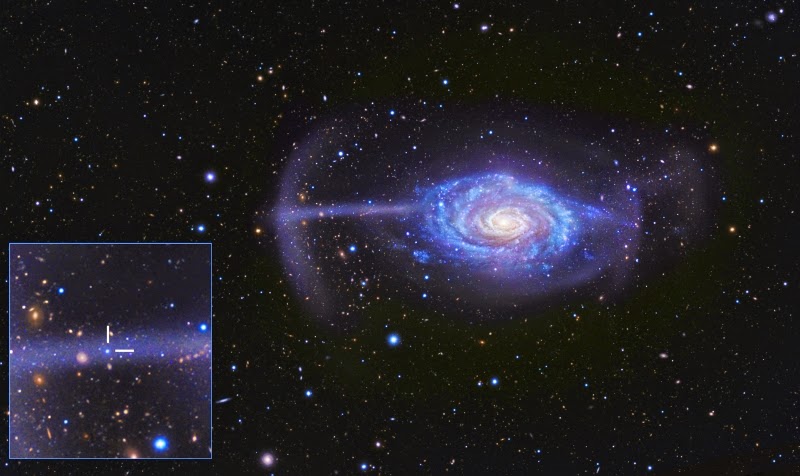
The Umbrella Galaxy (NGC 4651) takes its name from a mysterious feature seen on the left here, that is now found to be debris from a tiny galaxy, only a 50th its size, shredded apart by gravity. 

The image is a combination of data from the 0.5-meter BlackBird Remote Observatory Telescope and Suprime-Cam on the 8-meter Subaru Telescope. 

The inset shows a small cluster of stars embedded in the stream, which marks the center of the disrupted galaxy. 

Credit: R. JAY GABANY

Scientists studying a 'twin' of the Milky Way have used the W. M. Keck Observatory and Subaru Observatory to accurately model how it is swallowing another, smaller galaxy.

Their findings have opened the way to a better understanding of how structure forms in the universe and are being published in the Monthly Notices of the Royal Astronomical Society this week.

The work, led by Caroline Foster of the Australian Astronomical Observatory, has used the Umbrella Galaxy (NGC 4651) to reveal insights in galactic behaviour.

The Umbrella lies 62 million light-years away, in the northern constellation of Coma Berenices. Its faint parasol is composed of a stellar stream, thought to be the remnants of a smaller galaxy being pulled apart by the large galaxy's intense gravitational field. The Umbrella will eventually absorb this small galaxy completely.

The merging of small galaxies into larger ones is common throughout the universe, but because the shredded galaxies are so faint it has been hard to extract details in three-dimensions about how such mergers proceed.

Using the most powerful optical facilities in the world, the twin, 10-meter Keck Observatory and the 8-meter Subaru Observatory, near the summit of Mauna Kea, Foster and her collaborators have determined enough about the character of the merger to provide a detailed model of how and when it occurred.

In this three-dimensional, rotating computer model of the Umbrella Galaxy (NGC 4651), the disk of the main galaxy is shown by blue circles. 

The path of the dwarf galaxy through space is shown by a green curve. 

The white dots show stars that once belonged to the dwarf galaxy but have now been ripped off by tidal forces into a long stream of stars. 

Credit: N. SINGH/UCSC

After taking panoramic images of the Umbrella with Suprime-Cam on Subaru, the scientists used the DEIMOS instrument, installed on the Keck II telescope, to map out the motions of the stream and hence determine how the galaxy is being shredded.

The stars in the stream are incredibly faint, so it was necessary to use a proxy technique to measure the speeds of brighter tracer objects moving along with the stream stars.

These bright tracers include globular star clusters, planetary nebulae (dying stars that glow like neon lights), and patches of glowing hydrogen gas.

"This is important because our whole concept about what galaxies are and how they grow has not been fully verified," said co-author Aaron Romanowsky, an astronomer at both San José State University and University of California Observatories.

"We think they are constantly consuming smaller galaxies as part of a cosmic food chain, all pulled together by a mysterious form of invisible 'dark matter'.

When a galaxy is torn apart, we sometimes get a glimpse of the hidden vista because the stripping process lights it up. That's what occurred here."

"Through new techniques we have been able to measure the movements of the stars in the very distant, very faint, stellar stream in the Umbrella," Foster said.

"This allows us, for the first time, to reconstruct the history of the system."

"Being able to study streams this far away means that we can reconstruct the assembly histories of many more galaxies," Romanowsky said.

"In turn that means we can get a handle on how often these 'minor mergers,' thought to be an important way that galaxies grow, actually occur.

We can also map out the orbits of the stellar streams to test the pull of gravity for exotic effects, much like the Moon going around the Earth but without having to wait 300 million years for the orbit to complete."

The present work is a follow-up to a 2010 study, led by Dr. David Martínez-Delgado (University of Heidelberg), which used small robotic telescopes to image eight isolated spiral galaxies, and found the signs of mergers, shells, clouds and arcs of tidal debris, in six of them.

The W. M. Keck Observatory operates the largest, most scientifically productive telescopes on Earth.

The two, 10-meter optical/infrared telescopes on the summit of Mauna Kea on the Island of Hawaii feature a suite of advanced instruments including imagers, multi-object spectrographs, high-resolution spectrographs, integral-field spectroscopy and world-leading laser guide star adaptive optics systems.

DEIMOS (the DEep Imaging and Multi-Object Spectrograph) boasts the largest field of view (16.7 arcmin by 5 arcmin) of any of the Keck instruments, and the largest number of pixels (64 Mpix).

It is used primarily in its multi-object mode, obtaining simultaneous spectra of up to 130 galaxies or stars.

Astronomers study fields of distant galaxies with DEIMOS, efficiently probing the most distant corners of the universe with high sensitivity.