An eruption from Mount Etna lit up the night sky over much of eastern Sicily late on Saturday night and into the early hours of Sunday.
The latest lava flow did not endanger any houses, and no evacuation was ordered.
Credit: BBC Chris Eakin
As the Landsat Data Continuity Mission satellite flew over Indonesia's Flores Sea April 29, it captured an image of Paluweh volcano spewing ash into the air.
The satellite's Operational Land Imager detected the white cloud of smoke and ash drifting northwest, over the green forests of the island and the blue waters of the tropical sea. The Thermal Infrared Sensor (TIRS) on LDCM picked up even more.
By imaging the heat emanating from the 5-mile-wide volcanic island, TIRS revealed a hot spot at the top of the volcano where lava has been oozing in recent months.
The two LDCM instruments, working together, illustrate a quote from Aristotle: The whole is greater than the sum of its parts, said Betsy Forsbacka, TIRS instrument manager at NASA's Goddard Space Flight Center in Greenbelt, Md.
"Each instrument by itself is magnificent," she said. "When you put them together, with the clues that each give you on what you're seeing on Earth's surface, it's greater than either could do by themselves."
The image of Paluweh also illuminates TIRS' abilities to capture the boundaries between the hot volcanic activity and the cooler volcanic ash without the signal from the hot spot bleeding over into pixels imaging the cooler surrounding areas.
TIRS engineers tested and refined the instrument pre-launch to ensure each pixel correctly represents the heat source it images on Earth's surface.
Otherwise, Forsbacka said, it would be like shining a flashlight in your eyes—the bright light can leave you seeing spots and halos where it should be dark.
The same effect can occur with detectors. But the contrast is sharp on the Paluweh image.
A bright white hot spot, surrounded by cooler dark ash clouds, shows the volcanic activity at Paluweh volcano in the Flores Sea, Indonesia. This thermal image was taken by the Landsat Data Continuity Mission's Thermal Infrared Sensor on April 29, 2013. Credit: Robert Simmon, NASA's Earth Observatory, using data from USGS and NASA
"We can image the white, representing the very hot lava, and right next to it we image the gray and black from the cooler surrounding ash," Forsbacka said.
"It's exciting that we're imaging such diverse thermal activity so well. The TIRS instrument can also pick up subtle shifts of temperatures, within a 10th of a degree Celsius and, with two different thermal bands instead of the one band on previous Landsat satellites, LDCM is poised to make it easier for scientists to subtract out the effects of the atmosphere on the signal, obtaining a more accurate temperature of Earth's surface."
Scientists have developed a medical dressing that 'lights up' when a burn is infected. It could be lifesaving in young children with serious burns in whom infections can rapidly become fatal, the Bristol researchers said.
A prototype is available for demonstration purposes but trials in humans are still some years away.
Fast diagnosis of infection in children with burns, such as those caused by scalds from hot drinks, is a big problem for clinicians, the researchers said.
Current tests for an infected wound can take up to a couple of days but children - especially those of pre-school age - are particularly at risk from the effects of infection due to their relatively poor immunity.
They can quickly develop a condition called toxic shock syndrome, which if left untreated can be fatal in half of cases.
Fluorescent dye
The dressing developed by scientists at the University of Bath uses nanocapsules containing a dye that burst open in the presence of disease-causing bacteria.
Using a UV light, doctors can quickly check whether there is infection by seeing if the dressing glows.
The nanocapsules are activated when they come into contact with toxins produced by harmful bacteria, so do not release the dye in response to normal bacteria that live on the skin.
So far the dressing has been tested on skin samples in the laboratory.
"The big problem for clinicians is the fast diagnosis of infection. Current methods take between 24 and 48 hours to get an answer as to whether the wound is infected.
"However, our burns dressing gives a simple colour change under UV light if a pathogenic, disease-causing bacteria is present in the burn, meaning clinicians can be alerted quickly to a potential infection."
Dr Amber Young, consultant paediatric anaesthetist at the South West Paediatric Burns Centre at Frenchay Hospital in Bristol and clinical adviser to the project said when a child with a small burn develops a high temperature there is no easy way of knowing if the child has a serious bacterial infection, or simply a cough or cold.
"We currently have to remove the dressing to test for infection, which may result in slower healing and potentially life-long scarring and is very distressing for the child.
"This new dressing will mean we will be able to detect the early signs of infection so we can diagnose and treat the child quickly."
Prof Sheila MacNeil, from Sheffield University, said the technology was based on two clever concepts - that it only reacts in the presence of life-threatening bacteria and that the florescent dye only shows up once the nanocapsules have burst.
"It has been developed for use in paediatrics but it could also be useful in lots of other contexts, such as the management of chronic ulcers in the home," she added.

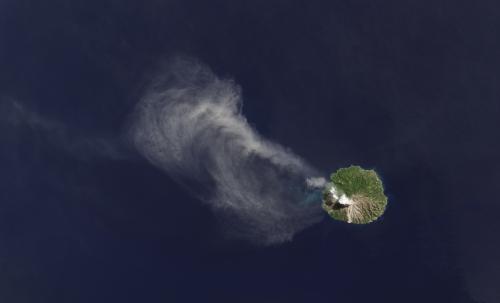 An ash plume drifts from Paluweh volcano in Indonesia in this image, taken April 29, 2013, from the Landsat Data Continuity Mission's Operational Land Imager instrument.


 Posts
Posts


