Showing posts with label liquid Nitrogen. Show all posts

Thursday, September 11, 2014

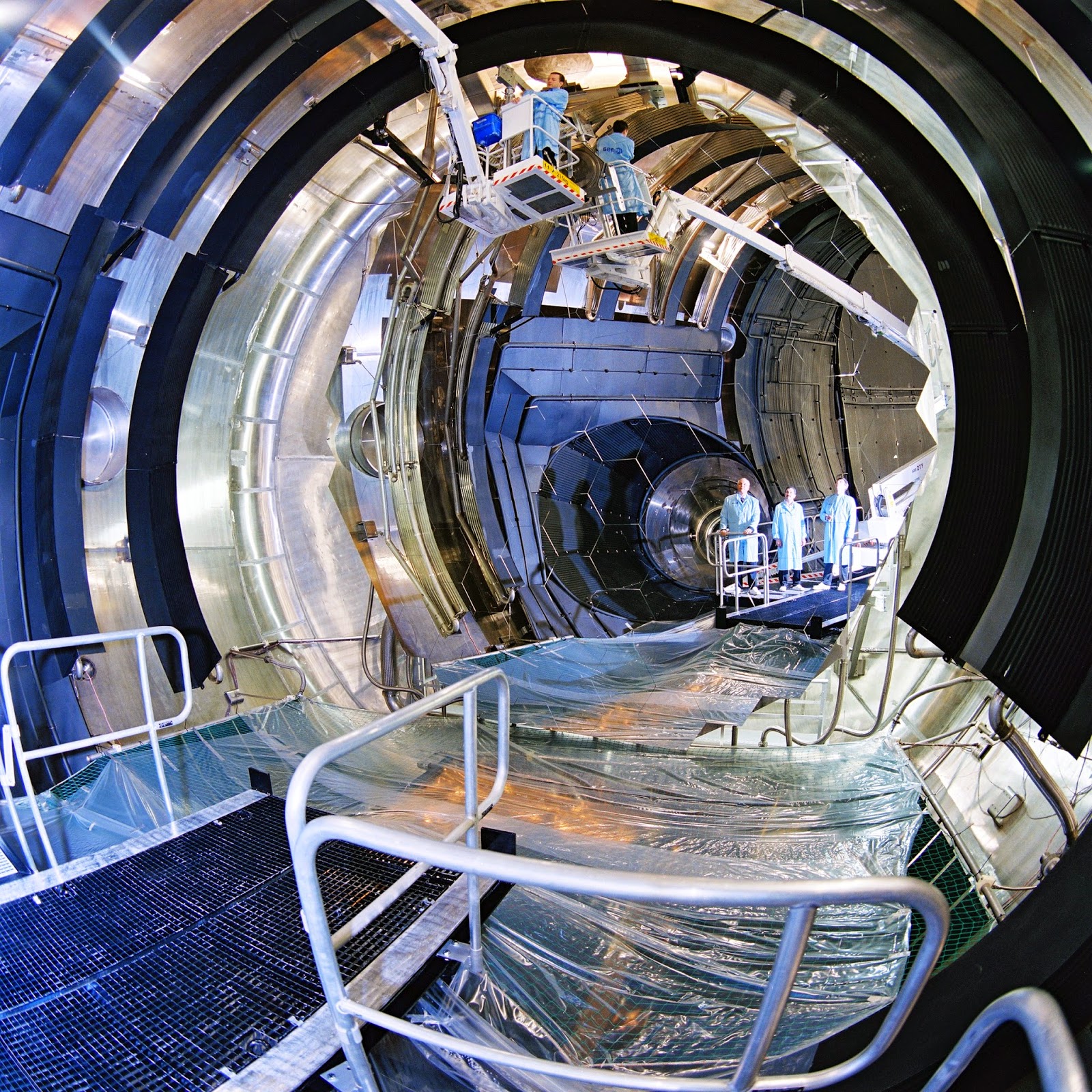
ESA Mirror array in Large Space Simulator

Credit: ESA-A. Le Floc'h

This vast enclosure, made to appear larger still by an array of mirrors at its end, is ESA's Large Space Simulator.

Europe's largest vacuum chamber, the LSS subjects entire satellites to space-like conditions ahead of launch.

This 15 m-high and 10 m-diameter chamber is cavernous enough to accommodate an upended double decker bus.

Visitors to this year's ESTEC Open Day will have the chance to see it for themselves.

Satellites are lowered down through a topside hatch. Once the top and side hatches are sealed, high-performance pumps create a vacuum a billion times lower than standard sea level atmosphere, held for weeks at a time during test runs.

ESA BepiColombo in ESTEC's LSS

Credit: ESA

The 121-segment mirror array seen in the image reflects simulated sunlight into the chamber, at the same time as the walls are pumped full of –190°C liquid nitrogen, together recreating the extreme thermal conditions prevailing in orbit.

Embedded sensors and measurement devices check whether a mission's thermal engineers have done their job well, and if the test satellite maintains an acceptable internal temperature range without buckling or other unwanted temperature-driven effects.

The LSS, seen here during a past refurbishment, is an essential part of ESA's Test Centre in the Netherlands, the largest facility of its kind in Europe, providing a complete suite of equipment for all aspects of satellite testing under a single roof.

Monday, September 10, 2012

NASA's giant cryogenic Chamber A is made ready for the JWST

The vast cryogenic Chamber A at Johnson Space Center with its door open awaiting the JWST. Credit: NASA

The latest vital stage in advancing the James Webb Space Telescope (JWST) has come with the upgrade of a vast NASA thermal-vacuum chamber that was once used to test Apollo spacecraft.

Chamber A at Johnson Space Center is 16.8 metres wide and 27.4 metres high and is the only "room" big enough to hold the giant successor to Hubble in conditions like those in deep space.

Engineers have completed eight years of work to design and rebuild the facility at Houston, Texas, to make it suitable for cryogenic testing.

A three-week test that lowered the temperature inside to 11 Kelvin (-262 C) showed that the systems perform better than imagined.

The JWST, which is due to launch on an Ariane 5 rocket from Europe's spaceport at Kourou, French Guiana, in 2018, is the size of a tennis court, and with a cost of $8 billion it is important to ensure it will work in its harsh space environment.

Chamber A: Altitude /Environmental/ Space Testing provides vacuum, thermal, and thermal-vacuum chamber test operations for both manned and unmanned test enviroments. 

Johnson Space Center's expertise and facilities supports a variety of other commercial applications, environmental testing, and pressure systems design.

Chamber A has been used to test all space vehicles and components for major space programmes since the Apollo Moon missions but to make it cold and clean enough for the JWST with its honeycomb of 18 perfect mirrors, several modifications had to be made.

Most significantly, the entire system for supplying liquid nitrogen to the chamber interior was redesigned and re-plumbed.

The number of valves was cut from more than a hundred valves, all presenting potential reliability risks, to fewer than two dozen of a new, more efficient design.

The result will not only keep working even during a power cut or a hurricane, but uses less than half the amount of liquid nitrogen as before.