Showing posts with label meteors. Show all posts

Thursday, April 25, 2013

NASA Casini Observes Meteors Colliding With Saturn's Rings

Five images of Saturn's rings, taken by NASA's Cassini spacecraft between 2009 and 2012, show clouds of material ejected from impacts of small objects into the rings. 

Image credit: NASA/JPL-Caltech /Space Science Institute/Cornell

NASA's Cassini spacecraft has provided the first direct evidence of small meteoroids breaking into streams of rubble and crashing into Saturn's rings.

These observations make Saturn's rings the only location besides Earth, the moon and Jupiter where scientists and amateur astronomers have been able to observe impacts as they occur.

Studying the impact rate of meteoroids from outside the Saturnian system helps scientists understand how different planet systems in our solar system formed.

The solar system is full of small, speeding objects. These objects frequently pummel planetary bodies. The meteoroids at Saturn are estimated to range from about one-half inch to several yards (1 centimeter to several meters) in size.

It took scientists years to distinguish tracks left by nine meteoroids in 2005, 2009 and 2012.

Details of the observations appear in a paper in the Thursday, April 25 edition of Science.

Results from Cassini have already shown Saturn's rings act as very effective detectors of many kinds of surrounding phenomena, including the interior structure of the planet and the orbits of its moons.

Linda Spilker
For example, a subtle but extensive corrugation that ripples 12,000 miles (19,000 kilometers) across the innermost rings tells of a very large meteoroid impact in 1983.

"These new results imply the current-day impact rates for small particles at Saturn are about the same as those at Earth -- two very different neighborhoods in our solar system -- and this is exciting to see," said Linda Spilker, Cassini project scientist at NASA's Jet Propulsion Laboratory in Pasadena, Calif.

"It took Saturn's rings acting like a giant meteoroid detector -- 100 times the surface area of the Earth -- and Cassini's long-term tour of the Saturn system to address this question."

The Saturnian equinox in summer 2009 was an especially good time to see the debris left by meteoroid impacts.

Matt Tiscareno
The very shallow sun angle on the rings caused the clouds of debris to look bright against the darkened rings in pictures from Cassini's imaging science subsystem.

"We knew these little impacts were constantly occurring, but we didn't know how big or how frequent they might be, and we didn't necessarily expect them to take the form of spectacular shearing clouds," said Matt Tiscareno, lead author of the paper and a Cassini participating scientist at Cornell University in Ithaca, N.Y.

"The sunlight shining edge-on to the rings at the Saturnian equinox acted like an anti-cloaking device, so these usually invisible features became plain to see."

Read the full article here

Wednesday, October 5, 2011

Draconid Meteor Outburst - Comet Giacobini-Zinner

On October 8th Earth is going to plow through a stream of dust from Comet 21P/Giacobini-Zinner, and the result could be an outburst of Draconid meteors. "We're predicting as many as 750 meteors per hour," says Bill Cooke of NASA's Meteoroid Environment Office.

"The timing of the shower favors observers in the Middle East, north Africa and parts of Europe."

Every 6.6 years Comet Giacobini-Zinner swings through the inner solar system. With each visit, it lays down a narrow filament of dust, over time forming a network of filaments that Earth encounters every year in early October.

"Most years, we pass through gaps between filaments, maybe just grazing one or two as we go by," says Cooke. "Occasionally, though, we hit one nearly head on--and the fireworks begin."

2011 could be such a year. Forecasters at NASA and elsewhere agree that Earth is heading for three or more filaments on October 8th. Multiple encounters should produce a series of variable outbursts beginning around 1600 Universal Time (noon EDT) with the strongest activity between 1900 and 2100 UT (3:00 pm - 5:00 pm EDT).

Forecasters aren't sure how strong the display will be, mainly because the comet had a close encounter with Jupiter in the late 1880s. At that time, the giant planet's gravitational pull altered the comet's orbit and introduced some uncertainty into the location of filaments it has shed since then.

Competing models place the filaments in slightly different spots; as a result, estimated meteor rates range from dozens to hundreds per hour.

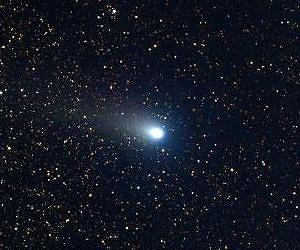
Comet Giacobini-Zinner, a fairly frequent visitor to the inner solar system, was captured by the Kitt Peak 0.9-meter telescope on Halloween Night 1998 (UT November 1st, from 02:07 to 03:40).

North is up with east to the left. Since the comet was moving across the sky fairly quickly, and since colour images are made by combining successive exposures through three different filters, a conventional combination would have either a streaked comet or a set of colored dots for each star.

To avoid this, the complete sequence of images, lasting over ninety minutes, was specially processed. All frames for one color were combined with filtering that removed the moving comet: this stars-only image was subtracted from each comet frame, and the comet frames were registered and summed with further filtering to remove any residuals.

The two images, with stars only and with comet only, were then added together to produce a single-color image in which neither the comet nor the stars was trailed. These three frames were then united in the final color picture, shown here.

Credit: N.A.Sharp/NOAO/AURA/NSF

Wednesday, August 12, 2009

In an Uncertain Universe: Perseids Meteor Storm is Reliable

The annual Perseid meteor shower is expected to put on a good show this week for those willing to get up in the wee hours of the morning and wait patiently for the shooting stars.

In North America, the best time to watch will be between midnight to 5 a.m. on Wednesday, Aug. 12, but late Tuesday night and also Wednesday night could prove fruitful, weather permitting.

The Perseids are always reliable, and sometimes rather spectacular. The only things that puts a damper on the August show are bad weather or bright moonlight. Unfortunately this week, as the Perseids reach their peak Tuesday and Wednesday nights, the moon will be high in the sky, outshining the fainter meteors.

Still, skywatchers around the globe will have a good chance of spotting the brighter meteors. Some already are enjoying the show.