Showing posts with label parachute. Show all posts

Saturday, January 18, 2014

NASA’s Orion spacecraft: Completion of Parachute Jettison Tests

A test version of NASA’s Orion spacecraft touches down in the Arizona desert after its most complicated parachute test to date. 

Image Credit: NASA

Engineers testing the parachute system for NASA's Orion spacecraft increased the complexity of their tests Thursday, Jan. 16, adding the jettison of hardware designed to keep the capsule safe during flight.

The test was the first to give engineers in-air data on the performance of the system that jettisons Orion's forward bay cover.

The cover is a shell that fits over Orion's crew module to protect the spacecraft during launch, orbital flight and re-entry into Earth's atmosphere.

When Orion returns from space, the cover must come off before the spacecraft's parachutes can deploy. It must be jettisoned high above the ground in order for the parachutes to unfurl.

Mark Geyer
"This was a tough one," said Mark Geyer, Orion program manager.

"We'd done our homework, of course, but there were elements here that could only be tested in the air, with the entire system working together."

"It's one of the most complicated tests that we'll do, so we were all excited to see it work just as it was meant to."

Thursday, April 4, 2013

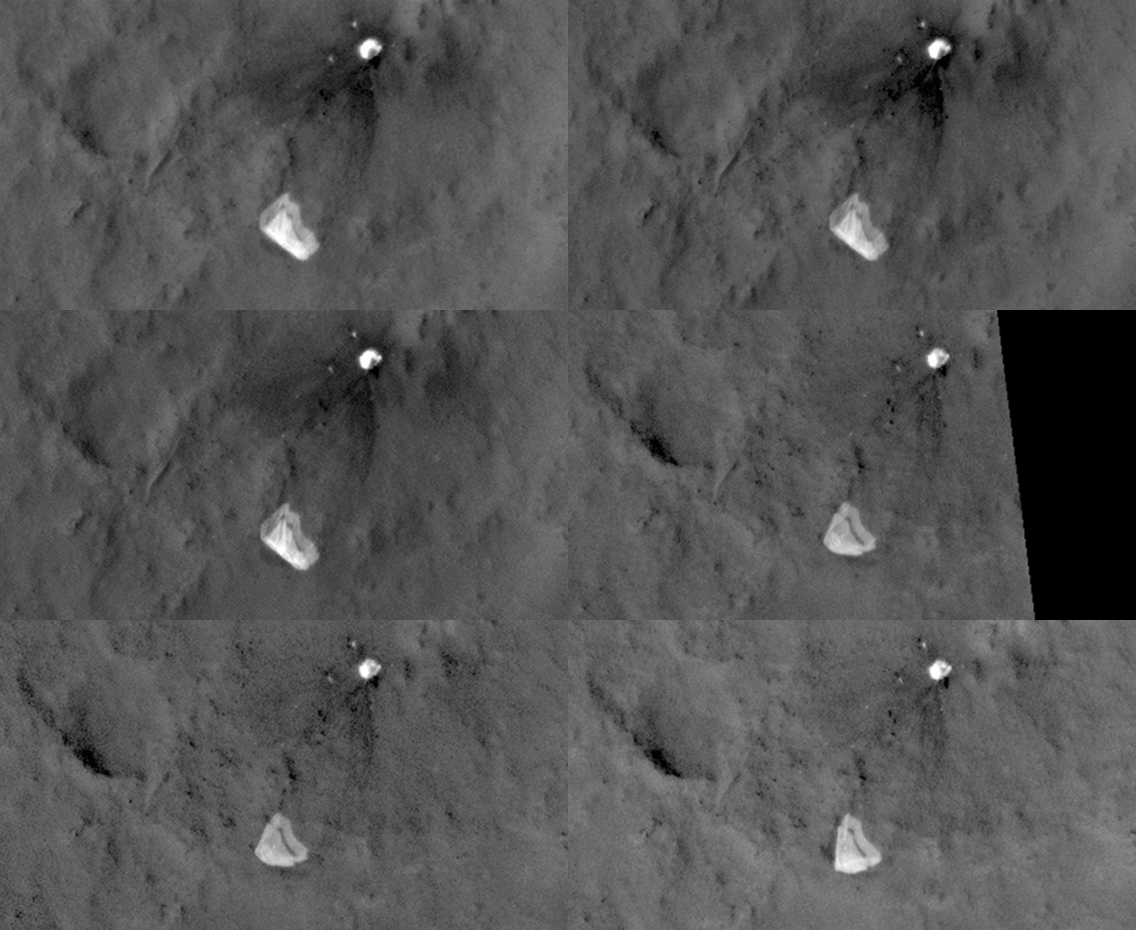
NASA Mars HiRise Images: Curiosity rover’s parachute flapping in the Martian wind

Credit: Nasa /Caltech

The orbiting HiRISE camera captures the Curiosity rover’s parachute flapping in the Martian wind!

The animation was made from seven images taken over the course of several months; the changes in between each frame are due to changing light conditions, angle of the camera to the ground, and so on.

You can also see the back shell that protected the parachute to the upper right; the distance from the parachute to the back shell is about 50 meters.

There may be some science to glean from this: the direction and strength of the wind, information on how durable the parachute is, etc. These could be useful in planning future missions.

Friday, August 10, 2012

NASA Orion Vehicle: The Main Parachutes from the CPAS

One of NASA Orion’s main parachutes from the Capsule Parachute Assembly System, or CPAS, is lowered into the water at the Neutral Buoyancy Lab (NBL) at the Johnson Space Center in Houston.

The Orion CPAS team joined the Exploration Flight Test 1 recovery team and representatives of the U.S. Navy to test recovery procedures for the Orion parachutes.

The NBL is 202 feet in length, 102 feet in width, and 40 feet in depth (20 feet above ground level and 20 ft below) and holds 6.2 million gallons of water.

In addition to the current parachute recovery test the facility has been used by the Orion program to test the Crew Module Uprighting system on a full size Orion mockup known as PORT.

Image Credit: NASA/James Blair

Monday, August 6, 2012

NASA HiRise Image: Older sibling sees Curiosity take the plunge

(Images: NASA/JPL/University of Arizona)

Thousands of humans weren't the only ones with eyes trained on NASA's newest Mars rover last night: One of the robot's orbiting relatives captured this lucky shot as Curiosity descended onto the Red Planet.


The HiRISE camera aboard NASA's Mars Reconnaissance Orbiter was in position to observe Curiosity as it plunged through the Martian atmosphere during its harrowing Entry, Descent and Landing phase, also called the "7 minutes of terror".

Seen about a minute before touchdown, Curiosity is still tucked into its backshell, part of the larger spacecraft that encased the rover during its roughly eight-month trek from Earth to Mars.

The craft is attached to its 16-metre-wide supersonic parachute, which slowed Curiosity's descent speed from 400 metres per second to 80 metres per second in less than two minutes.

A closer cutout view of the spacecraft and its chute (above left) was processed to avoid saturation, presenting better detail.

Shortly after this picture was taken, Curiosity let go of the backshell and fired up its retrorockets, beginning a powered descent that would end in the innovative but risky Sky Crane manoevre, with the rover being lowered on cables to land wheels first near a Martian mountain.

This isn't the first time HiRISE has watched over a new arrival on Mars. In May 2008 the orbiting camera spied NASA's Phoenix lander parachuting toward the Red Planet's north polar region.

The angle of that shot made it seem as if Phoenix was headed into a large crater, although it actually touched down on smooth plains about 20 kilometres from the crater rim.

HiRISE has also taken portraits of its predecessors, including the defunct rover Spirit and its still-operational twin, Opportunity.

"Guess you could consider us the closest thing to paparazzi on Mars," HiRISE team member Sarah Milkovich, of the Jet Propulsion Laboratory in Pasadena, California, said in a NASA statement.

Still, getting a bead on Curiosity during its descent was not guaranteed. The HiRISE team had just one chance to get an image as Curiosity passed through the orbiter's field of view.

"If HiRISE took the image one second before or one second after, we probably would be looking at an empty Martian landscape," says Milkovich.