Showing posts with label success. Show all posts

Saturday, January 10, 2015

SpaceX Falcon 6 Rocket Launch: Orbit Insertion success but loss of launcher

Dragon cargo ship on its way to the International Space Station. 

A Space Exploration Technologies Falcon 9 rocket blasted off from Cape Canaveral Air Force tion.

The rocket lifted off at 4:47 a.m. EST (0947 GMT), streaking through nighttime skies as it headed into orbit.

Nine minutes later, the rocket’s upper-stage engine shut down and deposited Dragon into its preliminary orbit.

The capsule was due to reach the space station, which circles about 260 miles above the planet, on Monday.

As Dragon began its solo journey, the discarded first-stage booster was attempting to land itself vertically on a platform in the ocean, part of an ongoing series of tests to develop reusable rockets.

"Rocket made it to drone spaceport ship, but landed hard," SpaceX founder and chief executive Elon Musk posted on Twitter.

The rocket was aiming for a 300- by 100-ft platform stationed about 200 miles off the coast of Jacksonville, Florida, in the Atlantic Ocean.

Ground control teams reported two engine restarts as the rocket descended back through the atmosphere before the communications link was lost.

The rocket was expected to make one more engine burn and extend four landing legs prior to touchdown.

SpaceX engineers stationed on a nearby support ship tried to catch the descent and landing on video, but it was "pitch dark and foggy," Musk said. "Didn't get good landing/impact video ... Will piece it together from telemetry and ... actual pieces."

The ship itself is fine, he added, though some of the support equipment on the deck will need to be replaced, Musk added.

He previously had pegged the chance of a successful touchdown on the first try at 50 per cent.

"Returning anything from space is a challenge, but returning a Falcon 9 first stage for a precision landing presents a number of additional hurdles," SpaceX said in a blog post about the test.

"At 14 stories tall and traveling upwards of 1300 m/s (meters per second), stabilizing the Falcon 9 first stage for re-entry is like trying to balance a rubber broomstick on your hand in the middle of a wind storm."

SpaceX Launch. Credit: M. Staples

To help stabilise the stage and to reduce its speed, SpaceX relights the engines for a series of three burns.

The first burn, the boostback burn, adjusts the impact point of the vehicle and is followed by the supersonic retro propulsion burn that, along with the drag of the atmosphere, slows the vehicle's speed from 1300 m/s to about 250 m/s.

"The final burn is the landing burn, during which the legs deploy and the vehicle's speed is further reduced to around 2 m/s.

“The legspan of the Falcon 9 first stage is about 70 ft and while the ship is equipped with powerful thrusters to help it stay in place, it is not actually anchored, so finding the bullseye becomes particularly tricky,” SpaceX said.

“During previous attempts, we could only expect a landing accuracy of within 10 km. For this attempt, we’re targeting a landing accuracy of within 10 meters,” SpaceX said.

SpaceX Falcon 9 rocket grid fins. Credit: SpaceX

Musk said dark and foggy conditions prevented cameras aboard the rocket and the landing barge from recording good video of the impact, but there is plenty of other data to help determine what happened.

SpaceX engineers revealed that a loss of power in the grid fins caused a loss of control of the launcher, resulting in it being damaged on impact.

Musk tweeted the grid fins added to the rocket launched Saturday “worked extremely well from hypersonic velocity to subsonic, but ran out of hydraulic fluid right before landing.”

An upcoming flight will carry 50 percent more hydraulic fluid, Musk said. The mission “should have plenty of margin for landing attempt next month.”

Thursday, September 25, 2014

Namira Salim, Pakistan explorer commends ISRO on Mars Orbiter success

Namira Salim, a Pakistani explorer expected to become her country's first person in space congratulated India on Thursday on reaching Mars on its maiden attempt.

India won the Asian space race to the Red Planet on Wednesday when its unmanned Mangalyaan successfully entered the Red Planet's orbit after a 10-month journey on a budget of just $74 million.

Despite having a space program since 1961 Pakistan has not yet launched a satellite into orbit.

But Namira Salim, the first Pakistani explorer to reach both poles said India's achievement had made the region proud.

"The success of the Mars Orbiter Mission (MOM), Mangalyaan, is a giant leap for South Asia," said Salim, who has booked a ticket on UK hedonist Richard Branson's Virgin Galactic space project planned for 2015.

"I commend the Indian Space Research Organisation (ISRO), and all its scientists and researchers for not only achieving this astronomical feat, but also for achieving it in the most cost-effective manner."

Pakistan has not yet officially congratulated India. The neighbours have fought three wars, two of them over the disputed territory of Kashmir.

Relations between the two countries have taken a turn for the worse after Pakistan's top envoy met Kashmiri separatist leaders in August, with India responding by calling off talks between the countries' foreign secretaries.

Friday, September 19, 2014

Lockheed Martin successfully mates NOAA GOES-R satellite modules

Lockheed Martin successfully mated together the large system and propulsion modules of the first GOES-R series weather satellite at the company’s Space Systems facilities near Denver, Colorado.

Credit: Lockheed Martin

A team of technicians and engineers at Lockheed Martin has successfully mated together the large system and propulsion modules of the first GOES-R series weather satellite at the company's Space Systems facilities near Denver, Colorado.

The Geostationary Operational Environmental Satellite-R series (GOES-R) is NOAA's next-generation geostationary weather satellites.

The system module of the A2100-based satellite houses more than 70 electronics boxes that comprise the three major electrical subsystems; command and data handling, communication, and electrical power.

The propulsion core contains the integrated propulsion system and serves as the structural backbone of the satellite.

The propulsion subsystem is essential for maneuvering the GOES-R satellite during transfer orbit to its final location, as well as conducting on-orbit repositioning maneuvers throughout its mission life.

"Positioning these large modules together in such a precise manor is a challenging task," said Tim Gasparrini, vice president and program manager for GOES-R at Lockheed Martin Space Systems.

"Our team spent many hours modeling and analyzing the procedure in our virtual reality lab called the CHIL before tackling the mate in the cleanroom."

"This was a critical step in the integration of GOES-R and the team did an outstanding job."

With the core spacecraft completed, the team will begin installing the six weather and solar-monitoring instruments onto the satellite.

Functional testing and environmental testing phases of the program will follow this fall. GOES-R is scheduled to be launched in early 2016.

Data from NOAA's GOES-R satellites provides accurate real-time weather forecasts and early warning products to NOAA's National Weather Service and other public and private sectors.

The advanced spacecraft and instrument technology on the GOES-R series will vastly improve forecasting quality and timeliness, generating significant benefits to the U.S. and Western Hemisphere in the areas of public safety, severe weather monitoring, space weather prediction, ecosystems management, commerce and transportation.

Sunday, April 13, 2014

NASA's Orion Spacecraft Powers through First Integrated System Testing

Engineers in the Operations and Checkout Building at NASA’s Kennedy Space Center in Florida, perform avionics testing on the Orion spacecraft being prepared for its first trip to space later this year.

Image Credit: Lockheed Martin

NASA's Orion spacecraft has proven its mettle in a test designed to determine the spacecraft's readiness for its first flight test, Exploration Flight Test-1 (EFT-1), later this year.

EFT-1 will send the spacecraft more than 3,600 miles from Earth and return it safely.

The spacecraft ran for 26 uninterrupted hours during the final phase of a major test series completed April 8 at the agency's Kennedy Space Center in Florida.

The test verified the crew module can route power and send commands that enable the spacecraft to manage its computer system, software and data loads, propulsion valves, temperature sensors and other instrumentation.

Gerstenmaier
"This has been the most significant integrated testing of the Orion spacecraft yet," said William Gerstenmaier, associate administrator for NASA's human exploration and operations at the agency's Headquarters in Washington.

"The work done to test the avionics with the crew module isn't just preparing us for Orion's first trip to space in a few months. It's also getting us ready to send crews far into the solar system."

In October 2013, NASA and Lockheed Martin engineers powered on Orion's main computer for the first time. Since then, they have installed harnessing, wiring and electronics.

This was the first time engineers ran the crew module through its paces to verify all system actuators respond correctly to commands and all sensors report back as planned.

More than 20 miles of wire are required to connect the different systems being powered.

"Getting all the wiring right, integrating every element of the avionics together, and then testing it continuously for this many hours is a big step toward getting to deep space destinations," said Mark Geyer, Orion program manager.

Engineers now are preparing the crew module for vibration testing, scheduled for the week of April 14. In May, the heat shield will be installed and, shortly thereafter, the crew module will be attached with the service module.

During EFT-1, an uncrewed Orion spacecraft will take a four-hour trip into space, traveling 15 times farther from Earth than the International Space Station.

During its reentry into Earth's atmosphere, Orion will be traveling at 20,000 mph, faster than any current spacecraft capable of carrying humans, and endure temperatures of approximately 4,000 degrees Fahrenheit.

The data gathered during the flight will inform design decisions to improve the spacecraft that will one day carry humans to an asteroid and eventually Mars. EFT-1 is targeted for launch in December.

Thursday, December 5, 2013

SCRAMSPACE: Autopsy of a space disaster turns failure to success

The scramjet crashed, but the experiment was a success. 

Credit: Janelle Kirkland (UQ)

On September 18 this year, far above the Arctic Circle at Norway's Andoya Rocket Range, the SCRAMSPACE hypersonic scramjet flight experiment was about to launch.

Three and a half years of intense effort by a small team of young scientists and engineers had gone into this moment.

Millions of dollars of investment were at stake. The international aerospace community and the broader public were watching in anticipation.

The team had seen three of this type of rocket launch during the HyShot program at Woomera. So when they looked skyward to see a corkscrew smoke trail from the lower stage rocket motor, they knew instantly the experiment was over before it had begun.

Disappointment and dismay, for many of the team, quickly turned to disbelief. What had been one chaotic smoke trail turned into two – the upper stage motor was now firing at the same time.

One insane minute later, the 150kg scramjet payload dived at 700km per hour into the water a few kilometres from the launch range.

But was it a total failure? Absolutely not. Despite the loss of precious scientific data, the project and flight experiment had been an amazing success.

What was the purpose of the SCRAMSPACE?
The SCRAMSPACE program was funded by the Australian Space Research Program to build a human talent pool – the capability and capacity to support an awakening Australian space sector.

In 2010, the core SCRAMSPACE flight team began to assemble at the University of Queensland to work on the experiment's design.

By late 2012, a rather weary but nevertheless committed, enthusiastic and increasingly skilled team set out to turn a detailed design into the most sophisticated hypersonics flight experiment Australia has ever flown.

SCRAMJETS
Scramjets are jet engines that will one day power aircraft that cruise at ultra-high speed in the atmosphere or even form part of space launch systems. Australia is a world leader in the research.

The SCRAMSPACE flight was intended to use rockets to take a generic scramjet experiment to the right speed and altitude (Mach 8 at 27km) to obtain a few seconds of concentrated data on the fundamental science - the flow physics and the way it affects combustion of the hydrogen fuel - that underpins such technology.

The data in turn would have been used to improve our understanding of the science and to test and validate our ability to simulate such engines in our shock tunnels and on our supercomputers.

That’s a nice looking jet: SCRAMSPACE before launch. 

Credit: AAP Image/Dan Peled

By mid 2013, the scramjet payload was assembled and the team started the exhaustive series of pre-flight tests to make sure the experiment was functioning properly and ready to fly.

These included thermal cycling, vibration in all axes, bend testing, spin balancing and pneumatic system calibration.

In parallel, the flight code had to be programmed. Some 13,000 lines of C and C++ were added to existing code supplied by partner Defence Science and Technology Organisation so that flight computers could control the on-board systems, and acquire, package and deliver data to the ground.

The most complex part of this was the use of our Reaction Control System thrusters to control roll, pitch and yaw, re-orient the payload prior to re-entry, and stabilise it during the early re-entry stage.

Scheduling the pulsed fuel system to maintain a fixed fuel-air ratio was also a key aspect of the code.

Computer-simulated flow patterns in and around the scramjet (image credit Dr Melrose Brown)

Despite the inevitable teething problems and bugs along the way, the hardware and software for a free-flying scramjet science experiment was ready for flight.

The experience was an unforgettable example of the reality that if something is hard to do, when you are pushing the boundaries in pursuit of new knowledge and innovation, then there is a real risk of something going dramatically wrong.

This is when the lessons learnt and experience gained are the most valuable.

The team did miss out on a few seconds of scramjet flight data but, despite withstanding incredible aerodynamic forces, the scramjet functioned perfectly all the way from launch to splash down.

It was a tribute to the quality of the payload that the team had designed and built.

The engineering was a success, and the research that surrounded it brought and continues to bring advances and new insight into hypersonics science and technology.

But above all, the talent pool that assembled and grew in skills and know-how, and the international credibility and partnerships and friendships that have resulted from that, have been a huge success.

Read the full story here

Sunday, September 1, 2013

Ultracold Big Bang Experiment Simulates Evolution of Early Universe

Scientists created this detailed, all-sky picture of the infant universe from nine years of data from the orbiting Wilkinson Microwave Anisotropy Probe

The image reveals 13.77 billion year old temperature fluctuations—shown as color differences—that correspond to the seeds that grew to become the galaxies. 

Physicists now are using clouds of ultracold atoms in a vacuum chamber to simulate the growth of structure in the early universe. 

Credit: NASA/WMAP Science Team

Physicists have reproduced a pattern resembling the cosmic microwave background radiation in a laboratory simulation of the big bang, using ultracold cesium atoms in a vacuum chamber at the University of Chicago.

"This is the first time an experiment like this has simulated the evolution of structure in the early universe," said Cheng Chin, professor in physics.

Cheng Chin
Chin and his associates reported their feat in the Aug. 1 edition of Science Express, and it will appear soon in the print edition of Science.

Chin pursued the project with lead author Chen-Lung Hung, PhD'11, now at the California Institute of Technology, and Victor Gurarie of the University of Colorado, Boulder.

Their goal was to harness ultracold atoms for simulations of the big bang to better understand how structure evolved in the infant universe.

The cosmic microwave background is the echo of the big bang. Extensive measurements of the CMB have come from the orbiting Cosmic Background Explorer in the 1990s, and later by the Wilkinson Microwave Anisotropy Probe and various ground-based observatories, including the UChicago-led South Pole Telescope collaboration.

These tools have provided cosmologists with a snapshot of how the universe appeared approximately 380,000 years following the Big Bang, which marked the beginning of the universe.

It turns out that under certain conditions, a cloud of atoms chilled to a billionth of a degree above absolute zero (-459.67 degrees Fahrenheit) in a vacuum chamber displays phenomena similar to those that unfolded following the big bang, Hung said.

"At this ultracold temperature, atoms get excited collectively. They act as if they are sound waves in air," he said.

The dense package of matter and radiation that existed in the very early universe generated similar sound-wave excitations, as revealed by COBE, WMAP and the other experiments.

The synchronized generation of sound waves correlates with cosmologists' speculations about inflation in the early universe.

"Inflation set out the initial conditions for the early universe to create similar sound waves in the cosmic fluid formed by matter and radiation," Hung said.

Journal Reference:
C.-L. Hung, V. Gurarie, C. Chin. From Cosmology to Cold Atoms: Observation of Sakharov Oscillations in a Quenched Atomic Superfluid. Science, 2013; DOI: 10.1126/science.1237557

Monday, August 26, 2013

CSIRO telescope marks 25 years of success

CSIRO's Australia Telescope Compact Array. Credit: David Smyth

One of the world's most successful astronomy observatories, CSIRO's Australia Telescope Compact Array near Narrabri, New South Wales (NSW), turns 25 years of age on 2 September.

CSIRO will celebrate with a public Open Day at the telescope site on 1 September, then a formal ceremony and a scientific meeting.

The Compact Array is a set of six dishes that work together as one much larger radio telescope. It lies between the towns of Narrabri and Wee Waa in northwest NSW, about 500 km from Sydney, at CSIRO's Paul Wild Observatory.

Black holes, exploding stars, magnetic fields in space, galaxies at the edge of the observable universe: the Compact Array studies them all.

The universe is a huge natural laboratory and astronomers study it to observe nature at its most extreme.

Jamie Stevens
"Every possible experiment is being played out somewhere in the universe," said Dr. Jamie Stevens, CSIRO's Senior Systems Scientist for the Compact Array.

The Compact Array has given us the first 3D picture of the radiation belts around Jupiter, the first good evidence linking exploding stars with flashes of gamma rays, and the first image showing how gas churns in interstellar space.

The telescope is so sensitive that it would see a mobile phone on the Moon as a very strong radio source. It can be pointed with an accuracy of better than two arcseconds—about the width of a finger seen one kilometer away.

The Compact Array is to astronomy what the Australian swimming team is to sport: a world-class achiever for many years.

It is among the top three telescopes of its kind by both publication numbers and citations. After the race, it would be standing on the podium!

About 500 scientists from around the world use the telescope each year.

The telescope has become better and better over time, as upgrades have made it more sensitive to faint radio signals and allowed it to capture more of the radio spectrum.

In 2012 Compact Array data led to 76 refereed science papers—more than in any previous year of the telescope's history.

"I never tire of observing with the Compact Array," Dr. Stevens said. "It's a factory for discovery."

The telescope was funded as a project for Australia's Bicentennial in 1988, and was opened by the then Prime Minister, Bob Hawke.

It boosted Australia's international standing in radio astronomy, enabling CSIRO to develop the Australian SKA Pathfinder in Western Australia and Australia to win the right to co-host the international Square Kilometre Array telescope.

Thursday, May 23, 2013

Animals Died in Space but Experiment deemed a success

Russia's Bion-M1 biological research satellite, which recently carried rodents, microorganisms and plants on a month-long space flight, successfully accomplished its mission, an official said on Wednesday, despite the death of most of the animals on board.

"The spacecraft did not show any noticeable failures and has accomplished its program in full," said Vladimir Sychev, deputy director of Russia's Institute of Medical and Biological Studies.

Russia launched the Bion-1M satellite, its first biological research satellite since 2007, on a 30-day mission on April 19 to conduct biology, physiology and biotechnology research in orbit.

The aim of the study was to help pave the way for future interplanetary flights including Mars missions, according to the Federal Space Agency Roscosmos.

Bion-M1 carried eight Mongolian gerbils, 45 mice, 15 geckos, slugs and snails and containers with various microorganisms and plants.

The satellite's returnable capsule landed on Sunday in the Russian Orenburg Region near the border with Kazakhstan.

Most of the satellite's "space passengers" failed to survive the flight due to technical faults in the spacecraft. The flight proved fatal for all the eight Mongolian gerbils, 39 out of 45 mice, and its cichlid fish. The geckos, slugs and snails were among the lucky survivors.

"We expected that there would be losses. Experiments that pass off ideally do not exist. We expected that up to a half of animals would return," Sychev said.

Stress could have killed the animals, he suggested.

"The transition to zero gravity could have led to stress which could have provoked a conflict in the group," the scientist said, but admitted the fishes' death was due to technical faults.

"Twelve days after [the start of the space flight], the lights went off, algae [in the fish tank] stopped photosynthesizing, oxygen ceased to be released and the fish died," he said, adding the experiment involving the fish had been carried out by German scientists.

The next flight by a Bion satellite could take place in a higher orbit, Sychev said.

"The [current] flight was at an altitude of 575 km [357 miles] where piloted spacecraft fly. We want [a future satellite] to fly to an altitude of 1,000 km. Conditions there will be tougher," he said.

NASA's Bion project science manager Richard Boyle told a news conference in Russia on behalf of all US specialists involved in the project that scientists were overjoyed at the condition of experimental mice and at how promptly they were delivered to Moscow.

Monday, February 4, 2013

The Curious Case of the Wrong Monkey - Iran

Iran's announcement that it had successfully sent a monkey into space stirred questions on the Internet.

Curious people pointed to differences between official images of the primate before takeoff and after landing.

On January 28, official Iranian media published pictures of a monkey named Pishgam (Pioneer) prior to the launch.

The animal had light grey fur and a red mole above its right eye.

But later, the ISNA news agency released photos taken during presenting the monkey to the press after its landing which showed a darker fur and no mole.

These differences have been pointed out by Western media, which have questioned the success of the monkey space mission. A previous attempt by Iran, to send a primate into space, failed in 2011.

On Facebook, a comment underneath the monkey's pictures reads: the monkey "went into space and met a doctor who removed its mole," an ironic reference to some Iranians passion for cosmetic surgery (and misleading information regarding their scientific and aerospace capabilities).

Iranian authorities did not directly respond to these questions.

Monday, January 28, 2013

Iran has successfully launched a live monkey into Earth Orbit

A view of an observatory at the Iranian Space Agency (ISA) in Mahdasht, about 60 km west of Tehran.

REUTERS/Raheb Homavandi 

Iran has successfully launched a live monkey into space, the Fars news agency reported on Monday, lauding it as an advance in a missile and space program that has alarmed the West and Israel.

There was no independent confirmation of the report and there have been no announcements by Western powers of any Iranian launch late last week.

Fars said the monkey was launched into space on a Kavoshgar rocket. The rocket reached a height of more than 120 kilometers and "returned its shipment intact", Fars reported.
Iran announced plans in 2011 to send a monkey into space, but that attempt was reported to have failed.

Western countries are concerned the long-range ballistic technology used to propel Iranian satellites into orbit could be used to launch atomic warheads. Tehran denies such suggestions and says its nuclear work is purely peaceful.

Friday, September 7, 2012

Nasa Robotic Lander "Mighty Eagle" - First Free Flight Test

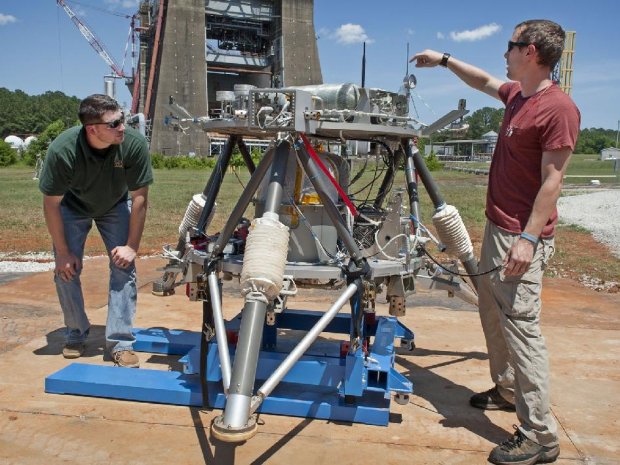
Mighty Eagle during free flight. Credit: NASA/MSFC/Dennis Olive

NASA's robotic lander Mighty Eagle completed a successful free flight test September 5.

The prototype, using its onboard autonomous flight software, moved to an altitude of 100 feet, found its target and descended gently to a controlled landing.

The craft is named after a character from the popular Angry Birds game, and is a test bed for technologies that may be used to build robotic landers for the Moon, asteroids and other destinations in our Solar System.

"The Mighty Eagle had a great flight, fulfilling the objectives we had for this test - finding and landing on its target using a closed-loop system," said Dr Greg Chavers, lead engineer for the project.

Marshall Space Flight Center engineers Logan Kennedy, right, and Adam Lacock check out the lander prototype. Credit: NASA/MSFC/Fred Deaton

After a series of tethered flights during 2011 and 2012, the Mighty Eagle had its first "free" flight on August 8, 2012.

That test met with its targets and was followed by another successful untethered flight on August 16 when the lander hovered at an altitude of about 30 feet, identified its target landing site 21 feet away, moved sideways and descended safely.

The test flight lasted 32 seconds.

An infrared view of the "Mighty Eagle" taking off from the pad. (NASA/MSFC)

Read more about the NASA Mighty Eagle here, at the Lunar Quest mission website.

Thursday, October 14, 2010

Good News from CERN

News | CERN users' pages

I would like to share with you the good news from CERN that their mission has been accomplished! For further proof of that please continue to read Rolf Heuer's explanation below. 

Unfortunately, it is somewhat outside my expertise, so please address all questions and arguments to him, Rolf.Heuer@CERN.ch or go to the CERN public web pages for more info.

"When we started running the LHC at the end of March, we set ourselves the objective of reaching a luminosity of 1032 by the end of 2010 proton running. Last night, we achieved that goal. The beams that went in at around 2:00am, were colliding with a luminosity of 1.01 × 1032 by 3:38am in both ATLAS and CMS, and had delivered an integrated luminosity of over 2 inverse picobarns to ATLAS, CMS and LHCb by midday today.

It’s a great achievement by all concerned to reach this important milestone with over two weeks to spare.
The remainder of this year’s proton running will be devoted to maximising the LHC 2010 data set and preparing for 2011 proton running before we switch to lead ions in November.

The significance of this milestone can’t be underestimated, since it is a necessary step on the way to the larger goal of delivering an integrated luminosity of one inverse femtobarn to the experiments by the end of 2011.

That’s the amount of data we need to ensure that if nature has put new physics in our path at the LHC’s current collision energy, we’ll have a good chance of seeing it.

At the moment, we’re running the LHC with 248 bunches per beam in a configuration that allows us to go much higher. As 2011 proton running gets underway early next year we’ll continue increasing the number of bunches, since a factor of two or so more luminosity is still needed if we’re to reach our one inverse femtobarn goal.

That, however, is for next year. In the meantime, the objective we set ourselves for this year was realistic, but tough, and it’s very gratifying to see it achieved in such fine style."

Rolf Heuer (CERN)

Sunday, February 21, 2010

NASA & ESA Celebrate Success of Cupola Installation on ISS,


Astronaut Nicholas Patrick participates in extravehicular activity as construction and maintenance continue on the International Space Station.

Saturday, August 29, 2009

NASA: Shuttle Discovery lifts off succesfully

CAPE CANAVERAL, Fla. -- Space shuttle Discovery, with its seven-member crew, launched at 11:59 p.m. EDT Friday from NASA's Kennedy Space Center in Florida.

The shuttle Discovery will deliver supplies, equipment and a new crew member to the International Space Station.


Inside the shuttle's cargo bay is the Leonardo Multi-Purpose Logistics Module, a pressurised "moving van" that will be temporarily installed to the station.

The module will deliver storage racks; materials and fluids science racks; a freezer to store research samples; a new sleeping compartment; an air purification system; and a treadmill named after comedian Stephen Colbert. The name "Colbert" received the most entries in NASA's online poll to name the station's Node 3. NASA named the node Tranquility.

Shortly before liftoff, Commander Rick Sturckow said, "Thanks to everyone who helped prepare for this mission. Let’s go step up the science on the International Space Station!"

The 13-day flight will include three spacewalks to replace experiments outside the European Space Agency's Columbus laboratory, install a new ammonia storage tank and return the used one. Ammonia is needed to move excess heat from inside the station to the radiators located outside.

Sturckow is joined on the STS-128 mission by Pilot Kevin Ford, Mission Specialists Pat Forrester, Jose Hernandez, Danny Olivas and European Space Agency astronaut Christer Fuglesang. NASA astronaut Nicole Stott will fly to the complex aboard Discovery to begin a three-month mission as a station resident. She replaces NASA's Tim Kopra, who will return home on Discovery. Ford, Hernandez and Stott are first-time space fliers.

The mission marks the start of the transition from assembling the space station to using it for continuous scientific research. Assembly and maintenance activities have dominated the available time for crew work. As completion nears, additional facilities and the crew members to operate them will enable a measured increase in time devoted to research as a national and multinational orbiting laboratory.

Discovery's first landing opportunity at Kennedy is scheduled for Thursday, Sept. 10, at 7:09 p.m. EDT. This mission is the 128th space shuttle flight, the 30th to the station, the 37th for Discovery and the fourth in 2009.