Showing posts with label successfully. Show all posts

Sunday, September 21, 2014

SpaceX Falcon 9 carrying a Dragon spacecraft, successfully launched

The SpaceX Falcon 9 carrying a Dragon spacecraft loaded with scientific equipment and cargo launches from Cape Canaveral Air Force Station, Florida, on Sept. 21, 2014.

Image Credit: NASA /Frankie Martin

An eruption of fire and smoke sent a SpaceX Dragon spacecraft skyward laden with 5,000 pounds of scientific equipment and supplies destined for use by the crew of the International Space Station.

"This launch kicks off a very busy time for the space station," said NASA's Sam Scimemi, director of the International Space Station, noting upcoming launches of a Soyuz carrying the next crew of the station and launches of cargo spacecraft within a month.

Lifting off at 1:52:03 a.m. EDT on Sunday, Sept. 21, from Launch Complex-40 at Cape Canaveral Air Force Station, Fla., the SpaceX Falcon 9 rocket and Dragon etched a yellow and white arc across the sky as it flew on a path roughly paralleling the East Coast of America.

The nine Merlin 1D engines of the first stage shut down as planned about 2 minutes and 41 seconds into flight and the single Merlin engine of the second stage ignited to carry the Dragon the rest of the way into orbit.

Cheers greeted the video from Dragon as the second stage pushed itself away from the orbit-bound spacecraft and a pair of solar array "wings" unfolded to recharge the Dragon's batteries.

"There's nothing like a good launch, it's just fantastic," said Hans Koenigsman, vice president of Mission Assurance for SpaceX. "From what I can tell, everything went perfectly."

Following the launch, the spacecraft starts a two-day chase to catch up with the space station. It is scheduled to complete this pursuit by Tuesday morning.

Once the SpaceX Dragon spacecraft reaches the ISS, European Space Agency (ESA) astronaut Alexander Gerst and NASA astronaut Reid Wiseman will reach out with CanadArm-2, the station's robot arm, and maneuver the capsule to latch onto a port of the station.

The station crew later will unload the equipment and supplies inside the Dragon, including a glovebox-sized habitat holding 20 mice that will be used for microgravity research into bone density.

Monday, August 2, 2010

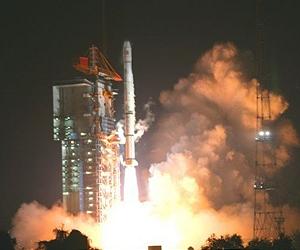
COMPASS GPS: China successfully launched its fifth orbiter


The fifth orbiter into space, as part of its satellite navigation and positioning network known as Beidou, or Compass system, is launched on the Long March 3I carrier rocket at Xichang Satellite Launch Center in Xichang, southwest China's Sichuan Province, on August 1, 2010. (Xinhua/Du Cai)


China successfully launched its fifth orbiter into space at 5:30 a.m. Sunday, as a part of its indigenous satellite navigation and positioning network.

The satellite was launched from the Long March 3I carrier rocket.

It is the 126th flight for the country's Long March series of rockets.

The satellite will join another four satellites in orbit to form a network that will eventually consist of 35 satellites.

The system, code named "COMPASS", is a crucial part of the country's space infrastructure for providing navigation and positioning services in transportation, meteorology, petroleum prospecting, forest fire monitoring, disaster forecast, telecommunications and public security among others.

China started building its own satellite navigation system to end its dependence upon the U.S. GPS system in 2000, when it sent two orbiters as a double-satellite experimental positioning system.

The system is designed to provide navigation, time and short message services in the Asia and Pacific region before 2012 and will be capable of providing global navigation services by 2020.

Monday, July 5, 2010

Russian Progress module finally docks successfully with ISS

The ISS Progress 38 cargo resupply ship successfully docked to the aft end of the International Space Station’s Zvezda service module at 12:17 p.m. EDT Sunday. The docking was executed flawlessly by Progress’ Kurs automated rendezvous system.

The Progress spacecraft carries 1,918 pounds of propellant, 110 pounds of oxygen, 220 pounds of water and 2,667 pounds of experiment equipment, spare parts and other supplies to the station.

It launched from the Baikonur Cosmodrome in Kazakhstan on June 30. An attempted docking Friday, July 2, was aborted when telemetry between the Progress and the space station was lost about 25 minutes before its planned docking.

The most likely cause of Friday’s aborted docking was traced to the activation of the TORU “Klest” TV transmitter, which created interference with TORU itself, causing a loss of the TORU command link between Progress and the International Space Station that triggered the abort of the Progress docking.

TORU was not activated for today’s docking. The TORU TV system is designed to provide a view of Zvezda’s docking target to station Commander Alexander Skvorstov, if he had to operate a joystick in the service module to dock Progress manually.

The Expedition 24 crew members monitored the arrival of the spacecraft. The crew will enjoy an off-duty day Monday in observance of the U.S. Independence Day holiday.