Thursday, April 26, 2012

NASA Dawn Reveals Secrets of Giant Asteroid Vesta - 3D

This set of images from NASA's Dawn mission shows topography of the southern hemisphere of the giant asteroid Vesta and a map of Vesta's gravity variations that have been adjusted to account for Vesta's shape. Image credit: NASA/JPL-Caltech/UCLA/MPS/DLR/IDA.

Findings from NASA's Dawn spacecraft reveal new details about the giant asteroid Vesta, including its varied surface composition, sharp temperature changes and clues to its internal structure.

The findings were presented at the European Geosciences Union meeting in Vienna, Austria, and will help scientists better understand the early solar system and processes that dominated its formation.

Images from Dawn's framing camera and visible and infrared mapping spectrometer, taken 420 miles (680 kilometers) and 130 miles (210 kilometers) above the surface of the asteroid, show a variety of surface mineral and rock patterns.

Coded false-colour images help scientists better understand Vesta's composition and enable them to identify material that was once molten below the asteroid's surface.

Researchers also see breccias, which are rocks fused during impacts from space debris. Many of the materials seen by Dawn are composed of iron- and magnesium-rich minerals, which often are found in Earth's volcanic rocks.

Images also reveal smooth pond-like deposits, which might have formed as fine dust created during impacts settled into low regions.

"Dawn now enables us to study the variety of rock mixtures making up Vesta's surface in great detail," said Harald Hiesinger, a Dawn participating scientist at Munster University in Germany. "The images suggest an amazing variety of processes that paint Vesta's surface."

At the Tarpeia crater near the south pole of the asteroid, Dawn imagery revealed bands of minerals that appear as brilliant layers on the crater's steep slopes. The exposed layering allows scientists to see farther back into the geological history of the giant asteroid.

The layers closer to the asteroid's surface bear evidence of contamination from space rocks bombarding Vesta. Layers below preserve more of their original characteristics. Frequent landslides on the slopes of the craters also have revealed other hidden mineral patterns.

"These results from Dawn suggest Vesta's 'skin' is constantly renewing," said Maria Cristina De Sanctis, lead of the visible and infrared mapping spectrometer team based at Italy's National Institute for Astrophysics in Rome.

Dawn has given scientists a near 3-D view into Vesta's internal structure. By making ultra-sensitive measurements of the asteroid's gravitational tug on the spacecraft, Dawn can detect unusual densities within its outer layers.

Data now show an anomalous area near Vesta's south pole, suggesting denser material from a lower layer of Vesta has been exposed by the impact that created a feature called the Rheasilvia basin. The lighter, younger layers coating other parts of Vesta's surface have been blasted away in the basin.

Dawn obtained the highest-resolution surface temperature maps of any asteroid visited by a spacecraft. Data reveal temperatures can vary from as warm as minus 10 degrees Fahrenheit (minus 23 degrees Celsius) in the sunniest spots to as cold as minus 150 degrees Fahrenheit (minus 100 degrees Celsius) in the shadows.

This is the lowest temperature measurable by Dawn's visible and infrared mapping spectrometer. These findings show the surface responds quickly to illumination with no mitigating effect of an atmosphere.

"After more than nine months at Vesta, Dawn's suite of instruments has enabled us to peel back the layers of mystery that have surrounded this giant asteroid since humankind first saw it as just a bright spot in the night sky," said Carol Raymond, Dawn deputy principal investigator at NASA's Jet Propulsion Laboratory in Pasadena, Calif.

"We are closing in on the giant asteroid's secrets."

Launched in 2007, Dawn began its exploration of the approximately 330-mile-wide (530-kilometers) asteroid in mid-2011. The spacecraft's next assignment will be to study the dwarf planet Ceres in 2015. These two icons of the asteroid belt have been witness to much of our solar system's history.

Wednesday, April 25, 2012

Paralysed Claire Lomas walks London marathon in Robotic Suit

Claire Lomas, paralysed in a horse riding accident, had some dashing male company as she continued her quest to complete the 2012 London Marathon yesterday.

Claire, 32, of Eye Kettleby, near Melton, is almost six miles into the 26-mile course, which she is walking in a Cyclone robotic suit, called ReWalk.

She was joined for the last mile of yesterday's leg, in south London, by former tennis ace Tim Henman and his wife, Lucy.

"I couldn't believe I was actually there with Tim Henman," said Claire.

"He was my favourite tennis player of them all and it was so strange to see him there in front of me. He's exactly like he is on the telly. I told him he used to put me through hell watching him play."

Claire, who was paralysed from the chest down in a riding accident five years ago, is aiming to complete the route in two weeks to raise thousands of pounds for Spinal Research.

She said: "It was a tiring day and I felt a little sore but having Matt and Tim walk with me really spurred me on – they are both lovely blokes."

Claire is walking in a pioneering suit using motion sensors, electronics and computers to help paraplegics walk again.

Tomorrow's leg will see her pass the Cutty Sark on her way through Greenwich.

More information can be found on her website www.get-claire-walking.co.uk

Below is a short video showing Claire training before the marathon. Other Videos uploaded by Claire can be found here: www.youtube.com/user/clairelom


NASA - Vibidia Crater in Color

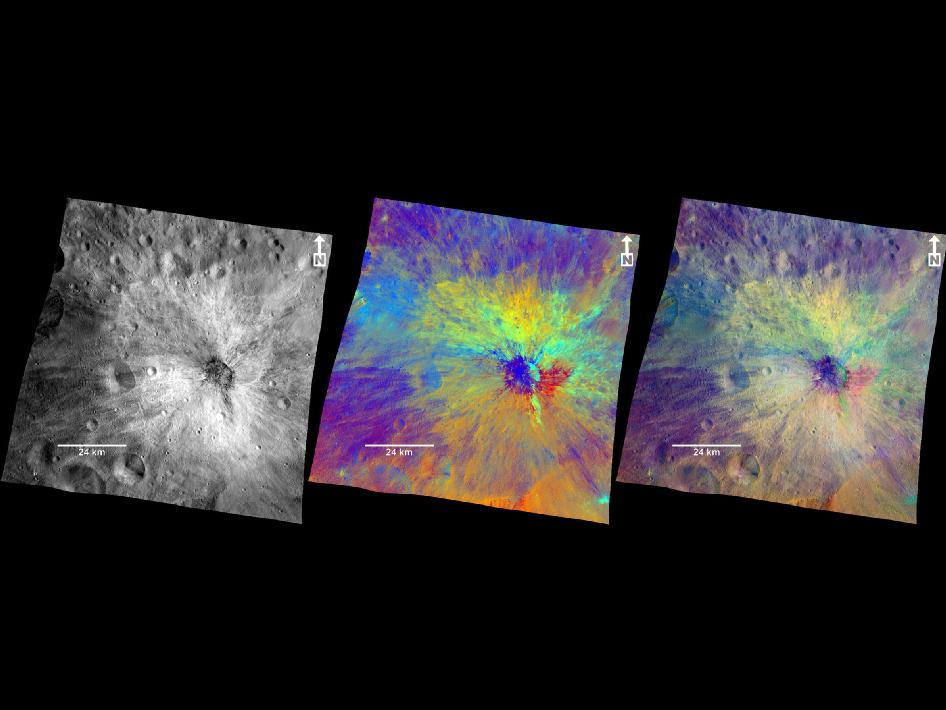
These composite images from the framing camera aboard NASA’s Dawn spacecraft show three views of the comparatively fresh crater named Vibidia on the giant asteroid Vesta.

A black-and-white image that highlights topography, a colorized image that highlights composition and a combination of the black-and-white and colorized images to show the relationship between topography and composition are included here.

The impact that created Vibidia occurred at the edge of a cratered highland in the equatorial region and extends to a basin known as Veneneia. It appears to be located in a gentle depression, presumably an older crater.

Scientists think a relatively small object caused the crater, which features many boulders inside and rays of dark material. As on the moon, bright rays can be the result of compositional differences in material thrown out by the impact compared to the surrounding terrain.

Or bright rays can indicate differences in maturity -- that is, the amount of time the surface has been exposed to subsequent bombardment by micrometeoroids and cosmic rays.

Vibidia exhibits a particularly colorful blanket of ejected material, demonstrating that the surface and the layer just beneath are made up of many different kinds of materials.

These patterns reflect a complex interplay of ancient volcanic and impact processes that shaped Vesta’s crust. The impact that created Vibidia also appears to have caused an area with a width five times the diameter of the crater to collapse.

The framing camera has seven color filters that allow it to image Vesta in a number of different wavelengths of light. Being able to image in many wavelengths enhances features and colors that would otherwise be indistinguishable to the human eye.

In this colorized image, scientists assigned different color channels to specific ratios of wavelengths of radiation. In this scheme, green shows the relative strength of a particular mineralogical characteristic -- the absorption of iron.

Brighter green signifies a higher relative strength of this band, which indicates chemistry involving pyroxene. On the other hand, reddish colors indicate either a different mineralogy or a stronger weathered surface.

These images are composite images made from those taken during Dawn’s high-altitude mapping orbit (420 miles or 680 kilometers above the surface) on Oct 27, 2011. They cover an area that is about 40 by 40 miles (60 by 60 kilometers). This area is near the edge of the Rheasilvia basin in Vesta’s southern hemisphere.

The Dawn mission to Vesta and Ceres is managed by NASA's Jet Propulsion Laboratory, a division of the California Institute of Technology in Pasadena, for NASA's Science Mission Directorate, Washington. UCLA is responsible for overall Dawn mission science.

More information about Dawn is online at http://www.nasa.gov/dawn and http://dawn.jpl.nasa.gov .

Hunt is on for pieces of van-sized California meteor


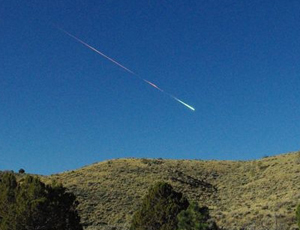
Wanted: fragments of a minivan-sized meteor that exploded over northern California and Nevada on Sunday morning and may well have survived to strike Earth.

Meteorites – meteors that make landfall – can provide crucial information about the chemical composition of the early solar system.

"It's like getting sample return without having to go there," says Bill Cooke of NASA's Meteoroid Environment Office at the Marshall Space Flight Centre in Huntsville, Alabama.

However, meteorites are rare. Though meteors frequently streak across the sky, they tend to burn up before reaching the ground or they land in the sea. There's reason to think the recent meteor is different.

Apart from exploding over land, it created a sonic boom, so it must have stayed intact for long enough for it to get down into the denser air low in the atmosphere – just 16 kilometres above the Earth's surface, Cooke reckons – raising the chance that some of it hit the dirt.

Sudan similarity
He estimates it was about 4 metres long, about 70 metric tonnes and packing the energy of 4 kilotonnes of TNT. "That's about one-fourth the energy of the 'Little Boy' bomb dropped on Hiroshima," he says.

That makes the rock even bigger than 2008 TC3, a meteorite which was detected before it entered the atmosphere and became the first cosmic impact to be traced from space to landfall when astronomers found its scattered fragments in Sudan in 2008.

Cooke is also hoping someone took a video of the new meteor.

Astronomers used infrasound signals – low frequency sound that travels great distances – detected at two ground-based stations to pinpoint the spots where the new meteor entered the atmosphere and then exploded. They don't yet know where the fragments went.
National Geographic’s zoomable panoramic photos of Discovery allow you to see the instrumentation and controls required to operate the space shuttle.

The space shuttle Discovery made its last flight on Tuesday, April 17, 2012 aboard a retrofitted 747 jumbo jet through restricted airspace over Washington, D.C. with an armed escort.

Its destination was the Smithsonian National Air and Space Museum. The National Geographic site has this two-minute video of Discovery’s final flight over D.C.

Discovery will be on display but, unfortunately, it is not going to be open to the public; the Smithsonian plans to seal it up indefinitely. But before they do, National Geographic, as well as many other news organizations, was able to get inside and take pictures of the shuttle’s interiors.

National Geographic took gigapans of Discovery – a gigapan is a 360-degree photograph with the equivalent of 340 8-megapixel photos stitched together. (Gigapans technology was developed for the Mars Rovers.)

National Georgraphic took 27 gigapans of Discovery, but only 10 gigapans are currently available online; National Geographic plans to release more images on its Spaceflight HD Gigapans page in the next few weeks.

These gigapans allow you to explore online the extensive instrumentation and controls required to operate a space-faring vehicle (check out the Discovery Flight Deck gigapan, which is 2.74 gigapixels) and other areas of the ship, such as the toilet. Each gigapan contains a few “snapshots,” which are areas of interest within the photo that immediately zoom the gigapan when clicked.

Discovery’s sister ships will become museum pieces as well, with Enterprise on display in New York City, Endeavor in LA, and Atlantis at the Kennedy Space Center in Florida.

Will you travel to the Smithsonian in Washington, D.C. or another one of these cities to see a shuttle up close? Share your plans in the comments.

Also read: The NASA site overview of Discovery

Scientist unveils mind-controlled robot for paraplegics

A professor at a Swiss university on Tuesday unveiled a robot that can be controlled by the brainwaves of a paraplegic person wearing an electrode-fitted cap, news agency ATS reported.

A paralysed man at a hospital in the town of Sion demonstrated the device, sending a mental command to a computer in his room, which transmitted it to another computer that moved a small robot 60 kilometres (37 miles) away in Lausanne.

The system was developed by Jose Millan, a professor at the Federal Polytechnic School of Lausanne who specialises in non-invasive interfaces between machines and the brain.

The same technology can be used to drive a wheelchair, Millan said.

"Once the movement has begun, the brain can relax, otherwise the person would soon be exhausted," he said.

But the technology has its limits, he added. The brain signals can be scrambled if too many people are gathered around a wheelchair, for example.

Besides making paraplegics mobile, neuroprosthetics could be used to help patients recover lost senses, researchers said.

Professor Stephanie Lacour and her team are working on an "electric skin" for amputees, a glove fitted with tiny sensors that would send information directly to the user's nervous system.

Eventually, researchers say they hope to create mechanised prosthetics that are as mobile and sensitive as a natural hand, Lacour said.

Other researchers at Lausanne are working on enabling paraplegics to walk again with electrodes implanted in their spinal cords.

"The goal is that after a year of training with a robotic aide, the patient will be able to walk without a robot. The electrodes would stay implanted for life," said Professor Gregoire Courtine.

He said he is currently setting up clinical trials and hopes to run tests at Zurich's university hospital within a year.

Pakistan Test Launch Ballistic Missile

Pakistan has test fired a nuclear-capable ballistic missile, military officials say, less than a week after India also test-launched a long-range missile.

The military said the test of the Shaheen 1-A, an intermediate-range missile capable of reaching targets in India, was successful.

India and Pakistan have fought three wars since 1947.

They conduct regular missile tests and inform each other in advance.

Both countries carried out nuclear weapons tests in 1998.

Defence experts say that while the exact range of the Pakistani missile has not been revealed, it is it capable of hitting targets up to 2,500 to 3,000km (1,550 to 1,850 miles) away - putting arch-rival India well within reach.

The Agni-V long-range intercontinental ballistic missile launched by India last week has a range of more than 5,000km (3,100 miles), potentially bringing targets in China within range.

Pakistan's last test was last month, when it launched the short-range nuclear-capable Abdali missile.

The missile tested on Wednesday landed in the sea, the military said. It is a version of the Shaheen-1 - with improvements in range and technical capabilities - and is able to carry nuclear and conventional warheads.

The military say that the missile - which successfully hit its target in the Indian Ocean - further consolidates and strengthens Pakistan's deterrence abilities.

Pakistan's missile arsenal includes short, medium and long range missiles, all named after Muslim conquerors.