Showing posts with label Dawn. Show all posts

Thursday, February 5, 2015

NASA DAWN: New Images of CERES - Animation

This image is one several images NASA's Dawn spacecraft took on approach to Ceres on Feb. 4, 2015 at a distance of about 90,000 miles (145,000 kilometers) from the dwarf planet. 

Image credit: NASA/JPL-Caltech/UCLA/MPS/DLR/IDA

NASA's Dawn spacecraft, on approach to dwarf planet Ceres, has acquired its latest and closest-yet snapshot of this mysterious world.

The above image of Ceres, taken on Feb. 4, 2015, from a distance of about 90,000 miles (145,000 kilometers).

At a resolution of 8.5 miles (14 kilometers) per pixel, the pictures represent the sharpest images to date of Ceres.

After the spacecraft arrives and enters into orbit around the dwarf planet, it will study the intriguing world in great detail.

Ceres, with a diameter of 590 miles (950 kilometers), is the largest object in the main asteroid belt, located between Mars and Jupiter.


Sunday, January 25, 2015

NASA DAWN: Mysterious Bright Spot on Dwarf Planet Ceres

A mysterious white spot can be seen in the newest images from NASA's Dawn spacecraft, which is rapidly approaching the dwarf planet. 

Credit: NASA /JPL-Caltech /UCLA /MPS /DLR /IDA /PSI

A strange, flickering white blotch found on the dwarf planet Ceres by NASA's Dawn spacecraft has scientists scratching their heads.

The white spot on Ceres in a series of new photos taken on Jan. 13 by NASA's Dawn spacecraft, which is rapidly approaching the round dwarf planet in the asteroid belt between the orbits of Mars and Jupiter, but when the initial photo release on Monday (Jan. 19), the Dawn scientists gave no indication of what the white dot might be.

"Yes, we can confirm that it is something on Ceres that reflects more sunlight, but what that is remains a mystery," Marc Rayman, mission director and chief engineer for the Dawn mission, told Space.com in an email.


The new images show areas of light and dark on the face of Ceres, which indicate surface features like craters, but at the moment, none of the specific features can be resolved, including the white spot.

"We do not know what the white spot is, but it's certainly intriguing," Rayman said. "In fact, it makes you want to send a spacecraft there to find out, and of course that is exactly what we are doing! So as Dawn brings Ceres into sharper focus, we will be able to see with exquisite detail what [the white spot] is."

Ceres is a unique object in our solar system. It is the largest object in the asteroid belt and is classified as an asteroid. It is simultaneously classified as a dwarf planet, and at 590 miles across (950 kilometers, or about the size of Texas), Ceres is the smallest known dwarf planet in the solar system.

The $466 million Dawn spacecraft is set to enter into orbit around Ceres on March 6. Dawn left Earth in 2007 and in the summer of 2011, it made a year-long pit stop at the asteroid Vesta, the second largest object in the asteroid belt.

Tuesday, September 23, 2014

NASA Dawn back on course after briefly slipping into Safe Mode


NASA's Dawn spacecraft has resumed normal operations after a high-energy particle event forced the mission to enter safe mode, knocking its ion drive offline.

Although mission managers deduced the source of the problem and restarted its propulsion systems, the unexpected hiccup will likely delay Dawn’s arrival at dwarf planet Ceres.

Safe mode was triggered on Sept. 11 and it is thought the same phenomenon that triggered a safe mode three years agoduring Dawn's approach to giant asteroid Vesta is to blame for this incident.

A high-energy cosmic ray hit the spacecraft's ion drive electronics, disabling it.

In addition to the ion drive glitch, Dawn's main antennae that the spacecraft uses to communicate with Earth was also knocked offline, meaning engineers had to decipher the problem using Dawn’s secondary, lower bandwidth antennae.

"This anomaly presented the team with an intricate and elaborate puzzle to solve," said Robert Mase, Dawn project manager at NASA’s Jet Propulsion Laboratory (JPL) in Pasadena, Calif.

"We followed the same strategy that we implemented three years ago to recover from a similar radiation strike, to swap to one of the other ion engines and a different electronic controller so we could resume thrusting quickly," said Dawn Mission Director and Chief Engineer Marc Rayman also of JPL.

“We have a plan in place to revive this disabled component later this year.”

Wednesday, September 17, 2014

NASA DAWN: Spacecraft operating normally after safe mode triggered

Artist concept of NASA's Dawn spacecraft orbiting Ceres during an upcoming flyby. 

Credit: NASA/JPL-Caltech/UCLA

The Dawn spacecraft has resumed normal ion thrusting after the thrusting unexpectedly stopped and the spacecraft entered safe mode on September 11.

That anomaly occurred shortly before a planned communication with NASA's Deep Space Network that morning.

The spacecraft was not performing any special activities at the time.

Engineers immediately began working to restore the spacecraft to its normal operational state.

The team determined the source of the problems, corrected them, and then resumed normal ion thrusting on Monday night, Sept. 15.

"This anomaly presented the team with an intricate and elaborate puzzle to solve," said Robert Mase, Dawn project manager at NASA's Jet Propulsion Laboratory in Pasadena, California.

After investigating what caused the spacecraft to enter safe mode, the Dawn team determined that it was likely triggered by the same phenomenon that affected Dawn three years ago on approach to the protoplanet Vesta: An electrical component in the ion propulsion system was disabled by a high-energy particle of radiation.

"We followed the same strategy that we implemented three years ago to recover from a similar radiation strike, to swap to one of the other ion engines and a different electronic controller so we could resume thrusting quickly," said Dawn Mission Director and Chief Engineer Marc Rayman of JPL.

"We have a plan in place to revive this disabled component later this year."

Complicating the issue, the team discovered that the spacecraft had experienced not just one anomaly, but also a second one that affected the ability to point the main antenna at Earth to communicate.

Because the spacecraft could not communicate using its main antenna, the team had to utilize the weaker signals of another antenna, slowing their progress.

In addition, Dawn is so far from Earth that radio signals take 53 minutes to make the round trip.

Although they have not yet specifically pinpointed the cause of this issue, it could also be explained by a high-energy particle corrupting the software running in the main computer.

Ultimately the team reset the computer, which restored the pointing performance to normal.

As a result of the change in the thrust plan, Dawn will enter into orbit around dwarf planet Ceres in April 2015, about a month later than previously planned.

Ceres
The plans for exploring Ceres once the spacecraft is in orbit, however, are not affected.

Vesta
Dawn orbited Vesta, the second most massive object in the main asteroid belt, from July 2011 until September 2012.

The spacecraft's ion propulsion system enabled it to spiral away from Vesta and head toward Ceres, the most massive object in that region.

Tuesday, December 17, 2013

NASA Dawn creates guide to Vesta's hidden attractions

This colorful composite image from NASA's Dawn mission shows the flow of material inside and outside a crater called Aelia on the giant asteroid Vesta

The area is around 14 degrees south latitude. 

The images that went into this composite were obtained by Dawn's framing camera from September to October 2011.

Credit: NASA /JPL-Caltech /UCLAMPS /DLR /IDA

Some beauty is revealed only at a second glance. When viewed with the human eye, the giant asteroid Vesta, which was the object of scrutiny by the Dawn spacecraft from 2011 to 2012, is quite unspectacular color-wise. Vesta looks grayish, pitted by a variety of large and small craters.

But scientists at the Max Planck Institute for Solar System Research in Katlenburg-Lindau, Germany, have re-analyzed the images of this giant asteroid obtained by Dawn's framing camera.

They assigned colors to different wavelengths of light and, in the process, revealed in unprecedented detail not only geological structures that are invisible to the naked eye, but also landscapes of incomparable beauty.

Researchers at Max Planck can now see structures such as melts from impacts, craters buried by quakes and foreign material brought by space rocks, visible with a resolution of 200 feet (60 meters) per pixel.

"The key to these images is the seven color filters of the camera system on board the spacecraft," said Andreas Nathues, the framing camera team lead at Max Planck."

"Since different minerals reflect light of different wavelengths to different degrees, the filters help reveal compositional differences that remain hidden without them. In addition, scientists calibrated the data so that the finest variations in brightness can be seen.

This coloured composite image from NASA's Dawn mission shows the crater Antonia, which lies in the enormous Rheasilvia basin in the southern hemisphere of the giant asteroid Vesta. 

The area lies around 58 degrees south latitude. 

Antonia has a diameter of 11 miles (17 kilometers). 

Credit: NASA/JPL-Caltech/UCLAMPS/DLR/IDA

In the new colorized images, different colors indicate different materials on the surface of Vesta. They reveal impressive formations and a wide range of geological diversity, said Nathues. But above all, the color-coded images are impressive because of their beauty.

"No artist could paint something like that. Only nature can do this," said Martin Hoffman, a member of the framing camera team also at Max Planck.

Pictures of the crater Aelia, the crater Antonia and an area near the crater Sextilia show some of Vesta's most impressive sites.

This colorful image from NASA's Dawn mission shows material northwest of the crater Sextilia on the giant asteroid Vesta. 

Sextilia, located around 30 degrees south latitude, is at the bottom right of this image. 

Credit: NASA/JPL-Caltech/UCLAMPS/DLR/IDA

Dawn visited Vesta from July 2011 to September 2012. The spacecraft is currently on its way to its second destination, the dwarf planet Ceres.

Ceres is the largest object in the main asteroid belt between Mars and Jupiter.

Wednesday, December 4, 2013

NASA DAWN readied for engagement with CERES

This artist's concept shows NASA's Dawn spacecraft heading toward the dwarf planet Ceres. 

Dawn spent nearly 14 months orbiting Vesta, the second most massive object in the main asteroid belt between Mars and Jupiter, from 2011 to 2012.

It is heading towards Ceres, the largest member of the asteroid belt.

When Dawn arrives, it will be the first spacecraft to go into orbit around two destinations in our solar system beyond Earth. 

Image credit: NASA/JPL-Caltech

NASA's Dawn spacecraft is ready to engage with dwarf planet Ceres, and mission managers have stated.

Dawn has been cruising toward Ceres, the largest object in the main asteroid belt between Mars and Jupiter, since September 2012, when it departed from its other target, Vesta.

Ceres presents an icy—possibly watery—counterpoint to the dry Vesta, where Dawn spent almost 14 months.

Vesta and Ceres are two of the largest surviving protoplanets—bodies that almost became planets—and will give scientists clues about the planet-forming conditions at the dawn of our solar system.

When Dawn enters orbit around Ceres, it will be the first spacecraft to see a dwarf planet up-close and the first spacecraft to orbit two solar system destinations beyond Earth.

"Our flight plan around Ceres will be choreographed to be very similar to the strategy that we successfully used around Vesta," said Bob Mase, Dawn's project manager at NASA's Jet Propulsion Laboratory, Pasadena, Calif.

"This approach will build on that and enable scientists to make direct comparisons between these two giants of the asteroid belt."

As a prelude, the team will begin approach operations in late January 2015. The next month, Ceres will be big enough in Dawn's view to be imaged and used for navigation purposes.

Dawn will arrive at Ceres—or, more accurately, it will be captured by Ceres' gravity—in late March or the beginning of April 2015.

NASA's Dawn spacecraft will be getting an up-close look at the dwarf planet Ceres starting in late March or the beginning of April 2015. 

This graphic shows the science-gathering orbits planned for the spacecraft, with the altitudes above the surface noted for each of the orbits. 

Credit: NASA/JPL-Caltech

Dawn will make its first full characterization of Ceres later in April, at an altitude of about 8,400 miles (13,500 kilometers) above the icy surface.

Then, it will spiral down to an altitude of about 2,750 miles (4,430 kilometers), and obtain more science data in its survey science orbit.

This phase will last for 22 days, and is designed to obtain a global view of Ceres with Dawn's framing camera, and global maps with the visible and infrared mapping spectrometer (VIR).

Dawn will then continue to spiral its way down to an altitude of about 920 miles (1,480 kilometers), and in August 2015 will begin a two-month phase known as the high-altitude mapping orbit.

During this phase, the spacecraft will continue to acquire near-global maps with the VIR and framing camera at higher resolution than in the survey phase.

The spacecraft will also image in "stereo" to resolve the surface in 3-D.

Tuesday, August 6, 2013

M31 Image heralds the dawn of Subaru Telescope's Hyper Suprime-Cam (HSC)'s productivity

Figure 1: M31 captured by HSC. Credit: HSC Project / NAOJ

A stunning image of M31 captured by Subaru Telescope's Hyper Suprime-Cam (HSC) displays the fruits of international collaboration and technological sophistication aligned with cutting-edge science.

In addition to providing information about a nearby galaxy that resembles our own, this image demonstrates HSC's capability to fulfill Subaru Telescope's intention of producing a large-scale survey of the Universe.

The combination of a large mirror, a wide field of view, and sharp imaging represents a giant step into a new era of observational astronomy and will contribute to answering questions about the nature of dark energy and matter.

It marks another successful stage in HSC's commissioning process, which involves checking all of HSC's capabilities before it is ready for open use.

HSC's first beautiful image of M31 gives an answer to the question: Does HSC really deliver what it promises in terms of image quality?

It displays a resounding "yes" by demonstrating the sharp, detailed resolution of which the camera is capable across the wide field of view that it embraces.

The image indicates why this powerful instrument is unique within the domain of current observational technology, enabling high-resolution images from observations with a large primary mirror (8.2 m) and large field of view (1.5 degrees).

M31, also known as the Andromeda Galaxy, is the spiral galaxy nearest to our own Milky Way Galaxy, 2.5 million light years from Earth.

It is one of the brightest objects listed in the Messier catalog and has garnered the attention of observers since 964 A.D., when the Persian astronomer al-Sufi wrote about it.

Messier catalogued it as M31 in 1764, 800 years later, and it continues to intrigue the public and astronomers alike.

It is visible to the naked eye on moonless nights, even in areas with moderate light pollution. Astronomers find it particularly interesting, because it is quite similar to the Milky Way Galaxy and can provide valuable information about how our own galaxy formed.

Since the galactic center is visible, it is possible to investigate how star formation varies in relation to distance from the center of the galaxy.

Of particular significance in HSC's image is the consistently high quality of resolution of the objects throughout the frame, which surpasses the clear resolution of the image of the Andromeda Galaxy captured by the Subaru Prime Focus Camera (Suprime-Cam) in 2001 (Figure 2).

Although HSC's field of view is seven times larger than that of its predecessor, Suprime-Cam, there is no degradation of the image at the edges.

Figure 2: A comparison of the images of M31 captured by Suprime-Cam (bottom left and middle) and HSC (right). 

The yellow-outlined boxes within HSC's image illustrate the dramatic difference between Suprime-Cam's field of view and HSC's as well as the high quality of resolution in the HSC image. 

An image of the apparent diameter of the Moon is shown as a standard by which to compare the fields of view of the Suprime-Cam and HSC images. 

Credit: NAOJ

HSC's image of M31 gives tangible evidence of features that HSC's developers had envisioned as early as 2002, when astronomers at Subaru Telescope tried to anticipate the future demands of cosmology-related research that existing technology could not handle.

Their foresight led to the establishment of the HSC Project in 2008 and was a catalyst for international collaboration among major research partners.

Sunday, May 26, 2013

NASA - Solar-Electric ION Engine Burns Blue

This image shows a cutting-edge solar-electric propulsion thruster in development at NASA's Jet Propulsion Laboratory, Pasadena, Calif., that uses xenon ions for propulsion. 

An earlier version of this solar-electric propulsion engine has been flying on NASA's Dawn mission to the asteroid belt.

This engine is being considered as part of the Asteroid Initiative, a proposal to robotically capture a small near-Earth asteroid and redirect it safely to a stable orbit in the Earth-moon system where astronauts can visit and explore it. 

This image was taken through a porthole in a vacuum chamber at JPL where the ion engine is being tested.

Image credit: NASA/JPL-Caltech

Thursday, January 3, 2013

NASA Dawn 3D Image: Cornelia Crater on Asteroid Vesta

This composite-colour view from NASA's Dawn mission shows Cornelia Crater, streaked with dark materials, on the giant asteroid Vesta.

The data were obtained by Dawn's framing camera during the mission's high-altitude mapping orbit, about 420 miles (680 kilometers) above the surface.

The images were integrated into a mosaic and wrapped on a topographical model of Vesta's surface.

Scientists colorised the picture by assigning red to the 0.75-micron wavelength, green to the 0.92-micron wavelength and blue to the 0.98-micron wavelength.

The Dawn mission to Vesta and Ceres is managed by NASA's Jet Propulsion Laboratory, a division of the California Institute of Technology in Pasadena, for NASA's Science Mission Directorate, Washington.

UCLA is responsible for overall Dawn mission science. The Dawn framing camera project is funded by the Max Planck Society, DLR, and NASA/JPL.

Image: NASA/JPL-Caltech/UCLA/MPS/DLR/IDA

Wednesday, September 26, 2012

Asteroid Vesta’s troughs suggest stunted planet

An image taken by NASA's Dawn spacecraft on July 24, 2011, shows troughs along the equator of the asteroid Vesta, including Divalia Fossa, which is larger than the Grand Canyon. 

A new study analyzing these troughs finds that they are probably graben – a dip in the surface with faults on either side that would indicate that Vesta has characteristics much like a planet or large moon.

Credit: NASA/JPL-Caltech/UCLA/MPS/DLR/IDA

Enormous troughs that reach across the asteroid Vesta may actually be stretch marks that hint of a complexity beyond most asteroids.

Scientists have been trying to determine the origin of these unusual troughs since their discovery just last year.

Now, a new analysis supports the notion that the troughs are faults that formed when a fellow asteroid smacked into Vesta’s south pole.

The research reinforces the claim that Vesta has a layered interior, a quality normally reserved for larger bodies, such as planets and large moons.

Asteroid surface deformities are typically straightforward cracks formed by crashes with other asteroids. Instead, an extensive system of troughs encircles Vesta, the second most massive asteroid in the solar system, about one-seventh as wide as the Moon.

The biggest of those troughs, named Divalia Fossa, surpasses the size of the Grand Canyon by spanning 465 kilometers (289 miles) long, 22 km (13.6 mi) wide and 5 km (3 mi) deep.

The origin of these troughs on Vesta has puzzled scientists. The complexity of their formation can’t be explained by simple collisions.

New measurements of Vesta’s topography, derived from images of Vesta  taken by NASA’s Dawn spacecraft last year, indicate that a large collision could have created the asteroid’s troughs.

But, this would only have been possible if the asteroid is differentiated – meaning that it has a core, mantle and crust -- said Debra Buczkowski of the Johns Hopkins University Applied Physics Laboratory in Laurel, Md.

Because Vesta is differentiated, its layers have different densities, which react differently to the force from the impact and make it possible for the faulted surface to slide, she added.

“By saying it’s differentiated, we’re basically saying Vesta was a little planet trying to happen.”

Her team’s research will be published online this Saturday in Geophysical Research Letters.

Most asteroids are pretty simple. “They’re just like giant rocks in space,” said Buczkowski. But previous research has found signs of igneous rock on Vesta, indicating that rock on Vesta’s surface was once molten, a sign of differentiation.

If the troughs are made possible by differentiation, then the cracks aren’t just troughs, they’re graben.

A graben is a dip in the surface that forms when two faults move apart from each other and the ground sinks into the widening gap, such as in Death Valley in California. Scientists have also observed graben on the Moon and planets such as Mars.

The images from the Dawn mission show that Vesta’s troughs have many of the qualities of graben, said Buczkowski.

For example, the walls of troughs on simpler asteroids such as Eros and Lutetia are shaped like the letter V.

But Vesta’s troughs have floors that are flat or curved and have distinct walls on either side, like the letter U – a signature of a fault moving apart, instead of simple cracking on the surface.

The scientists’ measurements also showed that the bottoms of the troughs on Vesta are relatively flat and slanted toward what’s probably a dominant fault, much as they are in Earth-bound graben. 

These observations indicate that Vesta is also unusually planet-like for an asteroid in that its mantle is ductile and can stretch under a lot of pressure. “It can become almost silly putty-ish,” said Buczkowski. “You pull it and it deforms.”

Friday, September 21, 2012

NASA Dawn Vesta: Satellite detects Hydrated Minerals on Giant Asteroid

This map from NASA's Dawn mission shows the global distribution of hydrogen on the surface of the giant asteroid Vesta. 
Credit: NASA JPL-Caltech UCLA PSI MPS DLR IDA.

NASA's Dawn spacecraft has revealed that the giant asteroid Vesta has its own version of ring around the collar.

Two new papers based on observations from the low-altitude mapping orbit of the Dawn mission show that volatile, or easily evaporated materials, have colored Vesta's surface in a broad swath around its equator.

Pothole-like features mark some of the asteroid's surface where the volatiles, likely water, released from hydrated minerals boiled off.

While Dawn did not find actual water ice at Vesta, there are signs of hydrated minerals delivered by meteorites and dust evident in the giant asteroid's chemistry and geology. The findings appear in the journal Science.

One paper, led by Thomas Prettyman, the lead scientist for Dawn's gamma ray and neutron detector (GRaND) at the Planetary Science Institute in Tucson, Ariz., describes how the instrument found signatures of hydrogen, likely in the form of hydroxyl or water bound to minerals in Vesta's surface.

"The source of the hydrogen within Vesta's surface appears to be hydrated minerals delivered by carbon-rich space rocks that collided with Vesta at speeds slow enough to preserve their volatile content," said Prettyman.

A complementary paper, led by Brett Denevi, a Dawn participating scientist based at the Johns Hopkins University Applied Physics Laboratory in Laurel, Md., describes the presence of pitted terrain created by the release of the volatiles.

Vesta is the second most massive member of the main asteroid belt. The orbit at which these data were obtained averaged about 130 miles (210 kilometers) above the surface.

Dawn left Vesta earlier this month, on Sept. 4 PDT (Sept. 5 EDT), and is now on its way to its second target, the dwarf planet Ceres.

Scientists thought it might be possible for water ice to survive near the surface around the giant asteroid's poles.

Unlike Earth's moon, however, Vesta has no permanently shadowed polar regions where ice might survive.

The strongest signature for hydrogen in the latest data came from regions near the equator, where water ice is not stable.

In some cases, other space rocks crashed into these deposits later at high speed. The heat from the collisions converted the hydrogen bound to the minerals into water, which evaporated.

The holes that were left as the water escaped stretch as much as 0.6 miles (1 kilometer) across and go down as deep as 700 feet (200 meters). Seen in images from Dawn's framing camera, this pitted terrain is best preserved in sections of Marcia crater.

"The pits look just like features seen on Mars, but while water was common on Mars, it was totally unexpected on Vesta in these high abundances," said Denevi.

"These results provide evidence that not only were hydrated materials present, but they played an important role in shaping the asteroid's geology and the surface we see today."

Friday, September 7, 2012

NASA's Dawn spacecraft Leaves Vesta and sets sail for Ceres

After becoming the first spacecraft to enter orbit around an object in the main asteroid belt between Mars and Jupiter in July 2011, NASA’s Dawn spacecraft has spent the last year mapping the giant asteroid Vesta.

The spacecraft has now bid adieu to Vesta, one of the largest asteroids in the Universe and is on its way to the dwarf planet Ceres to continue its mission to help shed light on the evolution of our solar system.

Communications sent via NASA’s Deep Space Network confirmed Dawn’s departure from Vesta at about 11:26 p.m. US PDT on Tuesday, September 4.

Launched on September 27, 2007, it took the spacecraft almost four years to reach its first port of call, but the second leg of its journey is set to be a bit quicker with Dawn expected to arrive at Ceres early in 2015.

Dawn’s departure from Vesta was far from dramatic.

It gently spiraled out of the giant asteroid's orbit propelled by, what Marc Rayman, Dawn's chief engineer and mission director, called “a blue-green pillar of xenon ions,” emitted from the ion propulsion system that generates thrust by using electricity to ionize xenon.

Wednesday, September 5, 2012

NASA Dawn: Probe Departing Asteroid Vesta for Ceres

This image taken by the NASA Dawn spacecraft shows the south pole of the giant asteroid Vesta. 

After spending a year examining Vesta, Dawn is poised to depart and head to another asteroid, Ceres, where it will arrive in 2015.

Picture: NASA/AP

Thursday, August 16, 2012

NASA Dawn Asteroid Probe Hits Snag on Way to Dwarf Planet, Ceres

An artist's impression of the Dawn spacecraft in orbit around Vesta.
CREDIT: NASA/JPL-Caltech

A NASA spacecraft orbiting the huge asteroid Vesta has suffered a glitch last week, but mission controllers say it will not affect plans for its upcoming trip to Ceres, the largest asteroid or Dwarf Planet, in the solar system.

The malfunction on NASA's Dawn spacecraft occurred during a maneuver on Aug. 8, when one of the probe's reaction wheels that is used to maintain its position in space unexpectedly shut down.

Mission controllers discovered the problem during a routine communications dispatch the following day, on Aug. 9, said Marc Rayman, chief engineer and mission director of the Dawn mission.

"The wheel was operating normally, and then the internal friction increased enough that the software that we call 'fault protection' — it's a system software that looks at parameters on the spacecraft and monitors the performance of the different components — detected something unusual," Rayman reported.

"If something isn't within the limits we've specified, it takes action. In this case, when the friction got up to a certain level, it turned that wheel off."

Three impact craters of different sizes, arranged in the shape of a snowman, make up one of the most striking features on Vesta, as seen in this view from NASA’s Dawn mission. 

In this view the three “snowballs” are upside down, so that the shadows make the features easily recognizable. 

North is to the lower right in the image, which has a resolution of 230 feet (70 meters) per pixel. 

Image credit: NASA/JPL-Caltech/UCLA/MPS/DLR/IDA

At the time when one of the probe's reaction wheels failed, Dawn was preparing for its departure from Vesta, after spending more than a year studying the asteroid.

The spacecraft completed its science objectives at Vesta on July 24. Since then, Dawn has been using its ion thrusters to gradually spiral away from the space rock.

"The ion propulsion system, while very efficient, is also very gentle," Rayman explained.

"It only gradually climbs away from Vesta, spiraling in ever larger loops until the spacecraft is going fast enough and is far away enough from Vesta that Vesta can no longer hold it in its gravitational grip."

Thursday, April 26, 2012

NASA Dawn Reveals Secrets of Giant Asteroid Vesta - 3D

This set of images from NASA's Dawn mission shows topography of the southern hemisphere of the giant asteroid Vesta and a map of Vesta's gravity variations that have been adjusted to account for Vesta's shape. Image credit: NASA/JPL-Caltech/UCLA/MPS/DLR/IDA.

Findings from NASA's Dawn spacecraft reveal new details about the giant asteroid Vesta, including its varied surface composition, sharp temperature changes and clues to its internal structure.

The findings were presented at the European Geosciences Union meeting in Vienna, Austria, and will help scientists better understand the early solar system and processes that dominated its formation.

Images from Dawn's framing camera and visible and infrared mapping spectrometer, taken 420 miles (680 kilometers) and 130 miles (210 kilometers) above the surface of the asteroid, show a variety of surface mineral and rock patterns.

Coded false-colour images help scientists better understand Vesta's composition and enable them to identify material that was once molten below the asteroid's surface.

Researchers also see breccias, which are rocks fused during impacts from space debris. Many of the materials seen by Dawn are composed of iron- and magnesium-rich minerals, which often are found in Earth's volcanic rocks.

Images also reveal smooth pond-like deposits, which might have formed as fine dust created during impacts settled into low regions.

"Dawn now enables us to study the variety of rock mixtures making up Vesta's surface in great detail," said Harald Hiesinger, a Dawn participating scientist at Munster University in Germany. "The images suggest an amazing variety of processes that paint Vesta's surface."

At the Tarpeia crater near the south pole of the asteroid, Dawn imagery revealed bands of minerals that appear as brilliant layers on the crater's steep slopes. The exposed layering allows scientists to see farther back into the geological history of the giant asteroid.

The layers closer to the asteroid's surface bear evidence of contamination from space rocks bombarding Vesta. Layers below preserve more of their original characteristics. Frequent landslides on the slopes of the craters also have revealed other hidden mineral patterns.

"These results from Dawn suggest Vesta's 'skin' is constantly renewing," said Maria Cristina De Sanctis, lead of the visible and infrared mapping spectrometer team based at Italy's National Institute for Astrophysics in Rome.

Dawn has given scientists a near 3-D view into Vesta's internal structure. By making ultra-sensitive measurements of the asteroid's gravitational tug on the spacecraft, Dawn can detect unusual densities within its outer layers.

Data now show an anomalous area near Vesta's south pole, suggesting denser material from a lower layer of Vesta has been exposed by the impact that created a feature called the Rheasilvia basin. The lighter, younger layers coating other parts of Vesta's surface have been blasted away in the basin.

Dawn obtained the highest-resolution surface temperature maps of any asteroid visited by a spacecraft. Data reveal temperatures can vary from as warm as minus 10 degrees Fahrenheit (minus 23 degrees Celsius) in the sunniest spots to as cold as minus 150 degrees Fahrenheit (minus 100 degrees Celsius) in the shadows.

This is the lowest temperature measurable by Dawn's visible and infrared mapping spectrometer. These findings show the surface responds quickly to illumination with no mitigating effect of an atmosphere.

"After more than nine months at Vesta, Dawn's suite of instruments has enabled us to peel back the layers of mystery that have surrounded this giant asteroid since humankind first saw it as just a bright spot in the night sky," said Carol Raymond, Dawn deputy principal investigator at NASA's Jet Propulsion Laboratory in Pasadena, Calif.

"We are closing in on the giant asteroid's secrets."

Launched in 2007, Dawn began its exploration of the approximately 330-mile-wide (530-kilometers) asteroid in mid-2011. The spacecraft's next assignment will be to study the dwarf planet Ceres in 2015. These two icons of the asteroid belt have been witness to much of our solar system's history.

Wednesday, April 25, 2012

NASA - Vibidia Crater in Color

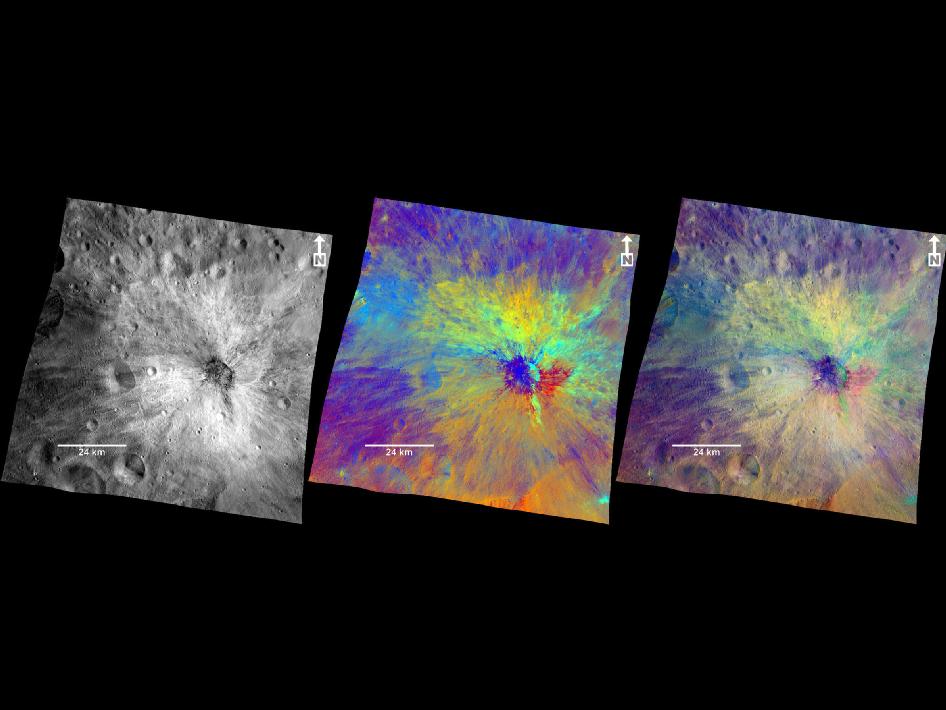
These composite images from the framing camera aboard NASA’s Dawn spacecraft show three views of the comparatively fresh crater named Vibidia on the giant asteroid Vesta.

A black-and-white image that highlights topography, a colorized image that highlights composition and a combination of the black-and-white and colorized images to show the relationship between topography and composition are included here.

The impact that created Vibidia occurred at the edge of a cratered highland in the equatorial region and extends to a basin known as Veneneia. It appears to be located in a gentle depression, presumably an older crater.

Scientists think a relatively small object caused the crater, which features many boulders inside and rays of dark material. As on the moon, bright rays can be the result of compositional differences in material thrown out by the impact compared to the surrounding terrain.

Or bright rays can indicate differences in maturity -- that is, the amount of time the surface has been exposed to subsequent bombardment by micrometeoroids and cosmic rays.

Vibidia exhibits a particularly colorful blanket of ejected material, demonstrating that the surface and the layer just beneath are made up of many different kinds of materials.

These patterns reflect a complex interplay of ancient volcanic and impact processes that shaped Vesta’s crust. The impact that created Vibidia also appears to have caused an area with a width five times the diameter of the crater to collapse.

The framing camera has seven color filters that allow it to image Vesta in a number of different wavelengths of light. Being able to image in many wavelengths enhances features and colors that would otherwise be indistinguishable to the human eye.

In this colorized image, scientists assigned different color channels to specific ratios of wavelengths of radiation. In this scheme, green shows the relative strength of a particular mineralogical characteristic -- the absorption of iron.

Brighter green signifies a higher relative strength of this band, which indicates chemistry involving pyroxene. On the other hand, reddish colors indicate either a different mineralogy or a stronger weathered surface.

These images are composite images made from those taken during Dawn’s high-altitude mapping orbit (420 miles or 680 kilometers above the surface) on Oct 27, 2011. They cover an area that is about 40 by 40 miles (60 by 60 kilometers). This area is near the edge of the Rheasilvia basin in Vesta’s southern hemisphere.

The Dawn mission to Vesta and Ceres is managed by NASA's Jet Propulsion Laboratory, a division of the California Institute of Technology in Pasadena, for NASA's Science Mission Directorate, Washington. UCLA is responsible for overall Dawn mission science.

More information about Dawn is online at http://www.nasa.gov/dawn and http://dawn.jpl.nasa.gov .

Monday, January 30, 2012

NASA's Dawn: Does Asteroid Vesta Have Water Ice?


Astronomers from NASA have discovered a giant asteroid - Vesta - that is expected to have water ice. They believe Vesta may have stayed frozen for billions of years. This is contrary to earlier Earth-based observations that the surface of the Vesta is dry.

The information was transmitted from NASA's Dawn spacecraft, which entered into orbit around Vesta in July.
The asteroid is reportedly the second largest object in the asteroid belt between Mars and Jupiter and is approximately 480km (300 miles) in diameter. It doesn't have a permanent shadow because its axis is tilted to roughly 27 degrees, meaning the asteroid sees seasons similar to the ones we experience on Earth. As a result, almost every part of Vesta's surface is expected to see the Sun, at some point during the year.

The average temperature on Vesta is, however, around minus 190 degrees Fahrenheit... the reason why water ice is able to survive in the soil.

According to the astronomers, the presence of water ice on Vesta gives us an idea about the tiny world's formation and evolution, its history of bombardment by comets and its interaction with the environment in surrounding space. Furthermore, the fact that Vesta may have reserves of water ice could lead to a greater understanding of the solar system.

Meanwhile, the Dawn is also investigating the role of water in the evolution of planets, by studying Vesta and Ceres... two bodies in the asteroid belt that are considered remnant protoplanets (young planets whose growth was interrupted when Jupiter formed).

The spacecraft is looking for water using the Gamma Ray and Neutron Detector (GRaND) spectrometer, a data collection process well suited to the Dawn's current low orbit position.

"On average, it's colder at Vesta's poles than near its equator, so in that sense, they are good places to sustain water ice," said Timothy Stubbs from NASA's Goddard Space Flight Center, "But they also see sunlight for long periods of time during the summer seasons, which isn't so good for sustaining ice. So if water ice exists in those regions, it may be buried beneath a relatively deep layer of dry regolith."

"Hopefully, we'll know in the next few months whether the GRaND spectrometer sees evidence for water ice in Vesta's regolith. This is an important and exciting time in planetary exploration," he added.

"Our perceptions of Vesta have been transformed in a few months as the Dawn spacecraft has entered orbit and spiraled closer to its surface," said Lucy McFadden, a planetary scientist at NASA Goddard, "More importantly, our new views of Vesta tell us about the early processes of solar system formation. If we can detect evidence for water beneath the surface, the next question will be is it very old or very young, and that would be exciting to ponder."

Tuesday, December 13, 2011

NASA's Dawn spacecraft orbiting the giant asteroid Vesta

An artist's concept shows NASA's Dawn spacecraft orbiting the giant asteroid Vesta. 

The depiction of Vesta is based on images obtained by Dawn's framing cameras. 

NASA announced on Monday that the spacecraft successfully manoeuvred into its closest orbit around the giant asteroid Vesta, beginning a new phase of science observations. 

The spacecraft is now circling Vesta at an altitude averaging about 130 miles (210 km).

Picture: REUTERS/NASA/JPL-Caltech

NASA's Dawn: Reaches Lowest Orbit Above Vesta

This image of the giant asteroid Vesta was obtained by NASA's Dawn spacecraft in the evening Nov. 27 PST (early morning Nov. 28, UTC), as it was spiraling down from its high altitude mapping orbit to low altitude mapping orbit. Full frame image available at NASA/JPL-Caltech.

NASA's Dawn spacecraft has successfully maneuvered into its closest orbit around the giant asteroid Vesta, beginning a new phase of science observations.

The spacecraft is now circling Vesta at an altitude averaging about 130 miles (210 kilometers) in the phase of the mission known as low altitude mapping orbit.

"Dawn has performed some complicated and beautiful choreography in order to reach this lowest orbit," said Marc Rayman, Dawn chief engineer and mission manager based at NASA's Jet Propulsion Laboratory, Pasadena, Calif. "We are in an excellent position to learn much more about the secrets of Vesta's surface and interior."

Thursday, October 13, 2011

Asteroid Vesta rocked by mighty impacts

Better information on surface shape (topography) reveals that Rhea Silvia sits on top of an older impact crater. 

Rhea Silvia itself may be 2.5 billion years old. The equatorial trough system is also visible in this image.

The scale of the pummelling Asteroid Vesta has taken through its history is starting to become clear.

Analysis of data returned by the orbiting Dawn spacecraft shows this giant rock took a mighty double beating in its southern polar region.

One impact had long been recognised from images of the asteroid acquired by the Hubble telescope.

But Dawn's measurements indicate that Vesta was also hit much earlier in time in almost exactly the same location.

These two major impacts gouged out depressions hundreds of kilometres in diameter, and sent shockwaves rippling around the body.

Scientists are fairly confident that the deep system of troughs extending around Vesta's equator and northern hemisphere are fractures that opened up in the surface as a direct consequence of the southern bombardments.