Showing posts with label Video. Show all posts

Tuesday, January 27, 2015

Mexico Volcano of Fire eruption caught on camera - Video


Dramatic video caught on webcam showed eruptions with clouds of smoke rising above the crater of the Volcan del Fuego (Volcano of Fire), set between the states of Colima and Jalisco.

Three separate bursts were seen on Wednesday (January 21), Sunday (January 25) with a nocturnal one on Monday (January 26). Webcams de Mexico.com captured the dramatic images.

The 9,939-feet above sea-level (3,860-meters) Volcan del Fuego, one of Mexico's most active, has frequent moderate explosions.

Activity at the volcano was also reported in January.

Friday, January 16, 2015

SpaceX Release images of Falcon 9 Launcher crash - Video

Video of SpaceX Falcon 9's Lower Stage Launcher crash 

Credit: SpaceX


SpaceX Falcon 9's Lower Stage Launcher crash.

Credit: Space X

SpaceX Falcon 9's Lower Stage Launcher crashes back onto the deck of the floating platform that was intended as its safe haven.

Elon Musk, CEO of SpaceX, has released pictures from his firms recent failed attempt to land a rocket on a boat.

The images show the first stage of SpaceX's Falcon 9 rocket hitting the boat at a 45 degree angle before exploding.

Looking closely at the images above, you can see the steerable fins at the top of the rocket, designed to bring it in for a safe landing.

Musk has previously said that the fins ran out of hydraulic fluid just before landing, meaning the rocket lost control, so SpaceX will be adding more fluid for its next attempt.

The rocket came in too fast, destroying its landing legs, and then the leftover fuel ignited and it exploded (see below).

"Full RUD (rapid unscheduled disassembly) event. Ship is fine minor repairs. Exciting day!" tweeted Musk.

UK Space Agency justify loss of Beagle 2 on Mars - Video

UK Space Agency continue to justify expenditure and efforts to launch Beagle 2 lander.

Grainy images picked up by NASA MRO HiRise camera scanning Mars.

Wednesday, January 14, 2015

Snake Monster: Six-legged robot first of new breed of reconfigurable modular robots - Video


Carnegie Mellon University's latest robot is called Snake Monster, however, with six legs, it looks more like an insect than a snake, but it really doesn't matter what you call it, says its inventor,

Howie Choset, the whole point of the project is to make modular robots that can easily be reconfigured to meet a user's needs.

Choset, a professor in CMU's Robotics Institute, said the walking robot, developed in just six months, is only one example of the robots that eventually can be built using this modular system.

His team already is working on modules such as force-sensing feet, wheels and tank-like treads that will enable the assembly of totally different robots.

"By creating a system that can be readily reconfigured and that also is easy to program, we believe we can build robots that are not only robust and flexible, but also inexpensive," Choset said.

"Modularity has the potential to rapidly accelerate the development of traditional industrial robots, as well as all kinds of new robots."

The Defense Advanced Research Projects Agency (DARPA) sponsored this work through its Maximum Mobility and Manipulation (M3) program, which focuses on ways to design and build robots more rapidly and enhance their ability to manipulate objects and move in natural environments.

Snake Monster, as well as some of Choset's other robots, will be demonstrated at the finals of the DARPA Robotics Challenge, June 5-6 in Pomona, Calif.

For years, Choset's lab has concentrated on building and operating snake-like robots—chains of repeated component joints.

By careful coordination of these joints, the robots can be made to move in ways that are similar to a snake's natural undulations and in other ways not seen in nature, such as rolling.

Applications for these robots include urban search and rescue, archaeological exploration and, thanks to the robots' ability to move through pipes, inspection of power plants, refineries and sewers.

Monday, January 5, 2015

Testing ESA's Mercury mission - Video


Europe’s Mercury mission is moved through ESA’s ESTEC Test Centre in this new video, positioning it for testing inside the largest vacuum chamber in Europe, for a trial by vacuum.

BepiColombo, Europe’s first mission to study Mercury, is a joint mission with Japan. Two spacecraft – the Mercury Planetary Orbiter and the Mercury Magnetospheric Orbiter – will fly in two different paths around the planet to study it from complementary perspectives.

Flight hardware for the mission is undergoing testing at ESA’s Technical Centre, ESTEC, in Noordwijk, the Netherlands, the largest spacecraft test facility in Europe, to prepare for its 2016 launch.

The Mercury Planetary Orbiter was placed inside the chamber in late October for ‘thermal–vacuum’ testing. It will sit in vacuum until early December, subjected to the equivalent temperature extremes that will be experienced in Mercury orbit.

Liquid nitrogen runs through the walls of the chamber to recreate the chill of empty space, while an array of lamps focuses simulated sunlight 10 times more intense than on Earth.

Saturday, December 27, 2014

From Dream to Discovery: Inside NASA Engineering - Video


Experience the challenges of the next generation of space exploration in this brand-new Planetarium show.

By using exciting real-life projects like NASA's James Webb Space Telescope (JWST) and the New Horizons mission to Pluto, the show highlights the extreme nature of spacecraft engineering and the life cycle of a space mission, from design and construction to the rigors of testing, launch, and operations.

Blast off and take the voyage with NASA!


Saturday, December 20, 2014

ESA Mars Express: Flying over Becquerel Crater - Video


This latest release from the camera on ESA’s Mars Express is a simulated flight over the Becquerel crater, showing large-scale deposits of sedimentary material.

Becquerel crater is 167 km in diameter and lies in the Arabia Terra region on Mars, on the boundary between the southern highlands and northern lowlands.

This movie shows the location of Becquerel crater on Mars and then provides a flyover of a mound of layered, sulphate-bearing deposits on the crater floor, thought to have formed under the influence of water.

The darker material surrounding the mound is wind-blown dust from a source to the north, and provides evidence for effects of wind in eroding the sedimentary deposits.

The movie was made from a mosaic of four individual images acquired by the High Resolution Stereo Camera on ESA’s Mars Express during orbits 3253/1, 5332, 5350 and 5368.

The image is centred at about 22ºN / 352ºE. The average ground resolution is about 17 m per pixel.

Friday, December 12, 2014

“All About That Space” NASA volunteer outreach video


“All About That Space” is a volunteer outreach video project created by the Pathways Interns of NASA's Johnson Space Center. It was created as a parody (to raise interest and excitement for Orion's first flight) of Meghan Trainor’s “All About That Bass”.

The lyrics and scenes in the video have been re-imagined in order to inform the public about the amazing work going on at NASA and the Johnson Space Center.

NASA’s Orion spacecraft is built to take humans farther than they’ve ever gone before. Orion will serve as the exploration vehicle that will carry the crew to space, provide emergency abort capability, sustain the crew during the space travel, and provide safe re-entry from deep space return velocities.

Thursday, December 11, 2014

Boeing short film: The Path to Mars


Can the recently flown and tested, Orion spacecraft truly get us to Mars?

NASA has been portraying the mission as part of the roadmap to the Red Planet, but there are observers who say a human landing mission is an unrealistic goal given the budget just isn't there right now in Congress.

That doesn't stop Boeing from dreaming, though. In this new video, the prime contractor for the future Space Launch System rocket suggests that going to Mars will take six spacecraft elements.

Two are in the works right now, Orion and SLS, while a Mars lander and other bits are just ideas right now, but shown in the video.

According to Boeing, the missing elements include a deep-space tug, a habitat, a lander and a rocket designed to get up out of the Mars gravity well.

They also suggest it will take several SLS launches to assemble all the pieces to bring humans to the Red Planet.

"I think we'll be able to colonize Mars someday," said Mike Raftery, director of Boeing Space Exploration Systems, in the video. "It'll take time."

"It may take hundreds of years. But that's not unusual for humans. It's really about establishing a human foothold on the planet. It's a natural evolution of humanity to take this challenge on."

That said, the video does hold to the old joke that a Mars landing is always 20 years in the future; the opening sequence suggests that the landing would take place in the 2030s and that those first astronauts are between the ages of 10 to 20 right now.

Wednesday, December 10, 2014

SpaceX to attempt Falcon 9 Rocket landing on Floating Ocean Platform

The SpaceX Falcon 9 rocket, complete with "hypersonic grid fins," that SpaceX will attempt to land on a floating platform in the Atlantic Ocean as part of a Dec. 16, 2014 launch.

Credit: Elon Musk/SpaceX

SpaceX will apparently attempt something truly epic during next week's cargo launch to the International Space Station.

During the Dec. 16 launch from Florida's Cape Canaveral Air Force Station, which will send SpaceX's robotic Dragon capsule toward the orbiting lab, the California-based company will try to bring the first stage of its Falcon 9 rocket back to Earth for a controlled landing on a floating platform in the Atlantic Ocean.

The bold maneuver marks a big step forward in SpaceX's development of reusable-rocket technology, which the company's billionaire founder, Elon Musk, says could eventually cut the cost of spaceflight by a factor of 100 and perhaps make Mars colonization economically feasible.

A photo of the "autonomous spaceport drone ship" on which SpaceX will attempt to land the Falcon 9 rocket.

Credit: Elon Musk/SpaceX

Musk shared photos of the Falcon 9 and landing platform via Twitter late last month, ratcheting up interest in the cargo mission, the fifth of 12 unmanned resupply flights SpaceX will make to the space station for NASA under a $1.6 billion contract.

"Autonomous spaceport drone ship. Thrusters repurposed from deep sea oil rigs hold position within 3m even in a storm," Musk tweeted about the platform on Nov. 22.

"Base is 300 ft by 100 ft, with wings that extend width to 170 ft. Will allow refuel & rocket flyback in future," he added in another tweet.


The Falcon 9 photo revealed that the rocket is outfitted with "hypersonic grid fins" to increase stability during a return to Earth.

"Grid fins are stowed on ascent and then deploy on reentry for 'x-wing' style control," Musk tweeted on Nov. 22. "Each fin moves independently for pitch/yaw/roll."

At a conference at MIT in October, Musk said that SpaceX would attempt to land the Falcon 9 first stage on the floating platform during the rocket's next flight.

The next liftoff on the rocket's schedule is the Dec. 16 Dragon launch.

Friday, December 5, 2014

ESA SMOS Earth Monitoring satellite - Five Years in Orbit - Video


ESA’s SMOS satellite has clocked up more than one billion kilometres orbiting Earth to improve our understanding of our planet’s water cycle.

Marking its fifth birthday, all the data collected over land and ocean have been drawn together to show how moisture in the soil and salinity in the ocean change over the year.

The Earth Explorer SMOS mission was launched on 2 November 2009 from Plesetsk in Russia.

Carrying a novel sensor, it captures images of ‘brightness temperature’. These images correspond to microwave radiation emitted from Earth’s surface and can be related to soil moisture and ocean salinity, two key variables in Earth’s water cycle.

The animation above uses five years of SMOS data to show how, on average, moisture in the soil changes with the seasons around the world.

It illustrates how change is more pronounced at higher latitudes, but monsoon dynamics in the Indian subcontinent are also clearly visible.

The ‘Sahel transition’ region in Africa is well depicted and seasonal flooding in regions such as La Plata in Argentina and the Orinoco Basin in Veneuzela can also be seen.


Over oceans, measurements from SMOS, the longest continuous record from space, show monthly differences in sea-surface salinity with respect to the average salinity, and show large deviations in the tropical Pacific Ocean and in the Indian Ocean.

This is linked to the occurrence of La Niña, which is associated with cooler than normal sea-surface temperatures in the eastern Pacific, and the Indian Ocean Dipole, which describes sea-surface temperature differences between the eastern and western equatorial Indian Ocean.

While these results are of interest to understanding aspects of the water cycle, information from SMOS is being used for a number of practical applications.

In fact, 18 TB of SMOS data are distributed every year, of which around 13 TB are used by scientists and around 5 TB for near-realtime applications by operational users.

For example, integrating these accurate near-realtime observations into the European Centre for Medium-Range Weather Forecasts’ (ECMWF) system is helping to improve air temperature and humidity forecasts near the surface.

In addition, the inclusion of SMOS observations are helping to improve the prediction of rain.

Friday, November 28, 2014

Neutron Stars: Ripples in Space-Time Could Reveal 'Strange Stars' - video


By looking for ripples in the fabric of space-time, scientists could soon detect "strange stars," objects made of stuff radically different from the particles that make up ordinary matter, researchers say.

The protons and neutrons that make up the nuclei of atoms are made of more basic particles known as quarks.

There are six types, or "flavours," of quarks: up, down, top, bottom, charm and strange. Each proton or neutron is made of three quarks: Each proton is composed of two up quarks and one down quark, and each neutron is made of two down quarks and one up quark.

In theory, matter can be made with other flavours of quarks as well. Since the 1970s, scientists have suggested that particles of "strange matter" known as strangelets, made of equal numbers of up, down and strange quarks, could exist.

In principle, strange matter should be heavier and more stable than normal matter, and might even be capable of converting ordinary matter it comes in contact with into strange matter.

Scene from a NASA animation showing two neutron stars colliding.

Credit: NASA's Goddard Space Flight Center

However, lab experiments have not yet created any strange matter, so its existence remains uncertain.

One place strange matter could naturally be created is inside neutron stars, the remnants of stars that died in catastrophic explosions known as supernovas.

Neutron stars are typically small, with diameters of about 12 miles (19 kilometers) or so, but are so dense that they weigh as much as the sun.

A chunk of a neutron star the size of a sugar cube can weigh as much as 100 million tons.

Under the extraordinary force of this extreme weight, some of the up and down quarks that make up neutron stars could get converted into strange quarks, leading to strange stars made of strange matter, researchers say.

A strange star that occasionally spurts out strange matter could quickly convert a neutron star orbiting it in a binary system into a strange star as well.

Prior research suggests that a neutron star that receives a seed of strange matter from a companion strange star could transition to a strange star in just 1 millisecond to 1 second.

The researchers suggest that events involving strange stars could explain two short gamma-ray bursts, giant explosions lasting less than 2 seconds, seen in deep space in 2005 and 2007.

The Laser Interferometer Gravitational-Wave Observatory (LIGO) did not detect gravitational waves from either of these events, dubbed GRB 051103 and GRB 070201.

Future research could detect strange-star events. Using the Advanced Laser Interferometer Gravitational-Wave Observatory (aLIGO), whose first observing run is scheduled for 2015, the researchers expect to detect about 0.13 mergers per year of neutron stars with strange stars, or about one such merger every eight years.

Using the Einstein Telescope currently being designed in the European Union, the scientists eventually expect to detect about 700 such events per year, or about two per day.

Thursday, November 27, 2014

Planet Labs are Using Tiny Satellites to Benefit Humanity - Video


A small group of scientists from Planet Labs monitor the Earth's resources using a network of tiny satellites that they call “Doves.”

In January 2014, they delivered Flock 1, the world’s largest constellation of Earth-imaging satellites, made up of 28 Doves.

Together with subsequent launches, they have launched 71 Doves, toward imaging the entire Earth, every day.

Planet creates commercial and humanitarian value with the market's most capable global imaging network.

Fresh data from any place on Earth is foundational to solving commercial, environmental, and humanitarian challenges.

Their global sensing and analytics platform unlocks the ability to understand and respond to change at a local and global scale.


Wednesday, November 26, 2014

How NASA Censored Astronauts Swearing


During the early days of the space race the public relations handlers at NASA had an image to uphold.

America's astronauts were the new face of a nation: they were the bold, brave explorers of the beyond. But this image didn't always align with the more rough-and-tumble types who got the job.

Barring a couple of scientists, almost all of Americas early astronauts had moved over from the military.

Many having been experimental aircraft test pilots, a job not exactly known for its dependence on decorum.

As space history writer Amy Shira Teitel notes, some astronauts had trouble maintaining family-friendly language, and NASA went to sometimes great lengths to keep that fact under wraps.

In some cases, as Teitel covers in her Vintage Space video series, sometimes this censorship amounted to little more than scrubbing down transcripts, replacing “farts” with “gas” and cutting a few f-bombs. (Caution: the video contains cussing.)

In other cases, however, NASA took great pains to clean up astronauts' language. A few years ago Teitel wrote about the space agency's trick to harness one unnamed astronaut's filthy mouth:

One [astronaut] in particular had the unfortunate habit of filling space with profanities, when his mind wandered.  
This posed a problem for NASA - with the world watching astronauts walking around the lunar surface, how could the organization be sure the his transmissions from the Moon would be family-friendly? 
In preparing for his mission, NASA had the astronaut hypnotized. Rather than curse, a psychiatrist put the idea in his head that he would rather hum when his mind wandered.  
The hypnotized astronaut is rarely named, but only one man can be heard humming as he skipps across the lunar surface.  
Transmissions from Commander Pete Conrad are punctuated with "dum de dum dum dum" and "dum do do do, do do" making him the likliest candidate.

Even today astronauts maintain a largely squeaky clean image (best personified, perhaps, by former Canadian astronaut Chris Hadfield's endearingly non-threatening mustache). But just as before, what we see on the surface isn't all there is, the inner lives of astronauts in orbit are filled with frustrations and annoyances, and, probably, a few interlaced swears.


JAXA Ready to Face New Challenges - Hayabusa2


It has been four years since the Hayabusa’s dramatic return from space,bringing back the world’s first samples from an asteroid.

To further clarify the mystery of the origin and evolution of human beings, the Hayabusa2 is leaving for space.

This video explains the special features and significance of the Hayabusa2 mission in an easy and simple manner.

Sunday, November 23, 2014

The Quadrofoil: Electric aquatic sports car - Video

A company has created a futuristic electric speedboat that allows passengers to fly across water. 

The Quadrofoil is like an aquatic sports car, with its C-shaped hydrofoils lifting the craft above the water, giving passengers a flying sensation. 

The electric vehicle features a top speed of 25mph and allows users to travel up to 62 miles on a single charge. 

Simon Pivec, director of research and development at Quadrofoil, said the focus was to create an interesting, eco-friendly electric boat.

Picture: QUADROFOIL / CATERS NEWS


NASA Computer Model Provides a New Portrait of Carbon Dioxide - Video


An ultra-high-resolution NASA computer model has given scientists a stunning new look at how carbon dioxide in the atmosphere travels around the globe. 

Plumes of carbon dioxide in the simulation swirl and shift as winds disperse the greenhouse gas away from its sources.

Image courtesy NASA's Goddard Space Flight Center/K. Sharghi.

An ultra-high-resolution NASA computer model has given scientists a stunning new look at how carbon dioxide in the atmosphere travels around the globe.

Plumes of carbon dioxide in the simulation swirl and shift as winds disperse the greenhouse gas away from its sources. The simulation also illustrates differences in carbon dioxide levels in the northern and southern hemispheres and distinct swings in global carbon dioxide concentrations as the growth cycle of plants and trees changes with the seasons.

Scientists have made ground-based measurements of carbon dioxide for decades and in July NASA launched the Orbiting Carbon Observatory-2 (OCO-2) satellite to make global, space-based carbon observations. But the simulation - the product of a new computer model that is among the highest-resolution ever created - is the first to show in such fine detail how carbon dioxide actually moves through the atmosphere.

"While the presence of carbon dioxide has dramatic global consequences, it's fascinating to see how local emission sources and weather systems produce gradients of its concentration on a very regional scale," said Bill Putman, lead scientist on the project from NASA's Goddard Space Flight Center in Greenbelt, Maryland.

"Simulations like this, combined with data from observations, will help improve our understanding of both human emissions of carbon dioxide and natural fluxes across the globe."

The carbon dioxide visualization was produced by a computer model called GEOS-5, created by scientists at NASA Goddard's Global Modeling and Assimilation Office. In particular, the visualization is part of a simulation called a "Nature Run."

The Nature Run ingests real data on atmospheric conditions and the emission of greenhouse gases and both natural and man-made particulates.

The model is then is left to run on its own and simulate the natural behaviour of the Earth's atmosphere. This Nature Run simulates May 2005 to June 2007.

While Goddard scientists have been tweaking a "beta" version of the Nature Run internally for several years, they are now releasing this updated, improved version to the scientific community for the first time.

Scientists are presenting a first look at the Nature Run and the carbon dioxide visualization at the SC14 supercomputing conference this week in New Orleans.

"We're very excited to share this revolutionary dataset with the modeling and data assimilation community," Putman said, "and we hope the comprehensiveness of this product and its ground-breaking resolution will provide a platform for research and discovery throughout the Earth science community."

In the spring of 2014, for the first time in modern history, atmospheric carbon dioxide - the key driver of global warming - exceeded 400 parts per million across most of the northern hemisphere.

Prior to the Industrial Revolution, carbon dioxide concentrations were about 270 parts per million. Concentrations of the greenhouse gas in the atmosphere continue to increase, driven primarily by the burning of fossil fuels.

Despite carbon dioxide's significance, much remains unknown about the pathways it takes from emission source to the atmosphere or carbon reservoirs such as oceans and forests.

Combined with satellite observations such as those from NASA's recently launched OCO-2, computer models will help scientists better understand the processes that drive carbon dioxide concentrations.

Saturday, November 22, 2014

LiquidPiston’s X Engine is an innovative High Efficiency Hybrid Cycle (HEHC)


LiquidPiston’s X Engine is a non-Wankel rotary embodiment of the company’s innovative High Efficiency Hybrid Cycle (HEHC). The X Engine has few parts and three combustion events per rotor revolution, resulting in tremendous power density.

Credit: Inventor Alexander Shkolnik

"Except for ancillary parts such as injectors, fuel pumps, and oil pumps, there are no other moving parts," according to a statement by LiquidPiston.

The president and co-founder, Dr. Alexander Shkolnik, said the team had plans to further optimize the engine for increased power (greater than 5 horsepower) and efficiency, and lower operational noise.

According to the company release, "When mature, the engine is expected to weigh 3 pounds, produce over 5 horsepower at up to 15,000 RPM, and be over 30 percent smaller and lighter than comparable four-stroke piston engines."

While it is a rotary engine, the company points out that the X Engine is not a Wankel engine, as it has "a fundamentally different thermodynamic cycle, architecture and operation."

Shkolnik co-authored a paper, "Development of a Small Rotary SI/CI Combustion Engine," which described small rotary internal combustion engines developed to operate on the High Efficiency Hybrid Cycle (HEHC).

"The cycle, which combines high compression ratio (CR), constant-volume (isochoric) combustion, and overexpansion, has a theoretical efficiency of 75 percent using air-standard assumptions and first-law analysis."

This image shows the size difference between a standard diesel engine and the X engine.

Credit: LiquidPiston

Similar to the Wankel rotary engine, the 'X' engine has only two primary moving parts, they said, but unlike the Wankel, "the X engine is uniquely configured to adopt the HEHC cycle and its associated efficiency and low-noise benefits."

"The result is an engine which is compact, lightweight, low-vibration, quiet, and fuel-efficient."

LiquidPiston adopted the saying "Think Outside the Cylinder" as their philosophy, on the premise that by rethinking the engine, starting with basic scientific principles (e.g., thermodynamics), engines can be significantly improved on all parameters.

The company is upbeat that the X Mini may enable new applications not possible with current engine technology; early next year, they will host an open call for ideas about new applications with a cash prize for the most innovative submission.

Europa's salty lakes may harbour simple life forms - video


Jupiter's moon Europa is thought to have a vast ocean beneath its frozen surface.

NASA Cassini and other past missions have shown proof of salty water, which from our experience, has life-bearing potential.

Exploration of Europa is still stated as a high priority for NASA and is definitely a place of interest for science.

The video is presented by Kevin Hand, Astrobiologist and Deputy Chief Scientist at JPL.

The puzzling, fascinating surface of Jupiter's icy moon Europa looms large in this newly-reprocessed colour view, made from images taken by NASA's Galileo spacecraft in the late 1990s. 

This is the colour view of Europa from Galileo that shows the largest portion of the moon's surface at the highest resolution. 

The view was previously released as a mosaic with lower resolution and strongly enhanced colour. 

To create this new version, the images were assembled into a realistic colour view of the surface that approximates how Europa would appear to the human eye. 

The scene shows the stunning diversity of Europa's surface geology. Long, linear cracks and ridges crisscross the surface, interrupted by regions of disrupted terrain where the surface ice crust has been broken up and re-frozen into new patterns. 

Colour variations across the surface are associated with differences in geologic feature type and location. 

For example, areas that appear blue or white contain relatively pure water ice, while reddish and brownish areas include non-ice components in higher concentrations. 

The polar regions, visible at the left and right of this view, are noticeably bluer than the more equatorial latitudes, which look more white. 

This colour variation is thought to be due to differences in ice grain size in the two locations. Images taken through near-infrared, green and violet filters have been combined to produce this view. 

The images have been corrected for light scattered outside of the image, to provide a color correction that is calibrated by wavelength. 

Gaps in the images have been filled with simulated color based on the colour of nearby surface areas with similar terrain types. 

This global colour view consists of images acquired by the Galileo Solid-State Imaging (SSI) experiment on the spacecraft's first and fourteenth orbits through the Jupiter system, in 1995 and 1998, respectively.

Image scale is 2 miles (1.6 kilometers) per pixel. North on Europa is at right. 

Credit: NASA/JPL-Caltech/SETI Institute

Friday, November 21, 2014

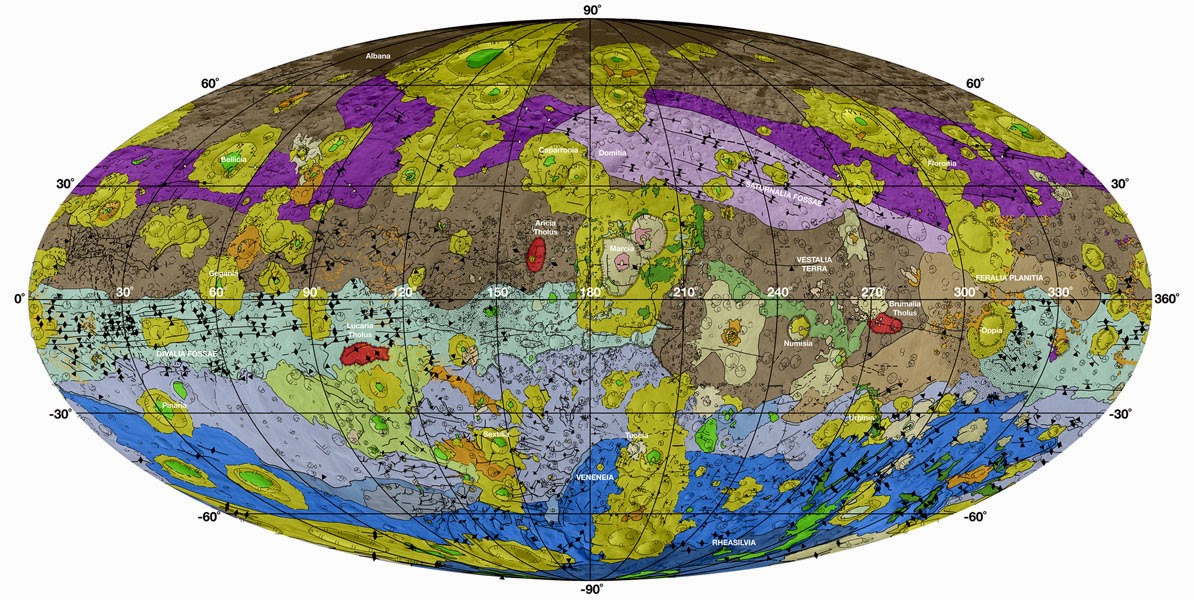
Asteroid Vesta: The Best Geologic view

The new map of Vesta is a detailed geologic record of the asteroid.

Credit: NASA/JPL-Caltech/ASU

High-resolution new maps show the cratered, rocky surface of the huge asteroid Vesta in unprecedented detail, researchers say.

Images captured by NASA's Dawn spacecraft were woven together to create geologic maps of the giant asteroid Vesta.

The maps, the most detailed ones yet of of Vesta's surface features, serve as a geologic record of the asteroid that astronomers can compare to other planets and celestial bodies, researchers said.

Scientists combined 15 separate maps into one Vesta uber-map, which shows that meteorites have pummeled the asteroid since its formation about 10 million years after the birth of the solar system.

Astronomers can piece together Vesta's geologic timeline based on the sequence of meteorite impacts.


The brown colours on the map show the oldest and most heavily cratered areas on Vesta, while purple shows where Vesta was struck by two large impactors; the light purple and dark blue colors show the interior basins of the two massive impacts.

Greens and yellows show the youngest material on Vesta, which likely came from landslides or later meteorite strikes, researchers said.

A special camera onboard the Dawn spacecraft made the geologic maps possible. The camera uses seven different color filers that help analyze the different minerals covering Vesta's surface.

The photos were used to create 3D topographic models, which were then converted into maps of the surface.

It took over two years to sift through all the images and create the maps, said David Williams of Arizona State University, one of the lead scientists on the project.

The maps were published this week along with a series of papers in the journal Icarus.