Showing posts with label 2014. Show all posts

Tuesday, November 4, 2014

ISRO GSLV III Unmanned crew module - Launch in December 2014

India will launch an unmanned crew module in December onboard a heavy rocket to test its re-entry into the atmosphere for the country's future maiden human space flight, the space agency chief said Thursday.

"We will send an unmanned crew module on the experimental GSLV-Mark III rocket in December and test its re-entry into the earth's atmosphere for a human space flight plan in future," Indian Space Research Organisation (ISRO) chairman K. Radhakrishnan told reporters here on the margins of an engineers conclave.

Weighing 3.6 tonnes, the crew module will be put into space orbit 100-120 km away in a satellite and brought back to earth for checking its re-entry characteristics when carrying two Indian astronauts in the proposed human space flight.

"Though the actual human space flight will be in an orbit around earth at a height of 270 km for a week, the experimental flight with the crew module in a spacecraft will go up to 100-120 km above earth to test its heat shield survive very high temperatures (about 1, 500 degrees Celsius) during the re-entry into the atmosphere," Radhakrishnan noted.

The crew module will have a parachute that will open up after re-entry into the atmosphere and fall into sea for retrieval.

"The parachute will open up for soft landing of the spacecraft carrying the crew module in the Bay of Bengal, about 450 km away from Andamans (islands), and will be retrieved by a boat," Radhakrishnan said.

The previous UPA government had sanctioned Rs.145 crore to ISRO for developing a crew module that will fly two Indian astronauts into space, space suits, life support systems and related technologies for the human space flight programme.

The Geosynchronous Satellite Launch Vehicle Mark III (GSLV) heavy rocket will, however, have a passive cryogenic stage - liquid nitrogen at super cooled temperature and gaseous nitrogen instead of liquid hydrogen and liquid oxygen.

The space agency is integrating the rocket with the crew module at its Sriharikota spaceport in Andhra Pradesh, about 90 km northeast of Chennai.

Friday, October 31, 2014

NOAA: Antarctic ozone hole remains static 2014

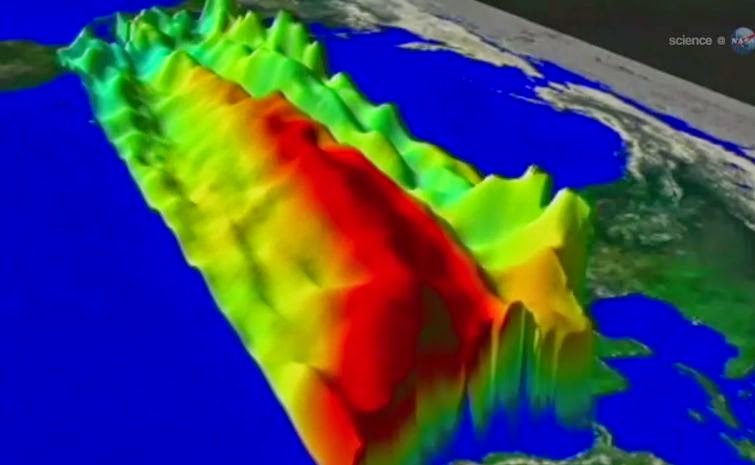
Ozone concentrations above Antarctica on Sept. 11, 2014. 

Credit: NASA

The Antarctic ozone hole reached its annual peak size on Sept. 11, according to scientists from NASA and the National Oceanic and Atmospheric Administration (NOAA).

The size of this year's hole was 24.1 million square kilometers (9.3 million square miles), an area roughly the size of North America.

The single-day maximum area was similar to that in 2013, which reached 24.0 million square kilometers (9.3 million square miles).

The largest single-day ozone hole ever recorded by satellite was 29.9 million square kilometers (11.5 million square miles) on Sept. 9, 2000.

Overall, the 2014 ozone hole is smaller than the large holes of the 1998–2006 period, and is comparable to 2010, 2012, and 2013.

With the increased atmospheric chlorine levels present since the 1980s, the Antarctic ozone hole forms and expands during the Southern Hemisphere spring (August and September).

The ozone layer helps shield life on Earth from potentially harmful ultraviolet radiation that can cause skin cancer and damage plants.

The Montreal Protocol agreement beginning in 1987 regulated ozone depleting substances, such as chlorine-containing chlorofluorocarbons and bromine-containing halons.

The 2014 level of these substances over Antarctica has declined about 9 percent below the record maximum in 2000.

"Year-to-year weather variability significantly impacts Antarctica ozone because warmer stratospheric temperatures can reduce ozone depletion," said Paul A. Newman, chief scientist for atmospheres at NASA's Goddard Space Flight Center in Greenbelt, Maryland.

"The ozone hole area is smaller than what we saw in the late-1990s and early 2000s, and we know that chlorine levels are decreasing. However, we are still uncertain about whether a long-term Antarctic stratospheric temperature warming might be reducing this ozone depletion."

Wednesday, October 8, 2014

Blood Moon: Total Lunar Eclipse October 8, 2014 Time Lapse Video by NASA

A lunar eclipse appears behind a gargoyle atop the old red Dallas County Courthouse early Wednesday morning, Oct. 8, 2014. 

The moon appears orange or red, the result of sunlight scattering off Earth's atmosphere. This is known as the blood moon. 

Credit: AP Photo/The Dallas Morning News, Tom Fox


Blood Moon:Total Lunar Eclipse October 8,2014 Time Lapse HD Video. Credit: NASA

The NASA timelapse video above shows the Moon re-appearing from the Earth's shadow.

A total lunar eclipse has been visible across much of the Americas and Asia, resulting in a dramatic "Blood Moon".

The eclipse began at 08:00 GMT on the east US coast and was visible in Asia at about 10:00 GMT.

During the eclipse, which is the second to occur this year, our only natural satellite was fully covered by the Earth's shadow.

The Moon appears orange or red, the result of sunlight scattering off our atmosphere, hence the name Blood Moon.

Weather permitting, skywatchers in North America, Australia, western South America and parts of East Asia were able to see the spectacle.


The Hong Kong Space Museum set up free viewing locations on a harbour-side promenade

Saturday, September 27, 2014

Japan's Mount Ontake Volcano eruption 27th Sept 2014 - Video - UPDATE


Mount Ontake erupted late Saturday morning, sending a plume of smoke and ash into the sky, the Japan Meteorological Agency reported.

The bodies of 31 hikers have been found near the top of Japan's Mount Ontake a day after a sudden volcanic eruption.

The hikers were not breathing and their hearts had stopped. The search for a total of 45 for missing climbers has now been called off for the night. 

They have observed 17-20 inches (40-50 centimeters) of volcanic ash covering the ground.

Local authorities had said there were roughly 150 hikers in the area at the time, according to the agency, which raised the Volcanic Alert Level for Ontake from 1 to 3.

Japan is at a triple-plate subduction boundary between the Eurasian continental plate and the Philippine and Pacific oceanic plates.

As the denser oceanic plates dive below the low-density continental plate, water from the saturated sediments lowers the melting point of surrounding rock.

That magma feeds a range of volcanoes mirroring the plate boundary.

Twitter images taken on the volcano were released by hikers.

Left: Hikers evacuating after the eruption. 

Credit: @mori_mori. 

Right: Aerial view of the Mount Ontake eruption. 

Credit: NHK

The volcano is a popular destination for religious pilgrimages, and many hikers were out enjoying the beautiful start to the weekend when the eruption hit.

This photo was posted from near the volcano shortly before the eruption.

The public is advised to not approach the volcano, and police and firefighters have deployed to help hikers near the summit.

About 250 people living near the mountain have decided to remain in their homes, police said.

The volcano last erupted in 2007.

It is located about 155 miles (250 kilometers) west of Tokyo.

A second CNN Video report.

Thursday, September 25, 2014

El Niño 2014: Ocean Circulation - Signs of a modest return

The image shows Kelvin waves of high sea level (red/yellow) crossing the Pacific Ocean at the equator. 

The waves can be related to El Niño events. Green indicates normal sea level, and blue/purple areas are lower than normal. 

Data are from the NASA /European Jason-2 satellite, collected Sept. 13-22, 2014. 

Image credit: NASA/JPL-Caltech

Prospects have been fading for an El Niño event in 2014, but now there's a glimmer of hope for a very modest comeback.

Scientists warn that unless these developing weak-to-modest El Niño conditions strengthen, the drought-stricken American West shouldn't expect any relief.

The latest sea-level-height data from the NASA /European Ocean Surface Topography Mission (OSTM) /Jason-2 satellite mission show a pair of eastward-moving waves of higher sea level, known as Kelvin waves, in the Pacific Ocean, the third such pair of waves this year.

Now crossing the central and eastern equatorial Pacific, these warm waves appear as the large area of higher-than-normal sea surface heights (warmer-than-normal ocean temperatures) hugging the equator between 120 degrees west and the International Dateline.

The Kelvin waves are traveling eastward and should arrive off Ecuador in late September and early October.

A series of larger atmospheric "west wind bursts" from February through May 2014 triggered an earlier series of Kelvin waves that raised hopes of a significant El Niño event.

Just as the warming of the eastern equatorial Pacific by these waves dissipated, damping expectations for an El Niño this year, these latest Kelvin waves have appeared, resuscitating hopes for a late arrival of the event.

For an overview of 2014's El Niño prospects and Kelvin waves, please see: phys.org/news/2014-05-el-nino.html

This latest image highlights the processes that occur on time scales of more than a year but usually less than 10 years, such as El Niño and La Niña.

The image also highlights faster ocean processes such as Kelvin waves. As Patzert says, "Jason-2 is a fantastic Kelvin wave counter."

These processes are known as the interannual ocean signal. To show that signal, scientists refined data for this image by removing trends over the past 21 years, seasonal variations and time-averaged signals of large-scale ocean circulation.

For a more detailed explanation of what this type of image means, visit: sealevel.jpl.nasa.gov/science/… lninopdo/latestdata/

For a time sequence of the evolution of the 2014 El Nino, visit: sealevel.jpl.nasa.gov/science/… /latestdata/archive/

Monday, September 22, 2014

2014 Arctic Sea Ice Minimum Sixth Lowest on Record

Arctic sea ice hit its annual minimum on Sept. 17, 2014. 

The red line in this image shows the 1981-2010 average minimum extent. 

Data provided by the Japan Aerospace Exploration Agency (JAXA) GCOM-W1 satellite.

Image Credit: NASA/Goddard Scientific Visualization Studio

Arctic sea ice coverage continued its below-average trend this year as the ice declined to its annual minimum on Sept. 17, according to the NASA-supported National Snow and Ice Data Center (NSIDC) at the University of Colorado, Boulder.

Over the 2014 summer, Arctic sea ice melted back from its maximum extent reached in March to a coverage area of 1.94 million square miles (5.02 million square kilometers), according to analysis from NASA and NSIDC scientists.

This year’s minimum extent is similar to last year’s and below the 1981-2010 average of 2.40 million square miles (6.22 million square km).

"Arctic sea ice coverage in 2014 is the sixth lowest recorded since 1978. The summer started off relatively cool, and lacked the big storms or persistent winds that can break up ice and increase melting," said Walter Meier, a research scientist at NASA’s Goddard Space Flight Center in Greenbelt, Maryland.

“Even with a relatively cool year, the ice is so much thinner than it used to be,” Meier said. “It’s more susceptible to melting.”

This summer, the Northwest Passage above Canada and Alaska remained ice-bound.

A finger of open water stretched north of Siberia in the Laptev Sea, reaching beyond 85 degrees north, which is the farthest north open ocean has reached since the late 1970s, according to Meier.


An animation of daily Arctic sea ice extent from March 21 to Sept. 17, when the ice appeared to reach it’s minimum extent for the year. 

It’s the sixth lowest minimum sea ice extent in the satellite era. The data was provided by the Japan Aerospace Exploration Agency (JAXA) GCOM-W1 satellite.

Image Credit: NASA/GSFC Scientific Visualization Studio/T. Schindler

While summer sea ice has covered more of the Arctic in the last two years than in 2012’s record low summer, this is not an indication that the Arctic is returning to average conditions, Meier said.

This year’s minimum extent remains in line with a downward trend; the Arctic Ocean is losing about 13 percent of its sea ice per decade.

To measure sea ice extent, scientists include areas that are at least 15 percent ice-covered. The NASA-developed computer analysis, which is one of several methods scientists use to calculate extent, is based on data from NASA’s Nimbus 7 satellite, which operated from 1978 to 1987, and the U.S. Department of Defense’s Defense Meteorological Satellite Program, which has provided information since 1987.

Due to global warming, larger and larger areas of sea ice melt in the summer and when sea ice freezes over in the winter it is thinner and more reduced. 

As the Arctic summers are getting warmer we may see an acceleration of global warming, because reduced sea ice in the Arctic will remove less CO2 from the atmosphere, according to Danish scientist Dorte Haubjerg Søgaard, PhD Fellow, Nordic Center for Earth Evolution, University of Southern Denmark and the Greenland Institute of Natural Resources, Nuuk..

In addition to monitoring sea ice from space, NASA is conducting airborne field campaigns to track changes in Arctic sea ice and its impact on climate.

Operation IceBridge flights have been measuring Arctic sea ice and ice sheets for the past several years during the spring.

A new field experiment, the Arctic Radiation – IceBridge Sea and Ice Experiment (ARISE) started this month to explore the relationship between retreating sea ice and the Arctic climate.

Monday, August 11, 2014

'Supermoon': Biggest Full Moon of 2014

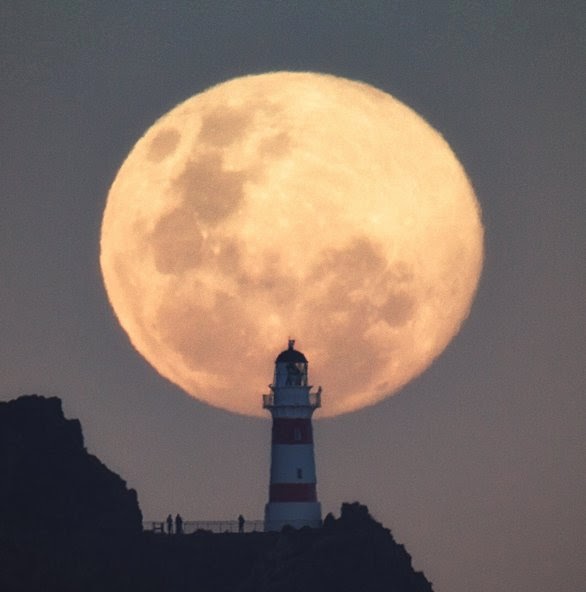
An astrophotographer captured this photo of the supermoon rising behind a lighthouse and some observers on Aug. 10, 2014.

Credit: Mark Gee

Photographers around the world ventured outside Sunday (Aug. 10) to snap photos of the bright, full "supermoon" rising in the night sky.

August's full moon, called a supermoon because it is occurred when the moon was closest to Earth in its orbit, wowed skywatchers, inspiring some of them to turn their cameras skyward to catch breathtaking views of the biggest full moon of 2014.

Some photographers had to wait for a break in the clouds to capture their images, while others chased the moon to different observing sites.

Saturday, March 15, 2014

NASA IceBridge: 2014 Arctic campaign starts with two surveys of sea ice north of Greenland

This is a moon shot over northeast Greenland while descending into the survey area north of the Fram Strait. 

Credit: NASA/Michael Studinger

NASA's Operation IceBridge started the 2014 Arctic campaign with two surveys of sea ice north of Greenland.

The two flights follow similar surveys flow in previous years and continue the mission's goals of collecting data on changing sea ice in the Arctic.

Following the Mar. 10 transit flight from NASA's Wallops Flight Facility in Virginia to Thule Air Base, Greenland, the IceBridge team continued preparing for the weeks of work ahead.

On Mar. 11 the team unpacked cargo and set up ground-based GPS stations that are used to ensure IceBridge's instruments are accurate.

The next morning, Mar. 12, researchers, pilots and flight crew boarded the P-3 and took off for the first science flight of the campaign, a mission called Sea Ice – Nansen Gap.


This survey was a variation of flights over the Fram Strait flown in previous years that sampled ice farther north and east than in the past.

Researchers used the mission's laser and radar instruments to collect data on sea ice elevation and snow depth and collected ice thickness and elevation data while flying high over the Greenland Ice Sheet.

While studying the ice below, the team was treated to interesting sights in the sky during this flight.

Shortly after takeoff the moon made an appearance on the horizon, giving those aboard the aircraft a good photo opportunity.

In addition the team got to see the sun setting twice – once on the eastern end of the survey line and again when returning to Thule Air Base.

At this time of year days are short at high latitudes, making this sort of thing common.

SECOND SURVEY
On Mar. 13, the IceBridge team carried out their second survey of the campaign, a flight plan known as Sea Ice – Zigzag East.

On this flight the P-3 headed north-northeast out of Thule, roughly following the coast of Greenland along the Nares Strait—a narrow body of water separating Greenland and Canada's Ellesmere Island.

Then researchers headed along an alternating north and south pattern to measure how sea ice thickness changes closer to the North Pole, something known as ice gradient.

On this flight, researchers collected data on thick, multi-year ice near the coast and thinner ice farther north.

With two successful surveys and nearly three weeks left before the mission moves south to KangerlussuaqIceBridge is off to a successful start.

Over the next several days the mission plans to collect even more sea ice data, including a cross-basin survey of the Arctic Ocean and several flights based out of Fairbanks, Alaska, over the Beaufort and Chukchi seas.

Friday, January 3, 2014

First Asteroid of 2014 Spotted: 2014 AA

This animated GIF shows Asteroid 2014 AA, discovered by the NASA-sponsored Catalina Sky Survey on Jan. 1, 2014, as it moved across the sky. 

Credit: CSS/LPL/UA

Early Wednesday morning (Jan. 1, 2014), while New Year's 2014 celebrations were still underway in the United States, the Catalina Sky Survey near Tucson, Ariz., collected a single track of observations with an immediate follow-up on what was possibly a very small asteroid—7 to 10 feet (2 to 3 meters) in size—on a potential impact trajectory with Earth.

Designated 2014 AA, which would make it the first asteroid discovery of 2014, the track of observations on the object allowed only an uncertain orbit to be calculated.

However, if this was a very small asteroid on an Earth-impacting trajectory, it most likely entered Earth's atmosphere sometime between 11 a.m. PST (2 p.m. EST) Wednesday and 6 a.m. PST (9 a.m. EST) Thursday.

Steve Chesley
Using the only available observations, three independent projections of the possible orbit by the independent orbit analyst Bill Gray, of the Minor Planet Center in Cambridge, Mass., and Steve Chesley, of NASA's Near-Earth Object Program Office at the Jet Propulsion Laboratory in Pasadena, Calif., are in agreement that 2014 AA would hit Earth's atmosphere.

According to Chesley, the potential impact locations are widely distributed because of the orbit uncertainty, falling along an arc extending from Central America to East Africa.

The most likely impact location of the object was just off the coast of West Africa at about 6 p.m. PST (9 p.m. EST) Jan. 1.

It is unlikely asteroid 2014 AA would have survived atmospheric entry intact, as it was comparable in size to asteroid 2008 TC3, which was about 7 to 10 feet (2 to 3 meters) in size.

2008 TC3 completely broke up over northern Sudan in October 2008. Asteroid 2008 TC3 is the only other example of an object discovered just prior to hitting Earth.

So far, there have been a few weak signals collected from infrasound stations in that region of the world that are being analyzed to see if they could be correlated to the atmospheric entry of 2014 AA.

Tuesday, May 7, 2013

Russian Angara Rocket Launch Delayed until 2014

Angara rockets, designed to provide lifting capabilities of between 2,000 and 40,500 kilograms into low earth orbit, have been in development since 1995.

The launch of Russia's new Angara carrier rocket has been delayed by at least a year, Defense Ministry officials said on Monday.

The light-class Angara is to be launched in mid-2014 and its heavy-class version toward the end of the same year, Deputy Defense Minister Yury Borisov said.

The light-class Angara was previously due to be launched in 2013.

Deputy Defense Minister Col. Gen. Oleg Ostapenko said in late April that the new rocket would only be launched after the construction of a new facility at the Plesetsk space center is completed.

Defense Minister Sergei Shoigu on Monday showed concern over the delays, saying the ministry would closely watch the development of the new rocket as a high priority project.

The development of the Angara is "very important," he said. "I will be regularly reviewing its progress in the course of weekly conference calls with the chief of the General Staff."

The Angara rocket family is a family of space-launch vehicles being developed by the Moscow-based Khrunichev State Research and Production Space Center.

The rockets, which are to provide lifting capabilities between 2,000 and 40,500 kg into low earth orbit, are intended to become the mainstay of the Russian unmanned launcher fleet in the future and replace several existing systems. Angara rockets have been in development since 1995.

The rockets have a modular design similar to the US Evolved Expendable Launch Vehicle (EELV), based on a common Universal Rocket Module (URM).

The main purpose of the Angara rocket family is to give Russia independent access to space.

The rockets will reduce Russia's dependence on the Baikonur space center it leases from Kazakhstan by allowing the launch of heavy payloads from the Plesetsk Cosmodrome in northern Russia and from the new Vostochny Cosmodrome in Russia's Far East.

Thursday, April 25, 2013

Planetary Resources: Private Asteroid-Mining Project Launching Tiny Satellites 2014


A billionaire-backed asteroid-mining company aims to start putting its big plans into action soon, launching its first hardware into space by this time next year.

Planetary Resources, which counts Google execs Larry Page and Eric Schmidt among its investors, plans to loft a set of tiny "cubesats" to Earth orbit in early 2014, to test out gear for its first line of asteroid-prospecting spacecraft.

"Our belief and our philosophy is that the best testbed is space itself," Chris Voorhees, Planetary Resources' vice president of spacecraft development, said Wednesday (April 24) during a Google+ Hangout event.


Interceptor missions will allow Planetary Resources to quickly acquire data on several near-Earth asteroids, stepping up the likelihood of prospecting these objects for their volatile, mineral and metallic resources.

CREDIT: Planetary Resources

"Despite the fact that we're a deep-space company, we're going to use Earth orbit as much as possible," Voorhees added. "For us, it's a valuable learning experience, and that's what we plan on doing one year hence."

The cubesats slated for launch in 2014 will measure 12 inches long by 4 inches wide by 4 inches tall (30 by 10 by 10 centimeters), company officials said. These "Arkyd-3" satellites will test out technologies for Planetary Resources' Arkyd-100 scouts, which the firm hopes to launch to low-Earth orbit on asteroid-hunting missions in 2015.

The Arkyd-3 "is the testbed manifestation of our Arkyd-100 spacecraft. It just happens to be flying," Voorhees said.

A series of other robotic probes beyond the 33-pound (15 kilograms) Arkyd-100 will investigate near-Earth asteroids up close, eventually mining suitable ones for resources such as water and precious metals. Water is the key focus at first, because it is the key enabler of off-Earth living, Planetary Resources officials said.

Water can keep astronauts hydrated, obviously, and serve as a shield against dangerous radiation. Split into its constituent hydrogen and oxygen, it can also provide breathable air and rocket fuel, allowing voyaging spaceships to fill up on the go.


Sourcing water in space will make space travel much cheaper and more efficient, Planetary Resources president Chris Lewicki said, noting that it currently costs about $10,000 to launch 1 liter (0.26 gallons) of water to low-Earth orbit.

"Water is the gateway drug of space. It's the enabler — in a good way, though," Lewicki said.

Planetary Resources held Wednesday's Google+ Hangout partly to mark the one-year anniversary of the company's public unveiling. After Planetary Resources announced its existence and intentions last year, another asteroid-mining firm called Deep Space Industries made its presence known as well.

Both companies hope their activities help spur humanity's push out into the solar system, officials have said.

Monday, April 15, 2013

NASA Orion capsule moving to 2014 launch: Future Asteroid Exploration

A crane lifts the Orion EFT-1 crew module from its birdcage processing stand for transfer to dolly for continued assembly inside the Operations and Checkout Building high bay at NASA’s Kennedy Space Center in Florida as workers monitor progress. 

Orion’s first unpiloted test flight is scheduled to launch in 2014. 

Credit: NASA/Frankie Martin 

NASA is picking up the construction pace on the inaugural space-bound Orion crew capsule at the Kennedy Space Center (KSC) in Florida and accelerating towards blastoff on the unmanned Exploration Flight Test-1 mission (EFT-1) slated for September 2014.

The Orion capsule is being constructed in the Orion manufacturing assembly facility in the Operations and Checkout Building (O & C) and will be mounted atop a mammoth Delta 4 Heavy Booster which will one day lead to deep space human forays to Asteroids and Mars.

"We plan to power up Orion for the first time this summer," said Scott Wilson, Orion's Production Operations manager for NASA at KSC stated to a group of reporters.

EFT-1 Mission
The Orion EFT-1 flight is a critical first step towards achieving NASA's new goal of capturing and retrieving a Near Earth Asteroid for eventual visit by astronauts flying aboard an Orion vehicle by 2021 – if NASA's proposed budget request is approved.

KSC will have a leading role in NASA's asteroid retrieval project that could occur some four years earlier than President Obama's targeted goal of 2025 for a human journey to an asteroid.

Capturing an asteroid and dispatching astronauts aboard Orion to collect precious rock samples is reputed to aid the scientific understanding of the formation of the Solar System as well as bolster Planetary Defense strategies.

The importance of understanding NEOs and Asteroids is gathering more interest, following the unforeseen Russian meteor strike in February which injured over 1200 people and damaged over 3000 buildings.