Showing posts with label Apollo. Show all posts

Monday, March 24, 2014

Hasselblad 500EL Unique camera from NASA's moon missions sold at auction

A Hasselblad 500EL "Data Camera HEDC Nasa" Jim Irwin Lunar Module Pilot camera, dated from 1968, used on the moon during Apollo lunar programs is sold at an auction for 550,000 euros ($760,000) at the Westlicht Gallery in Vienna on March 21, 2014

The Hasselblad 500EL is the only camera to return from NASA's moon missions in 1969-1972.

It was sold at an auction in Vienna Saturday for 550,000 euros ($760,000), far outdoing its estimated price.

The boxy silver-coloured camera, which was sold to a telephone bidder, was initially valued at 150,000-200,000 euros.

The Hasselblad model was one of 14 cameras sent to the moon as part of NASA's Apollo 11-17 missions but was the only one to be brought back.

As a rule, the cameras, which weighed several kilos and could be attached to the front of a space suit, were abandoned to allow the astronauts to bring back moon rock, weight being a prime concern on the missions.

"It has moon dust on it... I don't think any other camera has that," Peter Coeln, owner of the Westlicht gallery which organised the auction, said of the rare piece.

The camera, which was being sold by a private collector, was used by astronaut Jim Irwin to take 299 pictures during the Apollo 15 mission in July-August 1971.

A small plate inside is engraved with the number 38, the same number that appears on Irwin's NASA snapshots.

Close to 600 objects were on sale on Saturday at the Westlicht gallery, which is the world's largest auction house for cameras.

It has overseen the sale of some of the most expensive photographic equipment in history, including a 1923 Leica camera prototype that sold for 2.16 million euros, a world record.

Thursday, February 20, 2014

Soyuz cosmonaut Valery Kubasov dies at 79

Soviet cosmonaut Valery Kubasov is seen floating in space during the 1975 Apollo-Soyuz Test Project first joint American-Soviet mission. Kubsaov died on Feb. 19, 2014.

Credit: NASA

Soviet cosmonaut Valery Kubasov, who took part in the first docking of a US Apollo spacecraft with a Soviet Soyuz, has died aged 79, the Russian spacecraft corporation said Thursday.

Valery Kubasov was one of two crewmembers of the Soyuz 19 spacecraft that docked with the US Apollo spacecraft on July 17, 1975, marking both a technical breakthrough and a rare relaxation in Cold War tensions.

He died suddenly on Wednesday after a short illness, the Russian space corporation RKK Energiya said in a statement on its website.

Alexei Leonov
The historic docking saw Soyuz commander Alexei Leonov shake hands with American astronaut Thomas Stafford, a gesture that was watched on television around the world.

Leonov said that when the US astronauts crossed into the hatch, they saw an inscription from Shakespeare: "Brave new world that has such people in it." The teams then worked together for two days.

Four original crewmembers including Kubasov, who was the flight engineer, met in Moscow in 2010 to mark the 35th anniversary of the docking.

Kubasov recalled that the US crewmembers had surprised the Soviet cosmonauts by connecting them by radio with US President Gerald Ford who spoke to both of them, Rossiiskaya Gazeta daily reported.

The docking of the two crafts tested out pioneering technology that paved the way for the International Space Station.

Kubasov was twice decorated as a Hero of the Soviet Union, the country's top honour.

After training at Moscow's aviation institute, he began working as an engineer involved in spaceship construction before becoming a cosmonaut in 1966.

On his first space flight in 1969, he was the first ever to experiment with welding in open space. The Soyuz mission was his second space flight.

His third and last space flight was a 1980 mission to a Soviet orbital space station, Salyut 6.

Kubasov was a "strong personality, a man out of the ordinary," said the RKK Energiya statement.

He was a "brave instructor, cosmonaut and test pilot who made a significant contribution to studying space and learning the secrets of the Universe."

Valery Kubasov was married to Lyudmila Kurovskaya, with whom he had a daughter, Ekaterina, and son, Dmitry.

Read more about Valery Kubasov here

Monday, February 18, 2013

Water on the moon: Historical Evidence

Called the "Genesis Rock," this lunar sample of unbrecciated anorthosite collected during the Apollo 15 mission was thought to be a piece of the moon's primordial crust.

In a paper published online Feb. 17 in Nature Geoscience, a University of Michigan researcher and his colleagues report that traces of water were found in the rock. 

Credit: NASA/Johnson Space Center

Traces of water have been detected within the crystalline structure of mineral samples from the lunar highland upper crust obtained during the Apollo missions, according to a University of Michigan researcher and his colleagues.

The lunar highlands are thought to represent the original crust, crystallized from a magma ocean on a mostly molten early moon.

The new findings indicate that the early moon was wet and that water there was not substantially lost during the moon's formation.

The results seem to contradict the predominant lunar formation theory—that the moon was formed from debris generated during a giant impact between Earth and another planetary body, approximately the size of Mars, according to U-M's Youxue Zhang and his colleagues.

"Because these are some of the oldest rocks from the moon, the water is inferred to have been in the moon when it formed," Zhang said.

"That is somewhat difficult to explain with the current popular moon-formation model, in which the moon formed by collecting the hot ejecta as the result of a super-giant impact of a martian-size body with the proto-Earth.

"Under that model, the hot ejecta should have been degassed almost completely, eliminating all water," Zhang said.

A paper titled "Water in lunar anorthosites and evidence for a wet early moon" was published online Feb. 17 in the journal Nature Geoscience.

The first author is Hejiu Hui, postdoctoral research associate of civil and environmental engineering and earth sciences at the University of Notre Dame.

Hui received his doctorate at U-M under Zhang, a professor in the Department of Earth and Environmental Sciences and one of three co-authors of the Nature Geoscience paper.

Over the last five years, spacecraft observations and new lab measurements of Apollo lunar samples have overturned the long-held belief that the moon is bone-dry.  

Thursday, January 10, 2013

Astronauts on the London Underground!

Mock astronauts take the Tube in London to launch The Lynx Space Academy competition to find one UK winner and 21 others from around the globe who will be sent to where only a few elite have gone before. 

Buzz Aldrin has launched a once-in-a-lifetime chance for an average Briton to blast into orbit. 

Aldrin, the astronaut and pilot of the historic Apollo 11 spacecraft which landed on the moon in 1969, said: Space travel for everyone is the next frontier in the human experience. 

Picture: James McCauley/Lynx Space Academy /PA

Wednesday, October 17, 2012

NASA Apollo Lunar Rover Haynes Manual

The practical guide, in traditional Haynes Manual style, is being published to coincide with the 40th anniversary of the final Lunar Rover drive on the Moon on December 14, 1972.

The Lunar Rover Manual will be available from all good bookshops and direct from Haynes priced £21.99.

(Right) Apollo 15 astronaut Jim Irwin with the lunar rover.

Picture: Haynes/Rex/Nasa

Friday, August 31, 2012

Neil Armstrong Loved Charts


I am, and ever will be, a white-socks, pocket-protector, nerdy engineer, born under the second law of thermodynamics, steeped in steam tables, in love with free-body diagrams, transformed by Laplace and propelled by compressible flow.

Neil Armstrong

Neil Armstrong loved charts. RIP.


Monday, June 4, 2012

Fashioning Apollo: How the Spacesuit was Developed, Against the Odds

"On July 12, 1969, only 21 layers of fabric, most gossamer-thin, stood between Neil Armstrong and Buzz Aldrin and the lethal desolation of a lunar vacuum."

So begins UC Berkeley architecture professor Nicholas de Monchaux’s Spacesuit: Fashioning Apollo — a fascinating voyage into the sartorial history of space flight through the parallel history of one of its key technologies: the spacesuit.

Blending material science, iconic photography, and intriguing trivia (did you know that the Apollo mission’s computer-backup system was crafted into a binary pattern that was then physically woven into ropes?), the book itself is cleverly constructed as a series of layers corresponding to the 21 layers of the Apollo spacesuit.

Thursday, March 29, 2012

Amazon Founder Finds Apollo 11 Moon Rocket Engines On Atlantic Ocean Floor

This NASA file photo shows the first stage of the mighty Saturn V rocket used to launch the historic Apollo 11 moon landing mission in 1969 as the booster was being built. The five huge F-1 rocket engines were discarded into the Atlantic Ocean after the July 16, 1969 launch.
CREDIT: NASA

When NASA's mighty Saturn V rocket launched the historic Apollo 11 mission to land the first men on the moon in 1969, the five powerful engines that powered the booster's first stage dropped into the Atlantic Ocean and were lost forever.

Lost, that is, until now.

A private expedition financed by Amazon.com founder and billionaire Jeff Bezos has discovered the five F-1 rocket engines used to launch Apollo 11 into space on July 16, 1969 and is drawing up plans to retrieve one or more so they can be publicly displayed.

"I'm excited to report that, using state-of-the-art deep sea sonar, the team has found the Apollo 11 engines lying 14,000 feet below the surface, and we're making plans to attempt to raise one or more of them from the ocean floor," Bezos wrote in a statement posted to the Bezos Expeditions website.

"We don't know yet what condition these engines might be in - they hit the ocean at high velocity and have been in salt water for more than 40 years. On the other hand, they're made of tough stuff, so we'll see."

Friday, March 23, 2012

How many Apollo Goodwill Moon Rocks are missing?

Genesis Rock: Missing presumed Lost

The Apollo program, for all its inspirational accomplishments and technical achievements, was a servant of two masters.

The first was a pure scientific enterprise, to learn as much as possible about Earth’s only natural satellite and to push the boundaries of human spaceflight.

The second was political, with Apollo acting as the most compelling symbol of American technical prowess, industry, courage, and will.

This dichotomy is embodied by the Goodwill Moon Rocks program.

A case can be made that no field of study benefitted more from Apollo than the science of geology. Of the approximately 430 kilograms of known lunar materials on Earth, Apollo astronauts obtained roughly 382 kg.

The vast majority of those samples have been used to further our understanding of planetary formation, geochemistry, and the physical history of our solar system.

However, not all of those moon rocks were recovered in the name of science.

Specific lunar samples from Apollo 11 and Apollo 17 were earmarked as political souvenirs.

Precisely 270 prepared lunar rock samples were distributed as part of the Goodwill Moon Rocks program, most of them going to the 50 U.S. states and a number of foreign countries as tokens of appreciation for support of Apollo, NASA, and U.S. interests.

The recipients were charged with keeping custody of perhaps the rarest and most valuable artifacts ever distributed for diplomatic purposes.

Four decades later, no one can account for a significant number of those 270 valuable, and nigh-irreplaceable moon rocks.

Sunday, January 8, 2012

NASA Questions Commander Lovell’s Right to Auction Apollo 13 Checklist


NASA is questioning whether James Lovell, an Apollo 13 commander, has the right to sell a 70-page checklist that contains his handwritten calculations that were vital in guiding the damaged spacecraft back to Earth.

The rare document was sold by Lovell for more than $388,000 at an auction in Dallas in November 2011. The amount raised was around 15 times more than the estimated price value.

However, NASA now has laid its claims to the document that assisted the return of the Apollo 13 team to the Earth after an oxygen tank in the craft exploded.

The recent event comes a year after NASA filed a federal lawsuit against Edgar Mitchell, the Apollo 14 astronaut, obliging him to return a camera used on his Moon mission in 1971. The camera has since been placed in a museum.

Apart from the checklist, the agency has also raised questions about the hand glove worn by NASA astronaut Alan Shepard which fetched over $19,000, a lunar module identification plate valued at $13,000 and a hand controller sold by Apollo 9 astronaut Rusty Schweikart which was auctioned for $22,700 at the Heritage auctions.

NASA has, however, interpreted the inquiry in a different manner. "We haven't filed a claim against (the checklist) but what we have done is notify the auction house that we are seeking proof of ownership of the artefact," NASA spokesman Bob Jacobs claimed.

The checklist sold by Lovell has gained great popularity particularly after the release of the 1995 film "Apollo 13" where actor Tom Hanks portrayed the role of Lovell.

Thursday, January 5, 2012

NASA Halts Heritage Auction of Apollo 13 checklist


Heritage, we may have a problem. That's more or less what NASA told Heritage Auctions of Dallas, Texas recently, in response to their record-setting, $388,375 sale of astronaut James Lovell's Apollo 13 flown checklist.

"NASA has made a claim against astronaut Jim Lovell, claiming that he does not have title to the checklist," Greg Rohan, Heritage's president but the space agency interprets its inquiry differently.

Tuesday, November 8, 2011

NASA - Apollo 16 Lunar Module 'Orion' seen from the Lunar Rover

The Apollo 16 Lunar Module "Orion" is photographed from a distance by astronaut Chares M. Duke Jr., Lunar Module pilot, aboard the moving Lunar Roving Vehicle.

Astronauts Duke and Commander John W. Young, were returning from the third Apollo 16 extravehicular activity (EVA-2).

The RCA colour television camera mounted on the LRV is in the foreground. A portion of the LRV's high-gain antenna is at top left.

Image Credit: NASA and Chares M. Duke Jr.

Monday, October 17, 2011

Space travel: Returning from the moon | The Economist


Knowing the character and humour of the early NASA astronauts, you will not be surprised to know that this is a true story and an actual US Customs form completed by the Apollo 11 crew.

My favourite bit of this is the line asking whether there was "any condition on board which may lead to the spread of disease", and someone has typed "TO BE DETERMINED".

It seems a bit 'science-fiction-esque' but, in tose early learning days, there were real concerns about the health and welfare of the astronauts and the risk of contamination.

NASA assigned a contamination expert who studied the health effects of moon dust, and consequently, the Apollo 11 astronauts were quarantined for a short period, upon their return from the moon.

For Information:
Apollo 11 splashed down 920 miles (1,480 km) southwest of Hawaii and 13 miles (21 km) from the USS Hornet, a Navy ship sent to recover the crew.

It took a two more days for the astronauts to actually return to Hawaii on July 26, where they were welcomed with a July 27 ceremony at Pearl Harbour.

The catch
The astronauts were confined inside a NASA trailer as part of a quarantine effort just in case they brought back any germs or disease from the moon.

They had to wear special biological containment suits when they walked out on the deck of the USS Hornet, after being retrieved.

NASA transported them to Houston, quarantine trailer and all, and they emerged from isolation three weeks later.


The truth, alas, is less fun than the joke. Then again, if you were going to spend three weeks cooped up in an isolation trailer, you might need a laugh, too.

Wednesday, September 7, 2011

NASA LRO Images Offer Sharper Views of Apollo Landing Sites

NASA's Lunar Reconnaissance Orbiter (LRO) captured the sharpest images ever taken from space of the Apollo 12, 14 and 17 landing sites.

Images show the twists and turns of the paths made when the astronauts explored the lunar surface.

At the Apollo 17 site, the tracks laid down by the lunar rover are clearly visible, along with the last foot trails left on the moon. The images also show where the astronauts placed some of the scientific instruments that provided the first insight into the moon's environment and interior.

"We can retrace the astronauts' steps with greater clarity to see where they took lunar samples," said Noah Petro, a lunar geologist at NASA's Goddard Space Flight Center in Greenbelt, Md., who is a member of the LRO project science team.

All three images show distinct trails left in the moon's thin soil when the astronauts exited the lunar modules and explored on foot. In the Apollo 17 image, the foot trails, including the last path made on the moon by humans, are easily distinguished from the dual tracks left by the lunar rover, which remains parked east of the lander.

"The new low-altitude Narrow Angle Camera images sharpen our view of the moon's surface," said Arizona State University researcher Mark Robinson, principal investigator for the Lunar Reconnaissance Orbiter Camera (LROC). "A great example is the sharpness of the rover tracks at the Apollo 17 site. In previous images the rover tracks were visible, but now they are sharp parallel lines on the surface."

http://www.nasa.gov/mission_pages/LRO/news/apollo-sites.html

Wednesday, February 23, 2011

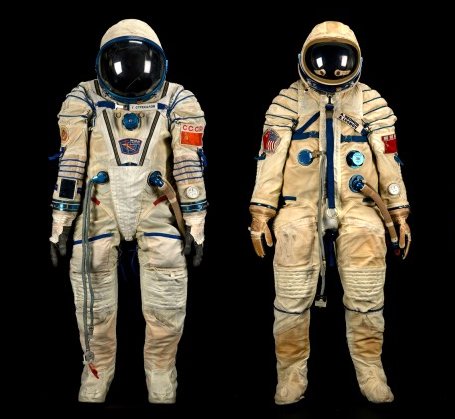
Apollo and Soyuz KV-2 Space Suits for Sale

More space history will go on sale in New York on May 5 when Bonhams will commemorate the 50th Anniversary of Alan Shepard's historic mission in Freedom 7 with a Space Sale.

Some early highlights of the sale include a Sokol K spacesuit worn by cosmonaut Alexei Leonov during the historic 1975 Apollo-Soyuz Project (the symbolic end to the Space Race) and a Sokol KV-2 spacesuit worn by Gennadi Strekalov during a 1990 mission to the Mir space station.

Can you tell which is which?

Lots are still being sought for the space history auction, but the two cosmonaut outfits will no doubt be amongst the stand-out items.

The historic Apollo-Soyuz Test Project was flown from July 15-19, 1975 was a sign of détente, the last Apollo mission, the first joint U.S./Soviet space flight, and the last manned US space mission until the first Space Shuttle flight in April 1981.

It set the tone for the of joint U.S.-Russian space flights such as the Shuttle-Mir Program and the International Space Station, and effectively ended the Space Race.

Cosmonaut Alexei Leonov was on his second space flight and the Commander of the Soyuz 19 Spacecraft. His Russian Sokol K spacesuit is estimated to fetch between US$100,000-150,000.

The Sokol KV-2 spacesuit used by cosmonaut Gennadi Strekalov on the Soyuz 10, flew in space from August 1 to December 10, 1990, during a mission to the Mir space station. It is expected to fetch between US$60,000-80,000.

The catalogue entry for the 1990 suit makes for interesting reading: "Sokol KV-2" pressure suit, white nylon canvas, royal blue trim. Attached pressurized hood, hinged plastic visor securing to blue-anodized aluminum clavicle flange. Sleeves with adjustable articulating cables in upper arm, webbed belt lashings. Pressure gauge on left sleeve, mirror affixed to right sleeve with elastic strap. Detachable gloves. V-shaped double-zip front closure, lace-up crotch covered by triangular Velco-affixed placket. Anodized aluminum umbilical interfaces on body for electrical, air and coolant supplies, with related cables and hoses. Anodized aluminum pressure equalization valve at center of chest. Support sling wrapping round chest and back, consisting of webbed belts and metal clips; adjustable webbed straps calibrated in metric attaching to metal rings on side-seams and at crotch. Pleated knees, cargo pocket on each thigh and each shin, integral boots with soles. Rubberized cloth lining. Patches of the Soviet standard on left sleeve and State Seal of the Soviet Union on right; Zvezda logo on chest, name label on chest-webbing.

Friday, October 22, 2010

Silver found in lunar rocks

Moon

Silver was found in small amounts in lunar rocks collected by the Apollo astronauts, and now its spectral signature may have been spotted by NASA's LCROSS mission (Image: T. A. Rector/I. P. Dell'Antonio/NOAO/AURA/NSF)

Tuesday, March 16, 2010

ESA's Automated Transport Vehicle (ATV): Edoardo Amaldi


Credits: ESA TV

Building on the Automated Transfer Vehicle (ATV) in the new scenario the pressurised Integrated Cargo Carrier would be replaced by a cargo re-entry capsule, equipped with a heat shield and able to bring back hundreds of kilograms of cargo and valuable experiments.

Such a project, named the Advanced Re-entry Vehicle (ARV), would use heritage from the Atmospheric Re-entry Demonstrator (ARD), which flew successfully in 1998, as well as the work done in the definition of past space transportation system concepts.

Re-entry systems are not new. The most complex was the NASA Shuttle but the Apollo programme also used a crude re-entry capsule. The concept of a re-useable re-entry system has been maintained by the Russians in the Soyuz Proton system, which is regularly used to upload astronauts and payloads to the ISS and return them safely to the Earth.

To add apersonal note: I was closely involved in the ATV programme for some years, as you will se from my blogsite and profile and our good friends, the Italians were always keen to put their stamp on prestigeous activities. So I wish them every success with these launches and subsequent flights.

The story so far ....

Production of the Automated Transfer Vehicles is gearing up. After the flawless flight of the first ATV, Jules Verne, the second, ATV Johannes Kepler, is being completed for launch later this year. Now the third ATV has been named after the Italian physicist and space pioneer Edoardo Amaldi.

Europe's ATV space freighter proved its maturity in 2008, when Jules Verne completed a demonstration flight to the International Space Station (ISS), docked with 4.5 tonnes of food, water, fuel, supplies and equipment, served as a propulsion module for six months and finally undocked and entered Earth’s atmosphere over the southern Pacific.

The ATV spacecraft are key to the Station's logistics and operations. They are an excellent demonstration of Europe’s capability in creating space infrastructure for human spaceflight and exploration. The first ATV was named after the visionary French science-fiction writer Jules Verne, and the second honoured German mathematician and astronomer Johannes Kepler.

"Italy is a key European country in our participation in the ISS partnership. By naming ATV-3 after Edoardo Amaldi, we celebrate a great Italian, but also a committed European who understood the importance of pooling resources and minds together to achieve important results," said fellow Italian, Simonetta Di Pippo, ESA Director for Human Spaceflight.

The occasion was a press conference held in the presence of Sottosegretario Pizza, Ministry of Education, University and Research and Enrico Saggese, President of Italy’s ASI space agency at the Italian Ministry in Rome.

"We are paying tribute to a visionary mind, to a great scientist but also to an idea of cooperation that is embodied in the ISS partnership. The ATV is the first recurring production of an exploration spacecraft and places Europe a step closer to our partners.

"I am glad that Italy is taking so much pride in their participation in the ISS, which is a recognition of their human and industrial capabilities."

Monday, March 1, 2010

US Scientist eyes 39-day voyage to Mars

A journey from Earth to Mars could in the future take just 39 days -- cutting current travel time nearly six times -- according to a rocket scientist who has the ear of the US space agency.

Franklin Chang-Diaz, a former astronaut and a physicist at the Massachusetts Institute of Technology (MIT), says reaching the Red Planet could be dramatically quicker using his high-tech VASIMR rocket, now on track for liftoff after decades of development.

The Variable Specific Impulse Magnetoplasma Rocket -- to give its full name -- is quick becoming a centerpiece of NASA's future strategy as it looks to private firms to help meet the astronomical costs of space exploration.

NASA, still reeling from a political decision to cancel its Constellation program that would have returned a human to the moon by the end of the decade, has called on firms to provide new technology to power rovers or even future manned missions.

Hopes are now pinned on firms like Chang-Diaz's Texas-based Ad Astra Rocket Company.

"In the early days... NASA support for the project was rather minimal because the agency did not emphasize advanced technologies as much as it's doing now," Chang-Diaz told AFP.

NASA was focused instead on the series of Apollo missions that delivered men to the moon for the first, and so far last, times.

"They were mesmerized by the Apollo days and lived in the Apollo era for 40 years, and they just forgot developing something new," he said.

Click here to read the full article