Showing posts with label Dione. Show all posts

Friday, February 21, 2014

NASA Cassini Image: Wispy cracks of Dione

Image courtesy NASA /JPL-Caltech /Space Science Institute.

Although the crack-like features seen here on Dione's surface appear wispy and faded, they are in reality a series of geologically fresh fractures!

Lit terrain seen here is on the trailing hemisphere of Dione.

North on Dione (698 miles, or 1,123 kilometers across) is up and rotated 29 degrees to the left.

The image was taken in visible light with the Cassini spacecraft narrow-angle camera on Sept. 10, 2013.

The view was acquired at a distance of approximately 554,000 miles (892,000 kilometers) from Dione. Image scale is three miles (five kilometers) per pixel.

See PIA10560 to learn more about Dione's wispy terrain.

Monday, June 10, 2013

Saturn's Icy Moon Dione Hides Watery Secret: A Subsurface Ocean

The Cassini spacecraft looks down, almost directly at the north pole of Dione. 

The feature just left of the terminator at bottom is Janiculum Dorsa, a long, roughly north-south trending ridge. Image taken March 22, 2008.

CREDIT: NASA/JPL/Space Science Institute

The plain-looking Saturn moon Dione may have once had a geologically active subsurface ocean, new images from NASA's Cassini spacecraft reveal.

Images of Dione's 500-mile-long (800 kilometers) mountain Janiculum Dorsa suggest that the moon could have been a weaker copycat of Enceladus, Saturn's icy geyser moon.

"There may turn out to be many more active worlds with water out there than we previously thought," Bonnie Buratti, who leads the Cassini science team at NASA's Jet Propulsion Laboratory in Pasadena, Calif., said in a statement.

Subsurface oceans are thought to exist on several bodies in the solar system, including Saturn's moons Enceladus and Titan and Jupiter's moon Europa.

These geologic hotspots have garnered the interest of scientists searching for the building blocks of life beyond Earth. If Dione turned out to have a liquid layer under its crust, that would increase the moon's chances of supporting life.

Cassini, which has been exploring Saturn since 2004, detected a weak particle stream coming from Dione with its magnetometer.

Images taken by the spacecraft suggest a slushy liquid layer might exist beneath its icy crust, as well as ancient, inactive fractures that now spew water ice and carbon-containing particles, much like ones seen on Enceladus.

Thursday, May 30, 2013

NASA Cassini Finds Hints of Geological Activity on Saturn Moon Dione

The NASA Cassini spacecraft swooped in for a close-up of the cratered, fractured surface of Saturn's moon Dione in this image taken during the spacecraft's Jan. 27, 2010, non-targeted flyby.

Image credit: NASA /JPL-Caltech /Space Science Institute.

From a distance, most of the Saturnian moon Dione resembles a bland cueball.

Thanks to close-up images of a 500-mile-long (800-kilometer-long) mountain on the moon from NASA's Cassini spacecraft, scientists have found more evidence for the idea that Dione was likely active in the past. It could still be active now.

Bonnie Buratti
"A picture is emerging that suggests Dione could be a fossil of the wondrous activity Cassini discovered spraying from Saturn's geyser moon Enceladus or perhaps a weaker copycat Enceladus," said Bonnie Buratti of NASA's Jet Propulsion Laboratory in Pasadena, Calif., who leads the Cassini science team that studies icy satellites.

"There may turn out to be many more active worlds with water out there than we previously thought."

Other bodies in the solar system thought to have a subsurface ocean - including Saturn's moons Enceladus and Titan and Jupiter's moon Europa - are among the most geologically active worlds in our solar system.

They have been intriguing targets for geologists and scientists looking for the building blocks of life elsewhere in the solar system.

The presence of a subsurface ocean at Dione would boost the astrobiological potential of this once-boring iceball.

Hints of Dione's activity have recently come from Cassini, which has been exploring the Saturn system since 2004.

This image, which is composed of data obtained by NASA's Cassini spacecraft, shows the topography of a mountain known as Janiculum Dorsa on the Saturnian moon Dione. 

Image credit: NASA/JPL-Caltech/SSI/Brown

The spacecraft's magnetometer has detected a faint particle stream coming from the moon, and images showed evidence for a possible liquid or slushy layer under its rock-hard ice crust.

Other Cassini images have also revealed ancient, inactive fractures at Dione similar to those seen at Enceladus that currently spray water ice and organic particles.

The mountain examined in the latest paper -- published in March in the journal Icarus -- is called Janiculum Dorsa and ranges in height from about 0.6 to 1.2 miles (1 to 2 kilometers).

The moon's crust appears to pucker under this mountain as much as about 0.3 mile (0.5 kilometer).

Noah Hammond
"The bending of the crust under Janiculum Dorsa suggests the icy crust was warm, and the best way to get that heat is if Dione had a subsurface ocean when the ridge formed," said Noah Hammond, the paper's lead author, who is based at Brown University, Providence, R.I.

Dione gets heated up by being stretched and squeezed as it gets closer to and farther from Saturn in its orbit.

With an icy crust that can slide around independently of the moon's core, the gravitational pulls of Saturn get exaggerated and create 10 times more heat, Hammond explained.

Other possible explanations, such as a local hotspot or a wild orbit, seemed unlikely.

Scientists are still trying to figure out why Enceladus became so active while Dione just seems to have sputtered along.

Perhaps the tidal forces were stronger on Enceladus, or maybe the larger fraction of rock in the core of Enceladus provided more radioactive heating from heavy elements.

Read more here

Saturday, March 3, 2012

NASA Cassini Saturn's Moon Dione: Oxygen Detected

Nasa's Cassini spacecraft has detected the presence of oxygen ions around Saturn's icy moon Dione for the first time.

Nasa has reported that the oxygen ions present on Dione moon are quite sparse and showed that Dione has an extremely thin neutral atmosphere, while Saturn's largest moon, Titan, has a much denser atmosphere.

The study done by an international team led by Los Alamos National Laboratory, Los Alamos, New Mexico, has been published in Geophysical Research Letters.

Saturn
Saturn's moon Dione was discovered in 1684 by astronomer Giovanni Cassini. It orbits Saturn at roughly the same distance as our own moon orbits Earth.

"The concentration of oxygen in Dione's atmosphere is roughly similar to what you would find in Earth's atmosphere at an altitude of about 300 miles," stated Robert Tokar, a Cassini team member based at Los Alamos National Laboratory.

He added that the presence of oxygen ions in Dione is not enough to sustain life, but said that with similar observations of other Saturn and Jupiter's moons could divulge more details about their habitability.

Nasa launched Cassini spacecraft, named after Giovanni Cassini, in 1997 and sent it on the first leg of its journey to Saturn. Cassini detected the oxygen ions in Dione's when it flew by the moon two years back in 2010.

Tuesday, January 24, 2012

NASA Cassini Image: Saturn's Moons Mimas And Dione

Saturn's moon Mimas peeks out from behind the night side of the larger moon Dione in this Cassini image captured during the spacecraft's Dec. 12, 2011, flyby of Dione.

Dione is 698 miles, or 1,123 kilometers, across and its day side dominates the view on the right of the image. Smaller Mimas is on the left and measures 246 miles, or 396 kilometers, across.

Lit terrain seen here is on the Saturn-facing side of Mimas and in the area between the trailing hemisphere and anti-Saturn side of Dione. North on the moons is up and rotated 20 degrees to the right.

The image was taken in visible light with the Cassini spacecraft narrow-angle camera.

The view was obtained at a distance of approximately 58,000 miles (94,000 kilometers) from Dione and at a Sun-Dione-spacecraft, or phase, angle of 42 degrees. Image scale is 1,833 feet (559 meters) per pixel on Dione.

The view was obtained at a distance of approximately 380,000 miles (611,000 kilometers) from Mimas and at a Sun-Mimas-spacecraft, or phase, angle of 41 degrees. Image scale is 2 miles (3 kilometers) per pixel on Mimas.

Friday, January 20, 2012

NASA Saturn Cassini: Closest Dione Flyby

Flying past Saturn's moon Dione, Cassini captured this view which includes two smaller moons, Epimetheus and Prometheus, near the planet's rings.

The image was taken in visible light with Cassini's narrow-angle camera during the spacecraft's flyby of Dione on Dec. 12, 2011.

This encounter was the spacecraft's closest pass of the moon's surface, but, because this flyby was intended primarily for other Cassini instruments, it did not yield Cassini's best images of the moon. Higher resolution images were obtained during earlier flybys (see PIA07638).

Dione (698 miles, or 1,123 kilometers across) is closest to Cassini here and is on the left of the image.

Potato-shaped Prometheus (53 miles, or 86 kilometers across) appears above the rings near the center top of the image. Epimetheus (70 miles, or 113 kilometers across) is on the right.

This view looks toward the northern, sunlit side of the rings from less than one degree above the ring plane.

The view was acquired at a distance of approximately 67,000 miles (108,000 kilometers) from Dione. Image scale is 2,122 feet (647 meters) per pixel on Dione.

Image credit: NASA/JPL-Caltech/Space Science Institute

Thursday, December 29, 2011

NASA CAssini: Snaps Amazing Photos of Saturn Moon - Titan, Enceladus & Dione

Saturn's largest moon, Titan, passes in front of the planet and its rings in this true colour snapshot from NASA's Cassini spacecraft. 

This view looks toward the northern, sunlit side of the rings from just above the ring plane. 

It was taken on May 21, 2011, when Cassini was about 1.4 million miles (2.3 million kilometers) from Titan.
CREDIT: NASA/JPL-Caltech/Space Science Institute
 
TITAN
Titan has a thick, nitrogen-rich atmosphere that shrouds the frigid body in a soupy brown haze. Complex organic molecules — the carbon-containing building blocks of life as we know it — swirl about in this atmosphere. 

The huge moon also has a hydrocarbon-based weather system, with methane rain falling from the sky and pooling in liquid-methane lakes. Astrobiologists speculate that Titan may be one of the best places in the solar system to search for life beyond Earth.

Cassini
NASA's Cassini spacecraft has captured stunning shots of three of Saturn's moons, showcasing the diversity and beauty of the ringed planet's natural satellites.

The Cassini probe recently beamed home photos of Titan, Dione and Enceladus, three of Saturn's six largest moons. The giant planet has 62 known satellites, but most of them are small, rocky moonlets too small to be rounded by their own gravity.

One of the newly released photos shows Titan passing in front of Saturn and its rings. Titan is the ringed planet's largest satellite; at 3,200 miles (5,150 kilometers) wide, it's nearly 1.5 times bigger than Earth's moon.

NASA's Cassini spacecraft obtained this unprocessed image on Dec. 12, 2011. The camera was pointing toward Saturn's moon Dione from approximately 69,989 miles (112,636 kilometers) away.
CREDIT: NASA/JPL/Space Science Institute


DIONE
Another of Cassini's new photos shows Dione, an icy, pockmarked globe 698 miles (1,123 km) across. The moon's leading hemisphere is heavily cratered, while its trailing one sports an intricate web of ice cliffs


This photo shows the leading hemisphere of Saturn's moon Enceladus. 

The image was captured on Nov. 6, 2011 by NASA's Cassini spacecraft, when the probe was about 67,700 miles (109,000 kilometers) from the icy moon.
CREDIT: NASA/JPL-Caltech/Space Science Institute

ENCELADUS
At 319 miles (513 km) across, Enceladus is Saturn's sixth-largest moon — but it may be the gas giant's most intriguing satellite.

Icy geysers erupt from Enceladus' south polar region, fueled by a powerful interior heat source of mysterious origin and scientists think an ocean of salty, liquid water lurks beneath the moon's icy crust, making Enceladus another key target in the search for alien life in our solar system.

Thursday, December 22, 2011

NASA Cassini: Saturn's Moons Titan and Dione


Image credit: NASA/JPL-Caltech/Space Science Institute

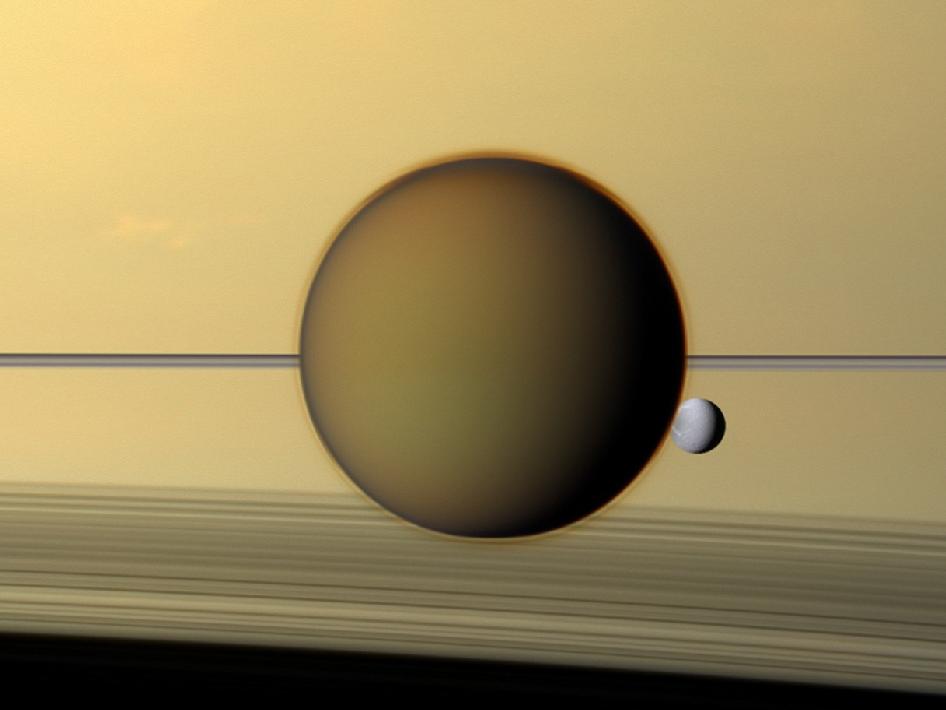
Saturn's third-largest moon Dione can be seen through the haze of its largest moon, Titan, in this view of the two posing before the planet and its rings from NASA's Cassini spacecraft.

The north polar hood can be seen on Titan appearing as a detached layer at the top of the moon here.

See PIA08137 and PIA09739 to learn more about Titan's atmosphere and the north polar hood.

See PIA10560 and PIA07638 to learn more about and see a closer view of the wisps on Dione's trailing hemisphere, which appear as bright streaks here.

This view looks toward the anti-Saturn side of Titan (3200 miles, 5150 kilometers across) and Dione (698 miles, 1123 kilometers across). North is up on the moons. This view looks toward the northern, sunlit side of the rings from just above the ring plane.

Images taken using red, green and blue spectral filters were combined to create this natural colour view.

The images were obtained with the Cassini spacecraft narrow-angle camera on May 21, 2011 at a distance of approximately 1.4 million miles (2.3 million kilometers) from Titan 2 million miles (3.2 million kilometers) from Dione. Image scale is 9 miles (14 kilometers) per pixel on Titan and 12 miles (19 kilometers) on Dione.

For more information about the Cassini-Huygens mission visit http://www.nasa.gov/cassini and http://saturn.jpl.nasa.gov . The Cassini imaging team homepage is at http://ciclops.org

Wednesday, December 14, 2011

NASA Cassini Fly-by - Saturn's moon Dione

NASA's Cassini spacecraft obtained this unprocessed image on Dec. 12, 2011.

The camera was pointing toward Saturn's moon Dione from approximately 69,989 miles (112,636 kilometers) away.
The camera was pointing toward Saturn's moon Dione from approximately 76,344 miles (122,864 kilometers) away.

Images credit: NASA/JPL/Space Science Institute

 
NASA's Cassini spacecraft successfully completed its closest-ever pass over Saturn's moon Dione on Monday, Dec. 12, slaloming its way through the Saturn system on its way to tomorrow's close flyby of Titan.

Cassini is expected to glide about 2,200 miles (3,600 kilometers) over the Titan surface on Dec. 13.

In the selection of the raw images obtained during the Cassini Dione flyby, Dione is sometimes joined by other moons. Mimas appears just beyond the dark side of Dione in one view.

In another view, Epimetheus and Pandora appear together, along with Saturn's rings.

This Dione encounter was intended primarily for Cassini's composite infrared spectrometer and radio science subsystem.

However, the imaging team did capture views of the distinctive, wispy fractures on the side of Dione that always trails in its orbit around Saturn.

It also obtained images of a ridge called Janiculum Dorsa on the hemisphere of Dione that always leads in its orbit around Saturn.

While other flybys produced more detailed views of the surface, the best resolved images from this flyby have scales ranging from about 1,100 feet (350 meters) to about 1,600 feet (500 meters) per pixel.

Janiculum Dorsa will be imaged by Cassini at higher resolution in May 2012

Monday, December 12, 2011

NASA Cassini to make a double pass at Saturn's Moons, Dione and Titan

A quartet of Saturn's moons, from tiny to huge, surround and are embedded within the planet's rings in this Cassini composition. Credit: NASA/JPL-Caltech/Space Science Institute

The closest approach to Dione, about 61 miles (99 kilometers) above the surface, will take place at about 1:39 a.m. PST (4:39 a.m. EST) on Dec. 12.

One of the questions Cassini scientists will be asking during this flyby is whether Dione's surface shows any signs of activity.


Understanding Dione's internal structure will help address that question, so Cassini's radio will learn how highly structured the moon's interior is by measuring variations in the moon's on the spacecraft.

The composite infrared spectrometer instrument will also look for heat emissions along fractures on the moon's surface.

Cassini will also be probing whether Dione, like another Saturnian moon, Rhea, has a tenuous atmosphere.

Scientists expect a Dionean atmosphere - if there is one - to be much more ethereal than even Rhea's.


Research published in journal and led by Sven Simon, a Cassini magnetometer team member at the University of Cologne, Germany, found magnetic field disturbances around Dione, hinting at a tenuous atmosphere.

But scientists hope to get stronger confirmation by "tasting" the space around the moon with Cassini's ion and neutral mass spectrometer.

On Cassini's journey out from Dione toward Titan, the imaging science subsystem will turn back to look at Dione's distinctive, wispy fractures and a ridge called Janiculum Dorsa.

Cassini will approach within about 2,200 milles (3,600 kilometers) of the Titan surface, at about 12:11 p.m. PST (3:11 PM EST) on Dec. 13.

At Titan, the will be making measurements to understand how the seasonal transition from spring to summer affects in the atmosphere near Titan's north pole. It will also search for mist.

The visual and infrared mapping spectrometer and imaging science subsystem will be observing the same equatorial deserts where the imaging science subsystem saw sudden and dramatic surface changes last year, when Titan was experiencing early northern spring.

One possibly theory is that rainstorms caused these changes. As Cassini recedes from , the imaging cameras will also continue to observe the moon for another day to monitor any new weather systems.

Monday, September 27, 2010

Saturn's Moons Rhea and Dione - co-joined

Two of Saturn's moons - Rhea (bottom) and Dione (top) - appear conjoined in this Cassini spacecraft image.

Dione is actually closer to the spacecraft here, but the reflection of the sun and a large crater at its south pole appears to make it blend seamlessly with Rhea.

The newly-released image was taken July 27, 2010 at a distance of approximately 1.1 million kilometres (688,000 miles) from Dione and 1.6 million kilometres (994,000 miles) from Rhea

Picture: NASA/JPL/SSI / Rex Features

Thursday, July 1, 2010

Cassini image: Saturn's moon Dione against hazy Titan

The surface of Saturn's moon Dione is rendered in crisp detail against a hazy, ghostly Titan.

Visible in this image are hints of atmospheric banding around Titan's north pole.

The image was taken in visible blue light with the Cassini spacecraft narrow-angle camera on April 10, 2010.

The view was acquired at a distance of approximately 1.8 million kilometers (1.1 million miles) from Dione and 2.7 million kilometers (1.7 million miles) from Titan.

Scale in the original image was 11 kilometers (7 miles) per pixel on Dione and 16 kilometers (10 miles) on Titan. The image has been magnified by a factor of 1.5 and contrast-enhanced to aid visibility.

Image Credit: NASA/JPL/Space Science Institute

Tuesday, February 16, 2010

Cassini Set to Do Retinal Scan of Saturnian Eyeball Mimas

NASA's Cassini spacecraft made its closest examination yet of Mimas, an eyeball-shaped moon of Saturn that has also been likened to the Death Star of "Star Wars."

The spacecraft returned the highest-resolution images yet of this battered satellite.

Mimas bears the mark of a violent, giant impact from the past - the 140-kilometer-wide (88-mile-wide) Herschel Crater - and scientists hope the encounter will help them explain why the moon was not blown to smithereens when the impact happened. They will also be trying to count smaller dings inside the basin of Herschel Crater so they can better estimate its age.

In addition, Cassini's composite infrared spectrometer was used to determine the thermal signature of the moon, and other instruments made measurements to learn more about the surface composition.

The Mimas flyby involved a significant amount of skill because the spacecraft passed through a dusty region to get there. Mission managers have planned for the Cassini spacecraft to lead with its high-gain antenna to provide a barrier of protection.

At closest approach, the spacecraft came within 9,500 kilometers (5,900 miles) of the moon. Cassini began taking images and measurements shortly after closest approach.

Mimas is an inner moon of Saturn that averages 396 kilometers (246 miles) in diameter. The diameter of Herschel Crater is about one-third that of the entire moon. The walls of the crater are about 5 kilometers (3 miles) high, and parts of the floor are approximately 10 kilometers (6 miles) deep.