Showing posts with label Saturn Moon. Show all posts

Thursday, September 18, 2014

On Titan, Methane Rain Transforms Into Icy Reservoirs

An artist's cross-section of the surface and subsurface of Titan.

The porous icy crust would allow the creation of a new reservoir formed by compounds known as clathrates

The two would interact, changing the composition of the surface body. 

Credit: ESA/ATG medialab


Compounds in the icy crust of Saturn's moon Titan may be slowly changing the composition of the liquid methane lakes and seas at its surface.

According to a new study, clathratescrystal structures in the icy crust of Titan, could mix with liquid from underground reservoirs, changing the makeup of the bodies of liquid created by hydrocarbon rainfall.

The shifting composition could allow scientists to understand more about processes going on deep underground by studying the surface.

"We knew that a significant fraction of the lakes on Titan's surface might possibly be connected with hidden bodies of liquid beneath Titan's crust, but we just didn't know how they would interact," lead author of the study Oliver Mousis, of the University of Franche-Comte in France, said in a statement.

"Now, we have a better idea of what these hidden lakes or oceans could be like."


Not long after it reached Saturn in 2004, NASA and the European Space Agency's Cassini spacecraft spotted the first of the known lakes and seas on the planet's large moon Titan.

Instead of water, these bodies of liquid are filled with organic compounds known as hydrocarbons, which include methane.

Other reservoirs are thought to house icy material beneath the surface. Most of the hundreds of lakes and seas known today are found in the moon's north polar region.

Rainfall from clouds in Titan's atmosphere seems to feed the lakes and seas, but scientists aren't certain how the liquids move through the crust and atmosphere.

Working with colleagues from Cornell University in New York and NASA's Jet Propulsion Laboratory in California, Mousis modeled how liquid hydrocarbons in a reservoir beneath the surface might spread through the moon's icy crust.

They determined that the formation of materials known as clathrates could change the composition of the rainfall runoffs that charge the reservoirs.

Crystal-like structures with small cages that trap other molecules, clathrates on Titan form as liquid hydrocarbons come into contact with the water ice that dominates the moon's crust.

On Earth, clathrites are found in some polar and ocean sediments, often capturing frozen methane.

On Titan, the lattice-like clathrates could capture substances such as methane and ethane, and should remain stable up to several miles beneath the moon's surface.

Thursday, July 3, 2014

NASA Cassini: Titan's Icy Ocean has extra high salt content

Researchers found that Titan's ice shell, which overlies a very salty ocean, varies in thickness around the moon, suggesting the crust is in the process of becoming rigid. 

Credit: NASA /JPL /SSI /Univ. of Arizona /G. Mitri /University of Nantes

Scientists analyzing data from NASA Cassini mission have firm evidence the ocean inside Saturn's largest moon, Titan, might be as salty as the Earth's Dead Sea.

The new results come from a study of gravity and topography data collected during Cassini's repeated flybys of Titan during the past 10 years.

Using the Cassini data, researchers presented a model structure for Titan, resulting in an improved understanding of the structure of the moon's outer ice shell.

The findings are published in this week's edition of the journal Icarus.

"Titan continues to prove itself as an endlessly fascinating world, and with our long-lived Cassini spacecraft, we're unlocking new mysteries as fast as we solve old ones," said Linda Spilker, Cassini project scientist at NASA's Jet Propulsion Laboratory (JPL) in Pasadena, California, who was not involved in the study.

Additional findings support previous indications the moon's icy shell is rigid and in the process of freezing solid.

Researchers found that a relatively high density was required for Titan's ocean in order to explain the gravity data.

This indicates the ocean is probably an extremely salty brine of water mixed with dissolved salts likely composed of sulphur, sodium and potassium.

The density indicated for this brine would give the ocean a salt content roughly equal to the saltiest bodies of water on Earth.

"This is an extremely salty ocean by Earth standards," said the paper's lead author, Giuseppe Mitri of the University of Nantes in France.

"Knowing this may change the way we view this ocean as a possible abode for present-day life, but conditions might have been very different there in the past."

Cassini data also indicate the thickness of Titan's ice crust varies slightly from place to place.

The researchers said this can best be explained if the moon's outer shell is stiff, as would be the case if the ocean were slowly crystalizing, and turning to ice.

Otherwise, the moon's shape would tend to even itself out over time, like warm candle wax.

This freezing process would have important implications for the habitability of Titan's ocean, as it would limit the ability of materials to exchange between the surface and the ocean.

A further consequence of a rigid ice shell, according to the study, is any outgassing of methane into Titan's atmosphere must happen at scattered "hot spots," like the hot spot on Earth that gave rise to the Hawaiian Island chain.

Titan's methane does not appear to result from convection or plate tectonics recycling its ice shell.

How methane gets into the moon's atmosphere has long been of great interest to researchers, as molecules of this gas are broken apart by sunlight on short geological timescales.

Titan's present atmosphere contains about five percent methane. This means some process, thought to be geological in nature, must be replenishing the gas.

The study indicates that whatever process is responsible, the restoration of Titan's methane is localized and intermittent.

"Our work suggests looking for signs of methane outgassing will be difficult with Cassini, and may require a future mission that can find localized methane sources," said Jonathan Lunine, a scientist on the Cassini mission at Cornell University, Ithaca, New York, and one of the paper's co-authors. "As on Mars, this is a challenging task."

More information: Icarus, www.sciencedirect.com/science/… ii/S0019103514001444

Sunday, June 22, 2014

Titan: Clue to 'Magic Island' mystery on Saturn moon

The bright feature shown in the image was spotted in images from July last year, but a few days later it had vanished

Scientists have outlined their best explanations for a mysterious feature dubbed the "magic island", which has been spotted on Saturn's moon Titan.

The Cassini spacecraft captured the "island" during a flyby, but it had vanished by the time of the next pass.

The bright splodge is seen in Ligeia Mare, one of the seas of methane and ethane found at Titan's north pole.

Icebergs, waves and gas bubbling up from the sea bed are all possibilities, the scientists say.

The study by an international team has been published in the journal Nature Geoscience.

Ligeia Mare is the second largest body of liquid on the saturnian moon

Saturn's largest moon shares much in common with Earth, such as a substantial atmosphere and a seasonal cycle. Wind and rain shape the surface to form river channels, seas, dunes and shorelines.

Titan's mountains and dune fields are made of ice, rather than rock or sand, and liquid hydrocarbons take many of the roles played by water on Earth.

The seas and lakes peppering the moon's north polar region are filled with methane and ethane. These are gases on Earth, but at typical Titan temperatures of -180C, they exist in a liquid state.

Titan, seen here with Tethys in the background, is shrouded in an orange haze of organic chemicals


  • Titan is Saturn's largest moon and the second biggest in the Solar System
  • It is the only moon in the Solar System with clouds and a substantial atmosphere
  • Wind and rain create similar features to those found on Earth, such as dunes, lakes and rivers
  • But on Titan it rains liquid methane, filling the rivers, lakes and seas with hydrocarbons


The bright feature was spotted in pictures from a Cassini flyby of Titan on 10 July 2013. The "island" is absent in imagery of Ligeia Mare taken on three previous flybys.

By the time of the next pass of Titan, on 26 July, the feature had vanished, and was not visible in two subsequent flybys.

"'Magic island' is a colloquial term that we use within the team to refer to this. But we don't actually think it's an island," co-author Jason Hofgartner told reporters.

The feature appears and disappears too quickly to be a volcanic islet. So the team were left with a handful of potential explanations.

Titan's lakes and seas are thought to be filled with a mixture of liquid methane and ethane

Mr Hofgartner, who is based at Cornell University in New York, explained: "We have four different hypotheses that are all equally preferred. In no particular order they are: waves, rising bubbles, floating solids and suspended solids."

Titan operates on a 30-year seasonal cycle, and the moon's northern region is expected to become a more dynamic place as Titan approaches its summer solstice in May 2017.

"Right now, Titan is basically half way between the vernal equinox (August 2009) - at the beginning of spring - and the summer solstice, the start of summer. It's roughly equivalent to what we would consider the beginning of May," said Mr Hofgartner.

"As Titan approaches its summer, more of the Sun's energy is being deposited in the northern hemisphere."

Winds will get stronger, causing an increase in waves, which are one potential explanation for the "magic island". Researchers have already seen possible evidence for small waves on another Titan sea.

Tuesday, April 15, 2014

NASA Cassini image: Birth of a Saturn moon

The disturbance visible at the outer edge of Saturn's A ring in this image from NASA's Cassini spacecraft could be caused by an object replaying the birth process of icy moons. 

Credit: JPL/NASA

NASA's Cassini spacecraft has documented the formation of a small icy object within the rings of Saturn that may be a new moon, and may also provide clues to the formation of the planet's known moons.

Images taken with Cassini's narrow angle camera on April 15, 2013, show disturbances at the very edge of Saturn's A ring, the outermost of the planet's large, bright rings.

One of these disturbances is an arc about 20 percent brighter than its surroundings, 750 miles (1,200 kilometers) long and 6 miles (10 kilometers) wide.

Scientists also found unusual protuberances in the usually smooth profile at the ring's edge.

Scientists believe the arc and protuberances are caused by the gravitational effects of a nearby object. Details of the observations were published online today by the journal Icarus.

The object is not expected to grow any larger, and may even be falling apart but the process of its formation and outward movement aids in our understanding of how Saturn's icy moons, including the cloud-wrapped Titan and ocean-holding Enceladus, may have formed in more massive rings long ago.

It also provides insight into how Earth and other planets in our solar system may have formed and migrated away from our star, the sun.

Carl Murray
"We have not seen anything like this before," said Carl Murray of Queen Mary University of London, the report's lead author.

"We may be looking at the act of birth, where this object is just leaving the rings and heading off to be a moon in its own right."

The object, informally named Peggy, is too small to be seen in images so far. Scientists estimate it is probably no more than about a half mile (about a kilometer) in diameter.

Saturn's icy moons range in size depending on their proximity to the planet—the farther from the planet, the larger, and many of Saturn's moons are composed primarily of ice, as are the particles that form Saturn's rings.

Based on these facts, and other indicators, researchers recently proposed that the icy moons formed from ring particles and then moved outward, away from the planet, merging with other moons on the way.

"Witnessing the possible birth of a tiny moon is an exciting, unexpected event," said Cassini Project Scientist Linda Spilker, of NASA's Jet Propulsion Laboratory in Pasadena, Calif.

According to Spilker, Cassini's orbit will move closer to the outer edge of the A ring in late 2016 and provide an opportunity to study Peggy in more detail and perhaps even image it.

It is possible the process of moon formation in Saturn's rings has ended with Peggy, as Saturn's rings now are, in all likelihood, too depleted to make more moons.

Because they may not observe this process again, Murray and his colleagues are wringing from the observations all they can learn.

"The theory holds that Saturn long ago had a much more massive ring system capable of giving birth to larger moons," Murray said.

"As the moons formed near the edge, they depleted the rings and evolved, so the ones that formed earliest are the largest and the farthest out."

More information: Carl D. Murray, Nicholas J. Cooper, Gareth A. Williams, Nicholas O. Attree, Jeffrey S. Boyer, The discovery and dynamical evolution of an object at the outer edge of Saturn's A ring, Icarus, Available online 28 March 2014, ISSN 0019-1035, dx.doi.org/10.1016/j.icarus.2014.03.024.

Saturday, April 5, 2014

NASA Cassini: Ocean inside Saturn's Icy Moon, Enceladus

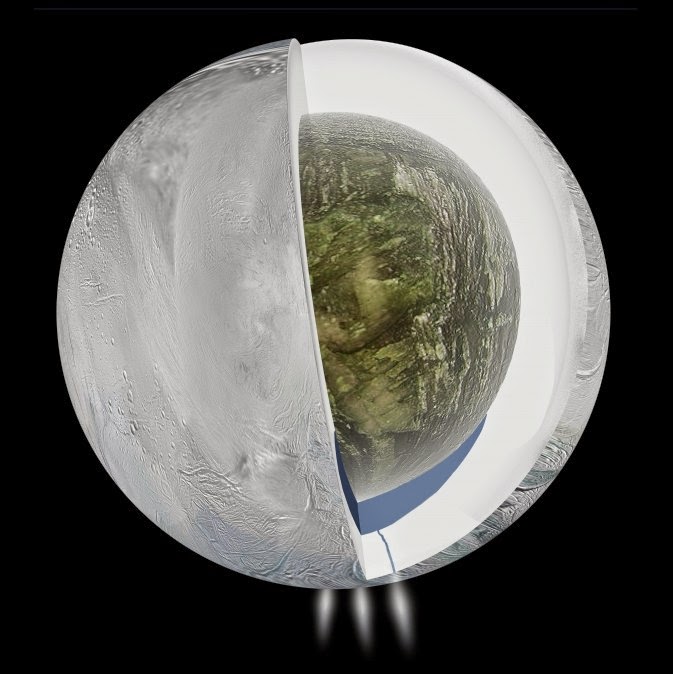
Gravity measurements by NASA's Cassini spacecraft and Deep Space Network suggest that Saturn's moon Enceladus, which has jets of water vapor and ice gushing from its south pole, also harbours a large interior ocean beneath an ice shell, as this illustration depicts.

Image Credit: NASA/JPL-Caltech

NASA's Cassini spacecraft and Deep Space Network have uncovered evidence Saturn's moon Enceladus harbors a large underground ocean of liquid water, furthering scientific interest in the moon as a potential home to extraterrestrial microbes.

Researchers theorized the presence of an interior reservoir of water in 2005 when Cassini discovered water vapor and ice spewing from vents near the moon's south pole.

The new data provide the first geophysical measurements of the internal structure of Enceladus, consistent with the existence of a hidden ocean inside the moon.

Findings from the gravity measurements are in the Friday April 4 edition of the journal Science.

"The way we deduce gravity variations is a concept in physics called the Doppler Effect, the same principle used with a speed-measuring radar gun," said Sami Asmar of NASA's Jet Propulsion Laboratory (JPL) in Pasadena, Calif., a coauthor of the paper.

"As the spacecraft flies by Enceladus, its velocity is perturbed by an amount that depends on variations in the gravity field that we're trying to measure. We see the change in velocity as a change in radio frequency, received at our ground stations here all the way across the solar system."

The gravity measurements suggest a large, possibly regional, ocean about 6 miles (10 kilometers) deep, beneath an ice shell about 19 to 25 miles (30 to 40 kilometers) thick.

The subsurface ocean evidence supports the inclusion of Enceladus among the most likely places in our solar system to host microbial life.

Before Cassini reached Saturn in July 2004, no version of that short list included this icy moon, barely 300 miles (500 kilometers) in diameter.

"This then provides one possible story to explain why water is gushing out of these fractures we see at the south pole," said David Stevenson of the California Institute of Technology, Pasadena, one of the paper's co-authors.

Cassini has flown near Enceladus 19 times. Three flybys, from 2010 to 2012, yielded precise trajectory measurements.

The gravitational tug of a planetary body, such as Enceladus, alters a spacecraft's flight path.

Variations in the gravity field, such as those caused by mountains on the surface or differences in underground composition, can be detected as changes in the spacecraft's velocity, measured from Earth.

The technique of analyzing a radio signal between Cassini and the Deep Space Network can detect changes in velocity as small as less than one foot per hour (90 microns per second).

With this precision, the flyby data yielded evidence of a zone inside the southern end of the moon with higher density than other portions of the interior.

The south pole area has a surface depression that causes a dip in the local tug of gravity. However, the magnitude of the dip is less than expected given the size of the depression, leading researchers to conclude the depression's effect is partially offset by a high-density feature in the region, beneath the surface.

"The Cassini gravity measurements show a negative gravity anomaly at the south pole that however is not as large as expected from the deep depression detected by the onboard camera," said the paper's lead author, Luciano Iess of Sapienza University of Rome.

"Hence the conclusion that there must be a denser material at depth that compensates the missing mass: very likely liquid water, which is seven percent denser than ice. The magnitude of the anomaly gave us the size of the water reservoir."

There is no certainty the subsurface ocean supplies the water plume spraying out of surface fractures near the south pole of Enceladus, however, scientists reason it is a real possibility.

The fractures may lead down to a part of the moon that is tidally heated by the moon's repeated flexing, as it follows an eccentric orbit around Saturn.

Much of the excitement about the Cassini mission's discovery of the Enceladus water plume stems from the possibility that it originates from a wet environment that could be a favorable environment for microbial life.

"Material from Enceladus’ south polar jets contains salty water and organic molecules, the basic chemical ingredients for life," said Linda Spilker, Cassini's project scientist at JPL.

"Their discovery expanded our view of the 'habitable zone' within our solar system and in planetary systems of other stars. This new validation that an ocean of water underlies the jets furthers understanding about this intriguing environment."

The Cassini-Huygens mission is a cooperative project of NASA, the European Space Agency and the Italian Space Agency.

Monday, March 10, 2014

NASA Cassini: Rhea's Day in the Sun

A nearly full Rhea shines in the sunlight in this recent Cassini image. 

Rhea (949 miles, or 1,527 kilometers across) is Saturn's second largest moon.

Lit terrain seen here is on the Saturn-facing hemisphere of Rhea. 

North on Rhea is up and rotated 43 degrees to the left. 

The image was taken in visible light with the Cassini spacecraft narrow-angle camera on Sept. 10, 2013.

The view was obtained at a distance of approximately 990,000 miles (1.6 million kilometers) from Rhea. 

Image scale is 6 miles (9 kilometers) per pixel.

The Cassini-Huygens mission is a cooperative project of NASA, the European Space Agency and the Italian Space Agency

The Jet Propulsion Laboratory, a division of the California Institute of Technology in Pasadena, manages the mission for NASA's Science Mission Directorate, Washington, D.C. 

The Cassini orbiter and its two onboard cameras were designed, developed and assembled at JPL. 

The imaging operations center is based at the Space Science Institute in Boulder, Colo.

For more information about the Cassini-Huygens mission, and saturn.jpl.nasa.gov. 

The Cassini imaging team homepage.
Image Credit: NASA/JPL-Caltech/Space Science Institute

Saturday, March 16, 2013

NASA Cassini Image: Last Close-Up Photos of Icy Saturn Moon, Rhea

This raw image of Saturn's icy moon Rhea was taken on March 10, 2013 by NASA's Cassini spacecraft, and received on Earth March 10, 2013. 

The camera was pointing toward Rhea at approximately 174,181 miles (280,317 kilometers) away. 

CREDIT: NASA/JPL/Space Science Institute

NASA's Cassini spacecraft has snapped its last up-close photos of Saturn's icy moon Rhea, revealing a battered satellite covered in craters from violent impacts.NASA's Cassini spacecraft has snapped its last up-close photos of Saturn's icy moon Rhea, revealing a battered satellite covered in craters from violent impacts.

Cassini took the amazing new photos of Rhea on Saturday (March 9) during its fourth and final planned encounter with the Saturn moon.

During the encounter, the probe flew within just 620 miles (997 kilometers) of Rhea, which is Saturn's second-largest satellite.

"Take a good, long, luxurious look at these sights from another world, as they will be the last close-ups you'll ever see of this particular moon,"

Cassini imaging team lead Carolyn Porco, of the Space Science Institute in Boulder, Colo., said in a statement accompanying the photos.

This image was taken on March 09, 2013, and received on Earth March 10, 2013, by NASA's Cassini spacecraft. 

The camera was pointing toward Rhea at approximately 1,727 miles (2,779 kilometers) away, and the image was taken using the CL1 and CL2 filters. 

This image has not been validated or calibrated. 

CREDIT: NASA/JPL-Caltech/Space Science Institute

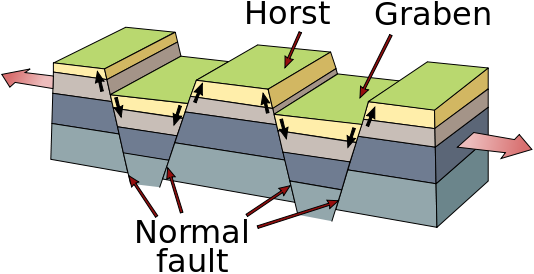
Saturday's flyby was designed primarily to measure Rhea's gravity field, mission scientists said, but Cassini also managed to take 12 pictures of the frigid moon's battered, pockmarked surface, including one that showcases a mysterious long, curving fracture called a graben.

Rhea is the second-largest of Saturn's 60-odd known moons, with a diameter of 949 miles (1528 km).

It's far smaller than the ringed planet's biggest natural satellite, Titan, which at 3,200 miles (5,150 km) across is nearly 50 percent wider than Earth's moon.

Rhea was discovered in 1672 by the mathematician and astronomer Giovanni Domenico Cassini, who gave his name to the NASA mission currently studying the Saturn system.

In 2010, researchers determined that the moon has a wispy atmosphere dominated by oxygen and carbon dioxide.

Possibly the oxygen was blasted free from water ice on Rhea's surface by charged particles streaming from Saturn, scientists say, but the origin of the carbon dioxide is more mysterious.

The Cassini mission — a joint effort involving NASA, the European Space Agency and the Italian Space Agency — launched in 1997 and arrived at Saturn in 2004.

It has been studying the ringed planet and its many moons ever since, and will continue to do so on an extended mission until at least 2017.

Monday, December 3, 2012

NASA Cassini: Saturn's moons - Tiny Tethys

Image credit: NASA/JPL-Caltech/Space Science Institute

Tethys may not be tiny by normal standards, but when it is captured alongside Saturn, it can't help but seem pretty small.

Even Saturn's rings appear to dwarf Tethys (660 miles, or 1,062 kilometers across), which is in the upper left of the image, although scientists believe the moon to be many times more massive than the entire ring system combined.

This view looks toward the unilluminated side of the rings from about 18 degrees below the ringplane.

The image was taken in green light with the Cassini spacecraft wide-angle camera on Aug. 19, 2012.

The view was acquired at a distance of approximately 1.5 million miles (2.4 million kilometers) from Saturn and at a Sun-Saturn-spacecraft, or phase, angle of 63 degrees. Image scale is 86 miles (138 kilometers) per pixel.

The Cassini-Huygens mission is a cooperative project of NASA, the European Space Agency and the Italian Space Agency. The Jet Propulsion Laboratory, a division of the California Institute of Technology in Pasadena, manages the mission for NASA's Science Mission Directorate, Washington, D.C.

The Cassini orbiter and its two onboard cameras were designed, developed and assembled at JPL. The imaging operations center is based at the Space Science Institute in Boulder, Colo.

Saturday, October 13, 2012

ESA Cassini Huygens: Titan Descent Movie (2005.01.14) - YouTube


This movie was built thanks to the data collected by ESA's Huygens Descent Imager/Spectral Radiometer (DISR) on 14 January 2005, during the 147-minutes plunge through Titan's thick orange-brown atmosphere to a soft sandy riverbed.

In 4 minutes 40 seconds, the movie shows what the probe 'saw' within the few hours of the descent and the eventual landing.

At first the Huygens camera just saw haze over the distant surface. The haze started to clear only at about 60 kilometers altitude, making it possible to resolve surface features as large as 100 meters.

Only after landing could the probe's camera resolve little grains of sand millions and millions times smaller than Titan. The movie provides a glimpse on such a huge change of scale.

Credit: ESA/NASA/JPL/University of Arizona

Source: jpl.nasa.gov/catalog/PIA08118

Thursday, June 14, 2012

NASA Saturn's Titan: Cassini spots tropical lagoons of Methane

Tropical lakes observed by Cassini. Credit: NASA

Planetary scientists have been surprised by the discovery of exotic lagoons in the tropics of Saturn's largest moon Titan.

These are not sun-kissed holiday spots however, but long-standing little lakes of methane beneath the satellites poisonous smog.

They come as a surprise because it had been thought that such wet areas would be found only around the poles due to circulation patterns within Titan's atmosphere.

Titan fascinates because, despite the unfriendly nature of its chemistry, it shows remarkable similarities to surface features and weather on our own planet.

This is largely because this distant moon is the only satellite in the Solar System to have a dense atmosphere. There it rains methane rather than water, with the liquid circulating in a way similar to the Earth's hydrological cycle.

Europe achieved a major space success in 2005 with the soft-landing of a space probe, Huygens, which had been carried there by NASA's Cassini mission to Saturn. The lander sent back pictures and other data about the region where it landed that suggested it might be a damp former lake bed with a consistency similar to creme brulee.

Tuesday, March 20, 2012

NASA Cassini sees Saturn stressing out Enceladus

These images, based on ones obtained by NASA's Cassini spacecraft, show how the pull of Saturn's gravity can deform the surface of Saturn's moon Enceladus in the south polar region crisscrossed by fissures known as "tiger stripes." Credit: NASA/JPL-Caltech/SSI/LPI/GSFC

These images from NASA's Cassini spacecraft have, for the first time, enabled scientists to correlate the spraying of jets of water vapour from fissures on Saturn's moon Enceladus with the way Saturn's gravity stretches and stresses the fissures.

The result is among the Cassini findings presented today at the Lunar and Planetary Science Conference at The Woodlands, Texas.

"This new work gives scientists insight into the mechanics of these picturesque jets at Enceladus and shows that Saturn really stresses Enceladus," said Terry Hurford, a Cassini associate based at NASA Goddard Space Flight Center in Greenbelt, Md.

Enceladus is unique in the Saturn system in having jets of water vapor and organic particles spray from long fissures in its south polar region. The long fissures have been nicknamed the "tiger stripes."

Hurford and colleagues suggested a few years ago that tidal pulls from Saturn's gravity could explain the existence of the jets, but they had not been able to correlate specific jets with calculated stresses until now.

They studied the jets emerging from the warmest regions within the tiger stripes Baghdad Sulcus and Damascus Sulcus.

The scientists found that the greatest stresses pulling apart the tiger stripes, occurred right after Enceladus made its closest approach to Saturn in its orbit.

The scientists found that Saturn's gravitational pull could also deform the fissure by making one side move relative to the other side.

That kind of deformation seemed to occur quite often during Enceladus' orbit around the planet, even when Enceladus was very far away.

The finding suggests that a large reservoir of liquid water - a global or local ocean - would be necessary to allow Enceladus to flex enough to generate stresses great enough to deform the surface, Hurford said.

That process would control the timing of the jet eruptions. The finding also suggests that Saturn's tides create an enormous amount of heat in the area.

Friday, March 16, 2012

NASA Cassini: Flaring fairy lights of Saturn's F ring


One of Saturn's rings is flaring and fading in a very strange fashion.

When Voyager 1 visited the planet in 1980, the ring was faint, but it sparkled with bright spots.

By the time the Cassini mission arrived in 2004, the spots were gone – but the ring as a whole had grown twice as bright.

Saturn's F ring has been a puzzle since it was discovered by the Pioneer 11 spacecraft in 1979.

While most of the inner rings have clear, well-defined edges, the F ring, which is the outermost of Saturn's main rings, has a thin central core surrounded by a diffuse skirt of smoke-sized ice particles.

That swirl of smoke forms kinks and knots, and some of it winds around the ring's core in a spiral.

Most of these funny features can be blamed on the little moon Prometheus, which orbits just inside the F ring.

As its elliptical orbit brings Prometheus towards and away from the ring on a 17-year cycle, the moon contorts the ring with its gravity.

It even steals material from the ring when it comes too close, as its mythical namesake stole fire from the gods.

"We knew the F ring changed on a day to day and even hour to hour basis because of interactions with Prometheus," says Robert French, a research assistant at the SETI Institute in Mountain View, California.

"But people always assumed it was stable over the longer term, over decades if not millennia."

So French and colleagues got a surprise when they compared images from the Voyager 1 and 2 missions, which zipped past Saturn in 1980 and 1981, with images from the Cassini spacecraft, which has been orbiting the planet since July 2004.

They found that the ring was twice as bright in 2004 as it was in 1980. It had also grown three times as wide and twice as opaque.

"All of that means there's a lot more dust today than there used to be," French says. Those tiny particles scatter sunlight, so when there are more of them the whole ring shines more brightly.

French's first thought was to blame Prometheus. But while Prometheus's orbit brought it closer to the F ring over the first 5 years of Cassini's stay in the Saturn system, the ring didn't change.

"That's very puzzling," French says. "People usually think of Prometheus as the cause of changes in the F ring, and Prometheus was making large changes in how it interacted with the F ring. Yet the F ring wasn't changing."

NASA CASSINI Image: Saturn's Moon Enceladus - Plume of Water Ice

Below a darkened Enceladus, a plume of water ice is backlit in this view of one of Saturn's most dramatic moons.

Dramatic plumes, both large and small, spray water ice from many locations along the moon's famed "tiger stripes" near the south pole of Enceladus. 

The tiger stripes are fissures that spray icy particles, water vapour and organic compounds.

The terrain seen here is on the leading hemisphere of Enceladus (313 miles, or 504 kilometers across). North is up.

The image was taken in visible light with the Cassini spacecraft narrow-angle camera on Feb. 20, 2012. 

The view was acquired at a distance of approximately 83,000 miles (134,000 kilometers) from Enceladus and at a Sun-Enceladus-spacecraft, or phase, angle of 165 degrees. Image scale is 2,628 feet (801 meters) per pixel.

Image credit: NASA/JPL-Caltech/Space Science Institute

Tuesday, March 13, 2012

NASA Cassini: Sharper image of Saturn moon Rhea

This photo made March 10, 2012, by NASA's Cassini spacecraft shows a raw, unprocessed image of Saturn's moon Rhea. 

The camera was pointing toward Rhea from a distance of approximately 42,096 kilometers (26,157 miles). 

(AP Photo/NASA/JPL-Caltech/SSI)

The pockmarked surface of Saturn's second-largest moon has come into sharper focus in new images released by Nasa.

The space agency released the new views of the moon Rhea, which were captured by the international Cassini spacecraft during a recent fly-by.

One of its cameras spied two huge impact basins and other geologic features on Rhea's icy surface from 26,000 miles away last week.

Cassini, funded by Nasa and the European and Italian space agencies, was launched in 1997. It reached Saturn in 2004 and has been studying the ringed planet and its numerous moons.

Saturday, March 3, 2012

NASA Cassini Saturn's Moon Dione: Oxygen Detected

Nasa's Cassini spacecraft has detected the presence of oxygen ions around Saturn's icy moon Dione for the first time.

Nasa has reported that the oxygen ions present on Dione moon are quite sparse and showed that Dione has an extremely thin neutral atmosphere, while Saturn's largest moon, Titan, has a much denser atmosphere.

The study done by an international team led by Los Alamos National Laboratory, Los Alamos, New Mexico, has been published in Geophysical Research Letters.

Saturn
Saturn's moon Dione was discovered in 1684 by astronomer Giovanni Cassini. It orbits Saturn at roughly the same distance as our own moon orbits Earth.

"The concentration of oxygen in Dione's atmosphere is roughly similar to what you would find in Earth's atmosphere at an altitude of about 300 miles," stated Robert Tokar, a Cassini team member based at Los Alamos National Laboratory.

He added that the presence of oxygen ions in Dione is not enough to sustain life, but said that with similar observations of other Saturn and Jupiter's moons could divulge more details about their habitability.

Nasa launched Cassini spacecraft, named after Giovanni Cassini, in 1997 and sent it on the first leg of its journey to Saturn. Cassini detected the oxygen ions in Dione's when it flew by the moon two years back in 2010.

Tuesday, February 28, 2012

NASA Cassini Image: Saturn's Moon Mimas - Cut-Off Rings

Image credit: NASA/JPL-Caltech/Space Science Institute

One of Saturn's moons, Mimas joins the planet's rings which appear truncated by the planet's shadow in this Cassini spacecraft image.

Saturn is off to the left, out of view here.

The inner rings are just visible there but the planet's shadow covers part of the rings across the middle of the image.

Mimas (246 miles, or 396 kilometers across) is closer to Cassini than the rings are here.

The bright speck above the rings is a star.

To increase visibility, the rings have been brightened by a factor of two relative to Mimas. This view looks toward the southern, un-illuminated side of the rings from just below the ring-plane.

The image was taken in visible light with the Cassini spacecraft narrow-angle camera on Dec. 21, 2011.

The view was obtained at a distance of approximately 1.7 million miles (2.7 million kilometers) from Mimas. Image scale is 10 miles (16 kilometers) per pixel on Mimas.


The Cassini-Huygens mission is a cooperative project of NASA, the European Space Agency and the Italian Space Agency.

The Jet Propulsion Laboratory, a division of the California Institute of Technology in Pasadena, manages the mission for NASA's Science Mission Directorate, Washington, D.C.

The Cassini orbiter and its two onboard cameras were designed, developed and assembled at JPL. The imaging operations center is based at the Space Science Institute in Boulder, Colo.

For more information about the Cassini-Huygens mission visit www.nasa.gov/cassini and saturn.jpl.nasa.gov . The Cassini imaging team homepage is at ciclops.org

Thursday, February 16, 2012

NASA Cassini: Rhea Before Titan

Craters appear well defined on icy Rhea in front of the hazy orb of the much larger moon Titan in this Cassini spacecraft view of these two Saturn moons.

Lit terrain seen here is on the leading hemispheres of Rhea and Titan. 

North on the moons is up and rotated 13 degrees to the left. 

The limb, or edge of the visible disk, of Rhea is slightly overexposed in this view.

The image was taken in visible green light with the Cassini spacecraft narrow-angle camera on Dec. 10, 2011. 

The view was acquired at a distance of approximately 1.2 million miles (2 million kilometers) from Titan and at a Sun-Titan-spacecraft, or phase, angle of 109 degrees.

The view was acquired at a distance of approximately 810,000 miles (1.3 million kilometers) from Rhea and at a Sun-Rhea-spacecraft, or phase, angle of 109 degrees. Image scale is 8 miles (12 kilometers) per pixel on Titan and 5 miles (8 kilometers) per pixel on Rhea.

Image credit: NASA/JPL-Caltech/Space Science Institute

Tuesday, January 31, 2012

Saturn: Plan to Fly A Nuclear powered Drone craft to Titan

Scientists have proposed a plan to send a nuclear-powered drone to Saturn's moon Titan, which is 10 times more distant from the sun than Earth and has a methane atmosphere that is four times a dense.

Led by BYU professor Jani Radebaugh, the plan is to put the drone in Titan for a year-long flight so it can observe the moon which shares many similarities with the Earth like rivers, oceans, mountains, sand dunes and winds.

"Titan is a really interesting place as far as understanding the processes on the early Earth," said Radebaugh.

"It orbits at a good distance, has organic molecules of carbon and hydrogen, there's energy in the atmosphere and perhaps occasionally water on or near the surface - those are the main things considered necessary for life."

According to the scientists, the proposed drone will operate on a nuclear battery that can power a couple light bulbs.

The battery would power a propeller except when it needed to beam data back to radio telescopes on earth, however, prior to these transmissions, the drone would climb high into Titan's atmosphere.

Power would then shift to the radio cone in the drone's nose as the aircraft glides back down to its usual flight altitude, the researchers explained.

Published in the Experimental Astronomy, Radebaugh and her group noted that while transporting the drone to Titan would take up to 7 years, once there the communication relay time would take a mere 90 minutes.

Titan is of great interest to scientists because it is the only moon in the solar system known to have clouds and a mysterious, thick, planet-like atmosphere.

TITAN
Recent researches have also found Titan to be more Earth-like than previously thought. Here are some interesting facts about this object in the solar system.

• Titan is the biggest of the 53 known moons orbiting Saturn. It is a cold world enclosed by a thick, hazy atmosphere that is yet to be penetrated by telescopes and cameras.

• Titan is the second largest moon in our solar system with an equatorial radius of 2,575 km (1,600 miles). It's bigger than Earth's Moon and the planet Mercury.
• Titan's surface temperature is about -289 degrees Fahrenheit (-178 degrees Celsius).

• Titan orbits Saturn at a distance of about 1.2 million km (745,000 miles), taking almost 16 days to complete a full orbit.

• Titan was discovered on 25 March 1655 by the Dutch astronomer Christiaan Huygens.

Radebaugh wants to collect the data from Titan to get more information on how the moon's geology has formed.

"One of the main things we're looking for is life or precursors for life. Titan has a lot of molecules made of carbon and hydrogen, there's water ice bedrock, and water volcanoes," Radebaugh said.

"With water, organic molecules, and energy, that's all the ingredients for life. It's a really good place to look for precursory biology," she added.

Tuesday, January 24, 2012

NASA Cassini Image: Saturn's Moons Mimas And Dione

Saturn's moon Mimas peeks out from behind the night side of the larger moon Dione in this Cassini image captured during the spacecraft's Dec. 12, 2011, flyby of Dione.

Dione is 698 miles, or 1,123 kilometers, across and its day side dominates the view on the right of the image. Smaller Mimas is on the left and measures 246 miles, or 396 kilometers, across.

Lit terrain seen here is on the Saturn-facing side of Mimas and in the area between the trailing hemisphere and anti-Saturn side of Dione. North on the moons is up and rotated 20 degrees to the right.

The image was taken in visible light with the Cassini spacecraft narrow-angle camera.

The view was obtained at a distance of approximately 58,000 miles (94,000 kilometers) from Dione and at a Sun-Dione-spacecraft, or phase, angle of 42 degrees. Image scale is 1,833 feet (559 meters) per pixel on Dione.

The view was obtained at a distance of approximately 380,000 miles (611,000 kilometers) from Mimas and at a Sun-Mimas-spacecraft, or phase, angle of 41 degrees. Image scale is 2 miles (3 kilometers) per pixel on Mimas.

Monday, January 23, 2012

ESA Cassini: The two faces of Saturn moon Titan's dunes

Two different dune fields on Titan: Belet and Fensal, as imaged by Cassini’s radar. It also shows two similar dune fields on Earth in Rub Al Khali, Saudi Arabia. 

Fensal is at higher latitude and elevation than Belet and clearly shows thinner dunes with brighter and wider areas in between, suggesting less abundant dune material in this region.

Credits: NASA/JPL–Caltech/ASI/ESA and USGS/ESA

A new analysis of radar data from the international Cassini spacecraft has revealed regional variations amongst Titan's sand dunes. The result yields new clues to the giant moon's climatic and geological history.

Dune fields are common on Titan, the largest moon of Saturn, second only to the seemingly uniform plains that cover most of the surface.

They cover about 13% of Titan, stretching over 10 million sq km, roughly equivalent to the area of Canada. Thus they offer a large-scale insight into the moon's environment.

Though similar in shape to the linear sand dunes found in the deserts of Namibia or southern Arabia, Titan's dunes are gigantic by Earthly standards. They are on average 1–2 km wide, hundreds of kilometres long and around 100 m high.

However, their size and spacing vary across the surface, betraying the environment in which they have formed and evolved.

Another difference is that sand on Titan is not made of silicates as on Earth, but of solid hydrocarbons that precipitate out of the atmosphere. These then aggregate into millimetre-sized grains by a still unknown process.

Using radar data from the NASA–ESA–ASI Cassini spacecraft, Alice Le Gall, of LATMOS-UVSQ, Paris and NASA–JPL, California, and collaborators have discovered that the size of Titan's dunes is controlled by at least two factors: altitude and latitude.

The main dune fields on Titan are found in lowland areas. Dunes at higher elevations tend to be narrower and more widely separated, and the gaps between them appear brighter to Cassini's radar, indicating a thinner covering of sand.

This suggests that there is relatively little sand available at higher elevations to build dunes, while more is present in the lowlands.

In terms of latitude, the dunes on Titan are confined to its equatorial region, in a band between 30°S and 30°N.

However, they tend to become narrower and more widely spaced at northern latitudes. Dr Le Gall and colleagues think that this may be due to Saturn's elliptical orbit.

Titan orbits Saturn and so the moon's seasons are controlled by Saturn's path around the Sun. Because Saturn takes about 30 years to complete an orbit, each season on Titan lasts for just over seven years.

The slightly elliptical nature of Saturn's orbit means that the southern hemisphere of the moon has shorter but more intense summers.

As a result, in southern regions, surface wetness due to ethane and methane vapour in the soil is reduced.

The drier the sand grains, the more easily they can be transported by the winds to make dunes.

"As one goes to the north, the soil moisture probably increases, making the sand particles less mobile and, as a consequence, the development of dunes more difficult," says Dr Le Gall.