Showing posts with label Distant. Show all posts

Tuesday, November 11, 2014

ALMA finds best evidence for galactic merger in distant protocluster AzTEC-3

An artist's impression of the protocluster observed by ALMA

It shows the central starburst galaxy AzTEC-3 along with its labeled cohorts of smaller, less active galaxies. 

New ALMA observations suggest that AzTEC-3 recently merged with another young galaxy and that the whole system represents the first steps toward forming a galaxy cluster. 

Credit: B. Saxton (NRAO/AUI/NSF)

Nestled among a triplet of young galaxies more than 12.5 billion light-years away is a cosmic powerhouse: a galaxy that is producing stars nearly 1,000 times faster than our own Milky Way.

This energetic starburst galaxy, known as AzTEC-3, together with its gang of calmer galaxies may represent the best evidence yet that large galaxies grow from the merger of smaller ones in the early Universe, a process known as hierarchical merging.

An international team of astronomers observed these remarkable objects with the Atacama Large Millimeter/submillimeter Array (ALMA).

"The ALMA data reveal that AzTEC-3 is a very compact, highly disturbed galaxy that is bursting with new stars at close to its theoretically predicted maximum limit and is surrounded by a population of more normal, but also actively star-forming galaxies," said Dominik Riechers, an astronomer and assistant professor at Cornell University in Ithaca, New York, and lead author on a paper published today (Nov. 10) in the Astrophysical Journal.

"This particular grouping of galaxies represents an important milestone in the evolution of our Universe: the formation of a galaxy cluster and the early assemblage of large, mature galaxies."

Combined data from Japan's Subaru telescope and ALMA of the AzTEC-3 region; the circled regions are members of this protocluster, which were previously highlighted by Subaru. 

The ALMA data are highlighted with arrows. 

Credit: Subaru/NASA/JPL, P. Capak (SSC/Caltech); ALMA (NRAO/ESO/NAOJ); B. Saxton (NRAO/AUI/NSF)

In the early Universe, starburst galaxies like AzTEC-3 were forming new stars at a monstrous pace fueled by the enormous quantities of star-forming material they devoured and by merging with other adolescent galaxies.

Over billions of years, these mergers continued, eventually producing the large galaxies and clusters of galaxies we see in the Universe today.

Evidence for this hierarchical model of galaxy evolution has been mounting, but these latest ALMA data show a strikingly clear picture of the all-important first steps along this process when the Universe was only 8 percent of its current age.

"One of the primary science goals of ALMA is the detection and detailed study of galaxies throughout cosmic time," said Chris Carilli, an astronomer with the National Radio Astronomy Observatory in Socorro, New Mexico.

"These new observations help us put the pieces together by showing the first steps of a galaxy merger in the early Universe."

AzTEC-3, which is located in the direction of the constellation Sextans, is what astronomers refer to as a submillimeter galaxy, since it shines brightly in that portion of the spectrum, but is remarkably dim at optical and infrared wavelengths.

This is due to light from its stars being absorbed by dust in the star-forming environments of the galaxy and then re-emitted by the dust at far-infrared wavelengths.

As this light travels across the cosmos, it becomes stretched due to the expansion of the Universe, so by the time it arrives at Earth, the far-infrared light has shifted to the submillimeter/millimeter portion of the spectrum.

More information: Dominik A. Riechers et al. 2014 ApJ 796 84: iopscience.iop.org/0004-637X/796/2/84/article

Thursday, July 24, 2014

NASA Hubble: New precise mass map of a distant galaxy cluster

This image from the NASA/ESA Hubble Space Telescope shows the galaxy cluster MCS J0416.1-2403. 

This is one of six being studied by the Hubble Frontier Fields programme. 

This programme seeks to analyse the mass distribution in these huge clusters and to use the gravitational lensing effect of these clusters, to peer even deeper into the distant Universe. 

Credit: ESA/Hubble, NASA, HST Frontier Fields

Astronomers using the NASA/ESA Hubble Space Telescope have mapped the mass within a galaxy cluster more precisely than ever before.

Created using observations from Hubble Frontier Fields observing programme, the map shows the amount and distribution of mass within MCS J0416.1-2403, a massive galaxy cluster found to be 160 trillion times the mass of the Sun.

The detail in this mass map was made possible thanks to the unprecedented depth of data provided by new Hubble observations, and the cosmic phenomenon known as strong gravitational lensing.

Measuring the amount and distribution of mass within distant objects in the Universe can be very difficult.

A trick often used by astronomers is to explore the contents of large clusters of galaxies by studying the gravitational effects they have on the light from very distant objects beyond them.

This is one of the main goals of Hubble Frontier Fields, an ambitious observing programme scanning six different galaxy clusters, including MCS J0416.1-2403, the cluster shown in this stunning new image.

Large clumps of mass in the Universe warp and distort the space-time around them. Acting like lenses, they appear to magnify and bend light that travels through them from more distant objects.

Despite their large masses, the effect of galaxy clusters on their surroundings is usually quite minimal.

For the most part they cause what is known as weak lensing, making even more distant sources appear as only slightly more elliptical or smeared across the sky.

However, when the cluster is large and dense enough and the alignment of cluster and distant object is just right, the effects can be more dramatic.

The images of normal galaxies can be transformed into rings and sweeping arcs of light, even appearing several times within the same image.

This effect is known as strong lensing, and it is this phenomenon, seen around the six galaxy clusters targeted by the Hubble Frontier Fields programme, that has been used to map the mass distribution of MCS J0416.1-2403, using the new Hubble data.

"The depth of the data lets us see very faint objects and has allowed us to identify more strongly lensed galaxies than ever before," explains Mathilde Jauzac of Durham University, UK, and Astrophysics & Cosmology Research Unit, South Africa, lead author of the new Frontier Fields paper.

"Even though strong lensing magnifies the background galaxies they are still very far away and very faint. The depth of these data means that we can identify incredibly distant background galaxies."

"We now know of more than four times as many strongly lensed galaxies in the cluster than we did before."

Using Hubble's Advanced Camera for Surveys, the astronomers identified 51 new multiply imaged galaxies around the cluster, quadrupling the number found in previous surveys and bringing the grand total of lensed galaxies to 68.

Because these galaxies are seen several times this equates to almost 200 individual strongly lensed images which can be seen across the frame.

This effect has allowed Jauzac and her colleagues to calculate the distribution of visible and dark matter in the cluster and produce a highly constrained map of its mass.

Thursday, March 6, 2014

Chandra and XMM-Newton: Direct measurement of distant black hole's spin

Multiple images of a distant quasar known as RX J1131-1231 are visible in this combined view from Chandra (pink) and Hubble (red, green, and blue). 

Credit: NASA/CXC/Univ of Michigan/R.C.Reis et al; Optical: NASA/STSc

Astronomers have used NASA's Chandra X-ray Observatory and the European Space Agency's (ESA) XMM-Newton to show a supermassive black hole six billion light years from Earth is spinning extremely rapidly.

This first direct measurement of the spin of such a distant black hole is an important advance for understanding how black holes grow over time.

Chandra X-ray Observatory
Black holes are defined by just two simple characteristics: mass and spin.

While astronomers have long been able to measure black hole masses very effectively, determining their spins has been much more difficult.

In the past decade, astronomers have devised ways of estimating spins for black holes at distances greater than several billion light-years away, meaning we see the region around black holes as they were billions of years ago.

However, determining the spins of these remote black holes involves several steps that rely on one another.

Rubens Reis
"We want to be able to cut out the middle man, so to speak, of determining the spins of black holes across the universe," said Rubens Reis of the University of Michigan in Ann Arbor, who led a paper describing this result that was published online Wednesday in the journal Nature.

Reis and his colleagues determined the spin of the supermassive black hole that is pulling in surrounding gas, producing an extremely luminous quasar known as RX J1131-1231 (RX J1131 for short).

ESA XMM-Newton
Because of fortuitous alignment, the distortion of space-time by the gravitational field of a giant elliptical galaxy along the line of sight to the quasar acts as a gravitational lens that magnifies the light from the quasar.

Gravitational lensing, first predicted by Einstein, offers a rare opportunity to study the innermost region in distant quasars by acting as a natural telescope and magnifying the light from these sources.

Mark Reynolds
"Because of this gravitational lens, we were able to get very detailed information on the X-ray spectrum – that is, the amount of X-rays seen at different energies – from RX J1131," said co-author Mark Reynolds also of Michigan.

"This in turn allowed us to get a very accurate value for how fast the black hole is spinning."

The X-rays are produced when a swirling accretion disk of gas and dust that surrounds the black hole creates a multimillion-degree cloud, or corona near the black hole.

X-rays from this corona reflect off the inner edge of the accretion disk.

The strong gravitational forces near the black hole alter the reflected X-ray spectrum. The larger the change in the spectrum, the closer the inner edge of the disk must be to the black hole.

More information: Paper: dx.doi.org/10.1038/nature13031

Monday, January 20, 2014

Distant quasar illuminates a filament of the cosmic web

This deep image shows the nebula (cyan) extending across 2 million light-years that was discovered around the bright quasar UM287 (at the center of the image). 

The energetic radiation of the quasar makes the surrounding intergalactic gas glow, revealing the morphology and physical properties of a cosmic web filament.

The image was obtained at the W. M. Keck Observatory

Credit: S. Cantalupo, UC Santa Cruz

Astronomers have discovered a distant quasar illuminating a vast nebula of diffuse gas, revealing for the first time part of the network of filaments thought to connect galaxies in a cosmic web.

Researchers at the University of California, Santa Cruz, led the study, published January 19 in Nature.

Using the 10-meter Keck I Telescope at the W. M. Keck Observatory in Hawaii, the researchers detected a very large, luminous nebula of gas extending about 2 million light-years across intergalactic space.

Sebastiano Cantalupo
"This is a very exceptional object: it's huge, at least twice as large as any nebula detected before, and it extends well beyond the galactic environment of the quasar," said first author Sebastiano Cantalupo, a postdoctoral fellow at UC Santa Cruz.

The standard cosmological model of structure formation in the universe predicts that galaxies are embedded in a cosmic web of matter, most of which (about 84 percent) is invisible dark matter.

This web is seen in the results from computer simulations of the evolution of structure in the universe, which show the distribution of dark matter on large scales, including the dark matter halos in which galaxies form and the cosmic web of filaments that connect them.

Gravity causes ordinary matter to follow the distribution of dark matter, so filaments of diffuse, ionized gas are expected to trace a pattern similar to that seen in dark matter simulations.

Until now, however, these filaments have never been seen. Intergalactic gas has been detected by its absorption of light from bright background sources, but those results don't reveal how the gas is distributed.

In this study, the researchers detected the fluorescent glow of hydrogen gas resulting from its illumination by intense radiation from the quasar.

Computer simulations suggest that matter in the universe is distributed in a "cosmic web" of filaments, as seen in the image above from a large-scale dark-matter simulation (Bolshoi simulation, by Anatoly Klypin and Joel Primack). 

The inset is a zoomed-in, high-resolution image of a smaller part of the cosmic web, 10 million light-years across, from a simulation that includes gas as well as dark matter (credit: S. Cantalupo). 

The intense radiation from a quasar can, like a flashlight, illuminate part of the surrounding cosmic web (highlighted in the image) and make a filament of gas glow, as was observed in the case of quasar UM287. 

Credit: Background image: A. Klypin and J. Primack; Inset: S. Cantalupo

J. Xavier Prochaska
"This quasar is illuminating diffuse gas on scales well beyond any we've seen before, giving us the first picture of extended gas between galaxies. It provides a terrific insight into the overall structure of our universe," said co-author J. Xavier Prochaska, professor of astronomy and astrophysics at UC Santa Cruz.

The hydrogen gas illuminated by the quasar emits ultraviolet light known as Lyman alpha radiation.


The distance to the quasar is so great (about 10 billion light-years) that the emitted light is "stretched" by the expansion of the universe from an invisible ultraviolet wavelength to a visible shade of violet by the time it reaches the Keck Telescope.

Knowing the distance to the quasar, the researchers calculated the wavelength for Lyman alpha radiation from that distance and built a special filter for the telescope's LRIS spectrometer to get an image at that wavelength.

More information: Paper: doi.org/10.1038/nature12898

Tuesday, April 23, 2013

NASA ESA Hubble Captures distant image of Comet ISON

Comet ISON may appear brighter than the full Moon around the time it approaches the Sun Nov. 28, but it is not yet visible to the naked eye. 

The Hubble Space Telescope snapped this image as ISON hurtles toward the sun at about 47,000 miles.

The NASA Hubble Space Telescope has given astronomers their clearest view yet of Comet ISON, a newly-discovered sun grazer comet that may light up the sky later this year, or come so close to the Sun that it disintegrates.

A University of Maryland-led research team is closely following ISON, which offers a rare opportunity to witness a comet's evolution as it makes its first-ever journey through the inner solar system.

Like all comets, ISON is a "dirty snowball" – a clump of frozen gases mixed with dust, formed in a distant reach of the solar system, traveling on an orbit influenced by the gravitational pull of the Sun and its planets.

ISON's orbit will bring it to a perihelion, or maximum approach to the Sun, of 700,000 miles on November 28, said Maryland assistant research scientist Michael S. Kelley.


This image was made on April 10, when ISON was some 386 million miles from the Sun – slightly closer to the Sun than the planet Jupiter.

Comets become more active as they near the inner solar system, where the Sun's heat evaporates their ices into jets of gases and dust but even at this great distance ISON is already active, with a strong jet blasting dust particles off its nucleus.

As these dust particles shimmer in reflected sunlight, a portion of the comet's tail becomes visible in the Hubble image.

Monday, March 22, 2010

Distant Star Factory


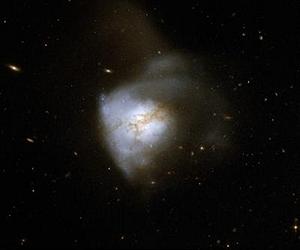
Arp 220 is a nearby example of a merged starburst galaxy similar to SMM J2135-0102. Located 250 million light-years from Earth, Arp 220 is the aftermath of a collision between two spiral galaxies.

The collision, which began about 700 million years ago, has sparked a crackling burst of star formation, resulting in about 200 huge star clusters in a packed, dusty region about 5,000 light-years across (about 5 percent of the Milky Way's diameter).

The star clusters are the bluish-white bright knots visible in the Hubble image. Credit: NASA, ESA, the Hubble Heritage-ESA/Hubble Collaboration, and A. Evans (UVa/NRAO/Stony Brook)


Astronomers have combined a natural gravitational lens and a sophisticated telescope array to get the sharpest view ever of "star factories" in a galaxy over 10 billion light-years from Earth. They found that the distant galaxy, known as SMM J2135-0102, is making new stars 250 times faster than our Galaxy, the Milky Way.

They also pinpointed four discrete star-forming regions within the galaxy, each over 100 times brighter than locations (like the Orion Nebula) where stars form in our Galaxy. This is the first time that astronomers have been able to study properties of individual star-forming regions within a galaxy so far from Earth.

Read the full article here