Showing posts with label spin. Show all posts

Thursday, October 16, 2014

Molten metals in spin cycle on ESA's centrifuge

Housed at ESA’s ESTEC technical centre in Noordwijk, the Netherlands, the Large Diameter Centrifuge (LDC) is not designed for astronaut training but specifically for research. 

Jointly financed by ESA and the Dutch government, it is available for a wide variety of applications. 

The 8 m-diameter LDC can operate at up to 20 g, with four gondolas able to accommodate up to 80 kg of payloads, with a central gondola as a control. 

Two additional gondolas can be attached to mid-arm to provide different g-levels simultaneously. Experiments can be spun for up to six months non-stop. 

Credit: ESA–A. Le Floc'h

The experimenters stared through bulletproof glass at the whirling 8 m-diameter centrifuge. Never mind the shaking or stirring of drink cocktails – what happens when you spin a cocktail of molten metal?

ESA's Large Diameter Centrifuge provides research teams with easy access to hypergravity.

Based at ESA's technical centre in Noordwijk, the Netherlands, it can spin at up to 67 revolutions per minute, producing gravity levels of up to 20 times Earth normal in the gondolas at the end of its four arms.

This time around, one of the gondolas contained a special furnace filled with a molten combination of titanium and aluminium. After around an hour's spinning, the alloy was allowed to cool and solidify over 15 minutes.

Afterwards, the titanium aluminide (TiAl) was removed to see how the newly formed metal's microstructure had been affected by a gravity level eight times stronger than Jupiter's.

"While lightweight, titanium aluminide (TiAl) is strong and corrosion-resistant," explained Laszlo Sturz of the Access company, a spin-off of Technical University of Aachen in Germany, taking part in the research.

"In particular, its strength increases with temperature, making it particularly promising for building aerospace and automotive engine elements as well as other moving parts.

A furnace for the solidification of titanium aluminide (TiAl) alloy ready to be placed into its Large Diameter Centrifuge gondola. 

The furnace chamber at the cylinder's core is surrounded by ceramic heatshields and buffered by inert argon gas, with telemetry systems and external water-cooling pipes seen wrapped around the cylinder. 

Credit: ESA–A. Le Floc'h

"Right now, titanium aluminide parts are cast in various ways, including centrifugal, where a ceramic mould is spun as the alloy cools. But such manufacturing follows a trial-and-error approach.

"Our project aims at creating a detailed mathematical model of how solidification is influenced by changing gravity levels, to help in optimising future casting technology."

Gravity-driven convection in the molten metal influences the solidification: change the level of gravity and the microscopic alloy grains should change their size, too.

While differing levels of hypergravity can been accessed through the ESA's centrifuge, microgravity casting will be tested next year during the 10–15 minutes of weightlessness available on the flight of a suborbital rocket.

A quartet of casting furnaces will be flown on the Maxus rocket.

The ESA-led GRADECET project (Gravity Dependence of Columnar to equiaxed transition in peritectic TiAl alloys) involves researchers from Germany, Ireland, Slovakia, France and Hungary. 

Data for the GRADECET model are being gathered by solidifying TiAl across a spectrum of gravity levels. 

Gravity drives convection flows in the molten metal that influence the solidification process; change the level of gravity and the microscopic grain size of the alloy should change too. 

A quartet of casting furnaces will be flown on an ESA Maxus suborbital rocket in 2015. 

A previous furnace design flew on Maxus-8 in 2010, seen here with four cylindrical furnaces. 

Credit: ESA

"This centrifuge campaign is also serving to qualify them for flight," said ESA's Antonio Verga.

The challenge was to design a self-contained furnace that can heat up to the 1700°C required on the inside while its outermost skin remains at no more than 70°C.

The chamber where electrical heaters melt the alloy is surrounded by ceramic heatshielding and buffeted by inert argon gas, with water coolant pipes threaded around the cylinder's exterior.

Temperature sensors will relay realtime data to eager researchers throughout the process.


Wednesday, September 10, 2014

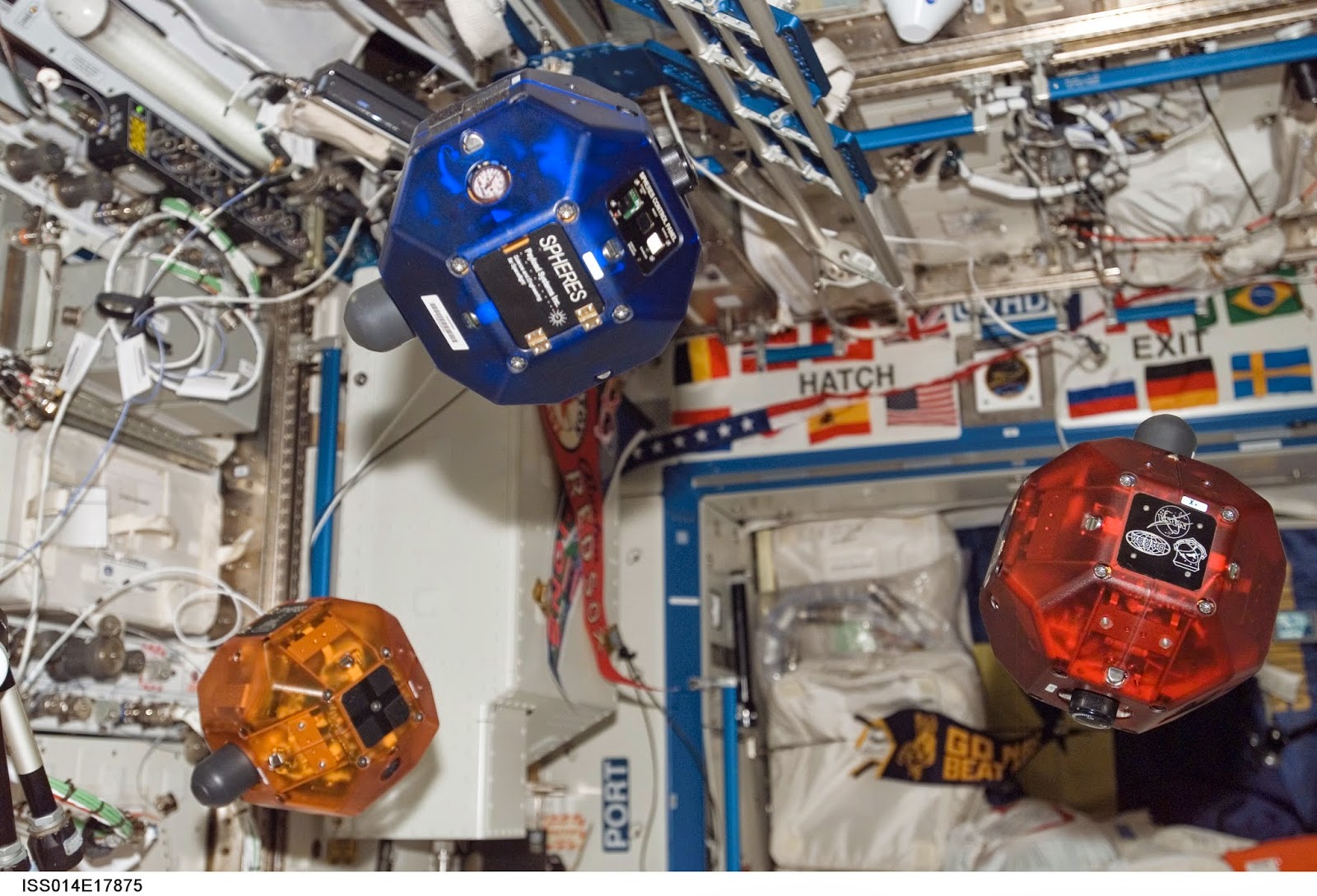
MIT SPHERES: Spin Algorithm tested aboard the International Space Station


MIT researchers tested an algorithm that gauges the rotation of objects in zero gravity aboard the International Space Station. 

This video shows a Zero-G flight where a tracked object is spinning on its major, minor, and intermediate axes.

Objects in space tend to spin, and spin in a way that's totally different from the way they spin on earth.

Understanding how objects are spinning, where their centers of mass are, and how their mass is distributed is crucial to any number of actual or potential space missions, from cleaning up debris in the geosynchronous orbit favoured by communications satellites to landing a demolition crew on a comet.

In a forthcoming issue of the Journal of Field Robotics, MIT researchers will describe a new algorithm for gauging the rotation of objects in zero gravity using only visual information, and at the International Conference on Intelligent Robots and Systems this month, they will report the results of a set of experiments in which they tested the algorithm aboard the International Space Station.

On all but one measure, their algorithm was very accurate, even when it ran in real time on the microprocessor of a single, volleyball-size experimental satellite.

On the remaining measure, which indicates the distribution of the object's mass, the algorithm didn't fare quite as well when running in real time, although its estimate may still be adequate for many purposes, but it was much more accurate when it had slightly longer to run on a more powerful computer.

Space trash

"There are satellites that are basically dead, that are in the 'geostationary graveyard,' a few hundred kilometers from the normal geostationary orbit," says Alvar Saenz-Otero, a principal research scientist in MIT's Department of Aeronautics and Astronautics.

"With over 6,000 satellites operating in space right now, people are thinking about recycling. Can we get to that satellite, observe how it's spinning, and learn its dynamic behaviour so that we can dock to it?"

Moreover, "there's a lot of space trash these days," Saenz-Otero adds. "There are thousands of pieces of broken satellites in space."

"If you were to send a supermassive spacecraft up there, yes, you could collect all of those, but it would cost lots of money, but if you send a small spacecraft, and you try to dock to a small, tumbling thing, you also are going to start tumbling."

"So you need to observe that thing that you know nothing about so you can grab it and control it."

Joining Saenz-Otero on the paper are lead author Brent Tweddle, who was an MIT graduate student in aeronautics and astronautics when the work was done and is now at NASA's Jet Propulsion Laboratory; his fellow grad student Tim Setterfield; AeroAstro Professor David Miller; and John Leonard, a professor of mechanical and ocean engineering.

The researchers tested their algorithm using two small satellites deployed to the space station through MIT's SPHERES project, which envisions that herds of coordinated satellites the size of volleyballs would assist human crews on future space missions.

One SPHERES satellite spun in place while another photographed it with a stereo camera.

Thursday, March 6, 2014

Chandra and XMM-Newton: Direct measurement of distant black hole's spin

Multiple images of a distant quasar known as RX J1131-1231 are visible in this combined view from Chandra (pink) and Hubble (red, green, and blue). 

Credit: NASA/CXC/Univ of Michigan/R.C.Reis et al; Optical: NASA/STSc

Astronomers have used NASA's Chandra X-ray Observatory and the European Space Agency's (ESA) XMM-Newton to show a supermassive black hole six billion light years from Earth is spinning extremely rapidly.

This first direct measurement of the spin of such a distant black hole is an important advance for understanding how black holes grow over time.

Chandra X-ray Observatory
Black holes are defined by just two simple characteristics: mass and spin.

While astronomers have long been able to measure black hole masses very effectively, determining their spins has been much more difficult.

In the past decade, astronomers have devised ways of estimating spins for black holes at distances greater than several billion light-years away, meaning we see the region around black holes as they were billions of years ago.

However, determining the spins of these remote black holes involves several steps that rely on one another.

Rubens Reis
"We want to be able to cut out the middle man, so to speak, of determining the spins of black holes across the universe," said Rubens Reis of the University of Michigan in Ann Arbor, who led a paper describing this result that was published online Wednesday in the journal Nature.

Reis and his colleagues determined the spin of the supermassive black hole that is pulling in surrounding gas, producing an extremely luminous quasar known as RX J1131-1231 (RX J1131 for short).

ESA XMM-Newton
Because of fortuitous alignment, the distortion of space-time by the gravitational field of a giant elliptical galaxy along the line of sight to the quasar acts as a gravitational lens that magnifies the light from the quasar.

Gravitational lensing, first predicted by Einstein, offers a rare opportunity to study the innermost region in distant quasars by acting as a natural telescope and magnifying the light from these sources.

Mark Reynolds
"Because of this gravitational lens, we were able to get very detailed information on the X-ray spectrum – that is, the amount of X-rays seen at different energies – from RX J1131," said co-author Mark Reynolds also of Michigan.

"This in turn allowed us to get a very accurate value for how fast the black hole is spinning."

The X-rays are produced when a swirling accretion disk of gas and dust that surrounds the black hole creates a multimillion-degree cloud, or corona near the black hole.

X-rays from this corona reflect off the inner edge of the accretion disk.

The strong gravitational forces near the black hole alter the reflected X-ray spectrum. The larger the change in the spectrum, the closer the inner edge of the disk must be to the black hole.

More information: Paper: dx.doi.org/10.1038/nature13031