Showing posts with label Doradus nebula. Show all posts

Thursday, August 16, 2012

NASA Hubble Watches Star Clusters on a Collision Course

This is a Hubble Space Telescope image of a pair of star clusters that are believed to be in the early stages of merging.

The clusters lie in the gigantic 30 Doradus nebula, which is 170,000 light-years from Earth.

The Hubble observations, made with the Wide Field Camera 3, were taken Oct. 20-27, 2009.

The blue colour is light from the hottest, most massive stars; the green from the glow of oxygen; and the red from fluorescing hydrogen.

Image Credit: NASA, ESA, R. O'Connell (University of Virginia), and the Wide Field Camera 3 Science Oversight Committee

Astronomers using data from NASA's Hubble Space Telescope have caught two clusters full of massive stars that may be in the early stages of merging.

The clusters are 170,000 light-years away in the Large Magellanic Cloud, a small satellite galaxy to our Milky Way, a small satellite galaxy to our Milky Way.

What at first was thought to be only one cluster in the core of the massive star-forming region 30 Doradus (also known as the Tarantula Nebula) has been found to be a composite of two clusters that differ in age by about one million years.

The entire 30 Doradus complex has been an active star-forming region for 25 million years, and it is currently unknown how much longer this region can continue creating new stars. Smaller systems that merge into larger ones could help to explain the origin of some of the largest known star clusters.

Lead scientist Elena Sabbi of the Space Telescope Science Institute in Baltimore, Md., and her team began looking at the area while searching for runaway stars, fast-moving stars that have been kicked out of their stellar nurseries where they first formed.

"Stars are supposed to form in clusters, but there are many young stars outside 30 Doradus that could not have formed where they are; they may have been ejected at very high velocity from 30 Doradus itself," Sabbi said.

She then noticed something unusual about the cluster when looking at the distribution of the low-mass stars detected by Hubble.

It is not spherical, as was expected, but has features somewhat similar to the shape of two merging galaxies where their shapes are elongated by the tidal pull of gravity.

Hubble’s circumstantial evidence for the impending merger comes from seeing an elongated structure in one of the clusters, and from measuring a different age between the two clusters.

According to some models, the giant gas clouds out of which star clusters form may fragment into smaller pieces.

Once these small pieces precipitate stars, they might then interact and merge to become a bigger system. This interaction is what Sabbi and her team think they are observing in 30 Doradus.

Friday, March 9, 2012

NASA Hubble Image: El Dorado Galaxies


NASA's Hubble Space Telescope has produced this beautiful image of the galaxy NGC 1483.

NGC 1483 is a barred spiral galaxy located in the southern constellation of Dorado, the dolphinfish (or Mahi-mahi fish) in Spanish.

The nebulous galaxy features a bright central bulge and diffuse arms with distinct star-forming regions.

Many other distant galaxies can be seen in the background.


The constellation Dorado is home to the Dorado Group of galaxies, a loose group comprised of an estimated 70 galaxies and located some 62 million light-years away.

The Dorado group is much larger than the Local Group that includes the Milky Way, which contains around 30 galaxies. It also approaches the size of a galaxy cluster.

Galaxy clusters are the largest groupings of galaxies (and indeed the largest structures of any type) in the universe to be held together by their gravity.

Barred spiral galaxies are so named because of the prominent bar-shaped structures found in their center. They form about two thirds of all spiral galaxies, including the Milky Way.

Recent studies suggest that bars may be a common stage in the formation of spiral galaxies, and may indicate that a galaxy has reached full maturity.

Image Credit: ESA/Hubble & NASA

NASA - Hubble Views Grand Star-Forming Region

This massive, young stellar grouping, called R136, is only a few million years old and resides in the 30 Doradus Nebula, a turbulent star-birth region in the Large Magellanic Cloud, a satellite galaxy of the Milky Way.

There is no known star-forming region in the Milky Way Galaxy as large or as prolific as 30 Doradus.

Many of the diamond-like icy blue stars are among the most massive stars known. Several of them are 100 times more massive than our sun. These hefty stars are destined to pop off, like a string of firecrackers, as supernovas in a few million years.

The image, taken in ultraviolet, visible and red light by Hubble's Wide Field Camera 3, spans about 100 light-years.

The nebula is close enough to Earth that Hubble can resolve individual stars, giving astronomers important information about the stars' birth and evolution.

The brilliant stars are carving deep cavities in the surrounding material by unleashing a torrent of ultraviolet light, and hurricane-force stellar winds (streams of charged particles), which are etching away the enveloping hydrogen gas cloud in which the stars were born.

The image reveals a fantasy landscape of pillars, ridges, and valleys, as well as a dark region in the center that roughly looks like the outline of a holiday tree.

Besides sculpting the gaseous terrain, the brilliant stars can also help create a successive generation of offspring. When the winds hit dense walls of gas, they create shocks, which may be generating a new wave of star birth.

These observations were taken Oct. 20-27, 2009. The blue color is light from the hottest, most massive stars; the green from the glow of oxygen; the red from fluorescing hydrogen.

Image Credit: NASA, ESA

Tuesday, January 10, 2012

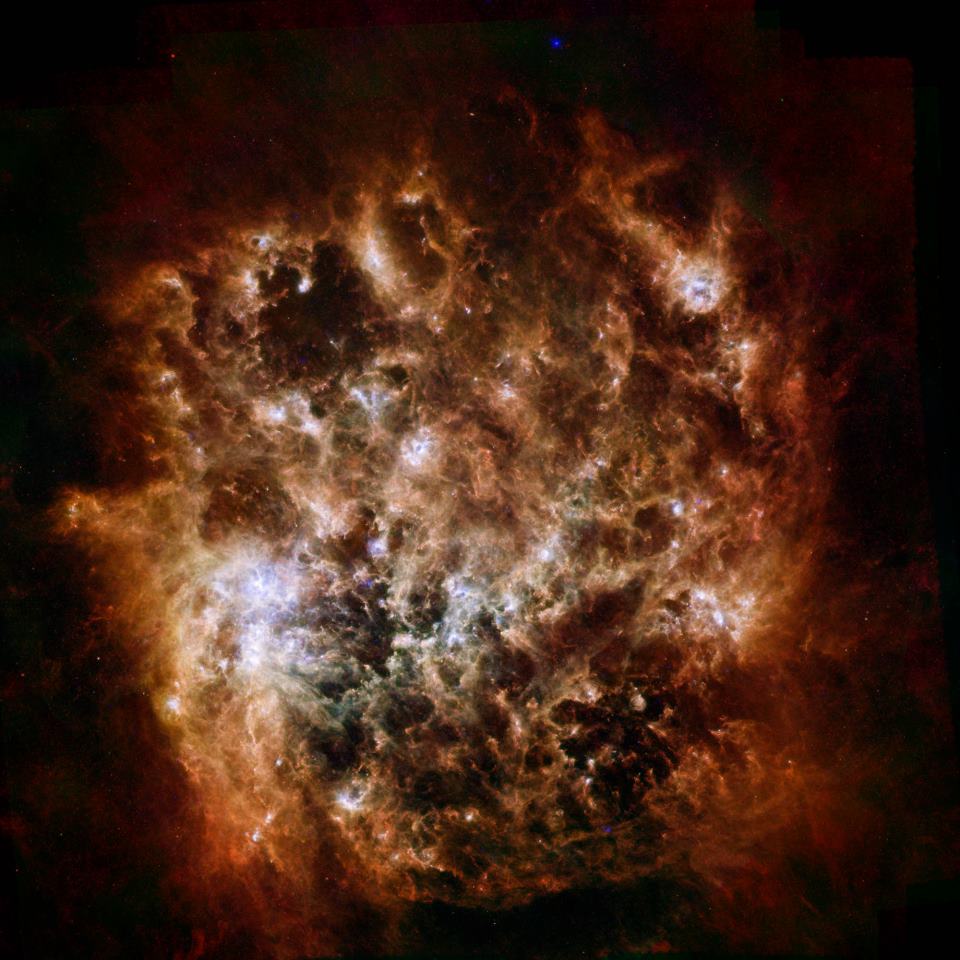
NASA Spitzer image: Large Megellanic Cloud

This new image shows the Large Magellanic Cloud galaxy in infrared light as seen by the Herschel Space Observatory, a European Space Agency-led mission with important NASA contributions, and NASA’s Spitzer Space Telescope.

In the instruments' combined data, this nearby dwarf galaxy looks like a fiery, circular explosion.

Rather than fire, however, those ribbons are actually giant ripples of dust spanning tens or hundreds of light-years.

Significant fields of star formation are noticeable in the center, just left of center and at right.

The brightest center-left region is called 30 Doradus, or the Tarantula Nebula, for its appearance in visible light.

The colours in this image indicate temperatures in the dust that permeates the Cloud. Colder regions show where star formation is at its earliest stages or is shut off, while warm expanses point to new stars heating surrounding dust.

The coolest areas and objects appear in red, corresponding to infrared light taken up by Herschel's Spectral and Photometric Imaging Receiver at 250 microns, or millionths of a meter.

Herschel's Photodetector Array Camera and Spectrometer fills out the mid-temperature bands, shown here in green, at 100 and 160 microns. The warmest spots appear in blue, courtesy of 24- and 70-micron data from Spitzer.

Image credit: ESA/NASA/JPL-Caltech/STScI

Thursday, May 13, 2010

Nasa Hubble COS Image: Doradus Nebula and the Runaway Star

A heavy runaway star is rushing away from a nearby stellar nursery at more than 250,000 miles an hour, a speed at which one could travel to the our moon and back in two hours.

This is the most extreme case of a very massive star that has been kicked out of its home by a group of even heftier siblings.

The homeless star is on the outskirts of the 30 Doradus Nebula, a raucous stellar breeding ground in the nearby Large Magellanic Cloud. The stellar nusery is seen at the center of this image. The finding bolsters evidence that the most massive stars in the local universe reside in 30 Doradus, making it a unique laboratory for studying heavyweight stars. Also called the Tarantula Nebula, 30 Doradus is roughly 170,000 light-years from Earth.

Tantalizing clues from three observatories, including the Hubble Space Telescope's newly installed Cosmic Origins Spectrograph (COS), and some old- fashioned detective work, suggest that the star may have traveled about 375 light-years from its suspected home, a giant star cluster called R136. Nestled in the core of 30 Doradus, R136 contains several stars topping 100 solar masses each.

Visit Hubble Catches Heavyweight Runaway Star for more information.

Image Credit: NASA, ESA, C. Evans (Royal Observatory Edinburgh), N. Walbom (STScI), and ESO

Wednesday, May 12, 2010

NASA Hubble (HST) Image: Doradus Nebula and the Runaway Star

This image of the 30 Doradus nebula, a rambunctious stellar nursery, and the enlarged inset photo show a heavyweight star that may have been kicked out of its home by a pair of heftier siblings.

In the inset image at right, an arrow points to the stellar runaway and a dashed arrow to its presumed direction of motion.

Credit for Hubble Image: NASA, ESA, J. Walsh (ST-ECF), and ESO Acknowledgment: Processing by Z. Levay (STScI) Credit for wide-field Image: ESO Acknowledgement: J. Alves (Calar Alto, Spain), and B. Vandame and Y. Beletski (ESO). Processing by B. Fosbury (ST-ECF).

A heavy runaway star is rushing away from a nearby stellar nursery at more than 250,000 miles an hour, a speed that will get you to the Moon and back in two hours. The runaway is the most extreme case of a very massive star that has been kicked out of its home by a group of even heftier siblings.

The homeless star is on the outskirts of the 30 Doradus nebula, a raucous stellar breeding ground in the nearby Large Magellanic Cloud.

The finding bolsters evidence that the most massive stars in the local universe reside in 30 Doradus, making it a unique laboratory for studying heavyweight stars. Also called the Tarantula Nebula, 30 Doradus is roughly 170,000 light-years from Earth.

Tantalising clues from three observatories, including the Hubble Space Telescope's newly installed Cosmic Origins Spectrograph (COS), and some old- fashioned detective work, suggest that the star may have traveled about 375 light-years from its suspected home, a giant star cluster called R136. Nestled in the core of 30 Doradus, R136 contains several stars topping 100 solar masses each.

The observations offer insights into how massive star clusters behave.

"These results are of great interest because such dynamical processes in very dense, massive clusters have been predicted theoretically for some time, but this is the first direct observation of the process in such a region," says Nolan Walborn of the Space Telescope Science Institute in Baltimore and a member of the COS team that observed the misfit star.

"Less massive runaway stars from the much smaller Orion Nebula Cluster were first found over half a century ago, but this is the first potential confirmation of more recent predictions applying to the most massive young clusters."