Showing posts with label ESA Herschel. Show all posts

Wednesday, January 30, 2013

ESA Herschel Image: Andromeda's Colourful Rings

The ring-like swirls of dust filling the Andromeda galaxy stand out colourfully in this new image from the Herschel Space Observatory, a European Space Agency mission with important NASA participation.

The glow seen here comes from the longer-wavelength, or far, end of the infrared spectrum, giving astronomers the chance to identify the very coldest dust in our galactic neighbor.

These light wavelengths span from 250 to 500 microns, which are a quarter to half of a millimeter in size.

Herschel's ability to detect the light allows astronomers to see clouds of dust at temperatures of only a few tens of degrees above absolute zero.

These clouds are dark and opaque at shorter wavelengths. The Herschel view also highlights spokes of dust between the concentric rings.

The colours in this image have been enhanced to make them easier to see, but they do reflect real variations in the data. The very coldest clouds are brightest in the longest wavelengths, and coloured red here, while the warmer ones take on a bluish tinge.

These data, together with those from other observatories, reveal that other dust properties, beyond just temperature, are affecting the infrared color of the image.

Clumping of dust grains, or growth of icy mantles on the grains towards the outskirts of the galaxy, appear to contribute to these subtle color variations.

These observations were made by Herschel's Spectral and Photometric Imaging Receiver (SPIRE) instrument

The data were processed as part of a project to improve methods for assembling mosaics from SPIRE observations.

Light with a wavelength of 250 microns is rendered as blue, 350-micron is green, and 500-micron light is red. Color saturation has been enhanced to bring out the small differences at these wavelengths.

Image credit: ESA/NASA/JPL-Caltech/NHSC

Saturday, August 4, 2012

ESA Herschel - Small Magellanic Star Formation in a Dwarf Galaxy

This image shows the Small Magellanic Cloud galaxy in infrared light from the Herschel Space Observatory, a European Space Agency-led mission, and NASA's Spitzer Space Telescope.

Considered dwarf galaxies compared to the big spiral of the Milky Way, the Large and Small Magellanic Clouds are the two biggest satellite galaxies of our home galaxy.

In combined data from Herschel and Spitzer, the irregular distribution of dust in the Small Magellanic Cloud becomes clear. A stream of dust extends to the left in this image, known as the galaxy's "wing," and a bar of star formation appears on the right.

The colors in this image indicate temperatures in the dust that permeates the Cloud. Colder regions show where star formation is at its earliest stages or is shut off, while warm expanses point to new stars heating surrounding dust.

The coolest areas and objects appear in red, corresponding to infrared light taken up by Herschel's Spectral and Photometric Imaging Receiver at 250 microns, or millionths of a meter.

Herschel's Photodetector Array Camera and Spectrometer fills out the mid-temperature bands, shown here in green, at 100 and 160 microns. The warmest spots appear in blue, courtesy of 24- and 70-micron data from Spitzer.

Image Credit: ESA/NASA/JPL-Caltech/STScI

Tuesday, March 13, 2012

NASA - Orion's Rainbow of Infrared Light

This new view of the Orion Nebula highlights fledgling stars hidden in the gas and clouds.

It shows infrared observations taken by NASA's Spitzer Space Telescope and the European Space Agency's Herschel mission, in which NASA plays an important role.

Stars form as clumps of this gas and dust collapses, creating warm globs of material fed by an encircling disk. 

These dusty envelopes glow brightest at longer wavelengths, appearing as red dots in this image. 

In several hundred thousand years, some of the forming stars will accrete enough material to trigger nuclear fusion at their cores and then blaze into stardom.

Spitzer is designed to see shorter infrared wavelengths than Herschel. By combining their observations, astronomers get a more complete picture of star formation.

The colours in this image relate to the different wavelengths of light, and to the temperature of material, mostly dust, in this region of Orion.

Data from Spitzer show warmer objects in blue, with progressively cooler dust appearing green and red in the Herschel datasets.

The more evolved, hotter embryonic stars thus appear in blue.

Infrared data at wavelengths of 8.0 and 24 microns from Spitzer are rendered in blue. Herschel data with wavelengths of 70 and 160 microns are represented in green and red, respectively.

This image was released on Feb. 29, 2012.

Image Credit: NASA/ESA/JPL-Caltech/IRAM

Thursday, January 19, 2012

ESA Herschel Image: A New View of the Eagle Nebula

Combining almost opposite ends of the electromagnetic spectrum, this composite of the Herschel in far-infrared and XMM-Newton’s X-ray images shows how the hot young stars detected by the X-ray observations are sculpting and interacting with the surrounding ultra-cool gas and dust, which, at only a few degrees above absolute zero, is the critical material for star formation itself.

Both wavelengths would be blocked by Earth’s atmosphere, so are critical to our understanding of the lifecycle of stars

Credits: far-infrared: ESA/Herschel/PACS/SPIRE/Hill, Motte, HOBYS Key Programme Consortium; X-ray: ESA/XMM-Newton/EPIC/XMM-Newton-SOC/Boulanger

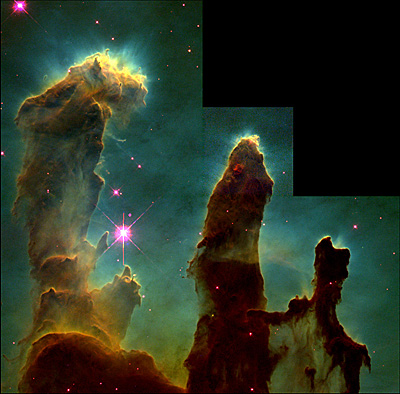
The Eagle Nebula as never seen before. In 1995, the Hubble Space Telescope's 'Pillars of Creation' image of the Eagle Nebula became one of the most iconic images of the 20th century. Now, two of ESA's orbiting observatories have shed new light on this enigmatic star-forming region.

The Eagle Nebula is 6500 light-years away in the constellation of Serpens. It contains a young hot star cluster, NGC6611, visible with modest back-garden telescopes, that is sculpting and illuminating the surrounding gas and dust, resulting in a huge hollowed-out cavity and pillars, each several light-years long.

The Hubble image hinted at new stars being born within the pillars, deeply inside small clumps known as 'evaporating gaseous globules' or EGGs. Owing to obscuring dust, Hubble's visible light picture was unable to see inside and prove that young stars were indeed forming.

The ESA Herschel Space Observatory's new image shows the pillars and the wide field of gas and dust around them. Captured in far-infrared wavelengths, the image allows astronomers to see inside the pillars and structures in the region.

In parallel, a new multi-energy X-ray image from ESA's XMM-Newton telescope shows those hot young stars responsible for carving the pillars.

This 1995 Hubble Space Telescope image of the ‘Pillars of Creation’ is probably the most famous astronomical image of the 20th Century.

Taken in visible light using a combination of SII/H-alpha and OIII filters, it shows a part of the Eagle Nebula where new stars are forming.

The tallest pillar is around 4 light-years high

Credits: NASA/ESA/STScI, Hester & Scowen (Arizona State University)

Combining the new space data with near-infrared images from the European Southern Observatory's (ESO's) Very Large Telescope at Paranal, Chile, and visible-light data from its Max Planck Gesellschaft 2.2m diameter telescope at La Silla, Chile, we see this iconic region of the sky in a uniquely beautiful and revealing way.

In visible wavelengths, the nebula shines mainly due to reflected starlight and hot gas filling the giant cavity, covering the surfaces of the pillars and other dusty structures.

At near-infrared wavelengths, the dust becomes almost transparent and the pillars practically vanish.
In far-infrared, Herschel detects this cold dust and the pillars reappear, this time glowing in their own light.

Intricate tendrils of dust and gas are seen to shine, giving astronomers clues about how it interacts with strong ultraviolet light from the hot stars seen by XMM-Newton.

In 2001, Very Large Telescope near-infrared images had shown only a small minority of the EGGs were likely to contain stars being born.

However, Herschel's image makes it possible to search for young stars over a much wider region and thus come to a much fuller understanding of the creative and destructive forces inside the Eagle Nebula.

Earlier mid-infrared images from ESA's Infrared Space Observatory and NASA's Spitzer, and the new XMM-Newton data, have led astronomers to suspect that one of the massive, hot stars in NGC6611 may have exploded in a supernova 6000 years ago, emitting a shockwave that destroyed the pillars.

However, because of the distance of the Eagle Nebula, we won't see this happen for several hundred years yet.

Powerful ground-based telescopes continue to provide astonishing views of our Universe, but images in far-infrared, mid-infrared and X-ray wavelengths are impossible to obtain owing to the absorbing effects of Earth's atmosphere.

Space-based observatories such as ESA's Herschel and XMM-Newton help to peel back that veil and see the full beauty of the Universe across the electromagnetic spectrum.

With regions like the Eagle Nebula, combining all of these observations helps astronomers to understand the complex yet amazing lifecycle of stars

Tuesday, January 10, 2012

NASA Spitzer image: Large Megellanic Cloud

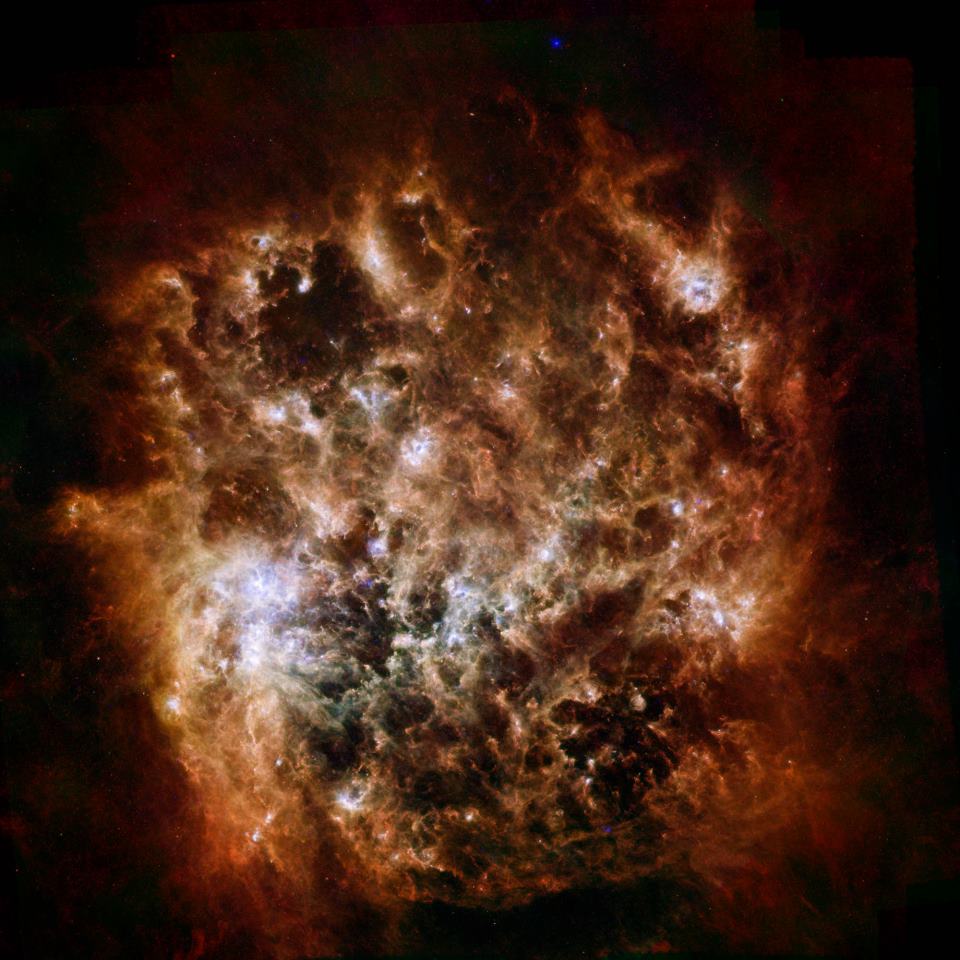
This new image shows the Large Magellanic Cloud galaxy in infrared light as seen by the Herschel Space Observatory, a European Space Agency-led mission with important NASA contributions, and NASA’s Spitzer Space Telescope.

In the instruments' combined data, this nearby dwarf galaxy looks like a fiery, circular explosion.

Rather than fire, however, those ribbons are actually giant ripples of dust spanning tens or hundreds of light-years.

Significant fields of star formation are noticeable in the center, just left of center and at right.

The brightest center-left region is called 30 Doradus, or the Tarantula Nebula, for its appearance in visible light.

The colours in this image indicate temperatures in the dust that permeates the Cloud. Colder regions show where star formation is at its earliest stages or is shut off, while warm expanses point to new stars heating surrounding dust.

The coolest areas and objects appear in red, corresponding to infrared light taken up by Herschel's Spectral and Photometric Imaging Receiver at 250 microns, or millionths of a meter.

Herschel's Photodetector Array Camera and Spectrometer fills out the mid-temperature bands, shown here in green, at 100 and 160 microns. The warmest spots appear in blue, courtesy of 24- and 70-micron data from Spitzer.

Image credit: ESA/NASA/JPL-Caltech/STScI

NASA Infra-Red: Small Magellanic Cloud

This new image shows the Small Magellanic Cloud galaxy in infrared light from the Herschel Space Observatory a European Space Agency-led mission with important NASA contributions, and NASA’s Spitzer Space Telescope.

The Large and Small Magellanic Clouds are the two biggest satellite galaxies of our home galaxy, the Milky Way, though they are still considered dwarf galaxies compared to the big spiral of the Milky Way.

In combined data from Herschel and Spitzer, the irregular distribution of dust in the Small Magellanic Cloud becomes clear. A stream of dust extends to the left in this image, known as the galaxy's "wing," and a bar of star formation appears on the right.

The colours in this image indicate temperatures in the dust that permeates the Cloud. Colder regions show where star formation is at its earliest stages or is shut off, while warm expanses point to new stars heating surrounding dust.

The coolest areas and objects appear in red, corresponding to infrared light taken up by Herschel's Spectral and Photometric Imaging Receiver at 250 microns, or millionths of a meter.

Herschel's Photodetector Array Camera and Spectrometer fills out the mid-temperature bands, shown here in green, at 100 and 160 microns. The warmest spots appear in blue, courtesy of 24- and 70-micron data from Spitzer.

Image credit: ESA/NASA/JPL-Caltech/STScI

Tuesday, December 20, 2011

Astronomy Image: Sculptor Group of Galaxies

NGC 253 is not only one of the brightest spiral galaxies visible, it is also one of the dustiest.

Discovered in 1783 by Caroline Herschel in the constellation of Sculptor, NGC 253 lies only about ten million light-years distant. NGC 253 is the largest member of the Sculptor Group of Galaxies, the nearest group to our own Local Group of Galaxies.

The dense dark dust accompanies a high star formation rate, giving NGC 253 the designation of starburst galaxy. Visible in the above photograph is the active central nucleus, also known to be a bright source of X-rays and gamma rays.

Sunday, October 23, 2011

ESA Herschel: Misty Star in the Sea Serpent

This artist's concept illustrates an icy planet-forming disk around a young star called TW Hydrae, located about 175 light-years away in the Hydra, or Sea Serpent, constellation.

Astronomers using the Herschel Space Observatory detected copious amounts of cool water vapor, illustrated in blue, emanating from the star's planet-forming disk of dust and gas.

The water vapour, which probably comes from icy grains in the disk, is located in the frigid outer regions of the star system, where comets will take shape.

In our own solar system, comets are thought to have carried water to Earth, creating our oceans. A similar process might be taking place around TW Hydrae, comets could, over the next several millions of years, transport water to young worlds.

The Herschel results demonstrate that vast reservoirs of water are available around stars for creating these hypothetical water worlds.

Herschel is a European Space Agency mission with significant NASA contributions. Launched in 2009, the spacecraft carries science instruments provided by consortia of European institutes.

NASA's Herschel Project Office based at JPL contributed mission-enabling technology for two of Herschel's three science instruments. The NASA Herschel Science Center, part of the Infrared Processing and Analysis Center at the California Institute of Technology in Pasadena, supports the U.S. astronomical community.

Image credit: NASA/JPL-Caltech

› See graph

Friday, October 7, 2011

ESA Herschel Image: Comet Hartley 2

Early last November, small but active Comet Hartley 2 (103/P Hartley) became the fifth comet imaged close-up by a spacecraft from planet Earth.

Still cruising through the solar system with a 6 year orbital period, Hartley 2 is is making astronomical headlines again, though.

New Herschel Space Observatory measurements indicate that the water found in this comet's thin atmosphere or coma has the same ratio of the hydrogen isotope deuterium (in heavy water) as the oceans of our fair planet.

Hartley 2 originated in the distant Kuiper Belt, a region beyond the orbit of Neptune that is a reservoir of icy cometary bodies and dwarf planets.

Since the ratio of deuterium is related to the solar system environment where the comet formed, the Herschel results indicate that Kuiper Belt comets could have contributed substantial amounts of water to Earth's oceans.

Comet Hartley 2 appears in this starry skyscape from last November sporting a tantalizing greenish coma appropriately sailing through the nautical constellation Puppis. Below the comet are open star clusters M47 (right) and M46 (left).

Tuesday, September 13, 2011

ESA Herschel: Painting a new story of galaxy evolution

A galaxy accretes mass from rapid, narrow streams of cold gas.

These filaments provide the galaxy with continuous flows of raw material to feed its star-forming at a rather leisurely pace.

This theoretical scenario for galaxy formation is based on the numerical simulations presented by Dekel et al., 2009 (Nature, 457, 451D).

However, the actual process of stream accretion onto a galaxy has never been directly observed and it remains speculative.

ESA's Herschel infrared space observatory has discovered that galaxies do not need to collide with each other to drive vigorous star birth. The finding overturns this long-held assumption and paints a more stately picture of how galaxies evolve.

The conclusion is based on Herschel's observations of two patches of sky, each about a third of the size of the full Moon.

It's like looking through a keyhole across the Universe – Herschel has seen more than a thousand galaxies at a variety of distances from the Earth, spanning 80% of the age of the cosmos.

These observations are unique because Herschel can study a wide range of infrared light and reveal a more complete picture of star birth than ever seen before.

It has been known for some years that the rate of star formation peaked in the early Universe, about 10 billion years ago. Back then, some galaxies were forming stars ten or even a hundred times more vigorously than is happening in our Galaxy today. 

GOODS-North is a patch of sky in the northern hemisphere that covers an area of about a third the size of the Full Moon.

This images was taken by Herschel at the following infrared wavelengths: 100μm (blue), 160μm (green) and 250μm (red). North is up and East is left.

Credits: ESA/GOODS-Herschel consortium/David Elbaz
 

GOODS-South is a patch of sky in the southern hemisphere that covers an area of about a third the size of the Full Moon. 

This image was taken by Herschel and NASA's Spitzer space telescope at the following infrared wavelengths:24 μm (blue), 100 μm (green) and 160 μm (red). North is up and East is left.

Credits: ESA/GOODS-Herschel consortium/NASA/JPL-Caltech/David Elbazere


Read more here at the ESA Herschel portal

Tuesday, June 14, 2011

NASA SOFIA: Through the Looking Glass

The NASA logo on Bldg. 703 at the Dryden Aircraft Operations Facility in Palmdale, Calif., is reflected in the 2.5-meter primary mirror of the SOFIA observatory's telescope.

SOFIA, the Stratospheric Observatory for Infrared Astronomy, is an airborne observatory, built to complement the Hubble, Spitzer and Herschel space telescopes, as well as major Earth-based telescopes.

SOFIA features a German-built 100-inch (2.5 meter) diameter far-infrared telescope weighing 20 tons mounted in the rear fuselage of a modified Boeing 747SP aircraft. (See SOFIA at DLR) It is one of the premier space science programs of NASA's Science Mission Directorate.

SOFIA is a joint program between NASA and the DLR, the German Aerospace Centre.

Image Credit: NASA/Tom Tschida

Tuesday, February 22, 2011

ESA Herschel: Finds less dark matter but more stars

ESA’s Herschel space observatory has discovered a population of dust-enshrouded galaxies that do not need as much dark matter as previously thought to collect gas and burst into star formation.

The galaxies are far away and each boasts some 300 billion times the mass of the Sun. The size challenges current theory that predicts a galaxy has to be more than ten times larger, 5000 billion solar masses, to be able form large numbers of stars.

The new result is published today in a paper by Alexandre Amblard, University of California, Irvine, and colleagues.

Most of the mass of any galaxy is expected to be dark matter, a hypothetical substance that has yet to be detected but which astronomers believe must exist to provide sufficient gravity to prevent galaxies ripping themselves apart as they rotate.

ESA Portal - Herschel finds less dark matter but more stars

Thursday, January 6, 2011

ESA Herschel & XMM-Newton Image: The Andromeda Galaxy

The Andromeda Galaxy is our nearest large galactic neighbour, containing several hundred billion stars. Combined, these images show all stages of the stellar life cycle.

The infrared image from Herschel shows areas of cool dust that trace reservoirs of gas in which forming stars are embedded.

The optical image shows adult stars. XMM-Newton's X-ray image shows the violent endpoints of stellar evolution, in which individual stars explode or pairs of stars pull each other to pieces.

Credits: infrared: ESA/Herschel/PACS/SPIRE/J. Fritz, U. Gent; X-ray: ESA/XMM-Newton/EPIC/W. Pietsch, MPE; optical: R. Gendler

Thursday, May 6, 2010

ESA Herschel Images: Our Celestial Backyard

A picture of the first field observed in the H-ATLAS survey, made by combining the images made with the SPIRE camera at 250, 350 and 500 microns.

The colours in the image are not real but have been used to represent the different infrared wavelengths.

The faint blue whisps at the top of the image show dust in our own Galaxy and the bright object just above the centre of the picture is a 'Bok globule', a dense cloud of gas and dust, also in our Galaxy, in which a small star may be forming.

The other objects in the picture are all galaxies, at distances up to 12 billion light-years.

The image shows that the survey is detecting objects in our celestial ‘backyard’ and also other, further ones that we are seeing as they were not long after the Big Bang.

Credits: ESA/ATLAS Consortium

ESA Herschel Images: Vulpecula Constellation


This image, in the constellation of Vulpecula, shows an entire assembly line of newborn stars.

The diffuse glow reveals the widespread cold reservoir of raw material that our Galaxy has in stock for building stars.

Large-scale turbulence from the giant colliding Galactic flows causes this material to condense into the web of filaments that we see all over the image.

These are the ‘pregnant’ entities where the material becomes colder and denser. At this point, gravitational forces take over and fragment these filaments into chains of stellar embryos that can finally collapse to form baby stars.

Credits: ESA/Hi-GAL Consortium

ESA Herschel Images: Eagle Constellation

This image is taken looking towards a region of the Galaxy in the Eagle constellation, closer to the Galactic centre than our Sun. Here, we see the outstanding end-products of the stellar assembly line.

At the centre and the left of the image, the two massive star-forming regions G29.9 and W43 are clearly visible. These mini-starbursts are forming, as we speak, hundreds and hundreds of stars of all sizes: from those similar to our Sun, to monsters several tens of times heavier than our Sun.

These newborn large stars are catastrophically disrupting their original gas embryos by kicking away their surroundings and excavating giant cavities in the Galaxy. This is clearly visible in the 'fluffy chimney' below W43.

Credits: ESA/Hi-GAL Consortium