Friday, August 10, 2012
NASA Mars Rover Curiosity: X-Duetto Instrument
An X-ray diffraction and fluorescence instrument the robot uses to study the composition of rock on the Red Planet's surface has found an application in an unlikely field: art conservation.
The instrument caught the eye of Giacomo Chiari, chief scientist at the Getty Conservation Institute in Los Angeles, as a potentially valuable means to examine priceless works of art without damaging them.
Determining the composition of ancient sculptures, paintings and buildings helps conservationists like Chiari to come up with ways to preserve pieces against the ravages of time.
Until recently, though, only a few instruments were available to determine the composition of ancient artefacts without cutting out physical samples.
Curiosity's instrument directs a beam of X-rays at objects and reads the radiation scattered back to determine what the object is made of in a matter of minutes.
Chiari contacted the instrument's designer, California-based company inXitu, to adapt and build a a more portable instrument for art analysis. (Watch inXitu videos on YouTube)
The new instrument, dubbed the X-Duetto (pdf), can examine objects while preserving their integrity and fits comfortably into a few briefcase-sized boxes.
It is now being used by Getty scientists to analyse a large collection of museum antiques and the Roman ruins of Herculaneum, Italy.
Sunday, April 22, 2012
New research advances development of handheld T-Ray devices
Researchers at the University of Texas at Dallas have reported a new approach to harnessing the potential of the terahertz band in portable devices.
The terahertz band sits between micro waves and infrared on the electromagnetic spectrum and can be used to see through objects such as walls, wood, plastics and paper.
The terahertz wavelength range hasn't been widely accessible for consumer devices until recently. New availability creates new applications however - earlier this year, we reported on how terahertz (or T-Ray) technology could make Star Trek-style tricorders a reality.
"We've created approaches that open a previously untapped portion of the electromagnetic spectrum for consumer use and life-saving medical applications," said Dr. Kenneth O, professor of electrical engineering at University of Texas at Dallas and director of the Texas Analog Center of Excellence, in a statement.
The University of Texas' research centers around the use of CMOS (Complimentary Metal-Oxide Semiconductor) technology to create a terahertz microchip. The approach also by-passes the need to use several lenses inside a device.
"CMOS is affordable and can be used to make lots of chips," Dr. O said on the University of Texas at Dallas website. "The combination of CMOS and terahertz means you could put this chip and receiver in the back of a cell phone, turning it into a device carried in your pocket that can see through objects."
Images produced using this technology can replace X-rays with a less expensive method that might even reduce the risks of exposure previously experienced with X-rays.
The technology might also be used to view more than just bones and related structures - researchers at the University of Texas say it can be used for imaging to detect cancer tumours, diagnosing disease through breath analysis, and monitoring air toxicity.
Because devices with "T-ray" imaging capabilities have the ability to see through most solid, opaque objects, this new technology has applications far beyond the medical field.
"Authentication of documents and currencies is the first application we are thinking of. You can also use this to see through walls to image wires and others," said Dr. O. "You could also use this inspect inside of items such as vase you are purchasing for defects that cannot be seen by eyes."
Dr. O said developing medical uses will take more time.
Terahertz imaging has its limitations. While it can penetrate fog and clouds, challenges occur when trying to penetrate metal and water. The Earth's atmosphere also absorbs terahertz radiation, limiting the range on which a terahertz imaging device can operate.
For now, that's not a big concern. The team plans to limit its uses to devices with a range of less than four inches (10 cm) to address privacy concerns. A device that can see through clothing, walls and other structures is after all, more invasive than the Backscatter scanners used at many airports.
Source: University of Texas at Dallas
Sunday, February 12, 2012
NASA: Portrait of a Doomed Asteroid
The study suggests a cloud around Sgr A*, a supermassive black hole at the center of our Milky Way Galaxy, which contains hundreds of trillions of asteroids and comets that have been stripped from their parent stars.
The flares occur when asteroids of six miles or larger in radius are consumed by the black hole.
An asteroid that undergoes a close encounter with another object, such as a star or planet, can be thrown into an orbit headed towards Sgr A*.
If the asteroid passes within about 100 million miles of the black hole, roughly the distance between the Earth and the sun, it is torn into pieces by the tidal forces from the black hole.
These fragments would then be vapourised by friction as they pass through the hot, thin gas flowing onto Sgr A*, similar to a meteor heating up and glowing as it falls through Earth's atmosphere.
A flare is produced and eventually the remains of the asteroid are swallowed by the black hole.
Image Credit: Illustrations: NASA/CXC/M.Weiss
Friday, January 27, 2012
Chandra X-Ray Image: Dark Energy
The purple emission is multi-million degree gas detected in X-rays by NASA's Chandra X-ray Observatory and the other colors show galaxies in an optical image from the Sloan Digital Sky Survey.
This galaxy cluster is one of 86 observed by Chandra to trace how dark energy has stifled the growth of these massive structures over the last 7 billion years. Galaxy clusters are the largest collapsed objects in the Universe and are ideal for studying the properties of dark energy, the mysterious form of repulsive gravity that is driving the accelerated expansion of the Universe.
The illustration above shows snapshots from a simulation by Volker Springel, representing the growth of cosmic structure when the Universe was 0.9 billion, 3.2 billion and 13.7 billion years old (now).
This shows how the Universe has evolved from a smooth state to one containing a vast amount of structure.
Gas is shown in these snapshots, where the yellow regions are stars and the brightest structures are galaxies and galaxy clusters.
The growth of these structures was initially driven only by the attractive force of gravity, but then later there was competition with the repulsive force of dark energy.
Understanding the nature of dark energy is one of the biggest problems in science. Possibilities include the cosmological constant, equivalent to the energy of empty space, a modification in general relativity on the largest scales, or a more general physical field.
To help decide between these options, Chandra was used to study the increase in mass of galaxy clusters with time over the last 7 billion years.
The results are remarkably consistent with those from previous results that measure the expansion of the Universe using distance measurements, revealing that general relativity works as expected on large scales.
The cluster work, in combination with other studies, also provides the strongest evidence to date that dark energy is the cosmological constant, or that `nothing weighs something'.
Thursday, January 19, 2012
ESA Herschel Image: A New View of the Eagle Nebula
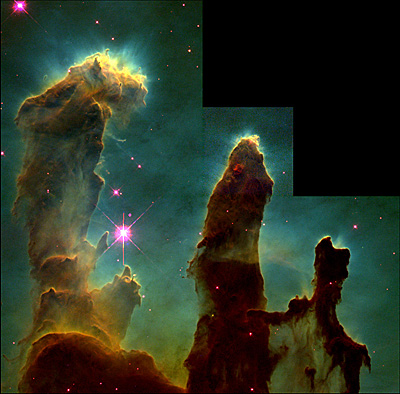
The Eagle Nebula as never seen before. In 1995, the Hubble Space Telescope's 'Pillars of Creation' image of the Eagle Nebula became one of the most iconic images of the 20th century. Now, two of ESA's orbiting observatories have shed new light on this enigmatic star-forming region.
The Eagle Nebula is 6500 light-years away in the constellation of Serpens. It contains a young hot star cluster, NGC6611, visible with modest back-garden telescopes, that is sculpting and illuminating the surrounding gas and dust, resulting in a huge hollowed-out cavity and pillars, each several light-years long.
The Hubble image hinted at new stars being born within the pillars, deeply inside small clumps known as 'evaporating gaseous globules' or EGGs. Owing to obscuring dust, Hubble's visible light picture was unable to see inside and prove that young stars were indeed forming.
The ESA Herschel Space Observatory's new image shows the pillars and the wide field of gas and dust around them. Captured in far-infrared wavelengths, the image allows astronomers to see inside the pillars and structures in the region.
In parallel, a new multi-energy X-ray image from ESA's XMM-Newton telescope shows those hot young stars responsible for carving the pillars.
Credits: NASA/ESA/STScI, Hester & Scowen (Arizona State University)
In visible wavelengths, the nebula shines mainly due to reflected starlight and hot gas filling the giant cavity, covering the surfaces of the pillars and other dusty structures.
At near-infrared wavelengths, the dust becomes almost transparent and the pillars practically vanish.
In far-infrared, Herschel detects this cold dust and the pillars reappear, this time glowing in their own light.
Intricate tendrils of dust and gas are seen to shine, giving astronomers clues about how it interacts with strong ultraviolet light from the hot stars seen by XMM-Newton.
In 2001, Very Large Telescope near-infrared images had shown only a small minority of the EGGs were likely to contain stars being born.
However, Herschel's image makes it possible to search for young stars over a much wider region and thus come to a much fuller understanding of the creative and destructive forces inside the Eagle Nebula.
Earlier mid-infrared images from ESA's Infrared Space Observatory and NASA's Spitzer, and the new XMM-Newton data, have led astronomers to suspect that one of the massive, hot stars in NGC6611 may have exploded in a supernova 6000 years ago, emitting a shockwave that destroyed the pillars.
However, because of the distance of the Eagle Nebula, we won't see this happen for several hundred years yet.
Powerful ground-based telescopes continue to provide astonishing views of our Universe, but images in far-infrared, mid-infrared and X-ray wavelengths are impossible to obtain owing to the absorbing effects of Earth's atmosphere.
Space-based observatories such as ESA's Herschel and XMM-Newton help to peel back that veil and see the full beauty of the Universe across the electromagnetic spectrum.
With regions like the Eagle Nebula, combining all of these observations helps astronomers to understand the complex yet amazing lifecycle of stars
Monday, November 8, 2010
Monday, August 31, 2009
Medical scans can give nuclear-plant radiation doses - New Scientist
Medical scans can give nuclear-plant radiation doses - New ScientistX-RAYS and CT scans expose a minority of Americans to radiation levels comparable to working in a nuclear power plant. We ask if such scans are really necessary or worth the risk?
Reza Fazel of Emory University in Atlanta, Georgia, and colleagues looked at health insurance records for over 650,000 people who had at least one imaging procedure in a three-year period. Most received low doses of radiation, but around 2 per cent got doses equal to or above the suggested yearly exposure for someone working in a nuclear power plant (The New England Journal of Medicine, vol 361, p 849). Fazel says further studies are needed to work out if such medical scans benefit or damage health overall.
Some patients got doses above the suggested levels for someone working in a nuclear power plant
Commenting on the research, radiologist James Thrall at Harvard Medical School points to a recent study reporting that medical imaging accounted for a one-year rise in life expectancy in the US between 1991 and 2004.
Shared via AddThis
Monday, July 27, 2009
Transparent Aluminum: Can we see a use for it?

Transparent Aluminium first 'appeared' in a Star Trek movie, now it has been made for real by the FLASH Lab in Germany. (Image: Everett Collection/Rex Features)
Transparent aluminium, a sci-fi material brought to 20th century Earth by the crew of The Enterprise in Star Trek IV: The Voyage Home, turns out to exist after all - if you can see in X-rays. X-ray vision has long been the fantasy of small boys and strange men but this is an entirely different, and more legitimate concept.
What's the Recipe?
To create this exotic state of matter, researchers at the FLASH facility in Hamburg, Germany, took a thin piece of aluminium foil and blasted it with an X-ray laser that can generate about 10 million gigawatts of power per square centimetre.
Knock out Electrons
At standard temperature and pressure, solid aluminium is a lattice of ions, with a sea of free electrons in between. The FLASH beam had enough energy to knock an electron out of each ion and set it free, while the photon got absorbed in the process.
No Replacement
Normally in a solid metal, another electron will instantly take the place of the missing one. Flash is so powerful that it can rip an electron out of every atom before others have a chance to replace them. With one electron removed, the remaining electrons around each ion settle into a different configuration, becoming too tightly bound for the laser to remove.
That means the X-ray photons can't be easily absorbed, and they fly straight through the material, making the previously opaque aluminium transparent to X-rays.
Self destructive
This state doesn't last long, though. Within fractions of a nanosecond, the energy pumped into the electrons is delivered to the ions, and the ions fly apart violently. "As soon as you make it, the stuff blows up," says Justin Wark of the University of Oxford.
What does the future hold?
The team hopes to study the properties of this hot, dense matter using new, more powerful lasers such as the Linac Coherent Light Source at Stanford, California. These lasers produce higher-energy X-rays that could probe the structure of the new material and measure its properties – perhaps providing some insight into the heart of Jupiter and the other giant planets.Friday, July 24, 2009
Colossal Cosmic Collision: Stephan's Quintet
This beautiful image gives a new look at Stephan's Quintet. The curved, light blue ridge running down the center of the image shows X-ray data from the Chandra X-ray Observatory. Four of the galaxies in the group are visible in the optical image (yellow, red, white and blue) from the Canada-France-Hawaii Telescope.
A labeled version identifies these galaxies (NGC 7317, NGC 7318a, NGC 7318b and NGC 7319) as well as a prominent foreground galaxy (NGC 7320) that is not a member of the group. Credit: X-ray (NASA/CXC/CfA/E.O'Sullivan); Optical (Canada-France-Hawaii-Telescope/Coelum)
A fresh glimpse of a well-known set of colliding galaxies gives scientists a rare opportunity to observe the way the galactic bodies evolve.
Galctical Shape Shifting
This newly released image of Stephan's Quintet, a compact group of galaxies located about 280 million light-years from Earth, shows a system dominated previously by spiral galaxies developing into one made up of elliptical galaxies.
Shock Wave
One of the galaxies (NGC 7318b) is hurtling through the core at almost 2 million mph (3.2 million kph), generating a shock wave that may be causing the ridge of X-ray emission seen by NASA's Chandra X-ray Observatory.
Supernova Explosions
Astronomers suspect that some of the X-ray emission may have been caused by Supernova explosions, stellar winds and binary systems with massive, disintegrating stars.
Signs of Complex Interactions
Scientists say other signs complex interactions, such as the long tails visible in the image, were likely the result of one or more passages through the galaxy group by NGC 7317.