Showing posts with label High energy. Show all posts

Tuesday, September 18, 2012

Warp Drive More Possible Than Thought, Scientists Say

A ring-shaped warp drive device could transport a football-shape starship (center) to effective speeds faster than light. 

The concept was first proposed by Mexican physicist Miguel Alcubierre.

CREDIT: Harold White

A warp drive to achieve faster-than-light travel — a concept popularized in television's Star Trek — may not be as unrealistic as once thought, scientists say.

A warp drive would manipulate space-time itself to move a starship, taking advantage of a loophole in the laws of physics that prevent anything from moving faster than light.

A concept for a real-life warp drive was suggested in 1994 by Mexican physicist Miguel Alcubierre; however, subsequent calculations found that such a device would require prohibitive amounts of energy.

Now physicists say that adjustments can be made to the proposed warp drive that would enable it to run on significantly less energy, potentially bringing the idea back from the realm of science fiction into science.

"There is hope," Harold "Sonny" White of NASA's Johnson Space Center said here Friday (Sept. 14) at the 100 Year Starship Symposium, a meeting to discuss the challenges of interstellar spaceflight.

Monday, August 13, 2012

Antartic Neutron Detectors Offer Predictions of Damaging Solar Radiation

Credit: Peter Rejcek, Antarctic Sun

One of the most frigid places on the planet appears to be an ideal location to help protect humans living and working in the cold of outer space against radiation bursts from the sun.

Scientists recently reported in the journal Space Weather and Space Climate that neutron detectors at the U.S. Antarctic Program's South Pole Station appear to offer a reasonably reliable early-warning system to detect damaging radiation associated with high-energy particles that sometimes accompany what's called coronal mass ejections (CMEs), a massive blast of low-energy plasma from the sun.

The high-energy protons and other subatomic particles ejected during such events blast through space near the speed of light. The particles that hit the Earth, called primary cosmic rays, are destroyed when they hit the atmosphere, producing a cascade of secondary subatomic particles.
Neutron detectors at the South Pole are particularly sensitive to the highest and rarest of the high-energy particles, which arrive before a slower but more intense "wave" of high-energy particles capable of delivering hazardous doses of radiation to humans in space.

The researchers used the measurements from a pair of ground-based detectors at the South Pole to predict the peak intensity at different particle energies.

"What we're predicting is a particle storm, which is a high-energy, high-intensity burst of particle radiation," explained Paul Evenson , a co-author on the study with the Bartol Research Institute at the University of Delaware .

"By using our comparatively simple technique -- measuring the energy spectrum of these particles -- we actually can make a prediction that's worth something for the lower-energy and more damaging particles."

The solar storm that produces such a blast of high-energy particles usually arrives about two days later, with the potential to disrupt satellites and the planet's energy grid.

Such an event crashed into Earth's magnetic field in mid-July, doing no damage but producing some of the most intense auroral displays seen in years, including at the South Pole.

These sorts of sun-generated storms are outside the scope of the South Pole early-warning system.

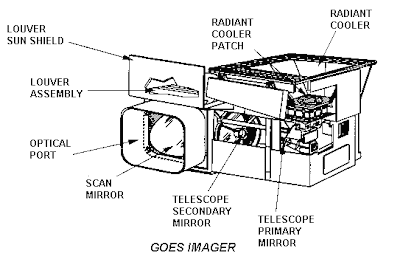
GOES GImager
The team validated its method against data collected from satellites that are part of the NOAA Geostationary Operational Environmental Satellite System (GOES).

However, the instruments aboard the satellites aren't capable of detecting particles much higher in energy than those associated with the peak radiation dose, according to Evenson.

"The instruments on the spacecraft are just too small to detect the faster, high-energy particles. They are set up to detect the particles that are most damaging," he explained.

Read more at the Antartic Sun

Friday, June 15, 2012

Dark Matter Explained - Animation video

NASA Voyager 1: Data points to breakthrough into an interstellar future

This artist's concept shows NASA's two Voyager spacecraft exploring a turbulent region of space known as the heliosheath, the outer shell of the bubble of charged particles around our sun. Credit: NASA/JPL-Caltech

Data from NASA's Voyager 1 spacecraft indicate that the venerable deep-space explorer has encountered a region in space where the intensity of charged particles from beyond our solar system has markedly increased.

Voyager scientists looking at this rapid rise draw closer to an inevitable but historic conclusion - that humanity's first emissary to interstellar space is on the edge of our solar system.


"The laws of physics say that someday Voyager will become the first human-made object to enter interstellar space, but we still do not know exactly when that someday will be," said Ed Stone, Voyager project scientist at the California Institute of Technology in Pasadena.

"The latest data indicate that we are clearly in a new region where things are changing more quickly. It is very exciting. We are approaching the solar system's frontier."

The data making the 16-hour-38 minute, 11.1-billion-mile (17.8-billion-kilometer), journey from Voyager 1 to antennas of NASA's Deep Space Network on Earth detail the number of charged particles measured by the two High Energy telescopes aboard the 34-year-old spacecraft.

These energetic particles were generated when stars in our cosmic neighborhood went supernova.

Artist's concept of NASA's Voyager spacecraft. Credit: NASA/JPL-Caltech

"From January 2009 to January 2012, there had been a gradual increase of about 25 percent in the amount of galactic cosmic rays Voyager was encountering," said Stone.

"More recently, we have seen very rapid escalation in that part of the energy spectrum.

Beginning on May 7, the cosmic ray hits have increased five percent in a week and nine percent in a month."

This marked increase is one of a triad of data sets which need to make significant swings of the needle to indicate a new era in space exploration.

The second important measure from the spacecraft's two telescopes is the intensity of energetic particles generated inside the heliosphere, the bubble of charged particles the sun blows around itself.

While there has been a slow decline in the measurements of these energetic particles, they have not dropped off precipitously, which could be expected when Voyager breaks through the solar boundary.

The final data set that Voyager scientists believe will reveal a major change is the measurement in the direction of the magnetic field lines surrounding the spacecraft.

While Voyager is still within the heliosphere, these field lines run east-west.

When it passes into interstellar space, the team expects Voyager will find that the magnetic field lines orient in a more north-south direction.

Such analysis will take weeks, and the Voyager team is currently crunching the numbers of its latest data set.

In 1972, Ed Stone became the Voyager Project Scientist. Twenty years later, both Voyager spacecraft were still operating, and this photo was taken in front of a full-scale model of the spacecraft, after Stone had been Director of JPL for about one year. 

"When the Voyagers launched in 1977, the space age was all of 20 years old," said Stone.

"Many of us on the team dreamed of reaching interstellar space, but we really had no way of knowing how long a journey it would be, or if these two vehicles that we invested so much time and energy in would operate long enough to reach it."

Launched in 1977, Voyager 1 and 2 are in good health. Voyager 2 is more than 9.1 billion miles (14.7 billion kilometers) away from the sun.

Both are operating as part of the Voyager Interstellar Mission, an extended mission to explore the solar system outside the neighborhood of the outer planets and beyond.

NASA's Voyagers are the two most distant active representatives of humanity and its desire to explore.

The Voyager spacecraft were built by NASA's Jet Propulsion Laboratory in Pasadena, Calif., which continues to operate both. JPL is a division of the California Institute of Technology.

The Voyager missions are a part of the NASA Heliophysics System Observatory, sponsored by the Heliophysics Division of the Science Mission Directorate in Washington.

Wednesday, May 2, 2012

NASA Chandra X-Ray Observatory: Pink Opaque

An extraordinary outburst produced by a black hole in a nearby galaxy has provided direct evidence for a population of old, volatile stellar black holes

The discovery, made by astronomers using data from NASA's Chandra X-ray Observatory, provides new insight into the nature of a mysterious class of black holes that can produce as much energy in X-rays as a million suns radiate at all wavelengths.

Researchers used Chandra to discover a new ultraluminous X-ray source, or ULX

These objects give off more X-rays than most binary systems, in which a companion star orbits the remains of a collapsed star. These collapsed stars form either a dense core called a neutron star or a black hole. 
The extra X-ray emission suggests ULXs contain black holes that might be much more massive than the ones found elsewhere in our galaxy.

A paper describing these results will appear in the May 10, 2012, issue of The Astrophysical Journal.

Image Credits: X-ray: NASA/CXC/Curtin University/R. Soria et al., Optical: NASA/STScI/ Middlebury College/F. Winkler et al.

Friday, March 23, 2012

Astronomers put forward new theory on size of black holes

Astronomers have put forward a new theory about why black holes become so hugely massive – claiming some of them have no 'table manners', and tip their 'food' directly into their mouths, eating more than one course simultaneously.

Researchers from the UK and Australia investigated how some black holes grow so fast that they are billions of times heavier than the sun.

The team from the University of Leicester (UK) and Monash University in Australia sought to establish how black holes got so big so fast.

Their research is due to published in the Monthly Notices of the Royal Astronomical Society.

The research was funded by the UK Science and Technology Facilities Council.

Professor Andrew King from the Department of Physics and Astronomy, University of Leicester, said: "Almost every galaxy has an enormously massive black hole in its centre. Our own galaxy, the Milky Way, has one about four million times heavier than the sun. But some galaxies have black holes a thousand times heavier still. We know they grew very quickly after the Big Bang."

"These hugely massive black holes were already full--grown when the universe was very young, less than a tenth of its present age."

Black holes grow by sucking in gas. This forms a disc around the hole and spirals in, but usually so slowly that the holes could not have grown to these huge masses in the entire age of the universe. `We needed a faster mechanism,' says Chris Nixon, also at Leicester, "so we wondered what would happen if gas came in from different directions."

Nixon, King and their colleague Daniel Price in Australia made a computer simulation of two gas discs orbiting a black hole at different angles.

After a short time the discs spread and collide, and large amounts of gas fall into the hole. According to their calculations black holes can grow 1,000 times faster when this happens.

"If two guys ride motorbikes on a Wall of Death and they collide, they lose the centrifugal force holding them to the walls and fall," says King. The same thing happens to the gas in these discs, and it falls in towards the hole.

This may explain how these black holes got so big so fast. "We don't know exactly how gas flows inside galaxies in the early universe," said King, "but I think it is very promising that if the flows are chaotic it is very easy for the black hole to feed."

The two biggest black holes ever discovered are each about ten billion times bigger than the Sun.

Thursday, February 16, 2012

CERN LHC: Particle collider to get energy boost

European particle physicists say the Large Hadron Collider in Switzerland will be run at higher energies in 2012 than in previous years

The higher energy 4 Tev level, 0.5 higher than levels used in 2010 and 2011, will allow the LHC to deliver the maximum possible amount of data this year before it goes into a long shutdown to prepare for even higher-energy running, a release from CERN headquarters in Geneva said Tuesday.

"When we started operating the LHC for physics in 2010, we chose the lowest safe beam energy consistent with the physics we wanted to do," Steve Myers, CERN's director for accelerators and technology, said.

"Two good years of operational experience with beam and many additional measurements made during 2011 give us the confidence to safely move up a notch, and thereby extend the physics reach of the experiments before we go into the LHC's first long shutdown."

In the last two years, the LHC has concentrated on narrowing the search for the Higgs boson, considered the foundation particle of particle physics.

However, to confirm its discovery or to rule out the Standard Model Higgs particle altogether will require one more year's worth of data, researchers said.

"By the time the LHC goes into its first long stop at the end of this year, we will either know that a Higgs particle exists or have ruled out the existence of a Standard Model Higgs," CERN's research director, Sergio Bertolucci, said.

"Either would be a major advance in our exploration of nature, bringing us closer to understanding how the fundamental particles acquire their mass, and marking the beginning of a new chapter in particle physics."

Wednesday, February 15, 2012

ESA Planck and Fermi: Galactic Haze

This all-sky image shows the distribution of the Galactic Haze seen by ESA's Planck mission at microwave frequencies superimposed over the high-energy sky as seen by NASA's Fermi Gamma-ray Space Telescope.

The Planck data (shown here in red and yellow) correspond to the Haze emission at frequencies of 30 and 44 GHz, extending from and around the Galactic Centre.

The Fermi data (shown here in blue) correspond to observations performed at energies between 10 and 100 GeV and reveal two bubble-shaped, gamma-ray emitting structures extending from the Galactic Centre.

The two emission regions seen by Planck and Fermi at two opposite ends of the electromagnetic spectrum correlate spatially quite well and might indeed be a manifestation of the same population of electrons via different radiation processes.

Synchrotron emission associated with the Galactic Haze seen by Planck exhibits distinctly different characteristics from the synchrotron emission seen elsewhere in the Milky Way. Diffuse synchrotron emission in the Galaxy is interpreted as radiation from highly energetic electrons that have been accelerated in shocks created by supernova explosions.

Compared to this well-studied emission, the Galactic Haze has a 'harder' spectrum, meaning that its emission does not decline as rapidly with increasing frequency.

Several explanations have been proposed for this unusual behaviour, including enhanced supernova rates, galactic winds and even annihilation of dark-matter particles. Thus far, none of them have been confirmed and the issue remains open.

The Planck image includes the mask that has been used in the analysis of the data to exclude regions with strong foreground contamination due to the Galaxy's diffuse emission. The mask also includes strong point-like sources located over the whole sky.

Credits: ESA/Planck Collaboration (microwave); NASA/DOE/Fermi LAT/D. Finkbeiner et al. (gamma rays)

Monday, February 6, 2012

Pulsars: The discovery of deceleration

An artist's impression of an accreting X-ray millisecond pulsar. 

The flowing material from the companion star forms a disk around the neutron star which is truncated at the edge of the pulsar magnetosphere. Credit: NASA / Goddard Space Flight Center / Dana Berry.

Pulsars are among the most exotic celestial bodies known. They have diameters of about 20 kilometres, but at the same time roughly the mass of our sun.

A sugar-cube sized piece of its ultra-compact matter on the Earth would weigh hundreds of millions of tons. A sub-class of them, known as millisecond pulsars, spin up to several hundred times per second around their own axes.

Previous studies reached the paradoxical conclusion that some millisecond pulsars are older than the universe itself.

The astrophysicist Thomas Tauris from the Max Planck Institute for Radio Astronomy and the Argelander Institute for Astronomy in Bonn could resolve this paradox by computer simulations.

Through numerical calculations on the base of stellar evolution and accretion torques, he demonstrated that millisecond pulsars loose about half of their rotational energy during the final stages of the mass-transfer process before the pulsar turns on its radio beam.

This result is in agreement with current observations and the findings also explain why radio millisecond pulsars appear to be much older than the white dwarf remnants of their companion stars - and perhaps why no sub-millisecond radio pulsars exist at all. The results are reported in the February 03 issue of the journal Science.

Millisecond pulsars are strongly magnetized, old neutron stars in binary systems which have been spun up to high rotational frequencies by accumulating mass and angular momentum from a companion star.

Today we know of about 200 such pulsars with spin periods between 1.4-10 milliseconds. These are located in both the Galactic Disk and in Globular Clusters.

Since the first millisecond pulsar was detected in 1982, it has remained a challenge for theorists to explain their spin periods, magnetic fields and ages. For example, there is the "turn-off" problem, i.e. what happens to the spin of the pulsar when the donor star terminates its mass-transfer process?

"We have now, for the first time, combined detailed numerical stellar evolution models with calculations of the braking torque acting on the spinning pulsar", says Thomas Tauris, the author of the present study.

"The result is that the millisecond pulsars loose about half of their rotational energy in the so-called Roche-lobe decoupling phase."

This phase describes the termination of the mass transfer in the binary system. Hence, radio-emitting millisecond pulsars should spin slightly slower than their progenitors, X-ray emitting millisecond pulsars which are still accreting material from their donor star.

This is exactly what the observational data seem to suggest. Furthermore, these new findings help explain why some millisecond pulsars appear to have characteristic ages exceeding the age of the Universe and perhaps why no sub-millisecond radio pulsars exist.

The key feature of the new results is that it has now been demonstrated how the spinning pulsar is able to break out of its so-called equilibrium spin.

At this epoch the mass-transfer rate decreases which causes the magnetospheric radius of the pulsar to expand and thereby expell the collapsing matter like a propeller. This causes the pulsar to loose additional rotational energy and thus slow down its spin rate.

"Actually, without a solution to the "turn-off" problem we would expect pulsars to even slow down to spin periods of 50-100 milliseconds during the Roche-lobe decoupling phase", concludes Thomas Tauris. "That would be in clear contradiction with observational evidence for the existence of millisecond pulsars."

Saturday, January 28, 2012

World’s Most Powerful X-Ray Laser Created


Scientists from the Oxford University in the UK and the U.S. Department of Energy's (DOE) SLAC National Accelerator Laboratory have invented a powerful X-ray laser - the Linac Coherent Light Source (LCLS).

For the first time, this laser will allow the heating of matter up to 2 million degrees Celsius, in a controlled setting.

The researchers tested the laser on a piece of aluminum foil and created hot dense matter (or a solid plasma).

The process of heating took less than a trillionth of a second.

According to the scientists, this represents a major step forward in understanding the composition of the more extreme forms of matter found in stars and giant planets; this could also help in experiments aimed at recreating the nuclear fusion process that powers the Sun.

"The LCLS X-ray laser is a truly remarkable machine," said Sam Vinko, a postdoctoral researcher at Oxford University, "Making extremely hot, dense matter is important scientifically if we are ultimately to understand the conditions that exist inside stars and at the center of giant planets within our own solar system and beyond."

"The LCLS, with its ultra-short wavelengths of X-ray laser light, is the first that can penetrate a dense solid and create a uniform patch of plasma - in this case a cube one-thousandth of a centimeter on a side - and probe it at the same time," said Bob Nagler from the SLAC.

"Those 60 hours when we first aimed the LCLS at a solid were the most exciting 60 hours of my entire scientific career," said Justin Wark, also from Oxford, "LCLS is really going to revolutionize the field, in my view."

Friday, January 27, 2012

Chandra X-Ray Image: Dark Energy

The composite image on the left is of the galaxy cluster Abell 85, located about 740 million light years from Earth.

The purple emission is multi-million degree gas detected in X-rays by NASA's Chandra X-ray Observatory and the other colors show galaxies in an optical image from the Sloan Digital Sky Survey.

This galaxy cluster is one of 86 observed by Chandra to trace how dark energy has stifled the growth of these massive structures over the last 7 billion years. Galaxy clusters are the largest collapsed objects in the Universe and are ideal for studying the properties of dark energy, the mysterious form of repulsive gravity that is driving the accelerated expansion of the Universe.


The illustration above shows snapshots from a simulation by Volker Springel, representing the growth of cosmic structure when the Universe was 0.9 billion, 3.2 billion and 13.7 billion years old (now).

This shows how the Universe has evolved from a smooth state to one containing a vast amount of structure.

Gas is shown in these snapshots, where the yellow regions are stars and the brightest structures are galaxies and galaxy clusters.

The growth of these structures was initially driven only by the attractive force of gravity, but then later there was competition with the repulsive force of dark energy.

Understanding the nature of dark energy is one of the biggest problems in science. Possibilities include the cosmological constant, equivalent to the energy of empty space, a modification in general relativity on the largest scales, or a more general physical field.

To help decide between these options, Chandra was used to study the increase in mass of galaxy clusters with time over the last 7 billion years.

The results are remarkably consistent with those from previous results that measure the expansion of the Universe using distance measurements, revealing that general relativity works as expected on large scales.

The cluster work, in combination with other studies, also provides the strongest evidence to date that dark energy is the cosmological constant, or that `nothing weighs something'.

Friday, January 20, 2012

SDO helps measure magnetic fields on the sun's surface

Science nuggets are a collection of early science results, new research techniques, and instrument updates that further our attempt to understand the sun and the dynamic space weather system that surrounds Earth.

A subset of data that helps map out the sun's magnetic fields was recently released from the Solar Dynamics Observatory (SDO).

Observations that measure the strength and direction of magnetic fields on the solar surface, known as vector magnetograms, play a crucial role in understanding how those fields change over time and trigger giant eruptions off the surface of the sun such as solar flares and coronal mass ejections (CMEs).

Collecting the information needed to make vector magnetograms is one of several tasks performed by SDO's Helioseismic and Magnetic Imager (HMI), an instrument led by a team at Stanford University.

HMI has been collecting data since May of 2010, providing scientific data on the strength of the sun's magnetic field and the sound waves moving around inside the Sun.

HMI relies on interpreting the way light is affected as it travels through the fields in order to measure them from afar.

For example, a phenomenon known as the Zeeman effect splits light into different wavelengths based on the magnetic field strength and, in addition, light may be polarized based on the magnetic field direction.

HMI uses these observations to produce vector magnetograms. Producing vector magnetograms at HMI’s high resolution, however, required developing new computer processing techniques to successfully interpret subtle details about the magnetic field.

Sunday, January 15, 2012

Deep sea methane: Energy Saviour Or Impending Disaster?


In December 2003, an international team of geologists announced that they had successfully tapped a new energy source.

Methane hydrate, a solidified form of natural gas bound into ice, lurks under the seafloor along the margins of every continent and under the Arctic permafrost.

On the Mackenzie River delta in the Canadian Northwest Territories, engineers drilled hundreds of meters below the permafrost into the hydrate deposits.

They punched fractures into the layers of sediment and pumped hot water into the earth, releasing the natural gas from its icy prison.

This first harvest of methane hydrate could mark a new direction for the energy industry. Engineers once assumed that the energy costs of melting the frozen fuel would outweigh the gains but rising oil and gas prices and creative uses of existing technology, like the recent test in the Canadian Arctic, are beginning to change their minds.

The United States Geological Survey estimates that the total amount of natural gas in methane hydrates surpasses all of the known oil, coal, and gas deposits on Earth in energy content, although only a fraction of the frozen fuel will be extractable.

The hydrates can form at any latitude on Earth if temperature and pressure conditions are right, and are usually mixed with sediment under the ocean floor.

There is a catch, however. Methane hydrates offer the energy industry dangers as well as opportunities, warns Charlie Paull, a geochemist at Monterey Bay Aquarium Research Institute in Moss Landing, Calif.

Deep-sea drilling operations that melt seafloor deposits of the icy fuel might set off an underwater accident under certain circumstances.

Saturday, January 14, 2012

GeoThermal Energy Project: Pouring water into volcano

In May 16, 2008, Newbery Crater project drilling manager Fred Wilson stands near a drilling rig at the Newberry Crater geothermal project as he describes the work near LaPine, Ore. 

Geothermal energy developers plan to pump 24 million gallons of water into the side of the dormant Central Oregon volcano this summer to demonstrate new technology they hope will give a boost to a green energy sector that has yet to live up to its promise. (AP Photo/Don Ryan, File)

They hope the water comes back to the surface fast enough and hot enough to create cheap, clean electricity that isn't dependent on sunny skies or stiff breezes - without shaking the earth and rattling the nerves of nearby residents.

Renewable energy has been held back by cheap natural gas, weak demand for power and waning political concern over global warming. Efforts to use the earth's heat to generate power, known as geothermal energy, have been further hampered by technical problems and worries that tapping it can cause earthquakes.

Even so, the federal government, Google and other investors are interested enough to bet $43 million on the Oregon project. They are helping AltaRock Energy, Inc. of Seattle and Davenport Newberry Holdings LLC of Stamford, Conn., demonstrate whether the next level in geothermal power development can work on the flanks of Newberrry Volcano, located about 20 miles south of Bend, Ore.

"We know the heat is there," said Susan Petty, president of AltaRock. "The big issue is can we circulate enough water through the system to make it economic."

The heat in the earth's crust has been used to generate power for more than a century. Engineers gather hot water or steam that bubbles near the surface and use it to spin a turbine that creates electricity. Most of those areas have been exploited. The new frontier is places with hot rocks, but no cracks in the rocks or water to deliver the steam.

To tap that heat - and grow geothermal energy from a tiny niche into an important source of green energy - engineers are working on a new technology called Enhanced Geothermal Systems.

"To build geothermal in a big way beyond where it is now requires new technology, and that is where EGS comes in," said Steve Hickman, a research geophysicist with the U.S. Geological Survey in Menlo Park, Calif.

Wells are drilled deep into the rock and water is pumped in, creating tiny fractures in the rock, a process known as hydroshearing.

Monday, November 28, 2011

Space 'Superbubbles' Could Spawn Energetic Cosmic Rays

An artist's concept of the heliosphere, a magnetic bubble that partially protects the solar system from cosmic rays.
CREDIT: Richard Mewaldt/Caltech

Enigmatic cosmic rays that strike Earth with giant amounts of energy might come from hot gaseous "superbubbles" in space, a new study reveals.

Cosmic rays have perplexed scientists for a century. These electrically charged particles bombard Earth with energies dwarfing anything we are capable of, but their origins remain a mystery.

Since cosmic rays are electrically charged, they can get pushed and pulled around by interstellar magnetic fields in the gas between the stars as they zip through space, obscuring where they come from.

One suspected fountain of cosmic rays are star-forming regions. The massive stars within these stellar nurseries can spew out massive amounts of energy and explode as supernovas.

Thursday, November 24, 2011

Plutonium-238 Scarcity Could Derail Future NASA Space Missions

NASA's future space missions may be delayed or cancelled to the scarcity of plutonium-238 which has been used by the space agency to fuel its manned spacecrafts for the past 50 years.

Scientists say that without additional stores of this fuel, the agency's ability to conduct future planetary science is in jeopardy, adding that it is something the United States simply cannot afford.

NASA's Mars rover Curiosity which is scheduled to launch Nov. 26, is powered by this radioactive element.

However, with the chemical getting scarce, Curiosity may be the last in a long line of spacecrafts to be powered by plutonium.

"It's like having a car and no gasoline in the car," said Ralph McNutt, a planetary scientist at Johns Hopkins University's Applied Physics Laboratory and a project scientist for NASA's Messenger mission to Mercury.

"The development of this power system has taken place in the U.S. over five decades, and we're on the verge of throwing it all away."

In 2009, the National Research Council reported that plutonium-238 has been and will continue to be "essential to the U.S. space science and exploration program."

The council recommended that domestic production of the material be restarted in order to sustain NASA's planetary science program, and to avoid delays or even cancellations of future missions.

Plutonium-238 is a toxic substance that gives off heat that can be converted to electricity in the cold, dark depths of space.

The United States produced this highly toxic chemical in facilities that supported the nuclear weapons program during the Cold War but they stopped making it in the late 1980s.

The NASA has used these plutonium-powered systems for famous missions like the Voyager probes.

However, Jim Adams, deputy director of planetary science at NASA, told NPR that even with slow down in space exploration due to budget constraints, fuel for NASA missions is only up to around 2022.

Saturday, November 19, 2011

LHC Physicists Get an Antimatter Surprise

This giant magnetic is part of the LHCb experiment at the Large Hadron Collider in Geneva, Switzerland.
CREDIT: CERN/LHCb

The world's largest atom smasher, designed as a portal to a new view of physics, has produced its first peek at the unexpected: bits of matter that don't mirror the behavior of their antimatter counterparts.

The discovery, if confirmed, could rewrite the known laws of particle physics and help explain why our universe is made mostly of matter and not antimatter.

Scientists at the Large Hadron Collider, the 17-mile (27 km) circular particle accelerator underground near Geneva, Switzerland, have been colliding protons at high speeds to create explosions of energy. From this energy many subatomic particles are produced.

Now researchers at the accelerator's LHCb experiment are reporting that some matter particles produced inside the machine appear to be behaving differently from their antimatter counterparts, which might provide a partial explanation to the mystery of antimatter.

Saturday, November 12, 2011

Mysterious Dark Energy: What Part in Early Universe

Light from distant galaxies is distorted by foreground matter. 

This so-called weak lensing can be used to characterize dark energy.

CREDIT: S. Colombi (IAP), CFHT Team

Scientists trying to understand dark energy, one of the weirdest things in the universe, have made a step forward in determining how much of it could have existed shortly after the Big Bang.

Dark energy is the mysterious force scientists think is responsible for pulling space apart at the seams, causing the expansion of the universe to accelerate. No one knows what dark energy is, and it hasn't been detected directly.

In the new study, researchers used the South Pole Telescope in Antarctica to observe the cosmic microwave background, the pervasive light left over from the Big Bang that is believed to have kick-started the universe. This radiation holds a record of many properties of the early universe, allowing scientists to deduce the maximum amount of dark energy that could have been present at the time.

Based on their measurements, the researchers found that dark energy could not have accounted for more than 1.8 percent of the total density of the universe. By contrast, dark energy dominates space today, accounting for about 74 percent of all the matter and energy in the universe.

Wednesday, October 19, 2011

NASA's Fermi Shows Highly Active Galaxies


Active galaxies called blazars make up the largest class of objects detected by Fermi's Large Area Telescope (LAT).

Massive black holes in the hearts of these galaxies fire particle jets in our direction.

Fermi team member Elizabeth Hays narrates this quick tour of blazars, which includes LAT movies showing how rapidly their emissions can change. 

Credit: NASA/Goddard Space Flight Center

Tuesday, October 11, 2011

'Pacman Nebula' Lives the High Life

High-mass stars are important because they are responsible for much of the energy pumped into our galaxy over its lifetime.

Unfortunately, these stars are poorly understood because they are often found relatively far away and can be obscured by gas and dust.

The star cluster NGC 281 is an exception to this rule.

It is located about 9,200 light years from Earth and, remarkably, almost 1,000 light years above the plane of the Galaxy, giving astronomers a nearly unfettered view of the star formation within it.

NGC 281 is known informally as the "Pacman Nebula" because of its appearance in optical images. In optical images the "mouth" of the Pacman character appears dark because of obscuration by dust and gas, but in the infrared Spitzer image the dust in this region glows brightly.

Image Credits: X-ray: NASA/CXC/CfA/S.Wolk; IR: NASA/JPL/CfA/S.Wolk