Showing posts with label Particle Collision. Show all posts

Wednesday, July 4, 2012

Higgs Particle Discovery: CERN LHC prepares for data pile-up

The world’s largest particle accelerator is roaring along at an unprecedented pace, delivering torrents of data to its physicist handlers. But the hundreds of millions of collisions happening inside the machine every second are now growing into a thick fog that, paradoxically, threatens to obscure a fabled quarry: the Higgs boson.

The problem is known as pile-up, and it promises to be one of the greatest challenges this year for scientists working on the Large Hadron Collider (LHC) at CERN, Europe’s main high-energy physics laboratory near Geneva, Switzerland.

Huge amounts of computing power, cunning software and technical tricks are helping scientists to stay ahead of the problem. But researchers may still need to scale back the collisions to find the long-sought Higgs, the manifestation of a field that is believed to confer mass on other particles.

If it exists, the Higgs will appear fleetingly inside the machine before decaying into lighter particles. Last year, the two biggest detectors at the LHC saw hints of a Higgs with a mass of about 125 gigaelectronvolts (energy and mass are interchangeable in particle physics). This year, researchers want to collect more data to see whether that signal grows into a certainty, or withers back to nothing.

Since it began its latest science run last month, the LHC has been squeezing trillions of protons into ever-smaller bunches, and smashing those bunches together tens of millions of times per second.

The resultant data are measured in inverse femtobarns (fb−1), a unit roughly equivalent to 100 trillion collisions. In the past month alone, the LHC recorded 1 fb−1 worth of collisions. By the end of the year it aims have captured at least 15 fb−1 (see ‘Smashing!’).

Thursday, February 16, 2012

CERN LHC: Particle collider to get energy boost

European particle physicists say the Large Hadron Collider in Switzerland will be run at higher energies in 2012 than in previous years

The higher energy 4 Tev level, 0.5 higher than levels used in 2010 and 2011, will allow the LHC to deliver the maximum possible amount of data this year before it goes into a long shutdown to prepare for even higher-energy running, a release from CERN headquarters in Geneva said Tuesday.

"When we started operating the LHC for physics in 2010, we chose the lowest safe beam energy consistent with the physics we wanted to do," Steve Myers, CERN's director for accelerators and technology, said.

"Two good years of operational experience with beam and many additional measurements made during 2011 give us the confidence to safely move up a notch, and thereby extend the physics reach of the experiments before we go into the LHC's first long shutdown."

In the last two years, the LHC has concentrated on narrowing the search for the Higgs boson, considered the foundation particle of particle physics.

However, to confirm its discovery or to rule out the Standard Model Higgs particle altogether will require one more year's worth of data, researchers said.

"By the time the LHC goes into its first long stop at the end of this year, we will either know that a Higgs particle exists or have ruled out the existence of a Standard Model Higgs," CERN's research director, Sergio Bertolucci, said.

"Either would be a major advance in our exploration of nature, bringing us closer to understanding how the fundamental particles acquire their mass, and marking the beginning of a new chapter in particle physics."

Friday, December 23, 2011

LHC Discovers First New Particle - Chi_b (3P)

CERN physicists, analysing data from the Atlas experiment, have made their first new particle discovery at the Large Hadron Collider, known as Chi_b (3P), which will help scientists better understand the forces that hold matter together.

This is the first clear observation of a new particle since the LHC opened in 2009. The LHC is the largest facility exploring fundamental questions in "big physics" by colliding proton particles together.

Physicists said the Chi_b (3P), which like the Higgs boson, is a boson, portends a new way of combining a beauty quark and its antiquark so that they bind together. But whereas the Higgs is not made up of smaller particles, the Chi_b(3P) combines two very heavy objects via the same 'strong force' which holds the atomic nucleus together.

According to Professor Roger Jones, who works on the Atlas detector at the LHC, the Chi_b (3P) is a more excited state of Chi particles already seen in previous collision experiments. "The new particle is made up of a 'beauty quark' and a 'beauty anti-quark', which are then bound together," he said.

He noted that people have thought this more excited state should exist for years, but nobody has managed to see it until now.

"The Chi_b(3P) is a particle that was predicted by many theorists, but was not observed at previous experiments, such as in my previous work on the D-Zero experiment in Chicago," said Dr James Walder, a Lancaster research associate who worked on the analysis.

"It's also interesting for what it tells us about the forces that hold the quark and the anti-quark together - the strong nuclear force. And that's the same force that holds, for instance, the atomic nucleus together with its protons and the neutrons," Jones said.

The physicist explained that LHC discoveries are an important part of this quest because they add to the wider background knowledge.

"The better we understand the strong force, the more we understand a large part of the data that we see, which is quite often the background to the more exciting things we are looking for, like the Higgs," Jones noted.

"While people are rightly interested in the Higgs boson, which we believe gives particles their mass and may have started to reveal itself, a lot of the mass of everyday objects comes from the strong interaction we are investigating using the chi b," he concluded.

Monday, December 12, 2011

CERN Physicists Anxiously Await News of Higgs Boson

High noon is approaching for the biggest manhunt in the history of physics.

On Tuesday morning, scientists from CERN, the European Center for Nuclear Research, are scheduled to give a progress report on the search for the Higgs boson — infamously known as the “God particle” — whose discovery would vindicate the modern theory of how elementary particles get mass.

The report comes amid rumors that the two competing armies of scientists sifting debris from hundreds of trillions of proton collisions in CERN’s Large Hadron Collider, or L.H.C., outside Geneva, have both finally seen hints of what might turn out be the elusive particle when more data is gathered next year.

Alternatively, the experimentalists say that a year from now they should have enough data to rule out the existence of the most popular version of the Higgs boson, sending theorists back to their blackboards in search of another explanation of why particles have mass.

So the whole world will be watching.

Sunday, November 20, 2011

ESA Cluster Mission: Cosmic particle accelerators

ESA's Cluster satellites have discovered that cosmic particle accelerators are more efficient than previously thought.

The discovery has revealed the initial stages of acceleration for the first time, a process that could apply across the Universe.

All particle accelerators need some way to begin the acceleration process. For example, the Large Hadron Collider (LHC) at CERN employs a series of small accelerators to get its particles up to speed before injecting them into the main 27 km-circumference ring for further acceleration.

In space, large magnetic fields guide particles known as cosmic rays across the Universe at almost the speed of light, but are notoriously bad at getting them moving in the first place.

Now ESA's Cluster mission has shown that something similar to the 'staging' process used at CERN is happening above our heads in the natural particle accelerators of space.

On 9 January 2005, Cluster's four satellites passed through a magnetic shock high above Earth. The spinning craft were aligned almost perfectly with the magnetic field, allowing them to sample what was happening to electrons on very short timescales of 250 milliseconds or less.

The measurements showed that the electrons rose sharply in temperature, which established conditions favourable to larger scale acceleration.

It had long been suspected that shocks could do this, but the size of the shock layers and the details of the process had been difficult to pin down.

Steven J. Schwartz, Imperial College London, and colleagues used the Cluster data to estimate the thickness of the shock layer. This is important because the thinner a shock is, the more easily it can accelerate particles.

"With these observations, we found that the shock layer is about as thin as it can possibly be," says Dr Schwartz.

Thin in this case corresponds to about 17 km. Previous estimates had only been able to tie down the width of the shock layers above Earth at no more than 100 km.

This is the first time anyone has seen such details of the initial acceleration region.

Saturday, November 19, 2011

LHC Physicists Get an Antimatter Surprise

This giant magnetic is part of the LHCb experiment at the Large Hadron Collider in Geneva, Switzerland.
CREDIT: CERN/LHCb

The world's largest atom smasher, designed as a portal to a new view of physics, has produced its first peek at the unexpected: bits of matter that don't mirror the behavior of their antimatter counterparts.

The discovery, if confirmed, could rewrite the known laws of particle physics and help explain why our universe is made mostly of matter and not antimatter.

Scientists at the Large Hadron Collider, the 17-mile (27 km) circular particle accelerator underground near Geneva, Switzerland, have been colliding protons at high speeds to create explosions of energy. From this energy many subatomic particles are produced.

Now researchers at the accelerator's LHCb experiment are reporting that some matter particles produced inside the machine appear to be behaving differently from their antimatter counterparts, which might provide a partial explanation to the mystery of antimatter.

Friday, September 2, 2011

NASA Needs Strategic Plan to Manage Orbital Debris Efforts

Although NASA's meteoroid and orbital debris programs have responsibly used their resources, the agency's management structure has not kept pace with increasing hazards posed by abandoned equipment, spent rocket bodies, and other debris orbiting the Earth, says a new report by the National Research Council.

NASA should develop a formal strategic plan to better allocate resources devoted to the management of orbital debris.

In addition, removal of debris from the space environment or other actions to mitigate risks may be necessary.

The complexity and severity of the orbital debris environment combined with decreased funding and increased responsibilities have put new pressures on NASA, according to the report. Some scenarios generated by the agency's meteoroid and orbital debris models show that debris has reached a "tipping point," with enough currently in orbit to continually collide and create even more debris, raising the risk of spacecraft failures, the report notes.

In addition, collisions with debris have disabled and even destroyed satellites in the past; a recent near-miss of the International Space Station underscores the value in monitoring and tracking orbital debris as precisely as possible.

"The current space environment is growing increasingly hazardous to spacecraft and astronauts," said Donald Kessler, chair of the committee that wrote the report and retired head of NASA's Orbital Debris Program Office.

"NASA needs to determine the best path forward for tackling the multifaceted problems caused by meteoroids and orbital debris that put human and robotic space operations at risk."

The strategic plan NASA develops should provide a basis for prioritizing efforts and allocating funds to the agency's numerous meteoroid and orbital debris programs, the report says.

Currently, the programs do not have a single management and budget structure that can efficiently coordinate all of these activities. The programs are also vulnerable to changes in personnel, as nearly all of them are staffed by just one person.

The strategic plan, which should consider short- and long-term objectives, a schedule of benchmark achievements, and priorities among them, also should include potential research needs and management issues. The report lists these.

Removal of orbital debris introduces another set of complexities, the report adds, because only about 30 percent of the objects can be attributed to the United States.

"The Cold War is over, but the acute sensitivity regarding satellite technology remains," explained committee vice chair George Gleghorn, former vice president and chief engineer for the TRW Space and Technology Group.

Although NASA has identified the need for removing debris, the agency and U.S. government as a whole have not fully examined the economic, technological, political, and legal considerations, the report says.

Monday, August 1, 2011

Big Bang experiments inside particle accelerators at CERN - images

A collection of tracks left by subatomic particles in a bubble chamber.

A bubble chamber is a container filled with liquid hydrogen which is superheated - momentarily raised above its normal boiling point by a sudden drop in pressure in the container.

Any charged particle passing through the liquid in this state leaves behind a trail of tiny bubbles as the liquid boils in its wake.

These bubbles are seen as fine tracks, showing the characteristic paths of different types of particle

Picture: SPL/Barcroft Media

Images of Big Bang experiments inside particle accelerators at CERN - Telegraph

Thursday, June 16, 2011

Neutrino particle 'flips to all flavours'

An important breakthrough may be imminent in the study of neutrinos.

The multinational T2K project in Japan says it has seen indications in its data that these elementary particles can flip to any of their three types.

The results are provisional because experiments had to be suspended in the wake of the Tohoku earthquake in March.

But if confirmed, they would open the door to further research on where the matter in the Universe came from.

Specifically, such studies would ask why the cosmos is composed of normal matter rather than its opposite - antimatter - which theorists say must have been created in equal amounts at the Big Bang.

"It's a step on the road," explained Professor Dave Wark, of Imperial College London and the STFC's Rutherford Appleton Laboratory, which leads the UK involvement in T2K.

"We want to address this asymmetry, but first we have to show that the different 'flavours' of neutrinos can spontaneously change into each other - something we call 'neutrino oscillation'. So far, our experiments have been very positive," he told BBC News.

Detecting 'ghosts'

Neutrinos are among the fundamental building blocks of matter. They swarm all about us.

The Sun, for example, releases them in huge quantities when it fuses hydrogen to make helium - the raw nuclear process at its core.

They are, however, very difficult to study because they interact so weakly with normal matter. Hence, their nickname - "ghost particles".

Nonetheless, scientists have been able to discern three flavours - electron neutrinos, muon neutrinos, and tau neutrinos.

Previous research has characterised two forms of oscillations.

The T2K experiment has now seen hints for a third transformation - that of a muon neutrino turning into an electron neutrino.

Sunday, April 10, 2011

LHC at Cern observe the decays of a rare particle

Shortly after experiments on the Large Hadron Collider (LHC) at the CERN laboratory near Geneva, Switzerland began yielding scientific data last fall, a group of scientists led by a Syracuse University physicist became the first to observe the decays of a rare particle that was present right after the Big Bang.

By studying this particle, scientists hope to solve the mystery of why the universe evolved with more matter than antimatter.

Led by Sheldon Stone, a physicist in SU's College of Arts and Sciences, the scientists observed the decay of a special type of B meson, which are created when protons traveling at nearly the speed of light smash into each other.

The work is part of two studies published in the March 28 issue of Physics Letters B. Stone leads SU's high-energy physics group, which is part of a larger group of scientists (the LHCb collaboration) that run an experiment at CERN. The National Science Foundation (NSF) funds Stone's research group.

"It is impressive to see such a forefront physics result produced so soon after data-taking commenced at the LHC," said Moishe Pripstein, program director for the NSF's Elementary Particle Physics program.

"These results are a tribute both to the ingenuity of the international collaboration of scientists and the discovery potential of the LHC."

Scientists are eager to study these special B mesons because of their potential for yielding information about the relationship between matter and antimatter moments after the Big Bang, as well as yet-to-be described forces that resulted in the rise of matter over antimatter.

"We know when the universe formed from the Big Bang, it had just as much matter as antimatter," Stone says. "But we live in a world predominantly made of matter, therefore, there had to be differences in the decaying of both matter and antimatter in order to end up with a surplus of matter."

All matter is composed of atoms, which are composed of protons (positive charge), electrons (negative charge) and neutrons (neutral). The protons and neutrons are composed, in turn, of even smaller particles called quarks. Antimatter is composed of antiprotons, positrons (the opposite of electrons), antineutrons, and thus anti-quarks.

While antimatter generally refers to sub-atomic particles, it can also include larger elements, such as hydrogen or helium. It is generally believed that the same rules of physics should apply to both matter and antimatter and that both should occur in equal amounts in the universe.

That they don't play by the same rules or occur in equal amounts are among the greatest unsolved problems in physics today.

B mesons are a rare and special subgroup of mesons composed of a quark and anti-quark. While B mesons were common after the Big Bang, they are not believed to occur in nature today and can only be created and observed under experimental conditions in the LHC or other high-energy colliders.

Because these particles don't play by the same rules of physics as most other matter, scientists believe B mesons may have played an important role in the rise of matter over antimatter. The particles may also provide clues about the nature of the forces that led to this lack of symmetry in the universe.

Saturday, May 22, 2010

LHC Towards higher intensities - CERN Bulletin

Towards higher intensities - CERN Bulletin

Over the past 2 weeks, commissioning of the machine protection system has advanced significantly, opening up the possibility of higher intensity collisions at 3.5 TeV. The intensity has been increased from 2 bunches of 1010 protons to 6 bunches of 2x10¹⁰ protons. Luminosities of 6x1028 cm-2s-1 have been achieved at the start of fills, a factor of 60 higher than those provided for the first collisions on 30 March.

The recent increase in LHC luminosity as recorded by the experiments.

(Graph courtesy of the experiments and M. Ferro-Luzzi)

To increase the luminosity further, the commissioning crews are now trying to push up the intensity of the individual proton bunches.

After the successful injection of nominal intensity bunches containing 1.1x10¹¹ protons, collisions were subsequently achieved at 450 GeV with these intensities.

However, half-way through the first ramping of these nominal intensity bunches to 3.5 TeV on 15 May, a beam instability was observed, leading to partial beam loss.

Work is now under way to understand, control and cure this instability by using longer bunches and by powering the special correction magnets (octupoles).

Tuesday, March 30, 2010

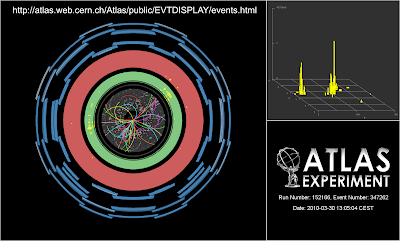
CERN LHC: First Proton Particle Collision recorded

A CERN LHC animation of one of the first 7 TeV collisions recorded by ATLAS. A high resolution version.

An historical event for European science and physics!

After the initial collision the scientists at CERN LHC stabalised the beams to ensure further collisions would occur and managed to sustain the stability for more than 3 hours. Whereby, the experiments team have recorded a half million events from the stable and colliding beams. WOW!

A spectacular day indeed, and the culmination of at least 17 years of work and effort from scientists and physicists across the world.

If you want to see into the CERN LHC Atlas control room in Switzerland, here is the live link.