Showing posts with label Galactic. Show all posts

Monday, April 7, 2014

ESO: Discovery Galactic Serial Killer

This new image from the MPG/ESO 2.2-metre telescope at ESO's La Silla Observatory in Chile shows a contrasting pair of galaxies: NGC 1316, and its smaller companion NGC 1317 (right). 

Although NGC 1317 seems to have had a peaceful existence, its larger neighbour bears the scars of earlier mergers with other galaxies. 

Image courtesy ESO.

This new image from the MPG/ESO 2.2-metre telescope at ESO's La Silla Observatory in Chile shows two contrasting galaxies: NGC 1316, and its smaller neighbour NGC 1317.

These two are quite close to each other in space, but they have very different histories. The small spiral NGC 1317 has led an uneventful life, but NGC 1316 has engulfed several other galaxies in its violent history and shows the battle scars.

Several clues in the structure of NGC 1316 reveal that its past was turbulent. For instance, it has some unusual dust lanes embedded within a much larger envelope of stars, and a population of unusually small globular star clusters.

These suggest that it may have already swallowed a dust-rich spiral galaxy about three billion years ago.

Also seen around the galaxy are very faint tidal tails - wisps and shells of stars that have been torn from their original locations and flung into intergalactic space.

These features are produced by complex gravitational effects on the orbits of stars when another galaxy comes too close.

All of these signs point to a violent past during which NGC 1316 annexed other galaxies and suggest that the disruptive behaviour is continuing.

NGC 1316 is located about 60 million light-years away from Earth in the southern constellation of Fornax (The Furnace).

It also bears the name Fornax A, reflecting the fact that it is the brightest source of radio emission in the constellation - and in fact the fourth brightest radio source in the entire sky.

This radio emission is driven by material falling into the supermassive black hole at the centre of the galaxy and has probably been provided with extra fuel by the interactions with other galaxies.

This very detailed new image from the MPG/ESO 2.2-metre telescope at ESO's La Silla Observatory in Chile was created by combining many individual images in the ESO archive.

The aim of the original observations was to reveal the faintest features and study the disruption of this interesting system.

As a bonus the new picture also provides a window into the distant Universe far beyond the two bright galaxies in the foreground.

Most of the faint fuzzy spots in the picture are much more distant galaxies - and there is a particularly dense concentration just to the left of NGC 1316.

Wednesday, May 8, 2013

Numerous Hydrogen Clouds discovered lurking among our galactic neighbours

This combined graphic shows new, high-resolution GBT imaging (in box) of recently discovered hydrogen clouds between M31 (upper right) and M33 (bottom left). 

Credit: Bill Saxton, NRAO/AUI/NSF

In a dark, starless patch of intergalactic space, astronomers have discovered a never-before-seen cluster of hydrogen clouds strewn between two nearby galaxies, Andromeda (M31) and Triangulum (M33).

The researchers speculate that these rarefied blobs of gas—each about as massive as a dwarf galaxy—condensed out of a vast and as-yet undetected reservoir of hot, ionized gas, which could have accompanied an otherwise invisible band of dark matter.

The astronomers detected these objects using the National Science Foundation's Green Bank Telescope (GBT) at the National Radio Astronomy Observatory (NRAO) in Green Bank, W.Va. The results were published in the journal Nature.

Spencer Wolfe
"We have known for some time that many seemingly empty stretches of the Universe contain vast but diffuse patches of hot, ionized hydrogen," said Spencer Wolfe of West Virginia University in Morgantown.

"Earlier observations of the area between M31 and M33 suggested the presence of colder, neutral hydrogen, but we couldn't see any details to determine if it had a definitive structure or represented a new type of cosmic feature."

"Now, with high-resolution images from the GBT, we were able to detect discrete concentrations of neutral hydrogen emerging out of what was thought to be a mainly featureless field of gas."

Astronomers are able to observe neutral atomic hydrogen, which is referred to as HI (H and the Roman numeral one), because of the characteristic signal it emits at radio wavelengths, which can be detected by radio telescopes on Earth.

Though this material is abundant throughout the cosmos, in the space between galaxies it can be very tenuous and the faint signal it emits can be extremely difficult to detect.


The animation demonstrates the difference in resolution from the original Westerbork Radio Telescope data (Braun & Thilker, 2004) and the finer resolution imaging of GBT, which revealed the hydrogen clouds between M31 and M33. 

Credit: Bill Saxton, NRAO/AUI/NSF.

A little more than a decade ago, astronomers had the first speculative hints that a previously unrecognized reservoir of hydrogen lay between M31 and M33.

The signal from this gas, however, was too faint to draw any firm conclusions about its nature, origin, or even certain existence.

Last year, preliminary data taken with the GBT confirmed that there was indeed hydrogen gas, and a lot of it, smeared out between the galaxies.

These preliminary observations, however, lacked the necessary sensitivity to see any fine-grain structure in the gas or deduce whence it came and what it signified.

The most likely explanation at the time was that a few billion years earlier, these two galaxies had a close encounter and the resulting gravitational perturbations pulled off some wispy puffs of gas, leaving a tenuous bridge between the two.

Wednesday, February 15, 2012

ESA Planck and Fermi: Galactic Haze

This all-sky image shows the distribution of the Galactic Haze seen by ESA's Planck mission at microwave frequencies superimposed over the high-energy sky as seen by NASA's Fermi Gamma-ray Space Telescope.

The Planck data (shown here in red and yellow) correspond to the Haze emission at frequencies of 30 and 44 GHz, extending from and around the Galactic Centre.

The Fermi data (shown here in blue) correspond to observations performed at energies between 10 and 100 GeV and reveal two bubble-shaped, gamma-ray emitting structures extending from the Galactic Centre.

The two emission regions seen by Planck and Fermi at two opposite ends of the electromagnetic spectrum correlate spatially quite well and might indeed be a manifestation of the same population of electrons via different radiation processes.

Synchrotron emission associated with the Galactic Haze seen by Planck exhibits distinctly different characteristics from the synchrotron emission seen elsewhere in the Milky Way. Diffuse synchrotron emission in the Galaxy is interpreted as radiation from highly energetic electrons that have been accelerated in shocks created by supernova explosions.

Compared to this well-studied emission, the Galactic Haze has a 'harder' spectrum, meaning that its emission does not decline as rapidly with increasing frequency.

Several explanations have been proposed for this unusual behaviour, including enhanced supernova rates, galactic winds and even annihilation of dark-matter particles. Thus far, none of them have been confirmed and the issue remains open.

The Planck image includes the mask that has been used in the analysis of the data to exclude regions with strong foreground contamination due to the Galaxy's diffuse emission. The mask also includes strong point-like sources located over the whole sky.

Credits: ESA/Planck Collaboration (microwave); NASA/DOE/Fermi LAT/D. Finkbeiner et al. (gamma rays)

Friday, October 21, 2011

NASA ESA Hubble Image: Galaxies Collide in Ursa Major - Mayall's object

This interacting pair of galaxies is included in Arp's catalog of peculiar galaxies as number 148. Arp 148 is the staggering aftermath of an encounter between two galaxies, resulting in a ring-shaped galaxy and a long-tailed companion.

The collision between the two parent galaxies produced a shockwave effect that first drew matter into the center and then caused it to propagate outwards in a ring.

The elongated companion perpendicular to the ring suggests that Arp 148 is a unique snapshot of an ongoing collision. Infrared observations reveal a strong obscuration region that appears as a dark dust lane across the nucleus in optical light.

Arp 148 is nicknamed Mayall's object and is located in the constellation of Ursa Major, the Great Bear, approximately 500 million light-years away.

This image is part of a large collection of 59 images of merging galaxies taken by the Hubble Space Telescope and released on April 24, 2008, the observatory's 18th anniversary.

Image Credit: NASA, ESA, the Hubble Heritage (STScI/AURA)-ESA/Hubble Collaboration, and A. Evans (University of Virginia, Charlottesville/NRAO/Stony Brook University)

Wednesday, August 31, 2011

Notre Dame astrophysicists identify missing fuel for galactic star formation

The Milky Way will have the fuel to continue forming stars, thanks to massive clouds of ionized gas raining down from its halo and intergalactic space.

This is the conclusion of a new study by Nicolas Lehner and Christopher Howk from the University of Notre Dame, Indiana.

Using the Cosmic Origins Spectrograph, one of the newest instruments on the NASA/ESA Hubble Space Telescope, these researchers measured for the first time the distances to fast-moving clouds of ionized gas previously seen covering a large fraction of the sky.

These fast-moving clouds reside in the distant reaches of the Milky Way and contain huge quantities of gas.

The Milky Way would rapidly change its gas into stars if no supply of new matter were available to replenish the gas.

Astronomers have hypothesized that the ionised fast-moving gas clouds could be this reservoir of gas, but it was not known if they were interacting with the Milky Way.

“Our findings explain why the Milky Way can keep having star formation,” Lehner said. “Knowing the distances to these clouds tells us where the gaseous fuel is for forming stars over billions of years.”

Gas clouds can be identified and studied because elements in the cloud absorb small amounts of light from a star or other light source as it passes through a cloud on its way to Earth. The characteristic “fingerprint” left in the spectrum allows astronomers to determine the properties of the gas.

Star formation in the Milky Way
Earlier studies of these fast-moving ionised clouds used light from quasars, which are too far away to mark the clouds’ locations.

To solve the problem, Lehner and Howk identified 27 stars around the Milky Way whose distances were known and used Hubble to take line-of-sight readings of light coming from them.

Results from the stellar sample showed the ionized clouds largely resided in the Milky Way’s halo. The authors concluded that these flows of ionized gas are within about 1 galactic radius (40,000 light-years) of Earth.

The new Hubble observations revealed the presence of ionized gas in half the stellar samples, comparable to the fraction observed toward more distant quasars.

The gas clouds are not uniformly distributed around the galaxy, but rather collected in different areas.

They cover only part of our galactic sky, analogous to the partial coverage of the sky on a partly cloudy day on Earth.

This research also confirmed models that predicted gas falling into the Milky Way slows as it approaches. Clouds closer to the galaxy seem to have been decelerated and do not move as fast as those farther away, much like a meteorite slowing as it enters Earth’s atmosphere.

“We know now where is the missing fuel for galactic star formation,”

Lehner said. “We now have to learn how it got there.”

Saturday, September 25, 2010

Aliens and Interstellar Archaeology on the Kardashev Galactic Scale

Kardashev Type III and Its Traces
What would happen if a true galaxy-spanning civilisation went to work on astro-engineering?

We call this a Kardashev Type III civilisation, one that could exploit the power resources of an entire galaxy, and the assumption made has always been that such a culture would be very high profile, if not, blindingly obvious. It's projects would be so vast that our astronomers would be able to detect them by noting anomalies, outside of natural occurences.

Imagine, for example, a galactic culture that encloses each individual star in a Dyson sphere.

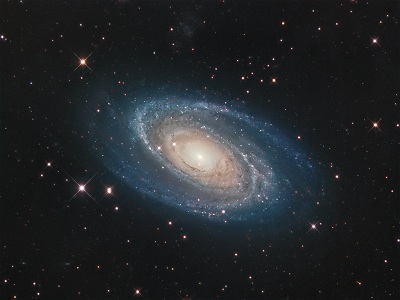
Image: M81, a spiral galaxy in Ursa Major. A ‘wavefront’ Dyson sphere culture might spread across such a galaxy, causing stars to drop out of visible light spectrum entirely, and then one by one, to be detected in the infrared. Credit and copyright: Giovanni Benintende.

A Dyson sphere or ‘shell’ would absorb all of the visible light from a star, re-radiating stellar energy at infrared wavelengths. A Dyson ‘ring’ would use planetary materials that would mask only part of the star’s light.

Scientists have used a list of very interesting infrared sources from the Infrared Astronomy Satellite (IRAS) in their searches, but have come up with no strong Dyson sphere candidates. Nonetheless, Dyson spheres remain interesting, if only because they vastly increase the habitable area around a star.

What would a Type III civilisation do with technologies that could create Dyson spheres not only in one place but across the galaxy?

Whatever the answer, you would think it would be clearly noticeable. Freeman Dyson himself has said that “…a type III (Kardashev civilisation) in our own galaxy would change the appearance of the sky so drastically that it could hardly have escaped our attention.”

James Annis, who has studied anomalous galaxies in a quest for signs of a Type III civilisation, reports: “It is quite clear that the Galaxy itself has not transformed into a type III civilisation based on starlight, nor have M31 or M33, our two large neighbours.” Nonetheless, we wonder whether we should take these statements as conclusive or definitive:
…what would happen for a civilisation that was on its way to becoming a type III civilisation, i.e. a type II.5 civilisation that is developing?
If it was busily turning stars into Dyson spheres the civilisation could create a “Fermi bubble” or void in the visible light from a patch of the galaxy with a corresponding upturn in the emission of infrared light.
This bubble would grow following the lines of a suggestion attributed to Fermi… that patient space travellers moving at 1/1000 to 1/100 of the speed of light could span a galaxy in one to ten million years.

To read more on Interstellar Archaeology ......

Thursday, September 9, 2010

Galactic 'Supervolcano' Seen Erupting With X-Rays


A galactic "supervolcano" in the massive galaxy M87 is erupting, blasting gas outwards. The cosmic volcano — driven by a giant black hole in M87's center — is preventing hundreds of millions of new stars from forming.

An image, taken by NASA's Chandra X-ray Observatory and the National Radio Astronomy Observatory's Very Large Array, captures the drama in action. [Photo of the galactic "supervolcano."]

"Our results show in great detail that supermassive black holes have a surprisingly good control over the evolution of the galaxies in which they live," said Norbert Werner of the SLAC National Accelerator Laboratory in Melo Park, Calif., who led one of two studies of M87's black hole and its effects. "The black hole's reach extends ever farther into the entire cluster, similar to how one small volcano can affect practically an entire hemisphere on Earth."

X-ray galaxy

M87 is about 50 million light-years from Earth and lies at the center of the Virgo cluster, which contains thousands of galaxies. M87 is filled with hot gas that emits X-ray light, which is detectable by Chandra. As the gas cools, it can fall toward the galaxy's center, where it should continue to cool even faster and form new stars.

Yet, radio observations from the Very Large Array suggest that in M87, jets of very energetic particles produced by the black hole interrupt this process. These jets lift up the relatively cool gas near the galaxy's center and produce shock waves in the galaxy's atmosphere from their supersonic speed.

Scientists have found that the interaction of this cosmic "eruption" with the galaxy's environment is very similar to volcanic processes on Earth. In particular, the researchers compared it to the aftermath of the Eyjafjallajokull volcanic eruption, which forced much of Europe to close its airports earlier this year.

The energetic particles produced near the black hole rise through the X-ray-emitting atmosphere of the cluster, lifting up the coolest gas near the center of M87 in their wake, similar to the way hot volcanic gases drag up clouds of dark ash.

Tuesday, July 20, 2010

Virgin Galactic's Private Spaceship Makes First Crewed Flight

Virgin Galactic's Private Spaceship Makes First Crewed Flight

A private suborbital spaceship built for the space tourism firm Virgin Galactic made its first flight with a crew onboard Thursday as it soared over California's Mojave Desert beneath its enormous mothership.

The commercial spaceliner – called VSS Enterprise, one of the company's fleet of SpaceShipTwo spacecraft – did not try to reach space in the test flight. Instead, it stayed firmly attached to its WhiteKnightTwo VMS Eve mothership.

The two crewmembers riding onboard VSS Enterprise evaluated all of the spacecraft's systems and functions during the 6-hour, 12-minute flight, Virgin Galactic officials said in a statement. In addition, automated sensors and ground crews conducted thorough vehicle systems tests. [Photos from the SpaceShipTwo test flight.]

"Objectives achieved," Virgin Galactic officials said in a statement on the company's website. "Congratulations to the whole team!"

Three other crewmembers flew aboard the Eve mothership, which is designed to carry SpaceShipTwo to an altitude above 50,000 feet (15,240 meters) before the spacecraft drops and fires its hybrid rocket motor to launch into suborbital space.

Monday, February 22, 2010

ESA Planck scanning - Galactic, mollweide


The ring of sky which the Planck satellite scans at any one time is shown as a white ring. As it orbits the Sun, it maps out the sky, shown here as the sky as measured by the WMAP satellite (credit NASA/WMAP Science Team).

The map is shown in Galactic coordinates, aligned with the plane of our Galaxy, and projected in a "Mollweide" projection, meaning that entire sky is shown in one oval, just like in some maps of the world in an Atlas.

The solar system is tilted relative to the plane of the Galaxy, so the ring which Planck scans moves oddly around the sky in this view.

http://planck.cf.ac.uk/scanning