Showing posts with label Discovered. Show all posts

Sunday, October 6, 2013

New shape-shifting metals discovered

A new shape-changing metal crystal is reported in the journal Nature, by scientists at University of Minnesota.

It is the prototype of a new family of smart materials that could be used in applications ranging from space vehicles to electronics to jet engines.

Called a "martensite", the crystal has two different arrangements of atoms, switching seamlessly between them.

It can change shape tens of thousands of times when heated and cooled without degrading, unlike existing technology.

Currently, martensite metals are made of an alloyed mixture of nickel and titanium.

They have the remarkable ability to "remember" their shape and even after being bent will return to their original form. For this, they are called "shape memory" metals.

They have been used in spectacle frames and brassiere wires, but also in surgery as frameworks for shaping healing bones, and as "stents" for holding heart arteries open.

Martensite metals change shape when heated or cooled through a certain temperature, when the atoms that make up their structure rearrange themselves in a sudden transformation.

Some call this a "military transformation" because the rows of atoms that make up the metal crystal click into their new shape in an orderly manner.

The transformation means that martensite can be used in smart mechanisms that respond to temperature change.


Examples include automatic windows-openers in glasshouses, a means for automatically guiding solar panels to point at the Sun on the Hubble Space Telescope, and, very recently, in the Boeing 787 Dreamliner to morph the trailing edge of the engine cowling, making it quieter when it runs hot on take-off.

The pitfall of current martensites is that after repeated shape changes, they build up stresses inside that degrade them and eventually break them apart.

The new alloy, made of a mixture of zinc, gold and copper, changes back and forth almost indefinitely with little internal damage, opening up a new range of applications for these types of "active materials".

The aim is now to apply the lessons learned from the new metal to make a family of ceramic solids that can also be shape-switched back and forth.

Wednesday, June 26, 2013

New Type of Matter Found: 'Nuclear Pasta' in Neutron Stars

Artistic representation of a neutron star. The layer of "nuclear pasta" would be located in the innermost crust, near the core.

CREDIT: University of Alicante

A rare state of matter dubbed "nuclear pasta" appears to exist only inside ultra-dense objects called neutron stars, astronomers say.

There, the nuclei of atoms get crammed together so tightly that they arrange themselves in patterns akin to pasta shapes — some in flat sheets like lasagna and others in spirals like fusilli.

And these formations are likely responsible for limiting the maximum rotation speed of these stars, according to a new study.

"Such conditions are only reached in neutron stars, the most dense objects in the universe besides black holes," said astronomer José Pons of Alicante University in Spain.

This new phase of matter had been proposed by theorists years ago, but was never experimentally verified.

Now, Pons and his colleagues have used the spin rates of a class of neutron stars called pulsars to offer the first evidence that nuclear pasta exists.

Pulsars emit light in a pair of beams that shoot out like rays from a lighthouse. As the pulsars spin, the beams rotate in and out of view, making the stars appear to "pulse" on and off, and allowing astronomers to calculate how fast the stars are spinning.

Researchers have observed dozens of pulsars, but have never discovered one with a spin period longer than 12 seconds.

"In principle, that is not expected. You should see some with larger periods," Pons told reporters. A longer spin period would mean the star is spinning more slowly.

But the pasta matter could explain the absence of pulsars with longer spin periods. The researchers realized that if atomic nuclei inside the stars were reorganizing into pasta formations, this matter would increase the electric resistivity of the stars, making it harder for electrons to travel through the material.

This, in turn, would cause the stars' magnetic fields to dissipate much faster than expected. Normally, pulsars slow their spin down by radiating electromagnetic waves, which causes the stars to lose angular momentum.

But if the stars' magnetic fields are already limited, as would happen with pasta-matter, they cannot radiate electromagnetic waves as strongly, so they cannot spin down.

This keeps the pulsars stuck at a minimum spin speed, or a maximum spin period.

"Making this connection between the observational astronomical effect, which is the existence of this upper spin period limit, with the need for this layer in the inner crust, is what makes the connection between observations and theory," Pons said.

Neutron stars form when massive stars reach the end of their lives and run out of fuel for nuclear fusion. These aging stars explode in supernovas, their cores collapsing into small, dense objects.

The resulting masses are so dense, in fact, that normal atoms cannot exist anymore. Instead, protons and electrons essentially melt into each other, producing neutrons as well as lightweight particles called neutrinos.

The end result is a neutron star, whose mass is 90-percent neutrons.

In these stars' crusts, which have been found to be billions of times stronger than steel, normal atomic nuclei made of protons and neutrons can still exist, albeit densely squished, and this is where the new pasta formations appear.

In normal matter, the separation among nuclei is huge (relatively speaking), as positively charged atomic nuclei don't like to be near each other.

"But in neutron stars, matter is very packed and nuclei are so close to each other that they almost touch," Pons said."It's like a huge, gigantic nuclei, a huge continuum."

The research was published June 9 in the journal Nature Physics.

Wednesday, May 8, 2013

Numerous Hydrogen Clouds discovered lurking among our galactic neighbours

This combined graphic shows new, high-resolution GBT imaging (in box) of recently discovered hydrogen clouds between M31 (upper right) and M33 (bottom left). 

Credit: Bill Saxton, NRAO/AUI/NSF

In a dark, starless patch of intergalactic space, astronomers have discovered a never-before-seen cluster of hydrogen clouds strewn between two nearby galaxies, Andromeda (M31) and Triangulum (M33).

The researchers speculate that these rarefied blobs of gas—each about as massive as a dwarf galaxy—condensed out of a vast and as-yet undetected reservoir of hot, ionized gas, which could have accompanied an otherwise invisible band of dark matter.

The astronomers detected these objects using the National Science Foundation's Green Bank Telescope (GBT) at the National Radio Astronomy Observatory (NRAO) in Green Bank, W.Va. The results were published in the journal Nature.

Spencer Wolfe
"We have known for some time that many seemingly empty stretches of the Universe contain vast but diffuse patches of hot, ionized hydrogen," said Spencer Wolfe of West Virginia University in Morgantown.

"Earlier observations of the area between M31 and M33 suggested the presence of colder, neutral hydrogen, but we couldn't see any details to determine if it had a definitive structure or represented a new type of cosmic feature."

"Now, with high-resolution images from the GBT, we were able to detect discrete concentrations of neutral hydrogen emerging out of what was thought to be a mainly featureless field of gas."

Astronomers are able to observe neutral atomic hydrogen, which is referred to as HI (H and the Roman numeral one), because of the characteristic signal it emits at radio wavelengths, which can be detected by radio telescopes on Earth.

Though this material is abundant throughout the cosmos, in the space between galaxies it can be very tenuous and the faint signal it emits can be extremely difficult to detect.


The animation demonstrates the difference in resolution from the original Westerbork Radio Telescope data (Braun & Thilker, 2004) and the finer resolution imaging of GBT, which revealed the hydrogen clouds between M31 and M33. 

Credit: Bill Saxton, NRAO/AUI/NSF.

A little more than a decade ago, astronomers had the first speculative hints that a previously unrecognized reservoir of hydrogen lay between M31 and M33.

The signal from this gas, however, was too faint to draw any firm conclusions about its nature, origin, or even certain existence.

Last year, preliminary data taken with the GBT confirmed that there was indeed hydrogen gas, and a lot of it, smeared out between the galaxies.

These preliminary observations, however, lacked the necessary sensitivity to see any fine-grain structure in the gas or deduce whence it came and what it signified.

The most likely explanation at the time was that a few billion years earlier, these two galaxies had a close encounter and the resulting gravitational perturbations pulled off some wispy puffs of gas, leaving a tenuous bridge between the two.

Tuesday, April 30, 2013

Two new exoplanets Discovered with Kepler, SOPHIE and HARPS-N

Artist’s impression of a “hot Jupiter”. 

Credit: Ricardo Cardoso Reis (CAUP)

An international team of astronomers, including Alexandre Santerne of the EXOEarths team at CAUP, identified and characterized two new exoplanets, thanks to combined observations from the Kepler space telescope, plus SOPHIE and HARPS-N spectrographs.

These planets, named KOI-200 b and KOI-889 b are among the first detected with the new high-accuracy spectrograph HARPS-N, the northern hemisphere counterpart of the most prolific exoplanet hunter, HARPS (ESO).

SOPHIE
CAUP researcher Alexandre Santerne commented: "The SOPHIE spectrograph was already playing an important role in the characterization of Kepler planets by unveiling the true nature of the candidates and measuring the mass of giant planets.

With the new HARPS-N spectrograph, with an even better accuracy, we expect to characterize much smaller exoplanets, hopefully down to the size of the Earth."

The new planets have about the size of Jupiter, but eccentric orbits with periods of less than 10 days. These new results help to further understand the evolution of orbits of these planets located very close to their star, known as "hot Jupiters".

There are currently more than 850 known exoplanets, but as seen from the Earth, only some of them are oriented in a way that they are passing in front of their star every orbital period. These periodic transits of the planet in front of its star produce a small dip in its brightness. These micro eclipses allow astronomers to know the diameter of the planet and some details about its atmosphere.

The Kepler space mission (NASA) has identified more than 2000 stars that have great chance of hosting transiting planets.

However, most of them need complementary ground-based observations to establish their nature and to complete their characterization.

HARPS-N
The team participated to these ground-based observations since 2010, using the SOPHIE instrument, which has already participated in the detection and characterization to more than fifteen Kepler planets, through the radial velocity method.

Their observing program is now completed by new observations with the more accurate HARPS-N spectrograph.

KOI-200 b is slightly bigger than Jupiter and slightly less massive. With a low density, this gaseous planet is orbiting around its star in less than one week.

The planet KOI-889 b is of the size of Jupiter but is ten times more massive.

This very-massive planet is orbiting around its star in slightly less than 9 days. These two planets have eccentric orbits: during their orbit, their distance to their star is varying.

This produces large variation in their equilibrium temperature of several hundred of degrees in a few days.

KOI-889 b, which is among the most massive planets discovered so far, is also among the most eccentric transiting planets. It could have been formed by a different mechanism than less massive planets.

Santerne added: "Even if there are just hot and giant planets as we already know hundreds of them, these two planets are orbiting on a highly eccentric orbit, which is relatively rare for such short-period planets.

I prefer to see these two new planets as two other bricks in the wall of our knowledge about planetary systems: bigger is the wall, better we understand planetary formation and evolution."

Thursday, March 7, 2013

Mysterious electron Cluster found hidden among Van Allen belts

This NASA rendering depicts Earth's Van Allen radiation belts and the path of the Van Allen Probe spacecraft, which were launched in August 2012. 

Data from the spacecraft have confirmed a never-before-seen phenomenon-a long-lived zone of high-energy electrons residing between the inner and outer radiation belts. (Credit: NASA illustration)

U.S. researchers, including a trio from Los Alamos National Laboratory, have witnessed the mysterious appearance of a relatively long-lived zone of high-energy electrons stored between Earth's Van Allen radiation belts.

The surprising findings, discovered by NASA's Van Allen Probes (formerly known as the Radiation Belt Storm Probes), were outlined Thursday in Science Express and during a press conference at NASA headquarters in Washington, D.C.

The research was led by Dan Baker of the University of Colorado, Boulder, Laboratory for Atmospheric and Space Physics.

"Nature keeps on surprising us by producing long-lived harsh environments in space in regions not previously considered," said Los Alamos plasma physicist Reiner Friedel of LANL's Intelligence and Space Research Division. "This finding may impact the planning of future space missions."

The Van Allen radiation belts - named in honor James Van Allen, who discovered them nearly 50 years ago - are a pair of donut shaped zones of charged particles that surround Earth and occupy the inner region of our planet's Magnetosphere.

The outer belt contains extremely high-energy electrons, while the inner belt is comprised of energetic protons and electrons.

The belts have been studied extensively since the dawn of the Space Age, because the high-energy particles in the outer ring can cripple or disrupt spacecraft. Long-term observation of the belts have hinted that the belts can act as efficient and powerful particle accelerators; the recent observations by the Van Allen Probes-a pair of spacecraft launched in August 2012-now seem to confirm this.

Shortly after launch, the spacecraft activated their Relativistic Electron-Proton Telescope (REPT) instruments to measure particles within the belts and their immediate environs.

The instrument immediately detected on September 1, 2012, the presence of a stable zone of high-energy electrons residing between the belts. This donut-shaped third ring nestled between the belts existed for nearly a month before being obliterated by a powerful shockwave of particles emanating from center of the solar system.

Such a distinct, long-lasting ring of high-energy electrons had never before been seen by any prior instrument in space or on Earth.

The findings suggest that the Van Allen Belts somehow capture and store energetic electrons in a circular path around our home planet, perhaps in much the same way as a cyclotron can capture and store charged particles here on Earth.

"One of the main reasons the Van Allen Probe instruments are seeing these new features are their unprecedented sensitivity and rejection of backgrounds," Friedel said.

"As the mission proceeds, we expect further surprises that will challenge our conventional wisdom on the transport, loss and energization processes in these highly energetic electron radiation regions."

Wednesday, March 6, 2013

Origin of aggressive Epithelial Ovarian cancer discovered

Cornell University researchers have discovered a likely origin of epithelial ovarian cancer (ovarian carcinoma), the fifth leading cause of cancer death among women in the United States.

Pinpointing where this cancer originates has been difficult because 70 percent of patients are in advanced stages of disease by the time it is detected.

Because the origin of ovarian carcinoma development is unknown, early diagnostic tests have so far been unsuccessful.

Some epithelial cancers are known to occur in transitional zones between two types of epithelium (layers of tissue that line the body and organs and form glands), while others originate in epithelial tissue stem cells.

All organs have the capacity for regeneration, which is done by adult stem cells located in areas of each organ called stem cell niches.

With this knowledge, the researchers discovered a novel stem cell niche for the ovarian surface epithelium in mice and showed that ovarian carcinoma preferentially originates from stem cells found in that niche, according to the study published March 6 in the journal Nature.

This stem cell niche lies in a transitional area known as the hilum region, a layer of cells that links the ovary to the rest of the body.

"We now know where these cells are located in mice, so we can look in humans in those areas," said Alexander Nikitin, professor of pathology, leader of the Cornell Stem Cell Program and the paper's senior author.

Andrea Flesken-Nikitin, a postdoctoral researcher in Nikitin's lab, is the paper's lead author.

The findings also provide a guide for scientists to look for stem cell niches and sources of cancer in other transitional zones in other organs, Nikitin added.

The researchers proved that stem cells from the hilum region were highly prone to ovarian carcinoma, using the most current genetic research techniques.

Thursday, February 28, 2013

Black hole Discovered to be spinning Close to the relativistic limit

A composite X-ray image of the galaxy NGC1365 taken by NuSTAR and XMM-Newton.

Courtesy: Guido Risaliti

The best evidence yet that some supermassive black holes (SMBH) rotate at extremely high rates has been found by an international team of astronomers.

Made using the recently launched NuStar space telescope, the study suggests that a huge black hole at the centre of a distant galaxy acquired a huge amount of rotational energy as it formed.

The discovery could provide important information about how SMBHs and their associated galaxies form and evolve.

Astronomers know that black holes that are as large as a billion solar masses can be found at the heart of most galaxies.

Because these gravitational behemoths are created at the same time as their host galaxies, understanding how they formed could provide important information about galaxy formation and evolution.

Knowing the spin of an SMBH can provide important clues about how it formed. If the black hole grew slowly, by sucking in small amounts of matter from all directions, then it isn't expected to have much spin.

However, if the formation process involves the black hole gorging rapidly on matter from a specific direction, conservation of angular momentum would leave it with an extremely large spin.

Redshifted X-rays
The spin of a supermassive black hole can be measured by looking at the effect that the spin has on material that is being sucked in to the black hole.

This material forms an accretion disc that swirls around the black hole before disappearing from sight. The faster the black hole is spinning, the closer the inner edge of the disc is to the centre of the black hole.

As a result, the X-rays emanating from the inner edge are affected by the black hole's gravity more when the black hole is spinning.

Astronomers see this as a "stretching" of the wavelength (redshift) of characteristic X-rays emanating from iron and other elements in the accretion disc. By measuring the redshift, the spin of the black hole can be deduced.

The problem, however, is that these X-rays must first travel through fast-moving clouds of gas that surround the accretion disc.

The absorption of X-rays by the gas could mimic the effect of a spinning black hole. As a result, astronomers have not been that confident about their estimates of black-hole spin.

Thursday, September 23, 2010

Primordial Magnetic Fields Discovered Across The Universe


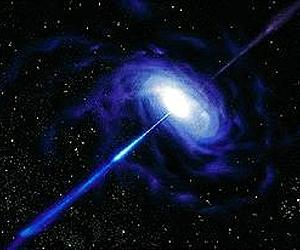
An artist's conception of an "active galactic nucleus" courtesy of NASA. In some galaxies the nucleus, or central core, produces more radiation than the entire rest of the galaxy. (Credit: NASA)

Scientists from the California Institute of Technology and UCLA have discovered evidence of "universal ubiquitous magnetic fields" that have permeated deep space between galaxies since the time of the Big Bang.

Caltech physicist Shin'ichiro Ando and Alexander Kusenko, a professor of physics and astronomy at UCLA, report the discovery in a paper to be published in an upcoming issue of Astrophysical Journal Letters; the research is currently available online.

Ando and Kusenko studied images of the most powerful objects in the universe - supermassive black holes that emit high-energy radiation as they devour stars in distant galaxies - obtained by NASA's Fermi Gamma-ray Space Telescope.

"We found the signs of primordial magnetic fields in deep space between galaxies," Ando said.

Physicists have hypothesized for many years that a universal magnetic field should permeate deep space between galaxies, but there was no way to observe it or measure it until now.

The physicists produced a composite image of 170 giant black holes and discovered that the images were not as sharp as expected.

"Because space is filled with background radiation left over from the Big Bang, as well as emitted from galaxies, high-energy photons emitted by a distant source can interact with the background photons and convert into electron-positron pairs, which interact in their turn and convert back into a group of photons somewhat later," said Kusenko, who is also a senior scientist at the University of Tokyo's Institute for Physics and Mathematics of the Universe.

"While this process by itself does not blur the image significantly, even a small magnetic field along the way can deflect the electrons and positrons, making the image fuzzy," he said.

From such blurred images, the researchers found that the average magnetic field had a "femto-Gauss" strength, just one-quadrillionth of the Earth's magnetic field. The universal magnetic fields may have formed in the early universe shortly after the Big Bang, long before stars and galaxies formed, Ando and Kusenko said.

Wednesday, July 28, 2010

Dimitar Sasselov: How we discovered hundreds of exoplanets


Astronomer Dimitar Sasselov and his colleagues search for exoplanets that may, someday, help us answer centuries-old questions about the origin and existence of biological life elsewhere (and on Earth). How many such planets have they found already? Several hundreds.

About Dimitar Sasselov

Dimitar Sasselov works on uniting the physical and life sciences in the hunt for answers to the question of how life began. Full bio and more links


Thursday, February 4, 2010

Prehistoric Pygmy Sea Cow Discovered in Madagascar

A new species of extinct pygmy sea cow (illustrated above with skull inset) is one of the first fossil mammal species found in Madagascar from the mysterious time period between 80 million years ago and 90,000 years ago, experts say.

"There's a big gap where we really don't know anything about what's going on in the fossil record," said study leader Karen Samonds, of McGill University in Montreal, Canada.

Sea cows, or sirenians, today include manatees and dugongs.

Known from a roughly 40-million-year-old skull and a few ribs, the new species has been named Eotheroides lambondrano, after the Malagasy word for dugong, which translates to "water bushpig." At about seven feet (two meters) long, the ancient pygmy sea cow was smaller than the modern dugong, which ranges from about 8 to 10 feet (2.4 to 3 meters) in length.

The pygmy sea cow would have been "a neat in-between" animal in the evolution from primitive land-dwelling mammals to today's aquatic sea cows, Samonds said. (Explore a prehistoric time line.)

E. lambondrano is also unique in that its closest relatives would have lived in what is now India and Egypt, according to the study—making its Madagascan location all the more special.

"This fossil gives us a new glimpse not just at a new time period, but at a new place," said Samonds, whose work was funded in part by the National Geographic Society's Committee for Research and Exploration. (The National Geographic Society owns National Geographic News.)

"Madagascar already has a lot of strange beasts, and we now have a glimpse of this species from so far away."

Findings published December 12 in the Journal of Vertebrate Paleontology.