Showing posts with label across. Show all posts

Monday, September 15, 2014

New algorithm enables MIT cheetah robot to run and jump across grass

MIT Biomimetic Robotics Laboratory members pose with the MIT cheetah robot in Killian Court. 

(Top row, from left) Deborah Ajilo, Negin Abdolrahim Poorheravi, John Patrick Mayo, Justin Cheung, Sangbae Kim, Shinsuk Park, Kathryn L. Evans, and Matt Angle. 

(Bottom row, from left) Will Bosworth, Joao Luiz Almeida Souza Ramos, Sehyuk Yim, Albert Wang, Meng Yee Chuah, and Hae Won Park. 

Credit: Jose-Luis Olivares/MIT

Speed and agility are hallmarks of the cheetah: The big predator is the fastest land animal on Earth, able to accelerate to 60 mph in just a few seconds.

As it ramps up to top speed, a cheetah pumps its legs in tandem, bounding until it reaches a full gallop.

Now MIT researchers have developed an algorithm for bounding that they've successfully implemented in a robotic cheetah, a sleek, four-legged assemblage of gears, batteries, and electric motors that weighs about as much as its feline counterpart.

The team recently took the robot for a test run on MIT's Killian Court, where it bounded across the grass at a steady clip.

In experiments on an indoor track, the robot sprinted up to 10 mph, even continuing to run after clearing a hurdle.

The MIT researchers estimate that the current version of the robot may eventually reach speeds of up to 30 mph.

The key to the bounding algorithm is in programming each of the robot's legs to exert a certain amount of force in the split second during which it hits the ground, to maintain a given speed: In general, the faster the desired speed, the more force must be applied to propel the robot forward.

Sangbae Kim, an associate professor of mechanical engineering at MIT, hypothesizes that this force-control approach to robotic running is similar, in principle, to the way world-class sprinters race.

"Many sprinters, like Usain Bolt, don't cycle their legs really fast," Kim says.

"They actually increase their stride length by pushing downward harder and increasing their ground force, so they can fly more while keeping the same frequency."

Kim says that by adapting a force-based approach, the cheetah-bot is able to handle rougher terrain, such as bounding across a grassy field.

In treadmill experiments, the team found that the robot handled slight bumps in its path, maintaining its speed even as it ran over a foam obstacle.

"Most robots are sluggish and heavy, and thus they cannot control force in high-speed situations," Kim says.

"That's what makes the MIT cheetah so special: You can actually control the force profile for a very short period of time, followed by a hefty impact with the ground, which makes it more stable, agile, and dynamic."


See the MIT cheetah-bot in action, and learn how it works. Credit: Melanie Gonick/MIT

Kim says what makes the robot so dynamic is a custom-designed, high-torque-density electric motor, designed by Jeffrey Lang, the Vitesse Professor of Electrical Engineering at MIT.

These motors are controlled by amplifiers designed by David Otten, a principal research engineer in MIT's Research Laboratory of Electronics.

The combination of such special electric motors and custom-designed, bio-inspired legs allow force control on the ground without relying on delicate force sensors on the feet.

Kim and his colleagues, research scientist Hae-Won Park and graduate student Meng Yee Chuah, will present details of the bounding algorithm this month at the IEEE/RSJ International Conference on Intelligent Robots and Systems in Chicago.

The custom, high-torque-density motors and amplifier. 

Credit: Jose-Luis Olivares/MIT

Kim and his colleagues developed an algorithm that determines the amount of force a leg should exert in the short period of each cycle that it spends on the ground.

That force, they reasoned, should be enough for the robot to push up against the downward force of gravity, in order to maintain forward momentum.

"Once I know how long my leg is on the ground and how long my body is in the air, I know how much force I need to apply to compensate for the gravitational force," Kim says.

"Now we're able to control bounding at many speeds. And to jump, we can, say, triple the force, and it jumps over obstacles."

In experiments, the team ran the robot at progressively smaller duty cycles, finding that, following the algorithm's force prescriptions, the robot was able to run at higher speeds without falling. Kim says the team's algorithm enables precise control over the forces a robot can exert while running.

The face of the MIT cheetah-bot. 

Credit: Jose-Luis Olivares/MIT

By contrast, he says, similar quadruped robots may exert high force, but with poor efficiency.

What's more, such robots run on gasoline and are powered by a gasoline engine, in order to generate high forces.

"As a result, they're way louder," Kim says. "Our robot can be silent and as efficient as animals. The only things you hear are the feet hitting the ground."

"This is kind of a new paradigm where we're controlling force in a highly dynamic situation. Any legged robot should be able to do this in the future."

Tuesday, March 25, 2014

NASA MODIS: Agricultural fires across Sierra Leone

Credit: NASA image courtesy Jeff Schmaltz, MODIS Rapid Response Team.

Marked in red, hundreds of land use fires burn in the fields across Sierra Leone.

Most fires in this region are deliberately set for a variety of reasons, including slash and burn agriculture.

When a plot of land becomes exhausted, farmers shift cultivation to another plot where they cut the trees and brush at the beginning of the dry season in January and February.

Once the dead plant material has dried, they set fire to it. Such fires peak in March and April right before farming season begins.

From space, MODIS detects thermal anomalies, including fires, flares, and volcanoes.

Each MODIS "fire pixel" or fire detection covers one square kilometer, which means that one or more fire is burning in the corresponding one-square kilometer area on the ground.

There are hundreds of fire pixels evident in this image, so there are at least that many distinct fires burning in this scene.

MODIS tends to undercount fires because it can't detect fires through smoke or clouds, nor does it see small cool fires, a fire type common to land use fires.

Where there is fire, there is also smoke, affecting air quality. Smoke contains soot and other particulates that pose a threat to human health and affect regional climate. Burning also releases greenhouse gases.

This natural-colour satellite image was collected by the Moderate Resolution Imaging Spectroradiometer (MODIS) aboard the Aqua satellite on March 24, 2014.


Monday, March 3, 2014

NASA SDO: Giant sunspot making third rotation across surface of the sun

A massive and significantly strong sunspot is currently making its third pass across a “complex region” of the Sun, according to NASA.

Sunspots like the one currently being tracked by NASA and NOAA, are part of the active Sun regions which typically produce large solar flares and coronal mass ejections.

Sunspot AR1990 was previously labeled AR1967 while on its second rotation around the Sun, and AR1944, during its initial trip around the face of the Sun.

As previously reported by NASA, the largest solar flare of 2014 was unleashed by the Sun late last week.

The huge X Class solar flare erupted from sunspot AR1990, according to NASA’s Solar Dynamics Observatory (SDO).

The agency’s spacecraft recorder captured the gigantic bursts of plasma from the coronal mass ejection – CME.

X Class solar flares are the strongest type of solar storms. The massive solar flare was not Earth-directed, so the power grid was not in jeopardy.

If the 4.9 X Class solar flare had been directed towards Earth, the CME could have likely prompted a significant geomagnetic storm.

During such a storm charged particles smash against the Earth’s magnetic field. The Sun is currently in the most active phase of its 11-year solar cycle.

Thursday, September 23, 2010

Primordial Magnetic Fields Discovered Across The Universe


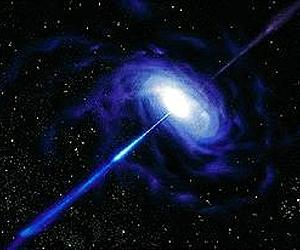
An artist's conception of an "active galactic nucleus" courtesy of NASA. In some galaxies the nucleus, or central core, produces more radiation than the entire rest of the galaxy. (Credit: NASA)

Scientists from the California Institute of Technology and UCLA have discovered evidence of "universal ubiquitous magnetic fields" that have permeated deep space between galaxies since the time of the Big Bang.

Caltech physicist Shin'ichiro Ando and Alexander Kusenko, a professor of physics and astronomy at UCLA, report the discovery in a paper to be published in an upcoming issue of Astrophysical Journal Letters; the research is currently available online.

Ando and Kusenko studied images of the most powerful objects in the universe - supermassive black holes that emit high-energy radiation as they devour stars in distant galaxies - obtained by NASA's Fermi Gamma-ray Space Telescope.

"We found the signs of primordial magnetic fields in deep space between galaxies," Ando said.

Physicists have hypothesized for many years that a universal magnetic field should permeate deep space between galaxies, but there was no way to observe it or measure it until now.

The physicists produced a composite image of 170 giant black holes and discovered that the images were not as sharp as expected.

"Because space is filled with background radiation left over from the Big Bang, as well as emitted from galaxies, high-energy photons emitted by a distant source can interact with the background photons and convert into electron-positron pairs, which interact in their turn and convert back into a group of photons somewhat later," said Kusenko, who is also a senior scientist at the University of Tokyo's Institute for Physics and Mathematics of the Universe.

"While this process by itself does not blur the image significantly, even a small magnetic field along the way can deflect the electrons and positrons, making the image fuzzy," he said.

From such blurred images, the researchers found that the average magnetic field had a "femto-Gauss" strength, just one-quadrillionth of the Earth's magnetic field. The universal magnetic fields may have formed in the early universe shortly after the Big Bang, long before stars and galaxies formed, Ando and Kusenko said.

Monday, May 17, 2010

Visual Trip across the Universe

So what would it look like to travel across the universe then? To help us visualize this, the American Museum of Natural History (AMNH) in partnership with Rubin Museum of Art has produced a modern movie titled “The Known Universe“, directed by Carter Emmart and curated by Ben R. Oppenheimer using visualization software “Uniview by SCISS” – featuring many visual highlights of such a trip.

The video starts in Earth’s Himalayan Mountains, the Tibetan Plateau and then dramatically zooms out, showing the orbits of Earth’s satellites, the Sun, the Solar System, the extent of humanities first radio signals, the Milky Way Galaxy, galaxies nearby, distant galaxies, and quasars.

As the distant surface of the microwave background is finally reached, radiation is depicted that was emitted billions of light years away and less than one million years after the Big Bang.

Watch this awesome video clip and get ready to be stunned. (You can see it in 720p HD quality too)