Showing posts with label NRAO. Show all posts

Wednesday, October 8, 2014

NRAO Radio telescopes unravel mystery of nova gamma rays

A nova does not explode like an expanding ball, but instead throws out gas in different directions at different times and different speeds. 

When this gas inevitably crashes together, it produces shocks and high-energy gamma-ray photons. 
The complex explosion and gas collisions in nova V959 Mon is illustrated here. 

In the first days of the nova explosion, dense, relatively slow-moving material is expelled along the binary star system's equator (yellow material in left panel). 
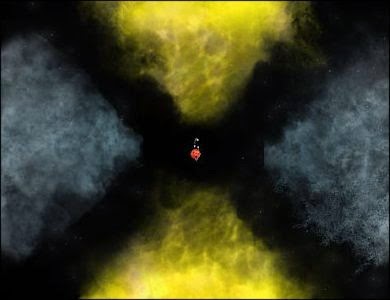
Over the next several weeks, fast winds pick up and are blown off the binary, but they are funneled along the binary star system's poles (blue material in central panel). 

The equatorial and polar material crashes together at their intersection, producing shocks and gamma-ray emission (red regions in central panel). 

Finally, at later times, the nova stops blowing a wind, and the material drifts off into space, the fireworks finished (right panel). 

Credit: Bill Saxton, NRAO/AUI/NSF

Highly-detailed radio-telescope images have pinpointed the locations where a stellar explosion called a nova emitted gamma rays, the most energetic form of electromagnetic waves.

The discovery revealed a probable mechanism for the gamma-ray emissions, which mystified astronomers when first observed in 2012.

"We not only found where the gamma rays came from, but also got a look at a previously-unseen scenario that may be common in other nova explosions," said Laura Chomiuk, of Michigan State University.

A nova occurs when a dense white dwarf star pulls material onto itself from a companion star, triggering a thermonuclear explosion that blows debris into interstellar space.

Astronomers did not expect this scenario to produce high-energy gamma rays.

However, in June of 2012, NASA's Fermi spacecraft detected gamma rays coming from a nova called V959 Mon, some 6500 light-years from Earth.

At the same time, observations with the Karl G. Jansky Very Large Array (VLA) indicated that radio waves coming from the nova probably were caused by subatomic particles moving at nearly the speed of light interacting with magnetic fields.

The high-energy gamma-ray emission, the astronomers noted, also required such fast-moving particles.

Later observations with the extremely-sharp radio "vision" of the Very Long Baseline Array (VLBA) and the European VLBI network revealed two distinct knots of radio emission. These knots then were seen to move away from each other.

This observation, along with studies made with e-MERLIN in the UK, and another round of VLA observations in 2014, provided the scientists with information that allowed them to put together a picture of how the radio knots, and the gamma rays, were produced.

In the first stage of this scenario, the white dwarf and its companion give up some of their orbital energy to boost some of the explosion material, making the ejected material move outward faster in the plane of their orbit.

Later, the white dwarf blows off a faster wind of particles moving mostly outward along the poles of the orbital plane.

When the faster-moving polar flow hits the slower-moving material, the shock accelerates particles to the speeds needed to produce the gamma rays, and the knots of radio emission.

"By watching this system over time and seeing how the pattern of radio emission changed, then tracing the movements of the knots, we saw the exact behavior expected from this scenario," Chomiuk said.

Since the 2012 outburst of V959 Mon, Fermi has detected gamma rays from three additional nova explosions.

"This mechanism may be common to such systems. The reason the gamma rays were first seen in V959 Mon is because it's close," Chomiuk said.

Because the type of ejection seen in V959 Mon also is seen in other binary-star systems, the new insights may help astronomers understand how those systems develop.

This "common envelope" phase occurs in all close binary stars, and is poorly understood.

"We may be able to use novae as a 'testbed' for improving our understanding of this critical stage of binary evolution," Chomiuk said.

Chomiuk worked with an international team of astronomers. The researchers reported their findings in the scientific journal Nature.

More information: Binary orbits as the driver of gamma-ray emission and mass ejection in classical novae , Nature, DOI: 10.1038/nature13773

Monday, September 29, 2014

NRAO: Milky Way Explorer Software Tours the Solar System

NRAO's Milky Way Explorer Tours the Solar System

Imagine seeing the Sun, planets, and a myriad other objects in our Solar System as you have never seen them before, in invisible radio light!

That is the experience you will get through the National Radio Astronomy Observatory's (NRAO) newly released Solar System installment of its popular Milky Way Explorer, an online tour of our interstellar neighbourhood guided by the actual astronomers who explore it using radio waves.

Through an entertaining and informative series of videos, NRAO's Science Visualization Team presents multimedia-rich tours of the radio Sun as well as many of the planets, moons, and asteroids that orbit it.

At each stop along the way, planetary radio astronomers reveal the new science and exciting details we have learned about our Solar System neighbours through the use of radio telescopes.

Unlike familiar optical telescopes, which can only study objects illuminated by our Sun and other stars, radio telescopes can see the otherwise invisible cold, dark features in space.

This includes the faint radio light that is naturally emitted by the molecules and chemicals that make up the atmospheres of planets and certain moons in our Solar System.

Radio dishes, when paired with powerful radar transmitters on Earth, can also reveal hidden landscapes, such as the Moon's dust-layered surface and Venus's alien features shrouded behind its thick clouds.

The Milky Way Explorer, which was launched in 2013, also includes dozens more videos showcasing the diverse radio astronomy studies of our spiral island of stars, stellar nurseries, and dark matter.

A third set of interviews and animations is scheduled for 2015 to share more radio astronomy discoveries made inside our Galaxy and among the nearest neighboring galaxies of our Universe.

Thursday, September 18, 2014

NRAO Very Long Baseline Array takes radio image of Voyager 1

Credit: NRAO/AUI/NSF

The image above is a radio image of Voyager 1.

It was taken from NRAO's Very Long Baseline Array (VLBA), which is a collection of 10 radio telescopes scattered from Hawaii to the Virgin Islands.

It captures the faint radio signal of the distant probe. That pale blue dot is the most distant object made by humans.

The radio strength of Voyager 1 is about 23 watts. That signal is directed toward Earth, but Voyager is about 15 billion kilometers from Earth, so by the time the probe's signal reaches us its power is less than an attowatt, or a billionth of a billionth of a watt.

That faint signal is the only information we have from a probe that left our planet 36 years ago.

Of course it isn't enough to simply detect the signal from Voyager 1, we must receive the signal the way you might receive a radio signal, or a mobile phone call.

That requires even greater sensitivity, which is why it requires large radio telescopes to communicate with Voyager.

We have to be able to hear Voyager's faint messages, and we have to send radio responses that are powerful enough and focused enough for Voyager to receive.

Voyager 1 has, arguably, entered interstellar space, but has only begun its journey to the edge of our solar system.

It will eventually leave our Sun's grasp, since it has enough speed to escape the Sun's gravity, but it will become silent long before then.

In another 5 – 10 years it won't have enough power to operate its instruments.

That's part of what makes this current milestone so significant. Voyager 1 has not only reached interstellar space, but it has communicated the fact to us and we have gained knowledge and insight from it.

That pale blue dot, a radio blip in a radio dark sky, is a part of us.

It is an 800 kg, car sized, nuclear-powered computer that we launched into space to explore the solar system.

Our curiosity and quest for knowledge drove us to create it, and our developing intelligence allowed us to build it.

After a 36 year journey towards the harshness of interstellar space, it continues to communicate with its creators.

Looking out from one pale blue dot towards another one.

(Taken from an article by Brian Koberlein)

Tuesday, August 5, 2014

ALMA pinpoints Pluto to help guide NASA's New Horizons spacecraft

The cold surface of Pluto and its largest moon Charon as seen with ALMA on July 15, 2014. 

Credit: NRAO/AUI/NSF

Astronomers using the Atacama Large Millimeter/submillimeter Array (ALMA) are making high-precision measurements of Pluto's location and orbit around the Sun to help NASA's New Horizons spacecraft accurately home in on its target when it nears Pluto and its five known moons in July 2015.

Though observed for decades with ever-larger optical telescopes on Earth and in space, astronomers are still working out Pluto's exact position and path around our Solar System.

ALMA - The Atacama Array

This lingering uncertainty is due to Pluto's extreme distance from the Sun (approximately 40 times farther out than the Earth) and the fact that we have been studying it for only about one-third of its orbit.

Pluto was discovered in 1930 and takes 248 years to complete one revolution around the Sun.

"With these limited observational data, our knowledge of Pluto's position could be wrong by several thousand kilometers, which compromises our ability to calculate efficient targeting maneuvers for the New Horizons spacecraft," said New Horizons Project Scientist Hal Weaver, from the Johns Hopkins University Applied Physics Laboratory in Laurel, Maryland.

NASA's New Horizons spacecraft
The New Horizons team made use of the ALMA positioning data, together with newly analyzed visible light measurements stretching back to Pluto's discovery, to determine how to perform the first such scheduled course correction for targeting, known as a Trajectory Correction Maneuver (TCM), in July.

This maneuver helped ensure that New Horizons uses the minimum fuel to reach Pluto, saving as much as possible for a potential extended mission to explore Kuiper Belt objects after the Pluto system flyby is complete.

Animated image of ALMA data showing the motion of the moon Charon around the icy dwarf planet Pluto. 

Credit: B. Saxton (NRAO/AUI/NSF)

To prepare for this first TCM, astronomers needed to pinpoint Pluto's position using the most distant and most stable reference points possible.

Finding such a reference point to accurately calculate trajectories of such small objects at such vast distances is incredibly challenging.

Normally, stars at great distances are used by optical telescopes for astrometry (the positioning of things on the sky) since they change position only slightly over many years.

For New Horizons, however, even more precise measurements were necessary to ensure its encounter with Pluto would be as on-target as possible.

The most distant and most apparently stable objects in the Universe are quasars, galaxies more than 10 billion light-years away.

Though quasars appear very dim to optical telescopes, they are incredibly bright at radio wavelengths, particularly the millimeter wavelengths that ALMA can see.

Ed Fomalont
"The ALMA astrometry used a bright quasar named J1911-2006 with the goal to cut in half the uncertainty of Pluto's position," said Ed Fomalont, an astronomer with the National Radio Astronomy Observatory in Charlottesville, Virginia, and currently assigned to ALMA's Operations Support Facility in Chile.

ALMA was able to study Pluto and its largest moon Charon by picking up the radio emission from their cold surfaces, which are about 43 degrees Kelvin (-230 degrees Celsius).

The team first observed these two icy worlds in November 2013, and then three more times in 2014, once in April and twice in July. Additional observations are scheduled for October 2014.

"By taking multiple observations at different dates, we allow Earth to move along its orbit, offering different vantage points in relation to the Sun," said Fomalont.

"Astronomers can then better determine Pluto's distance and orbit." This astronomical technique is called measuring Pluto's parallax.

"We are very excited about the state-of-the-art capabilities that ALMA brings to bear to help us better target our historic exploration of the Pluto system," said New Horizons Principal Investigator Alan Stern of the Southwest Research Institute in Boulder, Colorado.

"We thank the entire ALMA team for their support and for the beautiful data they are gathering for New Horizons."

Monday, June 23, 2014

Remarkable white dwarf star; coldest, dimmest ever detected

This is an artist impression of a white dwarf star in orbit with pulsar PSR J2222-0137. 

It may be the coolest and dimmest white dwarf ever identified. 

Credit: B. Saxton (NRAO /AUI /NSF)

A team of astronomers has identified possibly the coldest, faintest white dwarf star ever detected.

This ancient stellar remnant is so cool that its carbon has crystallized, forming an Earth-size diamond in space.

David Kaplan
"It's a really remarkable object," said David Kaplan, a professor at the University of Wisconsin-Milwaukee. "These things should be out there, but because they are so dim they are very hard to find."

Kaplan and his colleagues found this stellar gem using the National Radio Astronomy Observatory's (NRAO) Green Bank Telescope (GBT) and Very Long Baseline Array (VLBA), as well as other observatories.

White dwarfs are the extremely dense end-states of stars like our Sun that have collapsed to form an object approximately the size of the Earth.

Composed mostly of carbon and oxygen, white dwarfs slowly cool and fade over billions of years. The object in this new study is likely the same age as the Milky Way, approximately 11 billion years old.

Pulsars are rapidly spinning neutron stars, the superdense remains of massive stars that have exploded as supernovas.

As neutron stars spin, lighthouse-like beams of radio waves, streaming from the poles of its powerful magnetic field, sweep through space.

When one of these beams sweeps across the Earth, radio telescopes can capture the pulse of radio waves.

The pulsar companion to this white dwarf, dubbed PSR J2222-0137, was the first object in this system to be detected.

Jason Boyles
It was found using the GBT by Jason Boyles, then a graduate student at West Virginia University in Morgantown.

These first observations revealed that the pulsar was spinning more than 30 times each second and was gravitationally bound to a companion star, which was initially identified as either another neutron star or, more likely, an uncommonly cool white dwarf. The two were calculated to orbit each other once every 2.45 days.

The pulsar was then observed over a two-year period with the VLBA by Adam Deller, an astronomer at the Netherlands Institute for Radio Astronomy (ASTRON).

These observations pinpointed its location and distance from the Earth, approximately 900 light-years away in the direction of the constellation Aquarius.

This information was critical in refining the model used to time the arrival of the pulses at the Earth with the GBT.

By applying Einstein's theory of relatively, the researchers studied how the gravity of the companion warped space, causing delays in the radio signal as the pulsar passed behind it.

These delayed travel times helped the researchers determine the orientation of their orbit and the individual masses of the two stars.

The pulsar has a mass 1.2 times that of the Sun and the companion a mass 1.05 times that of the Sun.

These data strongly indicated that the pulsar companion could not have been a second neutron star; the orbits were too orderly for a second supernova to have taken place.

Knowing its location with such high precision and how bright a white dwarf should appear at that distance, the astronomers believed they should have been able to observe it in optical and infrared light.

Remarkably, neither the Southern Astrophysical Research (SOAR) telescope in Chile nor the 10-meter Keck telescope in Hawaii was able to detect it.

"Our final image should show us a companion 100 times fainter than any other white dwarf orbiting a neutron star and about 10 times fainter than any known white dwarf, but we don't see a thing," said Bart Dunlap, a graduate student at the University of North Carolina at Chapel Hill and one of the team members.

"If there's a white dwarf there, and there almost certainly is, it must be extremely cold."

The researchers calculated that the white dwarf would be no more than a comparatively cool 3,000 degrees Kelvin (2,700 degrees Celsius).

Astronomers believe that such a cool, collapsed star would be largely crystallized carbon, not unlike a diamond.

Other such stars have been identified and they are theoretically not that rare, but with a low intrinsic brightness, they can be deucedly difficult to detect.

Its fortuitous location in a binary system with a neutron star enabled the team to identify this one.

Thursday, May 15, 2014

Remarkable Features below the surface of the Moon

Mare Serenitatis / Sea of Serenity. 

Credit: Bruce Campbell (Smithsonian Institution, National Air and Space Museum); Arecibo /NAIC; NRAO /AUI /NSF

New images of Earth's Moon reveal more than can be seen with the naked eye, thanks to the combined efforts of the two largest radio telescopes of their kind, the National Radio Astronomy Observatory's Green Bank Telescope (GBT) in West Virginia and the Arecibo Observatory in Puerto Rico.

To make these images, radar signals beamed from Arecibo's powerful transmitter penetrated far below the Moon's dusty surface.

The signals then rebounded back and were picked up by the sensitive receivers on the GBT.

This observing technique, known as bistatic radar, has been used to study many objects in our solar system, including asteroids and other planets.

The first image reveals previously hidden features around an area known as Mare Serenitatis, or the Sea of Serenity, which is near the Apollo 17 landing site.

The radar observations were able to "see" approximately 10-15 meters (33-50 feet) below the lunar surface.

The light and dark features are the result of compositional changes in the lunar dust and differences in the abundance of rocks buried within the soil.

The second image is a similar observation of the lunar impact crater known as Aristillus.

The radar echoes reveal geologic features of the large debris field created by the force of the impact.

The dark "halo" surrounding the crater is due to pulverized debris beyond the rugged, radar-bright rim deposits.

The image also shows traces of lava-like features produced when lunar rock melted from the heat of the impact.

The crater is approximately 55 kilometers (34 miles) in diameter and 3.5 kilometers (2 miles) deep.

Aristillus Crater. 

Credit: Bruce Campbell (Smithsonian Institution, National Air and Space Museum); Arecibo/NAIC; NRAO/AUI/NSF

These images help planetary scientists interpret the complex history of the Moon, which is often obscured by dust layers built up over billions of years, better understand the geology of earlier landing sites, and plan for future lunar exploration.

Tuesday, April 1, 2014

Young Star Clusters In the Circumnuclear Region of Black Hole

In this false-colour image combining several sets of observations, the visible light is in blues (Hubble Space telescope) showing swirls of stars; the observations from NRAO's Very Large Array (VLA) radio telescope are in green and aqua displaying a central emission with two jets, and the newly discovered clusters are in red in the middle. 

The black hole is represented by a dot to show the location – the black hole itself can't be seen.

Huge young star clusters resembling a string of pearls around a black hole in the centre of a galaxy 120 million light-years away have been discovered by researchers at Swinburne University of Technology.

The galaxy, called NGC2110, is in the constellation of Orion.

Using the giant Keck telescopes in Hawaii, the researchers, Professor Jeremy Mould and PhD student Mark Durré from Swinburne's Centre for Astrophysics and Supercomputing, found four star clusters, very close (in astronomical terms) to a black hole.

"These star clusters hadn't been seen before because they are hidden by dust clouds around the black hole and because they appear very tiny, but they can be observed in infrared radiation that penetrates the clouds," Mr Durré said.

"The Keck telescopes also uses 'adaptive optics', which removes the atmospheric shimmer that blurs images."

Supermassive black holes – condensations of matter so dense that not even light can escape from its gravity – are thought to be at the centre of all large galaxies.

"Our own galaxy, the Milky Way, has a black hole that is almost four million times the mass of our Sun," Mr Durré said. "NGC2110 has a black hole about 100 times bigger."

Mark Durré
The black hole produces huge amounts of energy that comes from gas and dust falling into it.

As the material streams in, it hits an accretion disk – a spinning ring of superheated gas around the black hole's equator.

Enormous quantities of radiation shine out and some of the matter also gets spewed out in jets, which are most clearly observed by radio telescopes.

Tides from the black hole and other features of the galaxy can help form star clusters – collections of thousands of stars which are all formed together from a gas and dust cloud.

In turn, gas out-streaming from the young stars in the clusters can feed and energise the black hole.

"The jets can compress gas around them to start this star cluster formation, but they can also stop the process by blowing the gas completely out of the galaxy."

"The fine details of how the matter is funnelled in and how the black hole affects the galaxy around it remain fascinating questions for astronomers as they try to work out how galaxies form."

Mr Durré said that according to computer simulations, star clusters should form like beads or pearls on a string in a ring around the black hole – and this is just what the researchers have observed.

"After many millions of years, these clusters will be torn apart, again by tidal forces, and gradually settle into a central collection closer around the black hole." Mr Durré said.

This research has been published in the Astrophysical Journal.

More information: "Young Star Clusters In The Circumnuclear Region Of NGC 2110." Mark Durré, Jeremy Mould. arXiv:1402.3339 [astro-ph.GA]

Monday, February 3, 2014

Hubble Image: Starbursting in the galaxy M82

Credit: Josh Marvil (NM Tech/NRAO), Bill Saxton (NRAO/AUI/NSF), NASA

Messier 82 (M82), the galaxy in which the nearest supernova in decades recently exploded, also is the closest galaxy that is undergoing a rapid burst of star formation, known as a starburst.

About 12 million light-years away, it is seen nearly edge-on, as shown in the larger, visible-light image from the Hubble Space Telescope.

The inset is a new radio image, made with the Karl G. Jansky Very Large Array (VLA), that reveals fresh information about the central 5,200 light-years of the galaxy.

The radio emission seen here is produced by ionized gas and by fast-moving electrons interacting with the interstellar magnetic field.

The bright dots are a mix of star-forming regions and supernova remnants, the debris from stellar explosions; analysis of the VLA data tells scientists which of these are which.

Scientists also are studying the faint, wispy features, many of which were previously unseen, to investigate their relationship with this galaxy's starburst-driven superwind.

Supernova 2014J is located outside the inset, to the right. VLA observations to date show that, like all other supernovae of its particular type, SN 2014J has not yet been found to be emitting radio waves.

Monday, January 27, 2014

Green Bank Telescope (GBT): River of Hydrogen flowing through space

This composite image contains three distinct features: the bright star-filled central region of galaxy NGC 6946 in optical light (blue), the dense hydrogen tracing out the galaxy's sweeping spiral arms and galactic halo (orange), and the extremely diffuse and extended field of hydrogen engulfing NGC 6946 and its companions (red). 

The new GBT data show the faintly glowing hydrogen bridging the gulf between the larger galaxy and its smaller companions. 

This faint structure is precisely what astronomers expect to appear as hydrogen flows from the intergalactic medium into galaxies or from a past encounter between galaxies. 

Credit: D.J. Pisano (WVU); B. Saxton (NRAO/AUI/NSF); Palomar Observatory -- Space Telescope Science Institute 2nd Digital Sky Survey (Caltech); Westerbork Synthesis Radio Telescope (WSRT)

D.J. Pisano
Using the National Science Foundation's Robert C. Byrd Green Bank Telescope (GBT), astronomer D.J. Pisano from West Virginia University has discovered what could be a never-before-seen river of hydrogen flowing through space.

This very faint, very tenuous filament of gas is streaming into the nearby galaxy NGC 6946 and may help explain how certain spiral galaxies keep up their steady pace of star formation.

"We knew that the fuel for star formation had to come from somewhere. So far, however, we've detected only about 10 percent of what would be necessary to explain what we observe in many galaxies," said Pisano.

"A leading theory is that rivers of hydrogen – known as cold flows – may be ferrying hydrogen through intergalactic space, clandestinely fueling star formation. But this tenuous hydrogen has been simply too diffuse to detect, until now."

Spiral galaxy NGC 6946
Spiral galaxies, like our own Milky Way, typically maintain a rather tranquil but steady pace of star formation.

Others, like NGC 6946, which is located approximately 22 million light-years from Earth on the border of the constellations Cepheus and Cygnus, are much more active, though less-so than more extreme starburst galaxies.

This raises the question of what is fueling the sustained star formation in this and similar spiral galaxies.

Earlier studies of the galactic neighborhood around NGC 6946 with the Westerbork Synthesis Radio Telescope (WSRT) in the Netherlands have revealed an extended halo of hydrogen (a feature commonly seen in spiral galaxies, which may be formed by hydrogen ejected from the disk of the galaxy by intense star formation and supernova explosions).

A cold flow, however, would be hydrogen from a completely different source: gas from intergalactic space that has never been heated to extreme temperatures by a galaxy's star birth or supernova processes.

Using the GBT, Pisano was able to detect the glow emitted by neutral hydrogen gas connecting NGC 6946 with its cosmic neighbours. This signal was simply below the detection threshold of other telescopes.

The GBT's unique capabilities, including its immense single dish, unblocked aperture, and location in the National Radio Quiet Zone, enabled it to detect this tenuous radio light.

Astronomers have long theorized that larger galaxies could receive a constant influx of cold hydrogen by syphoning it off other less-massive companions.

In looking at NGC 6946, the GBT detected just the sort of filamentary structure that would be present in a cold flow, though there is another probable explanation for what has been observed.

It's also possible that sometime in the past this galaxy had a close encounter and passed by its neighbours, leaving a ribbon of neutral atomic hydrogen in its wake.

If that were the case, however, there should be a small but observable population of stars in the filaments.

Further studies will help to confirm the nature of this observation and could shine light on the possible role that cold flows play in the evolution of galaxies.

Journal Reference: D. J. Pisano. GREEN BANK TELESCOPE OBSERVATIONS OF LOW COLUMN DENSITY H I AROUND NGC 2997 AND NGC 6946. The Astronomical Journal, 2014; 147 (3): 48 DOI: 10.1088/0004-6256/147/3/48

Jansky Very Large Array (VLA): Solving a 30-year-old problem in massive star formation

This false-colour Very Large Array image of the ionized gas in the star forming region Sgr B2 Main was used to detect small but significant changes in brightness of several of the sources. 

The spots and filaments in this image are regions of ionized gas around massive stars. 

The changes in brightness detected support a model that could solve a 30-year-old question in high mass star formation. 

Credit: NRAO /Agnes Scott College

An international group of astrophysicists has found evidence strongly supporting a solution to a long-standing puzzle about the birth of some of the most massive stars in the universe.

Young massive stars, which have more than 10 times the mass of the Sun, shine brightly in the ultraviolet, heating the gas around them, and it has long been a mystery why the hot gas doesn't explode outwards.

Now, observations made by a team of researchers using the Jansky Very Large Array (VLA), a radio astronomy observatory in New Mexico, have confirmed predications that as the gas cloud collapses, it forms dense filamentary structures that absorb the star's ultraviolet radiation when it passes through them. As a result, the surrounding heated nebula flickers like a candle.

The findings were published recently in The Astrophysical Journal Letters.

"Massive stars dominate the lives of their host galaxies through their ionizing radiation and supernova explosions," said Mordecai-Mark Mac Low, a curator in the American Museum of Natural History's Department of Astrophysics and an author on the paper.

"All the elements heavier than iron were formed in the supernova explosions occurring at the ends of their lives, so without them, life on Earth would be very different."

Observations of the massive star forming region Sgr B2 were made with the Karl G. Jansky Very Large Array (VLA) in 1989 and 2012. 

The VLA has been operational since 1980 and received a major upgrade that was completed in 2011. 

Credit: NRAO/AUI

Stars form when huge clouds of gas collapse. Once the density and temperature are high enough, hydrogen fuses into helium, and the star starts shining.

The most massive stars, though, begin to shine while the clouds are still collapsing.

Their ultraviolet light ionizes the surrounding gas, forming a nebula with a temperature of 10,000 degrees Celsius. Simple models suggest that at this stage, the gas around massive stars will quickly expand.

But observations from the VLA radio observatory show something different: a large number of regions of ionized hydrogen (so-called HII regions) that are very small.

"In the old theoretical model, a high-mass star forms and the HII region lights up and begins to expand."

Chris De Pree
"Everything was neat and tidy," said lead author Chris De Pree, a professor of astronomy and director of the Bradley Observatory at Agnes Scott College.

"But the group of theorists I am working with were running numerical models that showed accretion was continuing during star formation, and that material was continuing to fall in toward the star after the HII region had formed."

More information: arxiv.org/abs/1312.7768

Wednesday, January 8, 2014

Dwarf galaxies provide clues to origin of supermassive black holes

Dwarf galaxy NGC 4395, about 13 million light-years from Earth, known to harbour a black hole some 300,000 times more massive than the Sun. 

It is a prototypical example of a small galaxy once thought to be too small to contain such a black hole. 

Credit: David W. Hogg, Michael R. Blanton, and the Sloan Digital Sky Survey Collaboration; NRAO/AUI/NSF.

Pouring through data from a large sky survey, astronomers have found more than 100 small, dwarf galaxies with characteristics indicating that they harbor massive black holes feeding on surrounding gas.

The discovery confounds a common assumption that only much larger galaxies hold such monsters and may help resolve the question of how such black holes originated and grew in the early universe.

Amy Reines
"We've shown that even small galaxies can have massive black holes and that they may be more common than previously thought," said Amy Reines, of the National Radio Astronomy Observatory (NRAO).

"This is really exciting because these little galaxies hold the clues to the origin of the first 'seeds' of supermassive black holes in the early universe," she said. Reines and her colleagues presented their findings to the American Astronomical Society's meeting in Washington, DC.

Black holes are concentrations of mass so dense that not even light can escape their gravitational pull.

Nearly all "full-sized" galaxies are known to have supermassive black holes, millions or billions of times more massive than the Sun, at their cores.

Until recently, however, smaller galaxies were thought not to harbor massive black holes.

Marla Geha
Reines, along with Jenny Greene of Princeton University and Marla Geha of Yale University, analyzed data from the Sloan Digital Sky Survey and found more than 100 dwarf galaxies whose patterns of light emission indicated the presence of massive black holes and their feeding process.

"The galaxies are comparable in size to the Magellanic Clouds, dwarf satellite galaxies of the Milky Way," Geha said.

"Previously, such galaxies were thought to be too small to have such massive black holes," she added.

In the nearby universe, astronomers have found a direct relationship between the mass of a galaxy's central black hole and a "bulge" in its center.

This indicates that the black holes and the bulges may have affected each others' growth.

Monday, January 6, 2014

ESO ALMA: Supernova 1987A's super dust factory

This is a composite image of supernova 1987A. 

ALMA data (in red) shows newly formed dust in the center of the remnant. 

HST (in green) and Chandra (in blue) show the expanding shockwave. 

Credit: Alexandra Angelich (NRAO/AUI/NSF); NASA Hubble; NASA Chandra

Galaxies can be remarkably dusty places and supernovas are thought to be a primary source of that dust, especially in the early Universe.

Direct evidence of a supernova's dust-making capabilities, however, has been slim and cannot account for the copious amount of dust detected in young, distant galaxies.

Striking new observations with the ESO Atacama Large Millimeter/submillimeter Array (ALMA) telescope capture, for the first time, the remains of a recent supernova brimming with freshly formed dust.

If enough of this dust makes the perilous transition into interstellar space, it could explain how many galaxies acquired their dusty, dusky appearance.

Remy Indebetouw
"We have found a remarkably large dust mass concentrated in the central part of the ejecta from a relatively young and nearby supernova," said Remy Indebetouw, an astronomer with the National Radio Astronomy Observatory (NRAO) and the University of Virginia, both in Charlottesville.

"This is the first time we've been able to really image where the dust has formed, which is important in understanding the evolution of galaxies."

The results are being reported at the January meeting of the American Astronomical Society (AAS). They also are accepted for publication in the Astrophysical Journal Letters.

An international team of astronomers used ALMA to observe the glowing remains of supernova 1987A, which is in the Large Magellanic Cloud, a dwarf galaxy orbiting the Milky Way approximately 168,000 light-years from Earth.

Light from this supernova arrived at Earth in 1987, inspiring its name. This makes 1987A the closest observed supernova explosion since Johannes Kepler's observation of a supernova inside the Milky Way in 1604.

This artist's illustration of supernova 1987A reveals the cold, inner regions of the exploded star's remnants (in red) where tremendous amounts of dust were detected and imaged by ALMA.

This inner region is contrasted with the outer shell (lacy white and blue circles), where the energy from the supernova is colliding with the envelope of gas ejected from the star prior to its powerful detonation. 

Credit: Alexandra Angelich (NRAO/AUI/NSF)

Astronomers predicted that as the gas cooled after the explosion, large amounts of molecules and dust would form as atoms of oxygen, carbon, and silicon bonded together in the cold central regions of the remnant.

However, earlier observations of 1987A with infrared telescopes, made within the first 500 days after the explosion, detected only a small amount hot dust.

With ALMA's unprecedented resolution and sensitivity, the research team was able to image the far more abundant cold dust, which glows brightly in millimeter and submillimeter light.

The astronomers estimate that the remnant now contains about 25 percent the mass of our Sun in newly formed dust. They also found that significant amounts of carbon monoxide and silicon monoxide have formed.

More information: J. Kamenetzky et al. 2013 ApJ 773 L34. doi:10.1088/2041-8205/773/2/L34

GBT NRAO: Pulsar in stellar triple system makes unique gravitational laboratory

The pulsar (L) is orbited by a hot white dwarf star (C) both of which are orbited by a cooler, distant white dwarf (R)

Credit: NRAO

Astronomers using the National Science Foundation's Green Bank Telescope (GBT) have discovered a unique stellar system of two white dwarf stars and a superdense neutron star, all packed within a space smaller than Earth's orbit around the Sun.

The results appear in Nature journal and will be presented at the 223rd American Astronomical Society meeting.

The closeness of the stars, combined with their nature, has allowed the scientists to make the best measurements yet of the complex gravitational interactions in such a system.

In addition, detailed studies of this system may provide a key clue for resolving one of the principal outstanding problems of fundamental physics—the true nature of gravity.

"This triple system gives us a natural cosmic laboratory far better than anything found before for learning exactly how such three-body systems work and potentially for detecting problems with General Relativity that physicists expect to see under extreme conditions," said Scott Ransom of the National Radio Astronomy Observatory (NRAO).

West Virginia University graduate student Jason Boyles (now at Western Kentucky University) originally uncovered the pulsar as part of a large-scale search for pulsars with the GBT.

Pulsars are neutron stars that emit lighthouse-like beams of radio waves that rapidly sweep through space as the object spins on its axis.

GALEX satellite
One of the search's discoveries was a pulsar some 4200 light-years from Earth, spinning nearly 366 times per second.

Such rapidly-spinning pulsars are called millisecond pulsars, and can be used by astronomers as precision tools for studying a variety of phenomena, including searches for the elusive gravitational waves.

Subsequent observations showed that the pulsar is in a close orbit with a white dwarf star, and that pair is in orbit with another, more-distant white dwarf.

WIYN NRAO Telescope
"This is the first millisecond pulsar found in such a system, and we immediately recognized that it provides us a tremendous opportunity to study the effects and nature of gravity," Ransom said.

The scientists began an intensive observational program using the GBT, the Arecibo radio telescope in Puerto Rico, and the Westerbork Synthesis Radio Telescope in the Netherlands.

They also studied the system using data from the Sloan Digital Sky Survey, the GALEX satellite, the WIYN telescope on Kitt Peak, Arizona, and the Spitzer Space Telescope.

"The gravitational perturbations imposed on each member of this system by the others are incredibly pure and strong," Ransom said.

"The millisecond pulsar serves as an extremely powerful tool for measuring those perturbations incredibly well," he added.

More information: Nature DOI: 10.1038/nature12917

Wednesday, January 1, 2014

Binary-star formation theory: New studies give a strong boost to swirling disk

Binary star formation through disk fragmentation.

The disk fragments under its own gravity, with a second star forming within the disk (center), surrounded by its own disk. 

Credit: Bill Saxton, NRAO/AUI/NSF

Using the new capabilities of the upgraded Karl G. Jansky Very Large Array (VLA), scientists have discovered previously-unseen binary companions to a pair of very young protostars.

The discovery gives strong support for one of the competing explanations for how double-star systems form.

Astronomers know that about half of all Sun-like stars are members of double or multiple-star systems, but have debated over how such systems are formed.

John Tobin
"The only way to resolve the debate is to observe very young stellar systems and catch them in the act of formation," said John Tobin, of the National Radio Astronomy Observatory (NRAO).

"That's what we've done with the stars we observed, and we got valuable new clues from them," he added.

Their new clues support the idea that double-star systems form when a disk of gas and dust whirling around one young star fragments, forming another new star in orbit with the first.

Young stars that still are gathering matter from their surroundings form such disks, along with jet-like outflows rapidly propelling material in narrow beams perpendicular to the disk.

Binary star formation through disk fragmentation starts (left) with a young star surrounded by a rotating disk of gas and dust. 

The disk fragments under its own gravity, with a second star forming within the disk (center), surrounded by its own disk. 

At right, the two stars form an orbiting pair. 100 Astronomical Units (AU) is roughly the diameter of our Solar System. 

Credit: Bill Saxton, NRAO/AUI/NSF

When Tobin and an international team of astronomers studied gas-enshrouded young stars roughly 1,000 light-years from Earth, they found that two had previously-unseen companions in the plane where their disks would be expected, perpendicular to the direction of the outflows from the systems.

One of the systems also clearly had a disk surrounding both young stars.

"This fits the theoretical model of companions forming from fragmentation in the disk," Tobin said. "This configuration would not be required by alternative explanations," he added.

The new observations add to a growing body of evidence supporting the disk-fragmentation idea.

In 2006, a different VLA observing team found an orbiting pair of young stars, each of which was surrounded by a disk of material.

The two disks, they found, were aligned with each other in the same plane.

Last year, Tobin and his colleagues found a large circumstellar disk forming around a protostar in the initial phases of star formation.

This showed that disks are present early in the star formation process, a necessity for binary pairs to form through disk fragmentation.

Leslie Looney
"Our new findings, combined with the earlier data, make disk fragmentation the strongest explanation for how close multiple star systems are formed," said Leslie Looney of NRAO and the University of Illinois.

"The increased sensitivity of the VLA, produced by a decade-long upgrade project completed in 2012, made the new discovery possible," Claire Chandler of NRAO said.

The new capability was particularly valuable at the VLA's highest frequency band, from 40-50 GHz, where dust in the disks surrounding young stars emits radio waves.

The astronomers observed the young stars during 2012 with the VLA and with the Combined Array for Research in Millimeter-wave Astronomy (CARMA) in California.

Tobin, Chandler, and Looney were part of a research team of astronomers from the U.S., Mexico, and the Netherlands.

The scientists published their findings in the Astrophysical Journal.

More information: iopscience.iop.org/0004-637X/779/2/93/