Showing posts with label Origin. Show all posts

Wednesday, September 24, 2014

The origin of Uranus and Neptune elucidated?

Uranus and Neptune as seen from NASA's Voyager mission. Credit: NASA

A team of French-American researchers led by the UTINAM Institute (CNRS/Université de Franche-Comté) has just proposed a solution to the problematic chemical composition of Uranus and Neptune, thus providing clues for understanding their formation.

The researchers focused on the positioning of these two outermost planets of the Solar System, and propose a new model explaining how and where they formed.

Their results have been published in The Astrophysical Journal on September 20.

Uranus and Neptune, the outermost planets in the Solar System, each have a mass approximately fifteen times that of the Earth, consisting of up to 90% ice, and highly enriched in carbon.

Because of these particular characteristics, the origin of the two planets remains unresolved today.

Earlier models for their formation, as well as observations of the outer Solar System, could not explain how they formed in the area where they are found today.

This area, which is located very far from the Sun, did not contain sufficient building blocks to form Uranus and Neptune quickly enough before the dissipation of the protosolar nebula.

Once the nebula dissipated, it became impossible for the two planets to accrete gaseous envelopes.

The ESA Herschel Space Observatory recently focused on the isotopic composition of Uranus and Neptune, and especially on the deuterium-to-hydrogen ratio (D/H), a tracer used in planetology to examine the origin of the elements that formed the Solar System.

This isotopic ratio is very sensitive to the temperature of the protosolar nebula, being low close to the Sun, and increasing with the distance.

Dynamic models suggest that Uranus and Neptune formed in the same distant region as the comets, and should therefore have a high D/H ratio.

Surprisingly though, the Herschel measurements show that the D/H ratio in the two planets is much lower than that measured in comets.

This study solves all of these problems at once, by proposing a new model based on detailed simulations of the distribution and transport of the most abundant volatile elements in the Solar System's protosolar nebula (H2O, CO and N2).

These simulations show the presence of density "peaks" of solids in regions where nebular temperature is low enough for gas condensation (or ice lines).

The results show that Uranus and Neptune apparently formed on the Carbon Monoxide (CO) ice line, which would explain why they consist of carbon-rich solids but nitrogen-depleted gas.

Accretion of large quantities of CO with low quantities of cometary H2O gives the D/H value measured in the atmosphere of these planets.

Moreover, since the nitrogen ice line is located slightly farther away, the planets formed naturally poor in nitrogen..

The proposed model gives carbon and nitrogen abundances that are consistent with observed values, and establishes that the formation of Uranus and Neptune took place in this distant region.

More information: "The Measured Compositions of Uranus and Neptune from their Formation on the CO Ice Line," Mohamad Ali-Dib, Olivier Mousis, Jean-Marc Petit and Jonathan I. Lunine, Astrophysical Journal, Vol. 793, Issue 1, September 2014. Arxiv.org/abs/1407.2568

Monday, April 21, 2014

Nasa Cassini: Origin of the Equatorial Ridge on Iapetus

Raw image from Cassini space probe of the equatorial ridge on Saturn's moon Iapetus

Image: NASA

A combined team of researchers from Brown University in Rhode Island and the Lunar and Planetary Institute in Texas is suggesting in a paper they've uploaded to the preprint server arXiv, that an equatorial mountainous ridge on Iapetusone of Saturn's moons, has an exogenic origin.

They are basing their theory on 3D models of the moon they've created and an analysis of the types of peaks present.

Iapetus, the 3rd largest of Saturn's approximately 60 moons, is distinct for two reasons.

One is its odd two-tone colouring; the other is the back-bone looking mountain range straddling part of its equator.

Scientists have been puzzled by the origin of the mountain range as the moon doesn't have other geologic qualities that could have given rise to it, such as shifting plates or volcanic activity.

Thus, some have suggested that the mountains came from above, rather than below, or in other words, they have an exogenic origin, meaning they came from somewhere else.

To gain a better understanding of the mountain range, the research team built a 3D model of it on a computer in their lab, faithfully replicating the 12 mile high by 12 mile wide by 800 miles long range in miniature, using data from the Cassini space probe.

Once created, the team set to work measuring the shape of the peaks, which they believed should offer clues as to their origin.

They found that the majority of the peaks sat in what is known as their angle of repose, which is the maximum angle at which material can rest on a peak without falling down to its base.

Normal geologic activity tends to create peaks that are shallower and have less uniformity.

This suggests, the researchers claim, that the mountains did not form due to geologic activity but more likely are part of a ring of material that once circled the moon and was pulled down to the surface.

A ring around the moon would most likely have come about due to a collision, either between another body and the moon, or two other bodies nearby.

The resulting material would have formed a ring around the equator which over time, would have been pulled to the surface by gravity.

Such a theory, the team notes, would also explain Iapetus's asymmetrical orbit and also why it orbits with the same face pointing at Saturn all of the time.

More information: Topographic Constraints on the Origin of the Equatorial Ridge on Iapetus, arXiv:1404.2337 [astro-ph.EP] arxiv.org/abs/1404.2337

Wednesday, January 8, 2014

Dwarf galaxies provide clues to origin of supermassive black holes

Dwarf galaxy NGC 4395, about 13 million light-years from Earth, known to harbour a black hole some 300,000 times more massive than the Sun. 

It is a prototypical example of a small galaxy once thought to be too small to contain such a black hole. 

Credit: David W. Hogg, Michael R. Blanton, and the Sloan Digital Sky Survey Collaboration; NRAO/AUI/NSF.

Pouring through data from a large sky survey, astronomers have found more than 100 small, dwarf galaxies with characteristics indicating that they harbor massive black holes feeding on surrounding gas.

The discovery confounds a common assumption that only much larger galaxies hold such monsters and may help resolve the question of how such black holes originated and grew in the early universe.

Amy Reines
"We've shown that even small galaxies can have massive black holes and that they may be more common than previously thought," said Amy Reines, of the National Radio Astronomy Observatory (NRAO).

"This is really exciting because these little galaxies hold the clues to the origin of the first 'seeds' of supermassive black holes in the early universe," she said. Reines and her colleagues presented their findings to the American Astronomical Society's meeting in Washington, DC.

Black holes are concentrations of mass so dense that not even light can escape their gravitational pull.

Nearly all "full-sized" galaxies are known to have supermassive black holes, millions or billions of times more massive than the Sun, at their cores.

Until recently, however, smaller galaxies were thought not to harbor massive black holes.

Marla Geha
Reines, along with Jenny Greene of Princeton University and Marla Geha of Yale University, analyzed data from the Sloan Digital Sky Survey and found more than 100 dwarf galaxies whose patterns of light emission indicated the presence of massive black holes and their feeding process.

"The galaxies are comparable in size to the Magellanic Clouds, dwarf satellite galaxies of the Milky Way," Geha said.

"Previously, such galaxies were thought to be too small to have such massive black holes," she added.

In the nearby universe, astronomers have found a direct relationship between the mass of a galaxy's central black hole and a "bulge" in its center.

This indicates that the black holes and the bulges may have affected each others' growth.

Thursday, December 5, 2013

Space mission to Venus might help explain origin of the Moon

The Moon's gravity field as mapped by NASA's Gravity Recovery and Interior Laboratory. 

Credit: NASA/JPL-CALTECH/MIT/GSFC

Robin Canup, a space scientist with the Southwest Research Institute in Colorado has published a Comment piece in the journal Nature proposing that a mission to Venus be considered to help better understand the development of our moon.

She suggests that current theories that describe how the moon came about rely too heavily on Mars data, which could be obscuring the real story.

Tim Elliot and Sarah Stewart offer their own opinions on the matter in a companion News & Views piece in the same journal.

Robin Canup
The general consensus among modern space scientists is that our moon came to exist as the result of a Mars size planet impacting the Earth—that impact, the thinking goes, would have caused a lot of debris (made up mainly of material from the impactor) being pushed into space which over would have coalesced over time into a disk and then eventually, into the moon as we know it today.

The problem with this theory, as Canup notes, is that evidence is mounting that indicates the moon, at least on its surface, is far more like the Earth than the theory suggests.

Silicate samples brought back from manned missions, for example have the same isotope composition as those found here on Earth.

It's possible the impacting body had a nearly identical composition to the Earth, but that seems unlikely considering the differences in composition between Earth, and say Mars.

That's part of the reason Canup argues, that we need to go to Venus. We don't have isotopic samples from that planet.

If we did go there and retrieve samples and then found them similar to those here on Earth, it would go a long way towards explaining why the Earth and Moon seem to be so similar.

Meanwhile, space scientists are left to consider other theories to explain not just how the moon was created and developed but how it and the Earth evolved together resulting in the relationship we have today.

Some have suggested that perhaps the impact was actually between two Earth-like bodies, or maybe, the Earth was spinning a lot faster way back when which would have resulted in a small impact causing a lot of Earth debris to be flung into space, leading to the formation of the moon.

The main point Canup seems to be making is that if we want to understand our own planet better, we need to understand the moon as well and to do that, we need more data—starting with surface samples from Venus, she notes, would be a great way to begin.

More information: Planetary science: Lunar conspiracies, by Robin Canup, Nature 504, 27–29 (05 December 2013) DOI: 10.1038/504027a

Wednesday, June 19, 2013

Mars Meteorites, Martian Rocks Have Same Origin

The rear of the stone from the Tissint Martian meteorite is almost completely covered with a glossy black fusion crust.

CREDIT: Image © Natural History Museum, London

Scientists are a step closer to reconciling a mystery on Mars, a cosmic oddity centered on Martian rocks and pieces of the Red Planet discovered on Earth.

The composition of meteorites long suspected to come from Mars have confounded scientists for a long time.

Planetary scientists know that rocks sampled from the Martian surface are high in nickel, yet the Martian meteorites (known as the SNC meteorites) happen to have significantly less nickel than those other sampled rocks.

Bernard Wood
Now, a new study unveiled today (June 19) may help explain why the rocks are chemically different yet still hail from the same planet.

"The Spirit rover in the Gusev crater found nickel concentrations five times as high in the crater than in the meteorites," Bernard Wood, a geologist at the University of Oxford and lead author of the study, said.

A study published in November 2012 that analyzed Martian meteorites found that Earth and the Red Planet share similar formation histories.

CREDIT: NASA

Wood and his team found that oxygen is a key element that could explain the chemical components of these rocks.

The older rocks sampled by the Spirit rover (in operation on Mars until 2010) formed under more oxygen-rich conditions, while the young meteorites were crafted in a low-oxygen environment, according to Wood's model.

Hap McSween
"[In Wood's model] the upper mantle of Mars was more oxidized than the lower mantel, so when you partially melt the upper mantle, you get these ancient rock compositions and when you partially melt the less oxidized lower mantel, you get the Martian meteorite compositions," said Hap McSween, a planetary geologist at the University of Tennessee who is unaffiliated with the study.

When the volcanic liquids that produced the SNC meteorites were formed under low-oxygen conditions in Mars' interior, sulfides remained behind as the liquids rose, leaving nickel trapped in the deep interior.

The volcanic rocks were therefore low in nickel, Wood said.

The surface rocks, found in the Gusev crater, were formed in a high-oxygen environment in Mars' interior where the sulfides — together with their nickel — dissolved in the volcanic liquid.

The rocks are therefore nickel-rich.

This piece of hardened lava came from Mars. 

After being knocked off the Martian surface by an asteroid or comet, it drifted in space for millions of years, until it reached Earth and fell to the ground as a meteorite.

CREDIT: AMNH/D. Finnin

The rocks in the Gusev crater formed more than 3.7 billion years ago while the SNC meteorites date back 118 million to 1.3 billion years, Wood said. This plays into the theories scientists have about Mars' past.

"It's still consistent with one idea of Mars, which is that it's sort of wet and warm … and the atmosphere was oxidized very early on, that's certainly an idea that's been kicking around for a long time," Wood told reporters.

Wood applied his knowledge of Earth's geological processes to understand what might be happening on Mars.

"On Earth, we know that we cycle oxygen rich rocks into the Earth's interior through plate tectonics, through so-called subduction," Wood said.

"The oxidized surface materials are pushed down into the interior and so we argue that’s a plausible explanation for Mars."

Although that explanation could account for why the older but oxygen-rich rocks were found in the upper mantle while the oxygen-poor rocks came from a deeper part of Mars' interior, McSween doesn't think there is necessarily evidence to support a tectonic past on Mars.

"Although there are some suggestions that Mars might have had plate tectonics at some point, there really is no evidence for it, but this is at least a suggestion that something presumably cycled oxidized materials from the surface back into the upper mantle and maybe that's in the cards here," McSween told reporters.

Wednesday, March 6, 2013

Origin of aggressive Epithelial Ovarian cancer discovered

Cornell University researchers have discovered a likely origin of epithelial ovarian cancer (ovarian carcinoma), the fifth leading cause of cancer death among women in the United States.

Pinpointing where this cancer originates has been difficult because 70 percent of patients are in advanced stages of disease by the time it is detected.

Because the origin of ovarian carcinoma development is unknown, early diagnostic tests have so far been unsuccessful.

Some epithelial cancers are known to occur in transitional zones between two types of epithelium (layers of tissue that line the body and organs and form glands), while others originate in epithelial tissue stem cells.

All organs have the capacity for regeneration, which is done by adult stem cells located in areas of each organ called stem cell niches.

With this knowledge, the researchers discovered a novel stem cell niche for the ovarian surface epithelium in mice and showed that ovarian carcinoma preferentially originates from stem cells found in that niche, according to the study published March 6 in the journal Nature.

This stem cell niche lies in a transitional area known as the hilum region, a layer of cells that links the ovary to the rest of the body.

"We now know where these cells are located in mice, so we can look in humans in those areas," said Alexander Nikitin, professor of pathology, leader of the Cornell Stem Cell Program and the paper's senior author.

Andrea Flesken-Nikitin, a postdoctoral researcher in Nikitin's lab, is the paper's lead author.

The findings also provide a guide for scientists to look for stem cell niches and sources of cancer in other transitional zones in other organs, Nikitin added.

The researchers proved that stem cells from the hilum region were highly prone to ovarian carcinoma, using the most current genetic research techniques.

Wednesday, February 27, 2013

Russian Meteorite Impact: Meteor's Origin and Size Determined


A meteor that exploded over Russia earlier this month likely hit Earth after a long trip from beyond the orbit of Mars, scientists say.

Astronomers and the public were caught off guard by the Russian fireball, which damaged thousands of buildings and wounded more than 1,000 people when it detonated over the city of Chelyabinsk on Feb. 15.

But some YouTube-aided detective work suggests that the meteor's parent body belonged to the Apollo family of Earth-crossing asteroids, whose elliptical orbits take them farther than one Earth-sun distance (about 93 million miles, or 150 million kilometers) from our star at some point, researchers said.


Jorge Zuluaga and Ignacio Ferrin of the University of Antioquia in Medellin, Colombia, reached this conclusion after analysing several videos of the Russian meteor, especially one taken in Chelyabinsk's Revolutionary Square and another recorded in the nearby city of Korkino.

They also took into account the location of a hole in the ice of Lake Chebarkul, about 43 miles (70 km) from Chelyabinsk. Scientists think the hole was caused by a piece of the space rock that hit Earth on Feb. 15.

Using trigonometry, Zuluaga and Ferrin calculated basic elements of the fireball's path through Earth's atmosphere.

"According to our estimations, the Chelyabinski meteor started to brighten up when it was between 32 and 47 km up in the atmosphere," they write in their paper, which has been posted to the online astronomy preprint site ArXiv.org.

"The velocity of the body predicted by our analysis was between 13 and 19 km/s (relative to the Earth) which encloses the preferred figure of 18 km/s assumed by other researchers."

Ural Federal University scientist
The pair then entered these figures into a software program developed by the United States Naval Observatory called NOVAS (short for Naval Observatory Vector Astrometry), which calculated the likely orbit of the meteor's parent body.

Some other scientists agree that this orbit took the space rock relatively far from the sun at times — farther than Mars, in fact.

"It came from the asteroid belt, about 2.5 times farther from the sun than Earth," Bill Cooke, of NASA's Meteoroid Environment Office at the Marshall Space Flight Center in Huntsville, Ala., said in a statement. Cooke was not involved in Zuluaga and Ferrin's study.

Meanwhile, the size of the meteor's parent object has come into clearer focus, thanks to measurements made by a global network of infrasound sensors operated by the Comprehensive Test Ban Treaty Organization (CTBTO).

These sensors monitor extremely low-frequency sound waves, which are a common product of nuclear explosions.

As the Russian meteor burned through Earth's atmosphere, it generated the most powerful infrasound signal ever detected by the CTBTO network, researchers said, and this signal revealed a great deal about the asteroid's size, speed and explosive power.

"The asteroid was about 17 meters in diameter and weighed approximately 10,000 metric tons," Peter Brown, a physics professor at the University of Western Ontario in Canada, said in a statement.

"It struck Earth's atmosphere at 40,000 mph and broke apart about 12 to 15 miles above Earth's surface. The energy of the resulting explosion exceeded 470 kilotons of TNT."

That's 30 to 40 times more powerful than the atomic bomb the United States dropped on the Japanese city of Hiroshima during World War II.

The Russian fireball likely produced the most powerful such space rock blast since a 130-foot (40 m) object exploded over Siberia in 1908, flattening 825 square miles (2,137 square km) of forest.

Preliminary reports suggest that the Chelyabinsk fireball's parent asteroid was composed primarily of stone, with a smidge of iron thrown in.

"In other words, [it's] a typical asteroid from beyond the orbit of Mars," Cooke said. "There are millions more just like it."

The Russian meteor struck just hours before the 130-foot asteroid 2012 DA14 gave Earth a close shave, missing our planet by just 17,200 miles (27,000 km), but the two space rocks are unrelated, researchers say, making Feb. 15 a day of remarkable cosmic coincidences.

You can see the Arxiv paper on the Russian meteor here.

Tuesday, October 16, 2012

Moon Water: Scientists Consider Solar Wind as Origin

Glass beads within moon rocks suggest that water seen on the lunar surface originates from the solar wind, researchers say.

These findings suggest that other airless bodies in the solar system may also possess water on their surfaces, investigators added.

Arguments raged for years as to whether the moon harboured frozen water or not.

Recent findings confirmed that water does wet the moon, although its surface remains drier than any desert on Earth.

"With the cost of $25,000 for taking one pint of water to the moon, it is essential that we develop processes of producing water from the materials on the moon," said the study's lead author, Yang Liu, at the University of Tennessee at Knoxville. "This is paramount to human settlement of the moon in the near future."

"This water would be of most value as rocket fuel — liquid hydrogen and liquid oxygen," Liu added.

"Until the recent discovery of water in and on the moon, this was going to be a very energy-intensive endeavor to separate these elements from the lunar rocks and soil."

"Now we have ready sources of water that can be consumed by plants and humans, but also broken up into its constituent elements — oxygen and hydrogen. Thus, we could use the moon as a jump-board for missions to Mars and beyond."

Monday, December 12, 2011

NASA Deputy Administrator, Lori Garver, Tours Blue Origin

NASA Deputy Administrator Lori Garver, fourth from left meets Blue Origin Founder Jeff Bezos, third from left, next to Blue Origin's crew capsule along with other Blue Origin team members, Bretton Alexander, left, Jeff Ashby, second from left, Rob Meyerson, fifth from left, and Robert Millman at the company's headquarters in Kent, Wash., Thursday, Dec. 8, 2011.

Blue Origin is one of the awardees selected to receive a Space Act Agreement (SAA) during the second round of the Commercial Crew Development Program (CCDev2). These awards, which began in 2009, were made to stimulate efforts within U.S. industry to develop and demonstrate human spaceflight capabilities and advance commercial crew space transportation system concepts. Current efforts among the companies will mature the design and development of elements of the system, such as launch vehicles and spacecraft.

Image Credit: NASA/Bill Ingalls

Monday, August 2, 2010

Orion Nebula Gives Clues To Origin Of Life On Earth


What is intriguing is that amino acids in several meteorites show enantiomeric excesses of the same handedness as that seen in biological amino acids. Therefore, the process that produced the handedness of amino acids in the meteorites may provide clues to how homochirality developed in life forms on Earth. The larger question becomes how enantiomeric excesses can be produced and under what conditions.

How did life on Earth begin? One hypothesis is that terrestrial life began when organics were delivered from outer space during the early, heavy bombardment phase of Earth's development. We know that several meteorites (e.g., Murchison) have amino acids with properties similar to those seen in biological amino acids, the building blocks of life.

An international team of astronomers led by Fukue and Tamura of the National Astronomical Observatory of Japan conducted research on the properties of light in a massive star-forming region (BN/KL nebula) of the Orion Nebula and have investigated a process that may have played a role in the development of life on Earth.

The origin of what is technically called "biomolecular homochirality" is a longstanding mystery and an important one to solve, since it characterizes most life forms on Earth.

Chirality refers to the handedness of an image or phenomenon, which is not identical to the mirror image of its counterpart, much as the right and left hands are similar in structure but are opposites and thus not the same.

Homochirality means that a group of molecules exhibit the same handedness. Therefore, biomolecular homochirality indicates an organic group of molecules that are characterized by the same handedness. Terrestrial living material displays homochirality and consists almost exclusively of one enantiomer, L-amino acid, one of a pair of amino acids.

What is intriguing is that amino acids in several meteorites show enantiomeric excesses of the same handedness as that seen in biological amino acids. Therefore, the process that produced the handedness of amino acids in the meteorites may provide clues to how homochirality developed in life forms on Earth. The larger question becomes how enantiomeric excesses can be produced and under what conditions.

Thursday, July 1, 2010

Durham Uni's Galactic Archaeologists Find Origin Of Milky Way's Ancient Stars


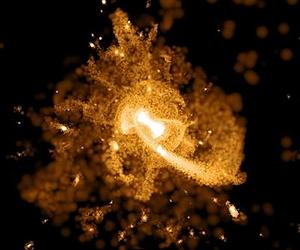
This simulation shows a Milky Way-like galaxy around five billion years ago when most satellite galaxy collisions were happening. Credit: Andrew Cooper/John Helly, Durham University


Many of the Milky Way's ancient stars are remnants of other smaller galaxies torn apart by violent galactic collisions around five billion years ago, according to researchers at Durham University.

Scientists at Durham's Institute for Computational Cosmology and their collaborators at the Max Planck Institute for Astrophysics, in Germany, and Groningen University, in Holland, ran huge computer simulations to recreate the beginnings of our galaxy.

The simulations revealed that the ancient stars, found in a stellar halo of debris surrounding the Milky Way, had been ripped from smaller galaxies by the gravity generated by colliding galaxies.

Cosmologists predict that the early Universe was full of small galaxies which led short and violent lives. These galaxies collided with each other leaving behind debris which eventually settled into more familiar looking galaxies like the Milky Way.

The researchers say their finding supports the theory that many of the Milky Way's ancient stars had once belonged to other galaxies instead of being the earliest stars born inside the galaxy when it began to form about 10 billion years ago.

The research, funded in the UK by the STFC, appears in the Monthly Notices of the Royal Astronomical Society.

Lead author Andrew Cooper, from Durham University's Institute for Computational Cosmology, said: "Effectively we became galactic archaeologists, hunting out the likely sites where ancient stars could be scattered around the galaxy.

"Our simulations show how different relics in the galaxy today, like these ancient stars, are related to events in the distant past.

"Like ancient rock strata that reveal the history of Earth, the stellar halo preserves a record of a dramatic primeval period in the life of the Milky Way which ended long before the Sun was born."