Showing posts with label e-Merlin. Show all posts

Wednesday, October 8, 2014

NRAO Radio telescopes unravel mystery of nova gamma rays

A nova does not explode like an expanding ball, but instead throws out gas in different directions at different times and different speeds. 

When this gas inevitably crashes together, it produces shocks and high-energy gamma-ray photons. 
The complex explosion and gas collisions in nova V959 Mon is illustrated here. 

In the first days of the nova explosion, dense, relatively slow-moving material is expelled along the binary star system's equator (yellow material in left panel). 
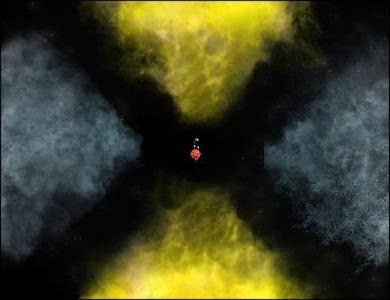
Over the next several weeks, fast winds pick up and are blown off the binary, but they are funneled along the binary star system's poles (blue material in central panel). 

The equatorial and polar material crashes together at their intersection, producing shocks and gamma-ray emission (red regions in central panel). 

Finally, at later times, the nova stops blowing a wind, and the material drifts off into space, the fireworks finished (right panel). 

Credit: Bill Saxton, NRAO/AUI/NSF

Highly-detailed radio-telescope images have pinpointed the locations where a stellar explosion called a nova emitted gamma rays, the most energetic form of electromagnetic waves.

The discovery revealed a probable mechanism for the gamma-ray emissions, which mystified astronomers when first observed in 2012.

"We not only found where the gamma rays came from, but also got a look at a previously-unseen scenario that may be common in other nova explosions," said Laura Chomiuk, of Michigan State University.

A nova occurs when a dense white dwarf star pulls material onto itself from a companion star, triggering a thermonuclear explosion that blows debris into interstellar space.

Astronomers did not expect this scenario to produce high-energy gamma rays.

However, in June of 2012, NASA's Fermi spacecraft detected gamma rays coming from a nova called V959 Mon, some 6500 light-years from Earth.

At the same time, observations with the Karl G. Jansky Very Large Array (VLA) indicated that radio waves coming from the nova probably were caused by subatomic particles moving at nearly the speed of light interacting with magnetic fields.

The high-energy gamma-ray emission, the astronomers noted, also required such fast-moving particles.

Later observations with the extremely-sharp radio "vision" of the Very Long Baseline Array (VLBA) and the European VLBI network revealed two distinct knots of radio emission. These knots then were seen to move away from each other.

This observation, along with studies made with e-MERLIN in the UK, and another round of VLA observations in 2014, provided the scientists with information that allowed them to put together a picture of how the radio knots, and the gamma rays, were produced.

In the first stage of this scenario, the white dwarf and its companion give up some of their orbital energy to boost some of the explosion material, making the ejected material move outward faster in the plane of their orbit.

Later, the white dwarf blows off a faster wind of particles moving mostly outward along the poles of the orbital plane.

When the faster-moving polar flow hits the slower-moving material, the shock accelerates particles to the speeds needed to produce the gamma rays, and the knots of radio emission.

"By watching this system over time and seeing how the pattern of radio emission changed, then tracing the movements of the knots, we saw the exact behavior expected from this scenario," Chomiuk said.

Since the 2012 outburst of V959 Mon, Fermi has detected gamma rays from three additional nova explosions.

"This mechanism may be common to such systems. The reason the gamma rays were first seen in V959 Mon is because it's close," Chomiuk said.

Because the type of ejection seen in V959 Mon also is seen in other binary-star systems, the new insights may help astronomers understand how those systems develop.

This "common envelope" phase occurs in all close binary stars, and is poorly understood.

"We may be able to use novae as a 'testbed' for improving our understanding of this critical stage of binary evolution," Chomiuk said.

Chomiuk worked with an international team of astronomers. The researchers reported their findings in the scientific journal Nature.

More information: Binary orbits as the driver of gamma-ray emission and mass ejection in classical novae , Nature, DOI: 10.1038/nature13773

Friday, August 22, 2014

Spectacular Type la supernova's mysteries revealed

Galaxy M82 in which the supernova exploded. 

Credit: NASA, ESA, & Hubble Heritage

New research by a team of UK and European-based astronomers is helping to solve the mystery of what caused a spectacular supernova in a galaxy 11 million light years away, seen earlier this year.

The supernova, a giant explosion of a star and the closest one to the Earth in decades, was discovered earlier this year by chance at the University of London Observatory.

These phenomena are extremely important to study because they provide key information about our universe, including how it is expanding and how galaxies evolve.

The new research into its cause, published in the latest issue of the Astrophysical Journal, used vast networks of radio telescopes in the UK and across Europe including the seven telescopes of e-MERLIN operated from The University of Manchester's Jodrell Bank Observatory.

These enabled them to obtain extremely deep images revealing a lack of radio emission from the supernova.

Known as 2014J, this was a Type la supernova caused by the explosion of a white dwarf star, the inner core of star once it has run out of nuclear fuel and ejected its outer layers.

A white dwarf star can explode if its mass increases to about 1.4x times that of the Sun. At this point its core temperature reaches the point where carbon starts to undergo nuclear fusion.

This spreads rapidly through the star resulting in a catastrophic thermonuclear explosion which rips the star apart, causing it to appear like a brilliant 'new star' shining billions of times brighter than the Sun.

For decades there has been a dispute about how this happens but these new results rule out the vast majority of models and show the merger of two white dwarf stars is by far the most likely cause.

The research was led by Miguel Pérez-Torres, researcher of the Spanish National Research Council who explained: "Supernovae play a fundamental role in the chemistry of galaxies and their evolution, as they are responsible for ejecting most of the heavy elements we see around us, including elements that cannot be formed in the interior of normal stars."

"A Nobel Prize was awarded in 2011 for the use of Type Ia supernovae to discover that the expansion of the Universe is accelerating. Yet, the basic question of what causes a Type Ia supernova was still a mystery".

Rob Beswick, a co-author of the research paper from the University of Manchester's Jodrell Bank Centre for Astrophysics added: "The explosion of a Type Ia supernova is a rare event in the nearby Universe."

"Supernova 2014J is the closest Type Ia supernova to Earth since 1986, and it's likely that more than a hundred years will pass until we see another such supernova so close to us."

"This was an amazing opportunity to learn more about these extremely important astrophysical phenomena and their underlying cause."

More information: "Constraints on the progenitor system and the environs of SN 2014J from deep radio observations" By M. A. Perez-Torres, P. Lundqvist, R. J. Beswick, C. I. Bjornsson, T. W. B. Muxlow, Z. Paragi, S. Ryder, A. Alberdi, C. Fransson, J. M. Marcaide, I. Marti-Vidal, E. Ros, M. K. Argo, J. C. Guirado are published in The Astrophysical Journal. iopscience.iop.org/0004-637X/792/1