Showing posts with label Kepler. Show all posts

Thursday, November 6, 2014

NASA WISE: Mysteries of 'Interstellar' Space revealed

This enormous mosaic of the Milky Way galaxy from NASA's Wide-field Infrared Survey Explorer (WISE), shows dozens of dense clouds, called nebulae. 

Many nebulae seen here are places where new stars are forming, creating bubble like structures that can be dozens to hundreds of light-years in size.

Image Credit: NASA

The new Paramount film "Interstellar" imagines a future where astronauts must find a new planet suitable for human life after climate change destroys the Earth's ability to sustain us.

Multiple NASA missions are helping avoid this dystopian future by providing critical data necessary to protect Earth.

Yet the cosmos beckons us to explore farther from home, expanding human presence deeper into the solar system and beyond.

For thousands of years we've wondered if we could find another home among the stars. We're right on the cusp of answering that question.

If you step outside on a very dark night you may be lucky enough to see many of the 2,000 stars visible to the human eye.

They're but a fraction of the billions of stars in our galaxy and the innumerable galaxies surrounding us.

Multiple NASA missions are helping us extend humanity's senses and capture starlight to help us better understand our place in the universe.

Largely visible light telescopes like Hubble show us the ancient light permeating the cosmos, leading to groundbreaking discoveries like the accelerating expansion of the universe.

Through infrared missions like Spitzer, SOFIA and WISE, we've peered deeply through cosmic dust, into stellar nurseries where gases form new stars.

With missions like Chandra, Fermi and NuSTAR, we've detected the death throes of massive stars, which can release enormous energy through supernovas and form the exotic phenomenon of black holes.

Yet it was only in the last few years that we could fully grasp how many other planets there might be beyond our solar system.

Some 64 million miles (104 kilometers) from Earth, the Kepler Space Telescope stared at a small window of the sky for four years.

As planets passed in front of a star in Kepler's line of view, the spacecraft measured the change in brightness.

Kepler was designed to determine the likelihood that other planets orbit stars. Because of the mission, we now know it's possible every star has at least one planet.

Solar systems surround us in our galaxy and are strewn throughout the myriad galaxies we see.

Though we have not yet found a planet exactly like Earth, the implications of the Kepler findings are staggering, there may very well be many worlds much like our own for future generations to explore.

NASA also is developing its next exoplanet mission, the Transiting Exoplanet Survey Satellite (TESS), which will search 200,000 nearby stars for the presence of Earth-size planets.


The Transiting Exoplanet Survey Satellite (TESS) will discover thousands of exoplanets in orbit around the brightest stars in the sky.

In a two-year survey of the solar neighbourhood, TESS will monitor more than 500,000 stars for temporary drops in brightness caused by planetary transits.

This first-ever spaceborne all-sky transit survey will identify planets ranging from Earth-sized to gas giants, around a wide range of stellar types and orbital distances. No ground-based survey can achieve this feat.

Sunday, September 28, 2014

NASA TESS: Exoplanet Mission to Hunt Down Earth-sized Worlds


Set to launch in 2017, NASA's Transiting Exoplanet Survey Satellite (TESS) will monitor more than half a million stars over its two-year mission, with a focus on the smallest, brightest stellar objects.

During its observations, TESS is expected to find more than 3,000 new planets outside of our solar system, most of which will be possible for ground-based telescopes to observe.

"Bright host stars are the best ones for follow-up studies of their exoplanets to pin down planet masses, and to characterize planet atmospheres," said TESS principal investigator George Ricker, of the Massachusetts Institute of Technology's Kavli Institute for Astrophysics.

"TESS should be able to find over 200 Earths and super-Earths, defined as being twice the size of Earth," said Peter Sullivan, a physics doctoral student at MIT.

"Ten to 20 of those are habitable-zone planets.”

Sullivan, who works with Ricker on TESS, led an analysis of the number of planets TESS would likely find based on the number and types of planets found by NASA's Kepler mission.

Kepler focused on a single region of the sky and studied all transiting planets within it.

TESS, on the other hand, will examine almost the entire sky over its two-year mission, but capture only the brightest stars, many of which are expected to host terrestrial planets.

NASA's Transiting Exoplanet Survey Satellite (TESS) mission is scheduled to launch in 2017 to hunt for Earth-size alien worlds.

Credit: MIT KAVLI Institute for Astrophysics and Space Research

TESS will travel around Earth in a highly elliptical orbit that will range as distant as the moon.

Along the way, it will use four cameras to observe a swatch of sky running from the celestial equator to the poles.

TESS will observe each swatch for approximately a month before switching to the next region.


Courtney Dressing, a doctoral student at the Harvard-Smithsonian Center for Astrophysics, compares the satellite's observations to peeling an apple in vertical cuts that overlap near the stem.

Because of the overlap, stars near the pole will be observed for more than 100 days, while stars near the equator will be observed for only 27 days.

Dressing worked on a second model, based on Sullivan's work, that predicts the number of planets near Earth that pass between the sun and their host star.

"We predicted there should be about 100 transiting planets within 20 parsecs [about 65 light-years], and that roughly three of them should lie within the habitable zone of their host stars," Dressing said.

Not all of these planets will be detectable to the TESS mission. According to Dressing, the new telescope will be most sensitive to small planets orbiting stars 20 to 50 percent the size of our sun.

Tuesday, August 19, 2014

Exoplanet measured with remarkable precision

Barely 30 years ago, the only planets astronomers had found were located right here in our own solar system.

The Milky Way is chock-full of stars, millions of them similar to our own sun. Yet the tally of known worlds in other star systems was exactly zero.

What a difference a few decades can make.

As 2014 unfolds, astronomers have not only found more than a thousand "exoplanets" circling distant suns, but also they're beginning to make precise measurements of them.

The old void of ignorance about exoplanets is now being filled with data precise to the second decimal place.

A team led by Sarah Ballard, a NASA Carl Sagan Fellow at the University of Washington in Seattle, recently measured the diameter of a "super Earth" to within an accuracy of 148 miles total or about 1 percent, remarkable accuracy for an exoplanet located about 300 light years from Earth.

"It does indeed seem amazing," says Ballard. "The landscape of exoplanet research has changed to an almost unrecognizable degree since I started graduate school in 2007."

To size up the planet, named "Kepler 93 b," Ballard used data from NASA's Kepler and Spitzer Space Telescopes.

First, Kepler discovered the planet. As seen from Earth, Kepler 93 b passes directly in front of its parent star, causing the starlight to dim during the transit.

That dimming, which occurs once per orbit, is what allowed Kepler mission scientists to find the planet in the first place.

Kepler Space Telescope
Next, both Spitzer and Kepler Space Telescope recorded multiple transits at visible and infrared wavelengths.

Data from the observatories agreed: Kepler 93 b was really a planet and not some artefact of stellar variability.

Ballard then knew that by looking carefully at the light curve she could calculate the size of the planet relative to the star.

At that point, the only missing piece was the diameter of the star itself.

"The precision with which we measured the size of the planet is linked directly to our measurement of the star," says Ballard. "And we measured the star using a technique called astero-seismology."

Most people have heard of "seismology," the study of seismic waves moving through the Earth. "We can learn a lot about the structure of our planet by studying seismic waves," she says.

Asteroseismology is the same thing, except for stars: The outer layers of stars boil like water on top of a hot stove. Those convective motions create seismic waves that bounce around inside the core, causing the star to ring like an enormous bell. Kepler can detect that "ringing," which reveals itself as fluctuations in a star's brightness.

Ballard's colleague, University of Birmingham professor Bill Chaplin led the asteroseismic analysis for Kepler-93 b.

"By analyzing the seismic modes of the star, he was able to deduce its radius and mass to an accuracy of a percent," she says.

The new measurements confirm that Kepler-93 b is a "super-Earth" sized exoplanet, with a diameter about one-and-a-half times the size of our planet.

Previous measurements by the Keck Observatory in Hawaii had put Kepler-93 b's mass at about 3.8 times that of Earth.

The density of Kepler-93 b, derived from its mass and newly obtained radius, suggests the planet is very likely made of iron and rock, like Earth itself.

Although super-Earths are common in the galaxy, none exist in our solar system. That makes them tricky to study.

Ballard's team has shown, however, that it is possible to learn a lot about an exoplanet even when it is very far away.

Monday, June 2, 2014

NASA Kepler: 'Neapolitan' exoplanets come in three flavours

This artist's conception shows a planet forming from a disk of gas and dust surrounding a young star. 

Credit: David A. Aguilar (CfA)

The planets of our solar system come in two basic flavors, like vanilla and chocolate ice cream.

We have small, rocky terrestrials like Earth and Mars, and large gas giants like Neptune and Jupiter.

We're missing the astronomical equivalent of strawberry ice cream - planets between about one and four times the size of Earth. NASA's Kepler mission has discovered that these types of planets are very common around other stars.

New research following up on the Kepler discoveries shows that alien worlds, or exoplanets, can be divided into three groups, terrestrials, gas giants, and mid-sized "gas dwarfs", based on how their host stars tend to fall into three distinct groups defined by their compositions.

"We were particularly interested in probing the planetary regime smaller than four times the size of Earth, because it includes three-fourths of the planets found by Kepler."

"That's where you'll find rocky worlds, which are the only kind that we would consider potentially habitable," says lead author Lars A. Buchhave of the Harvard-Smithsonian Center for Astrophysics (CfA).

Buchhave presented his research today in a press conference at a meeting of the American Astronomical Society.

Kepler finds exoplanets using the transit method, looking for a star that dims as a planet passes in front of it from our point of view.

We can learn the planet's size from how much starlight it blocks. However, to determine the planet's composition we need to measure its mass, so its density can be calculated.

A rocky planet will be much denser than a gas giant. Unfortunately, the smaller a planet, the harder it is to measure its mass, especially for the dim and distant stars examined by Kepler.

New research finds that exoplanets can be divided into three groups, terrestrials, gas giants, and mid-sized "gas dwarfs," based on how their host stars tend to fall into three distinct groups defined by their compositions. 

All three are portrayed in this artist's conception. 

Credit: J. Jauch

Buchhave and his colleagues took a different approach. They measured the amount of elements heavier than hydrogen and helium, which astronomers collectively call metals, in stars with exoplanet candidates.

Since a star and its planets form from the same disk of material, the metallicity of a star reflects the composition of the protoplanetary disk.

The team took follow-up spectra of more than 400 stars hosting over 600 exoplanets.

Then, they conducted a statistical test to see if the sizes of the planets fell into natural groups, along with the stellar metallicities.

They found two clear dividing lines - one at a size 1.7 times as large as Earth and the other at a size 3.9 times larger than Earth.

They infer that these boundaries also mark changes in composition. Planets smaller than 1.7 Earths are likely to be completely rocky, while those larger than 3.9 Earths are probably gas giants.

More information: Research Paper: v509/n7502/full/nature13254.html

Friday, March 21, 2014

Starshade: Space sunflower will help snap pictures of planets

The prototype Starshade, a giant structure designed to block the glare of stars so that future space telescopes can take pictures of planets.

A spacecraft that looks like a giant sunflower might one day be used to acquire images of Earth-like rocky planets around nearby stars.

The prototype deployable structure, called a starshade, is being developed by NASA's Jet Propulsion Laboratory in Pasadena, Calif.

The hunt is on for planets that resemble Earth in size, composition and temperature. Rocky planets with just the right temperature for liquid water—not too hot, not too cold—could be possible abodes for life outside our solar system.

NASA's Kepler mission has discovered hundreds of planets orbiting other stars, called exoplanets, some of which are a bit larger than Earth and lie in this comfortable "Goldilocks" zone.

Researchers generally think it's only a matter of time before we find perfect twins of Earth. The next step would be to image and characterise their spectra, or chemical signatures, which provide clear clues about whether those worlds could support life.

The Starshade is designed to help take those pictures of planets by blocking out the overwhelmingly bright light of their stars.

Simply put, the Starshade is analogous to holding your hand up to the sun to block it while taking a picture of somebody.

The proposed Starshade could launch together with a telescope. Once in space, it would separate from the rocket and telescope, unfurl its petals, then move into position to block the light of stars.

Monday, May 27, 2013

NASA Kepler: Big weather on hot Jupiters

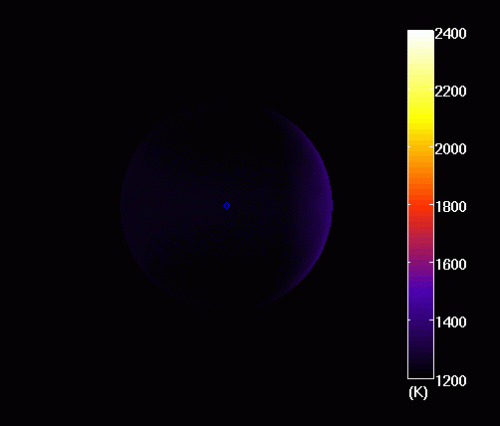
This exoplanet weather map shows temperatures on a hot Jupiter known as "HAT-P-2b". 

Among the hundreds of new planets discovered by NASA's Kepler spacecraft are a class of exotic worlds known as "hot Jupiters." 

Unlike the giant planets of our own solar system, which remain at a safe distance from the sun, these worlds are reckless visitors to their parent stars.

They speed around in orbits a fraction the size of Mercury's, blasted on just one-side by starlight hundreds of times more intense than the gentle heating experienced by Jupiter here at home."

Meteorologists watching this video are probably wondering what kind of weather a world like that might have.

Heather Knutson
The short answer is "big." Heather Knutson of Caltech made the first weather map of a hot Jupiter in 2007. "It's not as simple as taking a picture and—voila!—we see the weather," says Knutson.

These planets are hundreds of light years from Earth and they are nearly overwhelmed by the glare of their parent stars.

"Even to see the planet as a single pixel next to the star would be a huge accomplishment." Instead, Knutson and colleagues use a trick dreamed up by Nick Cowan of Northwestern University.

The key, she explains, is that "most hot Jupiters are tidally locked to their stars. This means they have a permanent dayside and a permanent night side.

Nick Cowan
As we watch them orbit from our vantage point on Earth, the planets exhibit phases—e.g., crescent, gibbous and full.

By measuring the infrared brightness of the planet as a function of its phase, we can make a rudimentary map of temperature vs. longitude."

NASA's Spitzer Space Telescope is the only infrared observatory with the sensitivity to do this work.

Since Knutson kick-started the research in 2007, nearly a dozen hot Jupiters have been mapped by astronomers using Spitzer.

Nikole Lewis
The most recent study, led by Nikole Lewis, a NASA Sagan Exoplanet Fellow working at MIT, shows a gas giant named HAT-P-2b.

"We can see daytime temperatures as high as 2400 K," says Lewis, "while the nightside drops below 1200K. Even at night," she marvels, "this planet is ten times hotter than Jupiter."

These exoplanet maps may seem crude compared to what we're accustomed to on Earth, but they are a fantastic accomplishment considering that the planets are trillions of miles away.

Wednesday, May 1, 2013

NASA's Kepler: Planet-Hunting Spacecraft Faces Serious Health Problems


Health issues are jeopardizing the planet-hunting work of NASA's prolific Kepler space telescope, which has identified more than 2,700 potential alien worlds to date.

One of Kepler's reaction wheels positioning devices that maintain the observatory's position in space — remains balky despite mitigation attempts.

Roger Hunter
The mission team now regards the problem as unsolvable and is considering what the telescope can do after the wheel fails.

"While the wheel may still continue to operate for some time yet, the engineering team has now turned its attention to the development of contingency actions should the wheel fail sooner, rather than later," Kepler mission manager Roger Hunter, of NASA's Ames Research Center in Moffett Field, Calif., wrote in an update Monday (April 29).


Tuesday, April 30, 2013

Two new exoplanets Discovered with Kepler, SOPHIE and HARPS-N

Artist’s impression of a “hot Jupiter”. 

Credit: Ricardo Cardoso Reis (CAUP)

An international team of astronomers, including Alexandre Santerne of the EXOEarths team at CAUP, identified and characterized two new exoplanets, thanks to combined observations from the Kepler space telescope, plus SOPHIE and HARPS-N spectrographs.

These planets, named KOI-200 b and KOI-889 b are among the first detected with the new high-accuracy spectrograph HARPS-N, the northern hemisphere counterpart of the most prolific exoplanet hunter, HARPS (ESO).

SOPHIE
CAUP researcher Alexandre Santerne commented: "The SOPHIE spectrograph was already playing an important role in the characterization of Kepler planets by unveiling the true nature of the candidates and measuring the mass of giant planets.

With the new HARPS-N spectrograph, with an even better accuracy, we expect to characterize much smaller exoplanets, hopefully down to the size of the Earth."

The new planets have about the size of Jupiter, but eccentric orbits with periods of less than 10 days. These new results help to further understand the evolution of orbits of these planets located very close to their star, known as "hot Jupiters".

There are currently more than 850 known exoplanets, but as seen from the Earth, only some of them are oriented in a way that they are passing in front of their star every orbital period. These periodic transits of the planet in front of its star produce a small dip in its brightness. These micro eclipses allow astronomers to know the diameter of the planet and some details about its atmosphere.

The Kepler space mission (NASA) has identified more than 2000 stars that have great chance of hosting transiting planets.

However, most of them need complementary ground-based observations to establish their nature and to complete their characterization.

HARPS-N
The team participated to these ground-based observations since 2010, using the SOPHIE instrument, which has already participated in the detection and characterization to more than fifteen Kepler planets, through the radial velocity method.

Their observing program is now completed by new observations with the more accurate HARPS-N spectrograph.

KOI-200 b is slightly bigger than Jupiter and slightly less massive. With a low density, this gaseous planet is orbiting around its star in less than one week.

The planet KOI-889 b is of the size of Jupiter but is ten times more massive.

This very-massive planet is orbiting around its star in slightly less than 9 days. These two planets have eccentric orbits: during their orbit, their distance to their star is varying.

This produces large variation in their equilibrium temperature of several hundred of degrees in a few days.

KOI-889 b, which is among the most massive planets discovered so far, is also among the most eccentric transiting planets. It could have been formed by a different mechanism than less massive planets.

Santerne added: "Even if there are just hot and giant planets as we already know hundreds of them, these two planets are orbiting on a highly eccentric orbit, which is relatively rare for such short-period planets.

I prefer to see these two new planets as two other bricks in the wall of our knowledge about planetary systems: bigger is the wall, better we understand planetary formation and evolution."

Tuesday, April 23, 2013

NASA TESS: Transiting Exoplanet Survey Satellite spacecraft to identify Exoplanets

An artist rendering of the Transiting Exoplanet Survey Satellite (TESS) spacecraft, to be launched in 2017. 

The TESS mission's primary goal would be to identify terrestrial planets orbiting nearby stars. 

NASA's Astrophysics Explorer Program has selected the Transiting Exoplanet Survey Satellite (TESS) Mission to fly in 2017.

TESS will follow in the footsteps of NASA's pioneering Kepler Mission, continuing the groundbreaking work of discovering Earth-size exoplanets.

NASA selected TESS and another explorer mission after a competition that evaluated proposals for the best scientific value and most feasible development plans.

TESS will use an array of four telescopes to perform an all-sky survey to discover transiting exoplanets of all sizes in orbit around the nearest and brightest stars in the sky.

Its goal is to identify terrestrial planets in the habitable zones of nearby stars that are best suited for extensive follow up observations and characterization.

TESS will collect 10 times as much data during its two-year mission as Kepler did during its first two years.

Jon M. Jenkins
SETI Institute scientist Jon M. Jenkins, co-investigator for data processing for both TESS and Kepler, will lead the development, design and operations of the TESS Data Processing Group (DPG) at NASA Ames Research Center.

The DPG will process the raw pixel data downlinked by TESS to detect the minuscule signatures of transiting exoplanets.

The DPG team will leverage the experience of the Science Operations Center of the Kepler Mission to develop a data processing facility that meets the rigorous requirements of the TESS mission at a low cost.

"It's extremely exciting to learn that the profound voyage of discovery that Kepler began in 2009 will continue with a mission to discover Earth's closest cousins," said Jon Jenkins.

Most exoplanets discovered by Kepler are hundreds of lights years from Earth.

Wednesday, April 4, 2012

NASA Kepler Explorer App Puts Distant Planets at Fingertips

Armchair explorers of the cosmos can now have at their fingertips the nearly 2,000 distant planetary systems discovered by NASA's Kepler Mission. Kepler Explorer, an innovative app for iPads and iPhones developed by a team at the University of California, Santa Cruz, provides interactive displays of newly discovered planetary systems based on Kepler data.

Now available for free from the iTunes App Store, Kepler Explorer was developed through the OpenLab initiative at UC Santa Cruz, which brought together faculty and students in astrophysics, art, and technology for a summer institute last year.

The Kepler Explorer team includes astrophysicist Jonathan Fortney, a member of the Kepler science team; two of his graduate students, Eric Lopez and Caroline Morley; artist Kyle McKinley, a recent graduate of the Digital Arts and New Media program; and John Peters, a recent graduate of the computer game design program.

"I learned a lot about astrophysics from this project. It was a lot of fun," said Peters, who wrote all of the software code for the app.

Fortney, an associate professor of astronomy and astrophysics at UCSC, said he enjoyed the opportunity to work on a project that could reach a wider audience than most of his research.

The team quickly settled on the idea to create an app, and also developed it into an exhibit that provides additional information and shows the app's output on a large screen.

The exhibit was part of two OpenLab public exhibitions last year, one at the UCSC Digital Arts Research Center and another at the Tech Museum in San Jose.

It is scheduled for long-term installation in the Lick Observatory visitors gallery later this month.

Kepler Explorer starts with drop-down menus listing all the Kepler-discovered planetary systems, plus our own solar system.

The selected system is displayed in a view that shows the planet or planets in their orbits around the host star.

Shown in real time the planets look motionless, but moving a slider increases the speed until the planets zip around their star.

The touch screen lets users zoom in and move around the system, and tapping on an individual planet brings it up for further exploration.

Another view shows the relative sizes of the individual planets compared to their host star.

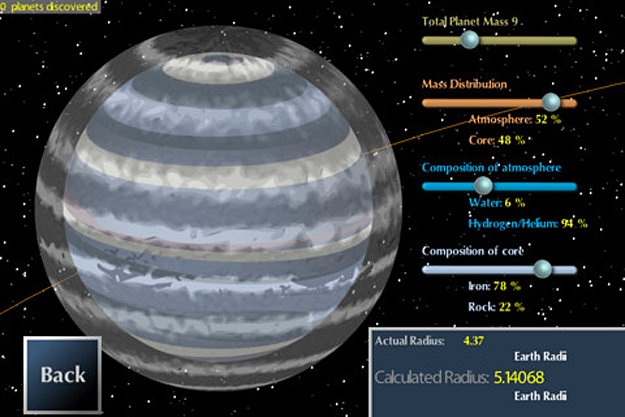
Kepler Explorer's most innovative features are seen when viewing individual planets. The user can manipulate the composition of the planet and its atmosphere and see which mixtures of components (iron, rock, water, and hydrogen) are consistent with Kepler's observations.

This feature represents graphically the type of in-depth analysis that Fortney does for the Kepler Mission. "I have pretty good intuition for what the likely composition of a planet is based on its size, but the app allows anyone to explore the properties of many different planets very quickly," he said.

Because Kepler detects planets as they pass in front of their host star, it only measures the radius of a planet, or how big it is. In most cases, the mass of the planet is unknown.

When the mass is unconstrained, there may be different combinations of components that result in a planet of a given size.

The app's interactive graphics show how this works. There are sliders for different components and how they are partitioned in the core and the atmosphere, and as you move the sliders the image of the planet grows and shrinks, based on hundreds of calculations.

As you change the settings, the app tells you when the size of your planet matches the observations. The calculations involved took hours of computer time, but the results are stored in tables so the app can use them on the fly.

"For a large-radius planet, you can very quickly tell that it can't be a rocky planet, for example, and that in itself is pretty informative," Lopez said.

So far, the Kepler Mission has detected a total of 2,321 planet candidates orbiting 1,790 host stars. Automatic updates for the Kepler Explorer app will add new planet candidates as they are discovered.

Jennifer Parker, an associate professor of art, started the OpenLab initiative in 2011 with astrophysicist Enrico Ramirez-Ruiz, who invited Fortney to participate, and recent graduates Amy Boewer and Jack O'Neill.

"We wanted to bring together faculty who are interested in interdisciplinary work with students from a range of disciplines," Parker said.

"There is such a vast amount of research on this campus, and one way to share it with the public is to make tangible things and playable media. It's not just about art illustrating science.

OpenLab is creating a space for new ways of thinking that can emerge from conversations between different disciplines."

Wednesday, March 14, 2012

NASA - Compact Planetary System

This artist's concept depicts a planetary system so compact that it's more like Jupiter and its moons than a star and its planets.

Astronomers using data from NASA's Kepler mission and ground-based telescopes recently confirmed that the system, called KOI-961, hosts the three smallest exoplanets currently known to orbit a star other than our sun.

An exoplanet is a planet that resides outside of our solar system.

The star, which is located about 130 light-years away in the Cygnus constellation, is a red dwarf that is one-sixth the size of the sun, or just 70 percent bigger than Jupiter. The star is also cooler than our sun, and gives off more red light than yellow.

The smallest of the three planets, called KOI-961.03, is actually located the farthest from the star, and is pictured in the foreground.

This planet is about the size of Mars, with a radius of 0.57 times that of Earth. The next planet to the upper right is KOI-961.01, which is 0.78 times the radius of Earth. The planet closest to the star is KOI-961.02, with a radius 0.73 times the Earth's.

All three planets whip around the star in less than two days, with the closest planet taking less than half a day.

Their close proximity to the star also means they are scorching hot, with temperatures ranging from 350 to 836 degrees Fahrenheit (176 to 447 degrees Celsius).

The star's habitable zone, or the region where liquid water could exist, is located far beyond the planets.

The ground-based observations contributing to these discoveries were made with the Palomar Observatory, near San Diego, Calif., and the W.M. Keck Observatory atop Mauna Kea in Hawaii.

Image Credit: NASA/JPL-Caltech

Tuesday, March 6, 2012

NASA Kepler Planet Candidates by Size

The histogram summarises the findings in the Feb. 27, 2012 Kepler Planet Candidate catalogue release. 

The catalogue contains 2,321 planet candidates identified during the first 16 months of observation conducted May 2009 to September 2010. 

Of the 46 planet candidates found in the habitable zone, the region in the planetary system where liquid water could exist, ten of these candidates are near-Earth-size.


Since science operations began in May 2009, the Kepler team has released two catalogues of transiting planet candidates.

The first catalogue (Borucki et al, 2010), released in June 2010, contains 312 candidates identified in the first 43 days of Kepler data. The second catalogue (Borucki et al, 2011), released in February 2011, is a cumulative catalog containing 1,235 candidates identified in the first 13 months of data.

Wendy Stenzel

Today the team presents the third catalogue containing 1,091 new planet candidates identified in the first 16 months of observation conducted May 2009 to September 2010.


These are the same candidates that the team discussed at the Kepler Science Conference held at NASA Ames Research Center in December 2011.

Here are the highlights of the new catalogue:
  • Planet candidates smaller than twice the size of Earth increased by 197 percent, compared to 52 percent for candidates larger than twice the size of Earth.
  • Planet candidates with orbital periods longer than 50 days increased by 123 percent, compared to 85 percent for candidates with orbital periods shorter than 50 days.
Since the last catalog was released in February 2011, the number of planet candidates identified by Kepler has increased by 88 percent and now totals 2,321 transiting 1,790 stars.

The cumulative catalog now contains well over 200 Earth-size planet candidates and more than 900 that are smaller than twice Earth-size. Of the 46 planet candidates found in the habitable zone, the region in the planetary system where liquid water could exist, ten of these candidates are near-Earth-size.

The number of planetary systems found with more than one planet candidate also has increased. Last year, 17 percent, or 170 stars, had more than one transiting planet candidate. Today, 20 percent, or 365, stars have more than one.

"With each new catalog release a clear progression toward smaller planets at longer orbital periods is emerging, " said Natalie Batalha, Kepler deputy science team lead at San Jose State University in California.

"This suggests that Earth-size planets in the habitable zone are forthcoming if, indeed, such planets are abundant."

Nearly 5,000 periodic transit-like signals were analyzed with known spacecraft instrumentation and astrophysical phenomena that could masquerade as transits, which can produce false positives.

The most common false positive signatures are associated with eclipsing binary stars- a pair of orbiting stars that eclipse each other from the vantage point of the spacecraft.

The Kepler space telescope identifies planet candidates by repeatedly measuring the change in brightness of more than 150,000 stars in search of planets that pass in front, or "transit," their host star. Kepler must record at least three transits to verify a signal as a planet.

The findings are published in the "Planetary Candidates Observed by Kepler III: Analysis of the First 16 Months of Data". The catalogue is available at the Kepler data archive at the Space Telescope Science Institute and can be downloaded from the NASA Exoplanet Archive.

For information about the Kepler Mission, visit: http://www.nasa.gov/kepler

Friday, September 9, 2011

NASA Kepler: 'Invisible' planet discovered with new technique

The "invisible" world Kepler-19c, seen in the foreground of this artist's conception, was discovered solely through its gravitational influence on the companion world Kepler-19b — the dot crossing the star's face.

Kepler-19b is slightly more than twice the diameter of Earth, and is probably a "mini-Neptune." Nothing is known about Kepler-19c other than that it exists.

For the first time, scientists have definitively discovered an "invisible" alien planet by noticing how its gravity affects the orbit of a neighbouring world, a new study reports.

NASA's Kepler space telescope detected both alien planets, which are known as Kepler-19b and Kepler-19c.

Kepler spotted 19b as it passed in front of, or transited, its host star. Researchers then inferred the existence of 19c after observing that 19b's transits periodically came a little later or earlier than expected. The gravity of 19c tugs on 19b, changing its orbit.

The discovery of Kepler-19c marks the first time this method — known as transit timing variation, or TTV — has robustly found an exoplanet, researchers said. But it almost certainly won't be the last.

"My expectation is that this method will be applied dozens of times, if not more, for other candidates in the Kepler mission," said study lead author Sarah Ballard of the Harvard-Smithsonian Center for Astrophysics in Cambridge, Mass.

Finding two new planets

The Kepler spacecraft launched in March 2009. It typically hunts for alien worlds by measuring the telltale dips in a star's brightness caused when a planet crosses the star's face from the telescope's perspective, blocking some of its light.

Kepler has been incredibly successful using this so-called transit method, spotting 1,235 candidate alien planets in its first four months of operation. That's the way it detected Kepler-19b, a world 650 light-years away from Earth in the constellation Lyra.

Kepler-19b has a diameter about 2.2 times that of Earth, researchers said, and orbits 8.4 million miles (13.5 million kilometers) from its parent star. The planet likely has a surface temperature around 900 degrees Fahrenheit (482 degrees Celsius).

Kepler-19b transits its host star once every nine days and seven hours. But that number isn't constant, Ballard and her team found; transits can occur up to five minutes early or five minutes late. That variation told them another planet was tugging on 19b, alternately speeding it up and slowing it down.

In our own solar system, scientists used similar methods to predict the existence of the planet Neptune. Astronomers noticed that Uranus did not orbit the sun exactly as expected, and surmised that an unseen planet was pulling on it. This prediction was borne out when telescopes confirmed Neptune's existence in 1846.

Researchers know little about Kepler-19c at the moment. It takes the alien world 160 days or less to zip around its host star, and 19c's mass could range from a few times that of Earth to six times that of Jupiter, researchers said.

But 19c should start coming into clearer focus soon.

"It's a mystery world, but of course we don't expect it to remain a mystery," study co-author David Charbonneau, also of the Harvard-Smithsonian Center for Astrophysics, told Space.com in an email. "Kepler, and large ground-based telescopes, should help us figure out its true identity soon enough!"

The study will be published in The Astrophysical Journal.

Thursday, August 11, 2011

Alien World is Blacker than Coal

Astronomers have discovered the darkest known exoplanet – a distant, Jupiter-sized gas giant known as TrES-2b. Their measurements show that TrES-2b reflects less than one percent of the sunlight falling on it, making it blacker than coal or any planet or moon in our solar system.

“TrES-2b is considerably less reflective than black acrylic paint, so it’s truly an alien world,” said astronomer David Kipping of the Harvard-Smithsonian Center for Astrophysics (CfA), lead author on the paper reporting the research.

In our solar system, Jupiter is swathed in bright clouds of ammonia that reflect more than a third of the sunlight reaching it. In contrast, TrES-2b (which was discovered in 2006 by the Trans-Atlantic Exoplanet Survey, or TrES) lacks reflective clouds due to its high temperature.

TrES-2b orbits its star at a distance of only three million miles. The star’s intense light heats TrES-2b to a temperature of more than 1,800° Fahrenheit – much too hot for ammonia clouds.

TrES-2bInstead, its exotic atmosphere contains light-absorbing chemicals like vaporized sodium and potassium, or gaseous titanium oxide. Yet none of these chemicals fully explain the extreme blackness of TrES-2b.

“It’s not clear what is responsible for making this planet so extraordinarily dark,” stated co-author David Spiegel of Princeton University. “However, it’s not completely pitch black. It’s so hot that it emits a faint red glow, much like a burning ember or the coils on an electric stove.”

Kipping and Spiegel determined the reflectivity of TrES-2b using data from NASA’s Kepler spacecraft. Kepler is designed to measure the brightnesses of distant stars with extreme precision.

The team monitored the brightness of the TrES-2 system as the planet orbited its star. They detected a subtle dimming and brightening due to the planet’s changing phase.
TrES-2b is believed to be tidally locked like our moon, so one side of the planet always faces the star and like our moon, the planet shows changing phases as it orbits its star.

This causes the total brightness of the star plus planet to vary slightly.

“By combining the impressive precision from Kepler with observations of over 50 orbits, we detected the smallest-ever change in brightness from an exoplanet: just 6 parts per million,” said Kipping. “In other words, Kepler was able to directly detect visible light coming from the planet itself.”

The extremely small fluctuations proved that TrES-2b is incredibly dark. A more reflective world would have shown larger brightness variations as its phase changed.

Kepler has located more than 1,200 planetary candidates in its field of view. Additional analysis will reveal whether any other unusually dark planets lurk in that data.

TrES-2b orbits the star GSC 03549-02811, which is located about 750 light-years away in the direction of the constellation Draco. (One light-year is about 6 trillion miles.)

This research has been accepted for publication in the Monthly Notices of the Royal Astronomical Society .

For more information on NASA’s Kepler mission, visit: http://www.nasa.gov/kepler.

Sunday, July 31, 2011

Amateur Astronomer Discovers Blue-Raspberry-Shaped Planetary Nebula

Combing through the night sky and looking for possible planetary nebulae is tough, tedious work.

NASA actually works with several amateur astronomy groups to examine the findings from its Kepler space observatory, so sometimes, the big discoveries are made by amateurs--including this one, the newest known planetary nebula, named Kronberger 61.

This image, provided by the Gemini Observatory, shows the "ionised shell of expelled gas," colored blue due to the double-ionisation of the oxygen.

If you look closely, you can see the star at the center of the system--it's the bright bluish dot near the centre of the blue-raspberry-like shell.

The Kepler mission's goal is to find Earth-like planets, so the discovery of a new planetary nebula opens up the possibility for some exciting new discoveries.

It'll take a lot more examination to find out if there are any "Goldlocks planets," close enough but not too close to a star to foster the kind of life we have on Earth, but the discovery certainly opens the door for that kind of study.

The star was discovered by, and named for, an amateur Austrian astronomer named Matthias Kronberger, who works with a group of other amateurs known as Deep Sky Hunters.

Sunday, March 8, 2009

Kepler Telescope launch - 6th March 2009

The search for Life continues. The Kepler Telescope launch
(Click picture for New Scientist story and NASA video)