Showing posts with label Ammonia. Show all posts

Friday, May 10, 2013

NASA: Space Station Leaking Vital Ammonia Coolant - Video


Droplets of liquid are seen floating out the the International Space Station on May 10th, 2013. The leak is emanating from the station's P6 truss.
CREDIT: NASA

Astronauts on the International Space Station have discovered a leak of ammonia coolant on their orbiting habitat, and NASA is looking into the problem, though it poses no immediate danger to the crew, officials said today (May 9).

The space station uses chilled liquid ammonia to cool down the power systems on its eight giant solar array panels. A minor leak of this ammonia was first noticed in 2007, and NASA has been studying the issue ever since.

In November 2012 two astronauts took a spacewalk to fix the problem, rewiring some coolant lines and installing a spare radiator due to fears the original radiator was damaged by a micrometeorite impact.

At the time, those measures appeared to fix the problem, but today astronauts on the football field-size space station noticed a steady stream of frozen ammonia flakes leaking from the area of the suspect coolant loop in the Photovoltaic Thermal Control System (PVTCS).

Kelly Humphries
"It is in the same area, but we don't know whether it's the same leak," NASA spokesman Kelly Humphries of the Johnson Space Center in Houston reported.

Humphries said the agency was taking the leak seriously because it affects an important system — if they lose the ability to cool that particular solar array, it won't be able to generate power for the station.

In fact, the leak has worsened to the point that Mission Control expects that particular loop to shut down within the next 24 hours.

However, "the crew is in no danger," Humphries stressed. It's too soon to speculate on a possible spacewalk or other measure to deal with the issue, he added.

Mission Control has been discussing the problem with the astronauts on the station throughout the afternoon.
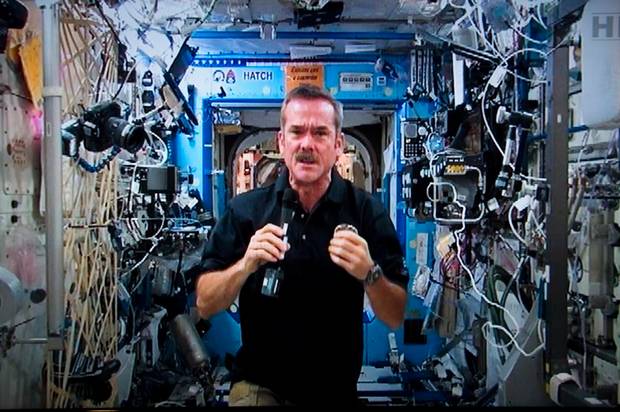
Chris Hadfield on ISS
"What you guys have provided in the way of imagery and video has been just like gold to us on the ground," astronaut Doug Wheelock from Mission Control radioed to space station commander Chris Hadfield, a Canadian Space Agency astronaut.

"We are fairly confident that it's coming from the vicinity of the aTCS."

However, flight contollers noted they were still unable to pinpoint the leak's exact location.

NASA engineers are reviewing plans to potentially move the station's robotic arm over to the area of the port truss, the scaffolding-like backbone of the station (the original leak was traced to the Port 6 truss).

"Tomorrow we'll plan to get the arm in the game to see if we can better pinpoint the location of the leak," Wheelock said.

Hadfield said he and his crewmates had noticed the rate of the leak varied depending on the orientation of the station with the sun, suggesting particular angles allowed the ammonia coolant to leak more quickly.

Thursday, August 11, 2011

Alien World is Blacker than Coal

Astronomers have discovered the darkest known exoplanet – a distant, Jupiter-sized gas giant known as TrES-2b. Their measurements show that TrES-2b reflects less than one percent of the sunlight falling on it, making it blacker than coal or any planet or moon in our solar system.

“TrES-2b is considerably less reflective than black acrylic paint, so it’s truly an alien world,” said astronomer David Kipping of the Harvard-Smithsonian Center for Astrophysics (CfA), lead author on the paper reporting the research.

In our solar system, Jupiter is swathed in bright clouds of ammonia that reflect more than a third of the sunlight reaching it. In contrast, TrES-2b (which was discovered in 2006 by the Trans-Atlantic Exoplanet Survey, or TrES) lacks reflective clouds due to its high temperature.

TrES-2b orbits its star at a distance of only three million miles. The star’s intense light heats TrES-2b to a temperature of more than 1,800° Fahrenheit – much too hot for ammonia clouds.

TrES-2bInstead, its exotic atmosphere contains light-absorbing chemicals like vaporized sodium and potassium, or gaseous titanium oxide. Yet none of these chemicals fully explain the extreme blackness of TrES-2b.

“It’s not clear what is responsible for making this planet so extraordinarily dark,” stated co-author David Spiegel of Princeton University. “However, it’s not completely pitch black. It’s so hot that it emits a faint red glow, much like a burning ember or the coils on an electric stove.”

Kipping and Spiegel determined the reflectivity of TrES-2b using data from NASA’s Kepler spacecraft. Kepler is designed to measure the brightnesses of distant stars with extreme precision.

The team monitored the brightness of the TrES-2 system as the planet orbited its star. They detected a subtle dimming and brightening due to the planet’s changing phase.
TrES-2b is believed to be tidally locked like our moon, so one side of the planet always faces the star and like our moon, the planet shows changing phases as it orbits its star.

This causes the total brightness of the star plus planet to vary slightly.

“By combining the impressive precision from Kepler with observations of over 50 orbits, we detected the smallest-ever change in brightness from an exoplanet: just 6 parts per million,” said Kipping. “In other words, Kepler was able to directly detect visible light coming from the planet itself.”

The extremely small fluctuations proved that TrES-2b is incredibly dark. A more reflective world would have shown larger brightness variations as its phase changed.

Kepler has located more than 1,200 planetary candidates in its field of view. Additional analysis will reveal whether any other unusually dark planets lurk in that data.

TrES-2b orbits the star GSC 03549-02811, which is located about 750 light-years away in the direction of the constellation Draco. (One light-year is about 6 trillion miles.)

This research has been accepted for publication in the Monthly Notices of the Royal Astronomical Society .

For more information on NASA’s Kepler mission, visit: http://www.nasa.gov/kepler.

Tuesday, March 1, 2011

Meteorites or Comets are the source of Life on Earth?

A chemical vital for life on Earth may have arrived ready-made from space. Unexpectedly, a chondritic meteorite has been found to contain large amounts of ammonia, a nitrogen-rich chemical needed to form the basic building blocks of life, including proteins, DNA and RNA.

Explaining how the early Earth gained enough ammonia for life to begin has been a puzzle, because sunlight rapidly destroys ammonia gas in the atmosphere. Furthermore, geological samples suggest that the environment was chemically neutral, rather than the reducing conditions that would have favoured ammonia formation.

Now, Sandra Pizzarello of Arizona State University in Tempe and her colleagues think they have solved that puzzle.

The team took dust from a chondritic meteorite and exposed it to water heated to 300 °C, before compressing it beneath 100 megapascals of pressure. The process "was designed to mimic early Earth conditions, which led to the formation of clays", she says.

To the researchers' surprise, the treatment liberated huge amounts of ammonia bound up in the debris; so much so that it accounted for 60 per cent of the nitrogen in the powder.

Pre-life ammonia

By analysing the nitrogen isotopes within the ammonia, they confirmed that it came from outer space and not from terrestrial contamination.

"Any theory that tries to explain biogenesis has to account for a supply of reduced nitrogen as ammonia," says Pizzarello. "The direct delivery of relatively large amounts of ammonia prebiotically is attractive" as an explanation, she adds.

"To see such available ammonia at twice the concentration levels as amino acids makes such primitive meteorites potentially significant exogenous sources of reactive nitrogen," says Terence Kee, who studies prebiotic chemistry at the University of Leeds in the UK.

Kee says that buried within the meteorite dust, the ammonia would potentially be shielded from destruction by sunlight, and therefore able to participate in reactions to create the building blocks of life.

Pizzarello speculates that the meteorite must have originated from asteroids or other environments where ammonia was a dominant chemical.

Tuesday, August 10, 2010

NASA-International Space Station: Coolant Leak and EVAs


Image above: In the International Space Station’s Quest airlock, Expedition 24 Flight Engineer Doug Wheelock works on a spacesuit in preparation for the second spacewalk to remove a failed ammonia pump module on the station's S1 Truss. Credit: NASA TV

Flight controllers and engineers continue meetings to review the results from the first spacewalk conducted Saturday by International Space Station Expedition 24 Flight Engineers Doug Wheelock and Tracy Caldwell Dyson and to plan for the second of what now will be three spacewalks to complete the replacement of a failed pump module on the station’s starboard truss.

In the wake of an eight-hour, three-minute spacewalk Saturday that fell short of removing the failed pump module due to a leak in the fourth of four ammonia line connectors hooked up to the old pump, mission operations and station program officials laid out a series of procedures for Wheelock and Caldwell Dyson to perform at the beginning of the second spacewalk Wednesday designed to greatly reduce, or eliminate the possibility of ammonia leaking from the final fluid connector – called M3 – when it is demated to set the stage for the failed pump to be removed from the truss.

The plan would call for Wheelock and Caldwell Dyson to close other quick disconnect lines where the S1 and S0 trusses meet that will isolate ammonia upstream in the system from the final connector, preventing any recurrence of leakage while the new pump module is being installed. Additional work to configure lines and valves would be conducted by the spacewalkers prior to the final electrical demating of the old pump so it can be parked on a stowage bracket on the station’s Mobile Base System.

The goal Wednesday will be to remove the old pump and stow it on a payload attachment bracket on the Mobile Base System on the station’s truss while preparing the replacement pump for its removal from a stowage platform adjacent to the Quest airlock and its installation on the truss during a third spacewalk targeted for no earlier than next Sunday.

Mission and station managers are continuing meetings today to prepare for the second spacewalk before the station Mission Management Team meets Tuesday morning to provide its final approval to proceed.

The station’s systems remain in good condition operating on the second of two cooling loops available for the complex and the crew is well rested following Saturday’s spacewalk, spending the last two days recharging spacesuit batteries, reviewing spacewalk procedures and configuring tools for Wednesday’s excursion.

Monday, August 9, 2010

Toxic leak: space station repair fails

A toxic ammonia leak and a jammed fitting have foiled plans to fix a cooling pump on the International Space Station, forcing astronauts to delay the repairs until Wednesday at the earliest, reports NASA.

On Saturday, Expedition 24 Flight Engineers Doug Wheelock and Tracy Caldwell Dyson suffered setbacks that stretched their space walk to 8 hours 3 minutes - the longest in space station history and the sixth longest ever undertaken, according to NASA.

The astronauts began their excursion outside the International Space Station at 0719 EDT (1119 GMT) as the outpost flew 220 miles (354 km) above Earth.

They planned to remove a broken ammonia coolant pump and install a replacement, which involved disconnecting four ammonia hoses and five electrical cables from the pump on the station's truss.

Problems arose about 4 hours into the spacewalk when one of the hoses wouldn't come loose. Colonel Wheelock managed initially to open the "quick-disconnect" fitting mechanism on the hose by hitting it with a hammer, but then reported a clearly visible ammonia leak.

"I see little sparklets of ammonia coming from the line," he said. The astronauts compared the crystals of frozen ammonia coolant to tiny snowflakes.

Colonel Wheelock re-tightened the fitting before returning to the airlock, where he had to delay entering the station so any toxic ammonia on his suit had time to evaporate.

Michael T. Suffredini, manager of the space station program at the Johnson Space Center in Houston, said he was disappointed by the setbacks.

He said that these ammonia quick-disconnect fittings are complicated. "It's very high-pressure ammonia, you have to try to be able to disconnect and reconnect on a regular basis."

The space station is now running on a single cooling system. "The challenge is to get through this problem before the next problem hits the other system," Suffredini stated.

Wednesday, November 18, 2009

Is Ammonia the smart new Hydrogen

The trouble with hydrogen as an energy source is that, as a gas, it’s not very energy-dense, it can explode, and it’s tough to transport.

So for the last 5 years the Iowa Energy Center at Iowa State University has been holding annual conferences on the use of ammonia as a fuel, and some of that dreaming is now coming out of the lab.

The chemical formula for ammonia is NH3. Combined with CO2 you know it as urea, the main component in urine. There are patents on producing anhydrous ammonia (the kind useful as fuel) from urea but currently the main feedstock for it is natural gas. Ammonia produced in this way is called “brown ammonia.”

The most recent Iowa State ammonia conference was held in Kansas City, and featured demonstrations of a car running on ammonia, and explanations of ammonia as a direct fuel (replacing hydrogen) for fuel cells, as well as many sessions on storing and transporting it.

Wizard Power in Australia has demonstrated a closed loop energy system. In this system solar energy converts hydrogen and nitrogen gas to ammonia, the ammonia is a feedstock for energy production, and nothing gets out.

A hydrogen energy cycle solves many of the problems we have with carbon energy, and with water as the “pollution” it can help solve the world’s water shortages. Ammonia has all these advantages, plus it can deal with agricultural pollution. And it’s more cost-efficient.

That’s why SunBorne Energy of India is funding research at the University of South Florida that hopes to use ammonia to cut the costs of solar energy by half, and produce energy at lower temperatures.

But note that connection with urea again. A coal-fired power plant in Wisconsin is testing the use of chilled ammonia to extract carbon directly, which could make clean coal a reality.

So hydrogen is smart energy. It bypasses the carbon cycle and gives us water as a by-product. But ammonia is smarter, because it is more energy dense, it is readily transported, and because it connects with carbon in the same way your own bladder does.