Showing posts with label ecology. Show all posts

Tuesday, June 24, 2014

Harley-Davidson, Project Livewire: First electric motorbike revealed


There are plenty of small and innovative startups working on producing the perfect electric motorcycle, but now one of the biggest companies in the world has got involved in the technology.

Harley-Davidson this week unveiled Project Livewire, in which the firm's first electric-powered bike will be touring the States along the historic Route 66.

The idea behind the tour is to give bikers a chance to test out Livewire and give feedback on its development.

The prototypes that Harley-Davidson has worked on will be modified and refined based on suggestions from the public, if there's enough interest in the vehicle, then a production model may not be too far away.

While Harley-Davidson is better known for rumbling engines and bulky designs, the new creation is surprisingly light and slim.

It can reach 60mph in less than four seconds, has a top speed of 92mph and boasts 74 horsepower and 52 foot-pounds of torque.

Harley-Davidson executives are reluctant to talk specifications right now, though, and would prefer riders to give Livewire a test drive rather than compare it against existing bikes.

The tour, which involves around a dozen prototypes, starts in New York and will also hit Europe sometime during 2015.

'Any business has always got to look ahead to see where customers are interested in going, and see where society might be going,' chief marketing officer Mark-Hans Richer told reporters.

At the moment we don't know much about the internal components of the Livewire, but Harley-Davidson is claiming the bike has a range of 53 miles and a battery that charges in 3.5 hours.

That would put the power pack somewhere in the 113kg (or 250lbs) range, so the bike's designers will have had to work hard to cut down on the size and the weight of other sections.

If you check out the teaser trailer released by Harley-Davidson you'll notice there's not quite the same trademark roar from the engines, the Livewire has been built to work very quietly and efficiently, even if it's not quite as powerful as the rest of the company's current line-up.

The full promotional video provides a look at a Livewire being taken through its paces by a test driver on a closed circuit.


Thursday, September 27, 2012

Nemesis The Record Breaking Electric car


A battery-powered car has broken the UK land-speed record for electric vehicles at Elvington airfield near York, its makers have said.

The original Nemesis was a heavily modified Lotus Exige with all the conventional mechanicals removed and replaced with a couple of 125kw (168bhp) electric motors, belt reduction drives and a 200-kilogram battery pack. It was originally bought off eBay and clocked an average speed of 148mph (239km/h).

The car was designed and built by a team of British motorsport engineers in Norfolk, and driven by estate agent Nick Ponting, 21, from Gloucestershire.

The previous record was 137mph (220km/h).

The vehicle clocked an average speed of 148.419mph during two runs along the mile-long course.

Mr Ponting said: "It was brilliant. The car felt really good."'Quite straightforward'

The car runs on green electricity which has been generated by wind turbines, run by the Stroud-based company Ecotricity.

Dale Vince, OBE and Founder of Ecotricity said: "It was quite straightforward. We're putting a bit of juice back in the batteries and we're going to go again.

"The driver says it could have been faster. We think we'll top 150mph before we leave here today.

"We built the Nemesis to smash the stereotype of electric cars as something Noddy would drive - slow, boring, not cool."

The previous record had been held by Don Wales, the grandson of Sir Malcolm Campbell.

An attempt by Mr Wales's son, Joe Wales, to beat the record in Bluebird Electric last year, was thwarted after the vehicle's suspension was damaged by a pothole at Pendine Sands in Carmarthenshire.

The record still needs to be ratified by the Motor Sports Association before the record can be officially declared.

Visit EVO website and see more pictures of the Nemesis!

Sunday, June 3, 2012

In Darwin's footsteps: Jessica Meeuwug at The University of Western Australia

A marine researcher at The University of Western Australia (UWA) has been appointed a Conservation Fellow of the Zoological Society of London - a society that appointed Charles Darwin a Fellow in 1837.

Professor Jessica Meeuwig, of UWA's Centre for Marine Futures, Oceans Institute and School of Animal Biology, joins one of the world's oldest scientific societies.

Established by Sir Stamford Raffles in 1826, the Zoological Society of London is renowned for its breeding programs for endangered species and work in field conservation programs in more than 50 countries.

Professor Meeuwig's main expertise is in marine and fisheries conservation and quantitative modelling.

Her research group works across a range of animals and includes projects such as investigating the displacement of humpback whales as a result of coastal development; researching how large sharks and fish use underwater banks and canyons; and how marine sanctuaries generate ecological and economic benefits.

She has worked around the world in places as diverse as the Baltic to the South China Sea and Western Australia. She is a keen science communicator and believes in the important role scientists can play in public debate.

Only a small number of Conservation Fellows are appointed to the Society each year. They are people who have made exceptional contributions to conservation.

Professor Meeuwig said she was delighted to accept the appointment, given the society's global contributions to conservation, both terrestrially and in marine environment.

"It is somewhat daunting to be part of such a distinguished society with its deep and early roots in the conservation sector and reputation for scientific integrity, but I am delighted to have access to the facilities and be part of the Society's scientific community and strengthen international collaborations," she said.

The Society has had a long involvement in the marine environment with sites such as the Indian Ocean's Chagos Archipelago, about 500 km south of the Maldives. The archipelago is the world's largest, fully protected marine sanctuary and Professor Meeuwig and her team, with researchers from the Society, will join an international expedition there later this year.

Darwin's appointment to the Zoological Society of London was made after his five-year expedition on HMS Beagle, during which, as a 22-year-old, he circumnavigated the globe, collecting samples and observations which would enable him to write On the Origin of Species, published in 1859.

Media references

Professor Jessica Meeuwig (UWA Oceans Institute) (+61 8) 6488 1464 / (+61 4) 00 024 999
Michael Sinclair-Jones (UWA Public Affairs) (+61 8) 6488 3229 / (+61 4) 00 700 783

Thursday, June 23, 2011

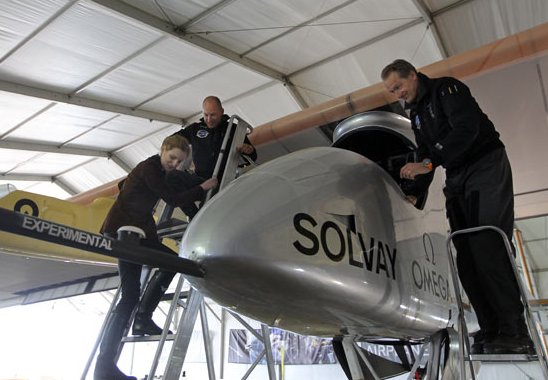
Solar Powered aircraft Solar Impulse at Paris Air show

French Ecology Minister Nathalie Kosciusko-Morizet examines the solar-powered aircraft Solar Impulse.

Read more about this amazing aircraft here at the Solar Impulse blog.

Monday, June 20, 2011

Gyrfalcons are 'secret seabirds'

Gyrfalcon (image: Ólafur Larsen)

The world's largest falcon, the fast, taloned gyrfalcon, is a secret seabird, scientists have discovered.

Gyrfalcons living in the high Arctic overwinter out at sea, spending long periods living and hunting on pack ice.

It is the first time any falcon species has been found regularly living at sea.

The birds likely rest on the ice and hunt other seabirds such as gulls and guillemots, over what appears to be one of the largest winter ranges yet documented for any raptor.

Some gyrfalcons actually spend large amounts of time living and hunting over the ocean”

Ornithologist Kurt Burnham

"I was very surprised by this finding," said ornithologist Kurt Burnham who made the discovery. "These birds are not moving between land masses, but actually using the ice floes or pack ice as winter habitat for extended periods of time."

"Previously, all species of falcon were considered to be land-based birds."

Dr Burnham of the High Arctic Institute, Illinois US and the University of Oxford, UK, together with colleague Professor Ian Newton of Centre for Ecology and Hydrology in Oxford, studied the seasonal movements of gyrfalcons (Falco rusticolus) by tagging 48 birds with radio transmitters.

This allowed them to track the movements of the birds living in three areas of Greenland: Thule in the northwest, Kangerlussuaq in the west, and Scoresbysund in the east.

Wednesday, May 26, 2010

Manta ray 16ft wide

A diver swims in the shadow of a 16-feet wide manta ray.

Diver and professional photographer Franco Banfi snapped this in the water off the coast of the Socorro and San Benedicto Islands in the Pacific Ocean

Picture: FRANCO BANFI / SOLENT

Saturday, May 22, 2010

Polluted by profit: Johann Hari on the real Climategate - Climate Change, Environment

Polluted by profit: Johann Hari on the real Climategate - Climate Change, Environment - The Independent

Why did America's leading environmental groups jet to Copenhagen to lobby for policies that will lead to the faster death of the rainforests – and runaway global warming? Why are their staff dismissing the only real solutions to climate change as "unworkable" and "unrealistic"? Why are they clambering into corporate "partnerships" with BP, which is responsible for the worst oil spill in living memory?

At first glance, these questions will seem bizarre. Groups such as Conservation International (CI) and the Nature Conservancy (TNC) are among the most trusted "brands" in the world, pledged to protect and defend nature.

Yet as we confront the biggest ecological crisis in human history, many of the green organisations meant to be leading the fight are busy shovelling up hard cash from the world's worst polluters – and simultaneously burying science-based environmentalism.

In the middle of a swirl of bogus climate scandals trumped up by deniers, here is the real Climategate, waiting to be exposed.

Read the full article by following the link

Saturday, May 8, 2010

Greenpeace Webcams: Esperanza, Arctic Sunrise and Rainbow Warrior

Travel with the intrepid Greenpeace ships and watch them as they sail the seven seas.

All, in the name of ecology and focussed on saving this beautiful planet and it's ocean-going species, from destruction by humanity, both directly through over exploitation and indirectly via pollution, chemical and oil spillage.

Get Involved
Sign up for our newsletter and action alerts, follow fellow Greenpeace twitterers, jump into the discussions at the Greenpeace Facebook page.

One of the things that makes Greenpeace  powerful is our ability to work together. We are a truly social network with more than 5 million people connected to one another worldwide and it's all free:

YouTube Video - Earth Day: Give Earth a Hand

YouTube - Earth Day: Give Earth a Hand

Monday, March 1, 2010

Quick Facts you may not know about the Amazon

Here are some quick facts about the Amazon that you may not know and can amaze your friends with.

  • 1.4 billion hectares of forest

  • The world's largest river basin and the source of one-fifth of all free-flowing fresh water on Earth

  • 60% of the Amazon is in Brazil, in an area larger than western Europe - the rest of the Amazon spans across Peru, Colombia, Venezuela, Ecuador, Bolivia, Guyana, Suriname, and French Guiana

  • One in ten known species in the world live in the Amazon Rainforest
    Threats – Soy plantation expansion, cattle ranching, unsustainable logging, human settlement

  • Amazon basin is home to 21 million people of which about 30% live in rural areas and 200,000 are indigenous

  • The Amazon covers approximately 50% of Brazil and stores huge amounts of carbon dioxide. Burning of forest, however, has released so much of this greenhouse gas that Brazil is now placed 4th in the world for CO2 emissions

For more information on the de-forestation of the Amazon and surrounding rainforests, click on this link to take you to Flora and Fauna International website

Wednesday, November 18, 2009

Is Ammonia the smart new Hydrogen

The trouble with hydrogen as an energy source is that, as a gas, it’s not very energy-dense, it can explode, and it’s tough to transport.

So for the last 5 years the Iowa Energy Center at Iowa State University has been holding annual conferences on the use of ammonia as a fuel, and some of that dreaming is now coming out of the lab.

The chemical formula for ammonia is NH3. Combined with CO2 you know it as urea, the main component in urine. There are patents on producing anhydrous ammonia (the kind useful as fuel) from urea but currently the main feedstock for it is natural gas. Ammonia produced in this way is called “brown ammonia.”

The most recent Iowa State ammonia conference was held in Kansas City, and featured demonstrations of a car running on ammonia, and explanations of ammonia as a direct fuel (replacing hydrogen) for fuel cells, as well as many sessions on storing and transporting it.

Wizard Power in Australia has demonstrated a closed loop energy system. In this system solar energy converts hydrogen and nitrogen gas to ammonia, the ammonia is a feedstock for energy production, and nothing gets out.

A hydrogen energy cycle solves many of the problems we have with carbon energy, and with water as the “pollution” it can help solve the world’s water shortages. Ammonia has all these advantages, plus it can deal with agricultural pollution. And it’s more cost-efficient.

That’s why SunBorne Energy of India is funding research at the University of South Florida that hopes to use ammonia to cut the costs of solar energy by half, and produce energy at lower temperatures.

But note that connection with urea again. A coal-fired power plant in Wisconsin is testing the use of chilled ammonia to extract carbon directly, which could make clean coal a reality.

So hydrogen is smart energy. It bypasses the carbon cycle and gives us water as a by-product. But ammonia is smarter, because it is more energy dense, it is readily transported, and because it connects with carbon in the same way your own bladder does.

Sunday, October 18, 2009

Global Warming in the Maldives

In the Maldives, ministers in scuba gear met on the sea bed to draw attention to the dangers of global warming for the island nation.

Wednesday, September 23, 2009

Greenpeace Bravehearts Fight on

Fish Fight goes on - Greenpeace activists fly a banner depicting a skeleton of a tuna between the hulls of US-flagged American Legacy fishing vessel and Panamian-flagged MV Fong Seong 888, in the Pacific Ocean.