Showing posts with label coolant. Show all posts

Friday, May 10, 2013

NASA: Space Station Leaking Vital Ammonia Coolant - Video


Droplets of liquid are seen floating out the the International Space Station on May 10th, 2013. The leak is emanating from the station's P6 truss.
CREDIT: NASA

Astronauts on the International Space Station have discovered a leak of ammonia coolant on their orbiting habitat, and NASA is looking into the problem, though it poses no immediate danger to the crew, officials said today (May 9).

The space station uses chilled liquid ammonia to cool down the power systems on its eight giant solar array panels. A minor leak of this ammonia was first noticed in 2007, and NASA has been studying the issue ever since.

In November 2012 two astronauts took a spacewalk to fix the problem, rewiring some coolant lines and installing a spare radiator due to fears the original radiator was damaged by a micrometeorite impact.

At the time, those measures appeared to fix the problem, but today astronauts on the football field-size space station noticed a steady stream of frozen ammonia flakes leaking from the area of the suspect coolant loop in the Photovoltaic Thermal Control System (PVTCS).

Kelly Humphries
"It is in the same area, but we don't know whether it's the same leak," NASA spokesman Kelly Humphries of the Johnson Space Center in Houston reported.

Humphries said the agency was taking the leak seriously because it affects an important system — if they lose the ability to cool that particular solar array, it won't be able to generate power for the station.

In fact, the leak has worsened to the point that Mission Control expects that particular loop to shut down within the next 24 hours.

However, "the crew is in no danger," Humphries stressed. It's too soon to speculate on a possible spacewalk or other measure to deal with the issue, he added.

Mission Control has been discussing the problem with the astronauts on the station throughout the afternoon.
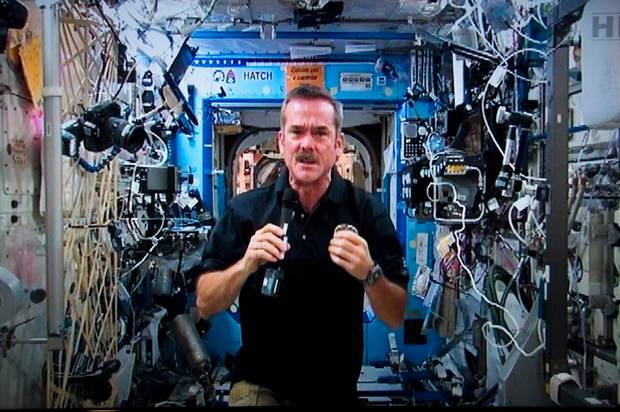
Chris Hadfield on ISS
"What you guys have provided in the way of imagery and video has been just like gold to us on the ground," astronaut Doug Wheelock from Mission Control radioed to space station commander Chris Hadfield, a Canadian Space Agency astronaut.

"We are fairly confident that it's coming from the vicinity of the aTCS."

However, flight contollers noted they were still unable to pinpoint the leak's exact location.

NASA engineers are reviewing plans to potentially move the station's robotic arm over to the area of the port truss, the scaffolding-like backbone of the station (the original leak was traced to the Port 6 truss).

"Tomorrow we'll plan to get the arm in the game to see if we can better pinpoint the location of the leak," Wheelock said.

Hadfield said he and his crewmates had noticed the rate of the leak varied depending on the orientation of the station with the sun, suggesting particular angles allowed the ammonia coolant to leak more quickly.

Tuesday, April 30, 2013

ESA Herschel: Deep-space Infra-red telescope runs out of Helium Coolant

Europe's deep-space Herschel telescope has given up the ghost -- running out of coolant after a successful mission to observe the birth of stars and galaxies, the European Space Agency said Monday.

"Herschel has made over 35,000 scientific observations, amassing more than 25,000 hours' worth of science data from about 600 observing programmes," it said in a eulogy.

"The archive will become the legacy of the mission. It is expected to provide even more discoveries than have been made during the lifetime of the Herschel mission."

Launched in May 2009, Herschel carried 2,300 litres of liquid helium coolant, which has been slowly evaporating.

Herschel became the largest and most powerful infrared telescope in space. Its expected lifetime was 3.5 years.

The helium was used to cool the satellite's instruments to near absolute zero (minus 273.15 degrees Celsius or minus 459.67 degrees Fahrenheit) to enable it to make its observations.

At 7.5 metres (24.3 feet) high and four metres (13 feet) wide, Herschel had a launch mass of 3.4 tonnes. It cost 1.1 billion euros ($1.4 billion)

It was named after Sir William Herschel, the German-born British astronomer who discovered Uranus in 1781 and infrared radiation in 1800.

It carried three cameras and spectrometers and a primary mirror 3.5 metres (11.37 feet) across -- able to collect almost 20 times more light than any previous infrared space telescope.

Its infrared technology allowed Herschel to see galaxies that were previously hidden from scientists' view by cosmic dust clouds.

In 2011, it was reported that Herschel found the first confirmed evidence of oxygen molecules in space.

"Herschel has offered us a new view of the hitherto hidden Universe, pointing us to a previously unseen process of star birth and galaxy formation, and allowing us to trace water through the Universe from molecular clouds to newborn stars and their planet-forming discs and belts of comets," said Goran Pilbratt, an ESA Herschel Project Scientist.

The telescope will still be able to communicate with its ground stations for some time, placed in a "parking orbit" around the Sun.

Thursday, July 5, 2012

South Pole Station makes the most of liquid helium supply

Image: A 4,000-gallon helium dewar is unloaded from an LC-130 at the South Pole Station. Such shipments may soon cease as experiments move away from using liquid helium to cool telescope sensors. 

Photo Credit: Paul Sullivan

Helium, it's not just good for party balloons.

At one of the coldest places on the planet -- where the temperature bolts down to minus 100 degrees Fahrenheit during the winter months -- liquid helium has been used to super-cool special telescopes designed to peer into the mysteries of the early universe.

However, the use of bulk liquid helium may also become a thing of the past, as the astrophysical experiments at the South Pole Station complete a conversion to a Cryocooler technology that cools telescope sensors to a temperature just above that of outer space by using and recapturing helium gas.

Helium is a limited resource that promises to become even scarcer and more expensive in the future. A bipartisan bill being considered in the U.S.

Senate this year would help conserve the nation's helium reserves -- locked up underground in a natural geological formation near Amarillo, Texas -- and give priority to federally funded researchers in times of shortage.

The South Pole Station has done its part over the last decade or so to stretch out the nation's helium supply, which is used in everything from the manufacture of fiber optics and microchips to cooling the superconducting magnets used in MRI machines.

The zero boil-off system now at the South Pole ensures that almost no helium is lost to the atmosphere.

Water, of course, has a boiling point of 100 degrees Celsius, transitioning from a liquid to a gas. Helium also has a boiling point, but a wee bit lower -- minus 269C.

On the Kelvin scale, that's about 4.2 degrees above absolute zero, the temperature at which all molecular motion stops. The temperature of outer space is about 3 Kelvin.

The telescopes at the South Pole do not operate in the visible light spectrum, but instead measure microwave radiation.

The telescope sensors use superconductive materials that must be cooled down to 250 milliKelvin, just a quarter of a degree above absolute zero, to study the cosmic microwave background, often described as an afterglow of the Big Bang when the universe burst into existence.

Liquid helium has been an integral part of cryogenic techniques since astrophysical experiments began at the South Pole in the 1980s, according to Paul Sullivan, South Pole Station manager of science support.

Read the full article: Full of cold air

Saturday, December 5, 2009

French Nuclear Power Station closed following coolant leakage

One of four reactors at the Cruas nuclear power station in southern France was shut down late on Tuesday following a lapse in the cooling system, France's nuclear safety agency said.

French energy company EDF reported the incident at 2250 GMT and followed its emergency procedures to shut down the reactor, it added.

The cooling system for the reactors use water from the Rhone river and the incident was due to a high level of plant debris in the river blocking intake, it added.

Intake of water into the cooling system was restored by 0400 GMT.


The agency rated the incident as a two on the seven-level international scale of nuclear incidents, adding control over the reactor was maintained at all times and there was no release of radioactivity to the environment.