Showing posts with label Spitzer. Show all posts

Monday, December 22, 2014

Multicoloured view of supernova remnant RCW 86


Credit: ESA/XMM-Newton & NASA/Chandra (X-ray); NASA/WISE/Spitzer (Infrared)

Most celestial events unfold over thousands of years or more, making it impossible to follow their evolution on human timescales.

Supernovas are notable exceptions, the powerful stellar explosions that make stars as bright as an entire galaxy for several days.

Although they are very rare, only a few such explosions take place every century in a typical galaxy, supernovas can be seen with the naked eye if they are reasonably nearby.

In fact, when supernovas were discovered they were thought to be new stars appearing in the sky, 'nova' means new in Latin.

Astronomers have recorded supernovas long before a theoretical understanding of these events as stellar explosions was developed in the 20th century.

The most ancient documented record dates back to 185 AD, when Chinese astronomers saw a 'guest star' that remained visible for several months, in the vicinity of the two stars Alpha and Beta Centauri.

The material ejected during these explosions sweeps up gas and dust from the surroundings, creating picturesque supernova remnants that can be observed long after the explosion.

Modern astronomers believe that the object shown in this image, the supernova remnant RCW 86, is what remains of the supernova that was discovered in 185 AD.

The blue and green glow at the edges of the bubble represents X-ray emission from hot gas, heated to millions of degrees by shock waves generated after the explosion.

The diffuse red glow marks infrared emission from warm dust in the interstellar medium around RCW 86.

Sprinkled across the image, in yellow, are young stars that shine brightly at infrared wavelengths.

This image combines X-ray data from ESA's XMM-Newton and NASA's Chandra X-ray Observatory (combined to form the blue and green colours) with infrared observations from NASA's Spitzer Space Telescope and Wide-Field Infrared Survey Explorer - WISE (yellow and red).

The supernova remnant RCW 86 is some 8000 light-years away.

Thursday, November 6, 2014

NASA WISE: Mysteries of 'Interstellar' Space revealed

This enormous mosaic of the Milky Way galaxy from NASA's Wide-field Infrared Survey Explorer (WISE), shows dozens of dense clouds, called nebulae. 

Many nebulae seen here are places where new stars are forming, creating bubble like structures that can be dozens to hundreds of light-years in size.

Image Credit: NASA

The new Paramount film "Interstellar" imagines a future where astronauts must find a new planet suitable for human life after climate change destroys the Earth's ability to sustain us.

Multiple NASA missions are helping avoid this dystopian future by providing critical data necessary to protect Earth.

Yet the cosmos beckons us to explore farther from home, expanding human presence deeper into the solar system and beyond.

For thousands of years we've wondered if we could find another home among the stars. We're right on the cusp of answering that question.

If you step outside on a very dark night you may be lucky enough to see many of the 2,000 stars visible to the human eye.

They're but a fraction of the billions of stars in our galaxy and the innumerable galaxies surrounding us.

Multiple NASA missions are helping us extend humanity's senses and capture starlight to help us better understand our place in the universe.

Largely visible light telescopes like Hubble show us the ancient light permeating the cosmos, leading to groundbreaking discoveries like the accelerating expansion of the universe.

Through infrared missions like Spitzer, SOFIA and WISE, we've peered deeply through cosmic dust, into stellar nurseries where gases form new stars.

With missions like Chandra, Fermi and NuSTAR, we've detected the death throes of massive stars, which can release enormous energy through supernovas and form the exotic phenomenon of black holes.

Yet it was only in the last few years that we could fully grasp how many other planets there might be beyond our solar system.

Some 64 million miles (104 kilometers) from Earth, the Kepler Space Telescope stared at a small window of the sky for four years.

As planets passed in front of a star in Kepler's line of view, the spacecraft measured the change in brightness.

Kepler was designed to determine the likelihood that other planets orbit stars. Because of the mission, we now know it's possible every star has at least one planet.

Solar systems surround us in our galaxy and are strewn throughout the myriad galaxies we see.

Though we have not yet found a planet exactly like Earth, the implications of the Kepler findings are staggering, there may very well be many worlds much like our own for future generations to explore.

NASA also is developing its next exoplanet mission, the Transiting Exoplanet Survey Satellite (TESS), which will search 200,000 nearby stars for the presence of Earth-size planets.


The Transiting Exoplanet Survey Satellite (TESS) will discover thousands of exoplanets in orbit around the brightest stars in the sky.

In a two-year survey of the solar neighbourhood, TESS will monitor more than 500,000 stars for temporary drops in brightness caused by planetary transits.

This first-ever spaceborne all-sky transit survey will identify planets ranging from Earth-sized to gas giants, around a wide range of stellar types and orbital distances. No ground-based survey can achieve this feat.

Tuesday, August 19, 2014

Exoplanet measured with remarkable precision

Barely 30 years ago, the only planets astronomers had found were located right here in our own solar system.

The Milky Way is chock-full of stars, millions of them similar to our own sun. Yet the tally of known worlds in other star systems was exactly zero.

What a difference a few decades can make.

As 2014 unfolds, astronomers have not only found more than a thousand "exoplanets" circling distant suns, but also they're beginning to make precise measurements of them.

The old void of ignorance about exoplanets is now being filled with data precise to the second decimal place.

A team led by Sarah Ballard, a NASA Carl Sagan Fellow at the University of Washington in Seattle, recently measured the diameter of a "super Earth" to within an accuracy of 148 miles total or about 1 percent, remarkable accuracy for an exoplanet located about 300 light years from Earth.

"It does indeed seem amazing," says Ballard. "The landscape of exoplanet research has changed to an almost unrecognizable degree since I started graduate school in 2007."

To size up the planet, named "Kepler 93 b," Ballard used data from NASA's Kepler and Spitzer Space Telescopes.

First, Kepler discovered the planet. As seen from Earth, Kepler 93 b passes directly in front of its parent star, causing the starlight to dim during the transit.

That dimming, which occurs once per orbit, is what allowed Kepler mission scientists to find the planet in the first place.

Kepler Space Telescope
Next, both Spitzer and Kepler Space Telescope recorded multiple transits at visible and infrared wavelengths.

Data from the observatories agreed: Kepler 93 b was really a planet and not some artefact of stellar variability.

Ballard then knew that by looking carefully at the light curve she could calculate the size of the planet relative to the star.

At that point, the only missing piece was the diameter of the star itself.

"The precision with which we measured the size of the planet is linked directly to our measurement of the star," says Ballard. "And we measured the star using a technique called astero-seismology."

Most people have heard of "seismology," the study of seismic waves moving through the Earth. "We can learn a lot about the structure of our planet by studying seismic waves," she says.

Asteroseismology is the same thing, except for stars: The outer layers of stars boil like water on top of a hot stove. Those convective motions create seismic waves that bounce around inside the core, causing the star to ring like an enormous bell. Kepler can detect that "ringing," which reveals itself as fluctuations in a star's brightness.

Ballard's colleague, University of Birmingham professor Bill Chaplin led the asteroseismic analysis for Kepler-93 b.

"By analyzing the seismic modes of the star, he was able to deduce its radius and mass to an accuracy of a percent," she says.

The new measurements confirm that Kepler-93 b is a "super-Earth" sized exoplanet, with a diameter about one-and-a-half times the size of our planet.

Previous measurements by the Keck Observatory in Hawaii had put Kepler-93 b's mass at about 3.8 times that of Earth.

The density of Kepler-93 b, derived from its mass and newly obtained radius, suggests the planet is very likely made of iron and rock, like Earth itself.

Although super-Earths are common in the galaxy, none exist in our solar system. That makes them tricky to study.

Ballard's team has shown, however, that it is possible to learn a lot about an exoplanet even when it is very far away.

Monday, March 24, 2014

NASA Spitzer Image: Star-forming region ON2

Massive stars are born in tumultuous clouds of gas and dust.

They lead a brief but intense life, blowing powerful winds of particles and radiation that strike their surroundings, before their explosive demise as supernovas.

The interplay between massive stars and their environment is revealed in this image of the star-forming region ON2.

It combines X-ray coverage from ESA’s XMM-Newton X-ray observatory with an infrared view from NASA’s Spitzer Space Telescope.

This stellar cradle is associated with the open cluster of stars named Berkeley 87, some 4000 light-years from Earth.

The cluster is home to over 2000 stars, most of which are low-mass stars like our Sun or smaller, but some, a few dozen, are stellar monsters weighing 10–80 times more.

Two glowing clouds of gas and dust, the raw material from which stars form, dominate the centre of the image and are shown in red.

Scattered across the image are a multitude of protostars, seeds of future stellar generations; these are shown in green.

The bright yellow star in the upper part of the image is BC Cygni, a massive star that has puffed up enormously and will eventually explode as a supernova.

Shown in blue is XMM-Newton X-ray view of ON2: it reveals individual sources, young, massive stars as well as protostars, and more diffuse regions of X-rays.

Two ‘bubbles’ of X-rays can be seen in the upper and lower clouds, respectively, pink against the red background.

These two bubbles conceal the cumulative emissions from many protostars, but also light radiated by very energetic particles, a signature of shockwaves triggered by massive stars and their winds.

The image combines observations performed in the X-ray energy range of 0.25–12 keV (blue) and at infrared wavelengths of 3.6 microns (green) and 8 microns (red).

It spans about 15 arcminutes on each side; north is up and east is to the left.

More Information:  paper “Hard X-Ray Emission in the Star-Forming Region ON 2: Discovery with XMM-Newton” by Oskinova et al. in April 2010.

Friday, March 21, 2014

NASA Spitzer Image: Dramatic new portrait helps define Milky Way's shape - Video

More than 200 million images like this one have been stitched together by Wisconsin astronomers to make a 360-degree portrait of the plane of our galaxy, the Milky Way. 

In this image, the billowing pink clouds are massive stellar nurseries. 

The stringy green filaments are the blown out remnants of a star that exploded in a supernova. 

Credit: NASA /JPL-Caltech /University of Wisconsin-Madison

Using more than 2 million images collected by NASA's orbiting Spitzer Space Telescope, a team of Wisconsin University scientists has stitched together a dramatic 360 degree portrait of the Milky Way, providing new details of our galaxy's structure and contents.


The new composite picture, using infrared images gathered over the last decade, was unveiled today (March 20, 2014) at a TED conference in Vancouver.

The galactic portrait provides an unprecedented look at the plane of our galaxy, using the infrared imagers aboard Spitzer to cut through the interstellar dust that obscures the view in visible light.

Edward Churchwell
"For the first time, we can actually measure the large-scale structure of the galaxy using stars rather than gas," explains Edward Churchwell, a University of Wisconsin-Madison professor of astronomy whose group compiled the new picture, which looks at a thin slice of the galactic plane.

"We've established beyond the shadow of a doubt that our galaxy has a large bar structure that extends halfway out to the sun's orbit. We know more about where the Milky Way's spiral arms are."

Lofted into space in 2003, the Spitzer Space Telescope has far exceeded its planned two-and-a-half-year lifespan.

Although limited by the depletion of the liquid helium used to cool its cameras, the telescope remains in heliocentric orbit, gathering a trove of astrophysical data that promises to occupy a new generation of astronomers.

In addition to providing new revelations about galactic structure, the telescope and the images processed by the Wisconsin team have made possible the addition of more than 200 million new objects to the catalog of the Milky Way.

"This gives us some idea about the general distribution of stars in our galaxy, and stars, of course, make up a major component of the baryonic mass of the Milky Way," notes Churchwell, whose group has been collecting and analyzing Spitzer data for more than a decade in a project known as GLIMPSE (Galactic Legacy Infrared Midplane Survey Extraordinaire). "That's where the ballgame is."

Barb Whitney
The new infrared picture, known as GLIMPSE360, was compiled by a team led by UW-Madison astronomer Barb Whitney.

It is interactive and zoomable, giving users the ability to look through the plane of the galaxy and zero in on a variety of objects, including nebulae, bubbles, jets, bow shocks, the center of the galaxy and other exotic phenomena.

The image is being shown for the first time this morning on a large visualization wall installed by Microsoft at the TED conference.

The new GLIMPSE composite image will be made widely available to astronomers and planetaria.

The data is also the basis for a “citizen science” project, known as the Milky Way Project, where anyone can help scour GLIMPSE images to help identify and map the objects that populate our galaxy.

Wednesday, February 26, 2014

Herschel: SMA unveils how small cosmic seeds in Snake nebula grow into big stars

These two panels show the Snake nebula as photographed by the Spitzer and Herschel space telescopes

At mid-infrared wavelengths (the upper panel taken by Spitzer), the thick nebular material blocks light from more distant stars. 

At far-infrared wavelengths, however (the lower panel taken by Herschel), the nebula glows due to emission from cold dust. 

The two boxed regions, P1 and P6, were examined in more detail by the Submillimeter Array

Credit: Spitzer /GLIMPSE /MIPS, Herschel /HiGal, Ke Wang, European Southern Observatory

New images from the Smithsonian's Submillimeter Array (SMA) telescope provide the most detailed view yet of stellar nurseries within the Snake nebula.

These images offer new insights into how cosmic seeds can grow into massive stars.

Stretching across almost 100 light-years of space, the Snake nebula is located about 11,700 light-years from Earth in the direction of the constellation Ophiuchus.

In images from NASA's Spitzer Space Telescope it appears as a sinuous, dark tendril against the starry background. It was targeted because it shows the potential to form many massive stars (stars heavier than 8 times our Sun).

"To learn how stars form, we have to catch them in their earliest phases, while they're still deeply embedded in clouds of gas and dust, and the SMA is an excellent telescope to do so," explained lead author Ke Wang of the European Southern Observatory (ESO), who started the research as a predoctoral fellow at the Harvard-Smithsonian Center for Astrophysics (CfA).

The team studied two specific spots within the Snake nebula, designated P1 and P6. Within those two regions they detected a total of 23 cosmic "seeds" - faintly glowing spots that will eventually birth one or a few stars.

The seeds generally weigh between 5 and 25 times the mass of the Sun, and each spans only a few thousand astronomical units (the average Earth-Sun distance).

The sensitive, high-resolution SMA images not only unveil the small seeds, but also differentiate them in age.

Previous theories proposed that high-mass stars form within very massive, isolated "cores" weighing at least 100 times the mass of the Sun.

These new results show that that is not the case. The data also demonstrate that massive stars aren't born alone but in groups.

"High-mass stars form in villages," said co-author Qizhou Zhang of the CfA. "It's a family affair."

The team also was surprised to find that these two nebular patches had fragmented into individual star seeds so early in the star formation process.

They detected bipolar outflows and other signs of active, ongoing star formation. Eventually, the Snake nebula will dissolve and shine as a chain of several star clusters.

Wednesday, February 19, 2014

NuSTAR telescope takes observes core of supernova

Cassiopeia A is among the best-studied supernova remnants. 

This image blends data from NASA's Spitzer (red), Hubble (yellow), and Chandra (green and blue) observatories. 

Credit: NASA /JPL-Caltech /STScI /CXC /SAO

Astronomers have peered for the first time into the heart of an exploding star in the final minutes of its existence.

The feat by the high-energy X-ray satellite NuSTAR provides details of the physics of the core explosion inaccessible until now, says team member Steven Boggs of UC Berkeley.

NuSTAR mapped radioactive titanium in the Cassiopeia A supernova remnant, which has expanded outward and become visible from Earth since the central star exploded in 1671.

Astronomers for the first time have peered into the heart of an exploding star in the final minutes of its existence.

The feat is one of the primary goals of NASA's NuSTAR mission, launched in June 2012 to measure high-energy X-ray emissions from exploding stars, or supernovae, and black holes, including the massive black hole at the center of our Milky Way Galaxy.

The NuSTAR team reported in this week's issue of the journal Nature the first map of titanium thrown out from the core of a star that exploded in 1671.

That explosion produced the beautiful supernova remnant known as Cassiopeia A (Cas A).

The well-known supernova remnant has been photographed by many optical, infrared and X-ray telescopes in the past, but these revealed only how the star's debris collided in a shock wave with the surrounding gas and dust and heated it up.

NuSTAR has produced the first map of high-energy X-ray emissions from material created in the actual core of the exploding star: the radioactive isotope titanium-44, which was produced in the star's core as it collapsed to a neutron star or black hole.

The energy released in the core collapse supernova blew off the star's outer layers, and the debris from this explosion has been expanding outward ever since at 5,000 kilometers per second.

Steven Boggs
"This has been a holy grail observation for high energy astrophysics for decades," said coauthor and NuSTAR investigator Steven Boggs, UC Berkeley professor and chair of physics.

"For the first time we are able to image the radioactive emission in a supernova remnant, which lets us probe the fundamental physics of the nuclear explosion at the heart of the supernova like we have never been able to do before."

"Supernovae produce and eject into the cosmos most of the elements are important to life as we know it," said UC Berkeley professor of astronomy Alex Filippenko, who was not part of the NuSTAR team.

Alex Filippenko
"These results are exciting because for the first time we are getting information about the innards of these explosions, where the elements are actually produced."

Boggs says that the information will help astronomers build three-dimensional computer models of exploding stars, and eventually understand some of the mysterious characteristics of supernovae, such as jets of material ejected by some.

Previous observations of Cas A by the Chandra X-ray telescope, for example, showed jets of silicon emerging from the star.

Fiona Harrison
"Stars are spherical balls of gas, and so you might think that when they end their lives and explode, that explosion would look like a uniform ball expanding out with great power," said Fiona Harrison, the principal investigator of NuSTAR at the California Institute of Technology.

"Our new results show how the explosion's heart, or engine, is distorted, possibly because the inner regions literally slosh around before detonating."

More information: Study paper: dx.doi.org/10.1038/nature12997

Tuesday, November 12, 2013

NASA Spitzer and ESO ALMA reveal a star's birth - HH 46/47

Combined observations from NASA's Spitzer Space Telescope and the newly completed Atacama Large Millimeter/submillimeter Array (ALMA) in Chile have revealed the throes of stellar birth, as never before, in the well-studied object known as HH 46/47. 

Image credit: NASA/JPL-Caltech/ALMA

It's a bouncing baby . . . star! Combined observations from NASA's Spitzer Space Telescope and the newly completed Atacama Large Millimeter/submillimeter Array (ALMA) in Chile have revealed the throes of stellar birth as never before in the well-studied object known as HH 46/47.

Herbig-Haro (HH) objects form when jets shot out by newborn stars collide with surrounding material, producing small, bright, nebulous regions.

To our eyes, the dynamics within many HH objects are obscured by enveloping gas and dust. But the infrared and submillimeter wavelengths of light seen by Spitzer and ALMA, respectively, pierce the dark cosmic cloud around HH 46/47 to let us in on the action.

The Spitzer observations show twin supersonic jets emanating from the central star that blast away surrounding gas and set it alight into two bubbly lobes.

HH 46/47 happens to sit on the edge of its enveloping cloud in such a way that the jets pass through two differing cosmic environments.

The rightward jet, heading into the cloud, is plowing through a "wall" of material, while the leftward jet's path out of the cloud is relatively unobstructed, passing through less material.

This orientation serves scientists well by offering a handy compare-and-contrast setup for how the outflows from a developing star interact with their surroundings.

"Young stars like our sun need to remove some of the gas collapsing in on them to become stable, and HH 46/47 is an excellent laboratory for studying this outflow process," said Alberto Noriega-Crespo, a scientist at the Infrared Processing and Analysis Center at the California Institute of Technology, Pasadena, Calif.

"Thanks to Spitzer, the HH 46/47 outflow is considered one of the best examples of a jet being present with an expanding bubble-like structure."

Noriega-Crespo led the team that began studying HH 46/47 with Spitzer nearly 10 years ago when the telescope first began observing the heavens.

Now, using a new image processing technique developed in the past few years, he and his colleagues have been able to render HH 46/47 in higher resolution.

Meanwhile, the fresh views of HH 46/47 by ALMA have revealed that the gas in the lobes is expanding faster than previously thought.

This faster expansion has an influence on the overall amount of turbulence in the gaseous cloud that originally spawned the star.

In turn, the extra turbulence could have an impact on whether and how other stars might form in this gaseous, dusty, and thus fertile, ground for star-making.

A team led by Héctor Arce at Yale University, New Haven, Conn., carried out the ALMA observations and their analysis was published recently in the Astrophysical Journal.

Tuesday, October 1, 2013

NASA Spitzer and Kepler Space telescopes find patchy clouds on exotic world

Kepler-7b (left), which is 1.5 times the radius of Jupiter (right), is the first exoplanet to have its clouds mapped. 

The cloud map was produced using data from NASA's Kepler and Spitzer space telescopes. 

Credit: NASA/JPL-Caltech/MIT

Astronomers using data from NASA's Kepler and Spitzer space telescopes have created the first cloud map of a planet beyond our solar system, a sizzling, Jupiter-like world known as Kepler-7b.

The planet is marked by high clouds in the west and clear skies in the east. Previous studies from Spitzer have resulted in temperature maps of planets orbiting other stars, but this is the first look at cloud structures on a distant world.

"By observing this planet with Spitzer and Kepler for more than three years, we were able to produce a very low-resolution 'map' of this giant, gaseous planet," said Brice-Olivier Demory of Massachusetts Institute of Technology (MIT) in Cambridge.

Demory is lead author of a paper accepted for publication in the Astrophysical Journal Letters.

"We wouldn't expect to see oceans or continents on this type of world, but we detected a clear, reflective signature that we interpreted as clouds."

Kepler has discovered more than 150 exoplanets, which are planets outside our solar system, and Kepler-7b was one of the first.

The telescope's problematic reaction wheels prevent it from hunting planets any more, but astronomers continue to pore over almost four years' worth of collected data.

Kepler's visible-light observations of Kepler-7b's moon-like phases led to a rough map of the planet that showed a bright spot on its western hemisphere. But these data were not enough on their own to decipher whether the bright spot was coming from clouds or heat.

The Spitzer Space Telescope played a crucial role in answering this question.

Like Kepler, Spitzer can fix its gaze at a star system as a planet orbits around the star, gathering clues about the planet's atmosphere.

Spitzer's ability to detect infrared light means it was able to measure Kepler-7b's temperature, estimating it to be between 1,500 and 1,800 degrees Fahrenheit (1,100 and 1,300 Kelvin).

This is relatively cool for a planet that orbits so close to its star—within 0.06 astronomical units (one astronomical unit is the distance from Earth and the sun)—and, according to astronomers, too cool to be the source of light Kepler observed.

Instead, they determined, light from the planet's star is bouncing off cloud tops located on the west side of the planet.

Thomas Barclay
"Kepler-7b reflects much more light than most giant planets we've found, which we attribute to clouds in the upper atmosphere," said Thomas Barclay, Kepler scientist at NASA's Ames Research Center in Moffett Field, Calif.

"Unlike those on Earth, the cloud patterns on this planet do not seem to change much over time—it has a remarkably stable climate."

The findings are an early step toward using similar techniques to study the atmospheres of planets more like Earth in composition and size.

"With Spitzer and Kepler together, we have a multi-wavelength tool for getting a good look at planets that are trillions of miles away," said Paul Hertz, director of NASA's Astrophysics Division in Washington.

"We're at a point now in exoplanet science where we are moving beyond just detecting exoplanets, and into the exciting science of understanding them."

The technical paper is online at www.mit.edu/~demory/preprints/kepler-7b_clouds.pdf .

Thursday, August 1, 2013

Spitzer discovers young stars with a 'hula hoop'

In this artist's impression, a disk of dusty material leftover from star formation girds two young stars like a hula hoop. 

As the two stars whirl around each other, they periodically peek out from the disk, making the system appear to "blink" every 93 days. 

Image credit: NASA/JPL-Caltech

Astronomers using NASA's Spitzer Space Telescope have spotted a young stellar system that "blinks" every 93 days.

Called YLW 16A, the system likely consists of three developing stars, two of which are surrounded by a disk of material left over from the star-formation process.

As the two inner stars whirl around each other, they periodically peek out from the disk that girds them like a hula hoop.

The hoop itself appears to be misaligned from the central star pair, probably due to the disrupting gravitational presence of the third star orbiting at the periphery of the system.

The whole system cycles through bright and faint phases, with the central stars playing a sort of cosmic peek-a-boo as the tilted disk twirls around them.

It is believed that this disk should go on to spawn planets and the other celestial bodies that make up a solar system.

Spitzer observed infrared light from YLW 16A, emitted by the warmed gas and dust in the disk that still swathes the young stars.

Other observations came from the ground-based 2MASS survey, as well as from the NACO instrument at the European Southern Observatory's Very Large Telescope in Chile.

NB: NACO is an Adaptive Optics facility producing images as sharp as if taken in space. It is also equipped with a spectrometer, polarimeter, coronographs, etc

YLW 16A is the fourth example of a star system known to blink in such a manner, and the second in the same star-forming region Rho Ophiuchus.

The finding suggests that these systems might be more common than once thought.

Blinking star systems with warped disks offer scientists a way to study how planets form in these environments.

The planets can orbit one or both of the stars in the binary star system. The famous science fictional planet Tatooine in "Star Wars" orbits two stars, hence its double sunsets.

Such worlds are referred to as circumbinary planets. Astronomers can record how light is absorbed by planet-forming disks during the bright and faint phases of blinking stellar systems, which in turn reveals information about the materials that comprise the disk.

"These blinking systems offer natural probes of the binary and circumbinary planet formation process," said Peter Plavchan, a scientist at the NASA Exoplanet Science Institute and Infrared Processing and Analysis Center at the California Institute of Technology, Pasadena, Calif., and lead author of a new paper accepted for publication in Astronomy & Astrophysics.

More information: arxiv.org/abs/1304.2398

Wednesday, July 10, 2013

Astronomers witness birth of Milky Way's most massive star

a) Mid-infrared Spitzer composite image. 

b) Herschel column density image of SDC335. 

c) ALMA 3.2 mm dust continuum emission of the central region of SDC335 where two cores are identified, MM1 and MM2. 

Credit: A&A 555, A112 (2013)

Scientists have observed in unprecedented detail the birth of a massive star within a dark cloud core about 10,000 light years from Earth.

The team used the new ALMA (Atacama Large Millimetre/submillimetre Array) telescope in Chile – the most powerful radio telescope in the world – to view the stellar womb which, at 500 times the mass of the Sun and many times more luminous, is the largest ever seen in our galaxy.

The researchers say their observations – to be published in the journal Astronomy and Astrophysics – reveal how matter is being dragged into the centre of the huge gaseous cloud by the gravitational pull of the forming star – or stars – along a number of dense threads or filaments.

"The remarkable observations from ALMA allowed us to get the first really in-depth look at what was going on within this cloud," said lead author Dr Nicolas Peretto, from Cardiff University.

"We wanted to see how monster stars form and grow, and we certainly achieved our aim. One of the sources we have found is an absolute giant—the largest protostellar core ever spotted in the Milky Way!

"Even though we already believed that the region was a good candidate for being a massive star-forming cloud, we were not expecting to find such a massive embryonic star at its centre. This cloud is expected to form at least one star 100 times more massive than the Sun and up to a million times brighter. Only about one in 10,000 of all the stars in the Milky Way reach that kind of mass."

Different theories exist as to how these massive stars form but the team's findings lend weight to the idea that the entire cloud core begins to collapse inwards, with material raining in towards the centre to form one or more massive stars.

Co-author Professor Gary Fuller, from The University of Manchester, said: "Not only are these stars rare, but their births are extremely rapid and childhood short, so finding such a massive object so early in its evolution in our Galaxy is a spectacular result.

More information: 'Global collapse of molecular clouds as a formation mechanism for the most massive stars,' Astronomy & Astrophysics, www.aanda.org/articles/aa/pdf/2013/07/aa21318-13.pdf

Monday, May 27, 2013

NASA Kepler: Big weather on hot Jupiters

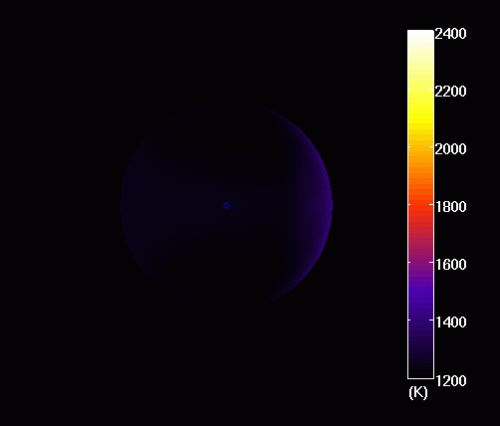
This exoplanet weather map shows temperatures on a hot Jupiter known as "HAT-P-2b". 

Among the hundreds of new planets discovered by NASA's Kepler spacecraft are a class of exotic worlds known as "hot Jupiters." 

Unlike the giant planets of our own solar system, which remain at a safe distance from the sun, these worlds are reckless visitors to their parent stars.

They speed around in orbits a fraction the size of Mercury's, blasted on just one-side by starlight hundreds of times more intense than the gentle heating experienced by Jupiter here at home."

Meteorologists watching this video are probably wondering what kind of weather a world like that might have.

Heather Knutson
The short answer is "big." Heather Knutson of Caltech made the first weather map of a hot Jupiter in 2007. "It's not as simple as taking a picture and—voila!—we see the weather," says Knutson.

These planets are hundreds of light years from Earth and they are nearly overwhelmed by the glare of their parent stars.

"Even to see the planet as a single pixel next to the star would be a huge accomplishment." Instead, Knutson and colleagues use a trick dreamed up by Nick Cowan of Northwestern University.

The key, she explains, is that "most hot Jupiters are tidally locked to their stars. This means they have a permanent dayside and a permanent night side.

Nick Cowan
As we watch them orbit from our vantage point on Earth, the planets exhibit phases—e.g., crescent, gibbous and full.

By measuring the infrared brightness of the planet as a function of its phase, we can make a rudimentary map of temperature vs. longitude."

NASA's Spitzer Space Telescope is the only infrared observatory with the sensitivity to do this work.

Since Knutson kick-started the research in 2007, nearly a dozen hot Jupiters have been mapped by astronomers using Spitzer.

Nikole Lewis
The most recent study, led by Nikole Lewis, a NASA Sagan Exoplanet Fellow working at MIT, shows a gas giant named HAT-P-2b.

"We can see daytime temperatures as high as 2400 K," says Lewis, "while the nightside drops below 1200K. Even at night," she marvels, "this planet is ten times hotter than Jupiter."

These exoplanet maps may seem crude compared to what we're accustomed to on Earth, but they are a fantastic accomplishment considering that the planets are trillions of miles away.

Saturday, April 20, 2013

NASA’s Spitzer space telescope: Silica (sand) in the supernova remnant Cassiopeia A.

In 2007 NASA’s Spitzer space telescope found the infrared signature of silica (sand) in the supernova remnant Cassiopeia A. 

The light from this exploding star first reached Earth in the 1600s.

The cyan dot just off center is all that remains of the star that exploded. 

Credit: NASA/JPL-Caltech/ O.Krause (Steward Observatory)

It's a bit like learning the secrets of the family that lived in your house in the 1800s by examining dust particles they left behind in cracks in the floorboards.

By looking at specks of dust carried to earth in meteorites, scientists are able to study stars that winked out of existence long before our solar system formed.

This technique for studying the stars – sometimes called astronomy in the lab—gives scientists information that cannot be obtained by the traditional techniques of astronomy, such as telescope observations or computer modeling.

Now scientists working at Washington University in St. Louis with support from the McDonnell Center for the Space Sciences, have discovered two tiny grains of silica (SiO2; the most common constituent of sand) in primitive meteorites.

This discovery is surprising because silica is not one of the minerals expected to condense in stellar atmospheres—in fact, it has been called 'a mythical condensate.'

Five silica grains were found earlier, but, because of their isotopic compositions, they are thought to originate from AGB stars, red giants that puff up to enormous sizes at the end of their lives and are stripped of most of their mass by powerful stellar winds.

These two grains are thought to have come instead from a core-collapse supernova, a massive star that exploded at the end of its life.

Because the grains, which were found in meteorites from two different bodies of origin, have spookily similar isotopic compositions, the scientists speculate in the May 1 issue of Astrophysical Journal Letters, that they may have come from a single supernova, perhaps even the one whose explosion is thought to have triggered the formation of the solar system.

A summary of the paper will also appear in the Editors' Choice compilation in the May 3 issue of Science magazine.

More information: 
AJL paper: iopscience.iop.org/2041-8205/768/1/L17/

Monday, February 25, 2013

NASA Telescopes Discover Strobe-Like Flashes in a Suspected Binary Protostar

NASA's Spitzer and Hubble space telescopes have teamed up to uncover a mysterious infant star that behaves like a police strobe light.

Left: This is a false-color, infrared-light Spitzer image of LRLL 54361 inside the star-forming region IC 348 located 950 light-years away and has an unusual variable object that has the typical signature of a protostar.

  • Larger image Center: This Hubble Space Telescope monochromatic-colour image resolves the detailed structure around the protostar, consisting of two cavities that are traced by light scattered off their edges above and below a dusty disk.
  • Larger image Right: This is an artist's impression of the hypothesized central object that may be two young binary stars.
  • Larger image Image credit: NASA, ESA, J. Muzerolle (STScI), E. Furlan (NOAO and Caltech), K. Flaherty (Univ. of Ariz./Steward Observatory), Z. Balog (Max Planck Institute for Astronomy), and R. Gutermuth (Univ. Mass. Amherst) 

Image acknowledgment: R. Hurt (Caltech/Spitzer Science Center) Two of NASA's great observatories, the Spitzer and Hubble space telescopes, have teamed up to uncover a mysterious infant star that behaves like a strobe light.

Every 25.34 days, the object, designated LRLL 54361, unleashes a burst of light. Although a similar phenomenon has been observed in two other young stellar objects, this is the most powerful such beacon seen to date.

Friday, February 15, 2013

NASA Spitzer Image: Heavenly Valentine

Generations of stars can be seen in this infrared portrait from NASA's Spitzer Space Telescope.

In this wispy star-forming region, called W5, the oldest stars can be seen as blue dots in the centers of the two hollow cavities (other blue dots are background and foreground stars not associated with the region).

Younger stars line the rims of the cavities, and some can be seen as pink dots at the tips of the elephant-trunk-like pillars. 

The white knotty areas are where the youngest stars are forming. Red shows heated dust that pervades the region's cavities, while green highlights dense clouds. 

Image Credit: NASA/JPL-Caltech/Harvard-Smithsonian

Sunday, October 14, 2012

NASA Spitzer: Scientists refine measurement of Universe's expansion rate

The Spitzer Space Telescope has measured the universe's expansion rate with one of the most precise instruments yet, according to NASA.

The edge of space is blasting outwards at the rate of around 74.3 kilometres per second per megaparsec; a megaparsec is about three million light-years in length.

NASA initially announced the results October 3, but clarified it a few days later to include mention of an independent study from the United States' Space Telescope Science Institute (STSCI) in Baltimore, Maryland.

"Spitzer is yet again doing science beyond what it was designed to do," stated JPL project scientist Michael Werner in a recent press release.

"First, Spitzer surprised us with its pioneering ability to study exoplanet atmospheres, and now, in the mission's later years, it has become a valuable cosmology tool."

Spitzer Space Telescope
The Spitzer Space Telescope (SST), formerly the Space Infrared Telescope Facility (SIRTF) is an infrared space observatory launched in 2003. It is the fourth and final of the NASA Great Observatories program.

The Hubble Constant
The universe's expansion rate is known as the Hubble Constant, and it has been revised several times over the years as the technology to measure it has improved.

Measuring Cepheids
Astronomers used the Spitzer telescope to observe Cepheids, which are stars that pulse at a regular rate.

Since observed Cepheids pulse at a rate that is relative to their brightness, these provide a useful measuring stick for astronomers seeking to measure the expanse of the universe.

Standard Candles
Cepheids are also known as "standard candles" because the principle to measuring the universe with them is similar to a person trying to measure his surroundings by observing candles.

Spitzer watched 10 Cepheids in the Milky Way and another 80 in the Large Magellanic Cloud, a galaxy that is relatively close to Earth.

Because Spitzer can peer through cosmic dust that obscures starlight, the measurements of brightness it came up with were more precise than previous observations.

This measurement led to the calculation of a more precise Hubble Constant.

Friday, October 5, 2012

NASA GALEX, Spitzer, WISE Image: Helix Nebula - Unraveling

A dying star is throwing a cosmic tantrum in this combined image from NASA's Spitzer Space Telescope and the Galaxy Evolution Explorer (GALEX), which NASA has lent to the California Institute of Technology in Pasadena.

In death, the star's dusty outer layers are unraveling into space, glowing from the intense ultraviolet radiation being pumped out by the hot stellar core.

This object, called the Helix nebula, lies 650 light-years away, in the constellation of Aquarius.

Also known by the catalog number NGC 7293, it is a typical example of a class of objects called planetary nebulae.

Discovered in the 18th century, these cosmic works of art were erroneously named for their resemblance to gas-giant planets.

Planetary nebulae are actually the remains of stars that once looked a lot like our sun.

These stars spend most of their lives turning hydrogen into helium in massive runaway nuclear fusion reactions in their cores.

In fact, this process of fusion provides all the light and heat that we get from our sun. Our sun will blossom into a planetary nebula when it dies in about five billion years.

When the hydrogen fuel for the fusion reaction runs out, the star turns to helium for a fuel source, burning it into an even heavier mix of carbon, nitrogen and oxygen.

Eventually, the helium will also be exhausted, and the star dies, puffing off its outer gaseous layers and leaving behind the tiny, hot, dense core, called a white dwarf.

The white dwarf is about the size of Earth, but has a mass very close to that of the original star; in fact, a teaspoon of a white dwarf would weigh as much as a few elephants!

The glow from planetary nebulae is particularly intriguing as it appears surprisingly similar across a broad swath of the spectrum, from ultraviolet to infrared.

The Helix remains recognizable at any of these wavelengths, but the combination shown here highlights some subtle differences.

The intense ultraviolet radiation from the white dwarf heats up the expelled layers of gas, which shine brightly in the infrared.

GALEX has picked out the ultraviolet light pouring out of this system, shown throughout the nebula in blue, while Spitzer has snagged the detailed infrared signature of the dust and gas in yellow

A portion of the extended field beyond the nebula, which was not observed by Spitzer, is from NASA's all-sky Wide-field Infrared Survey Explorer (WISE). The white dwarf star itself is a tiny white pinprick right at the center of the nebula.

The brighter purple circle in the very center is the combined ultraviolet and infrared glow of a dusty disk circling the white dwarf (the disk itself is too small to be resolved).

This dust was most likely kicked up by comets that survived the death of their star.

Before the star died, its comets, and possibly planets, would have orbited the star in an orderly fashion.

When the star ran out of hydrogen to burn, and blew off its outer layers, the icy bodies and outer planets would have been tossed about and into each other, kicking up an ongoing cosmic dust storm.

Any inner planets in the system would have burned up or been swallowed as their dying star expanded.

Infrared data from Spitzer for the central nebula is rendered in green (wavelengths of 3.6 to 4.5 microns) and red (8 to 24 microns), with WISE data covering the outer areas in green (3.4 to 4.5 microns) and red (12 to 22 microns). Ultraviolet data from GALEX appears as blue (0.15 to 2.3 microns).

Image Credit: NASA/JPL-Caltech

Tuesday, June 14, 2011

NASA SOFIA: Through the Looking Glass

The NASA logo on Bldg. 703 at the Dryden Aircraft Operations Facility in Palmdale, Calif., is reflected in the 2.5-meter primary mirror of the SOFIA observatory's telescope.

SOFIA, the Stratospheric Observatory for Infrared Astronomy, is an airborne observatory, built to complement the Hubble, Spitzer and Herschel space telescopes, as well as major Earth-based telescopes.

SOFIA features a German-built 100-inch (2.5 meter) diameter far-infrared telescope weighing 20 tons mounted in the rear fuselage of a modified Boeing 747SP aircraft. (See SOFIA at DLR) It is one of the premier space science programs of NASA's Science Mission Directorate.

SOFIA is a joint program between NASA and the DLR, the German Aerospace Centre.

Image Credit: NASA/Tom Tschida

Thursday, March 18, 2010

NASA's Spitzer Space Telescope: Ancient Black Holes

Original Caption Released with Image:
This artist's conception illustrates one of the most primitive supermassive black holes known (central black dot) at the core of a young, star-rich galaxy.
Astronomers using NASA's Spitzer Space Telescope have uncovered two of these early objects, dating back to about 13 billion years ago.

The monstrous black holes are among the most distant known, and appear to be in the very earliest stages of formation, earlier than any observed so far. Unlike all other supermassive black holes probed to date, this primitive duo, called J0005-0006 and J0303-0019, lacks dust.

As the drawing shows, gas swirls around a black hole in what is called an accretion disk. Usually, the accretion disk is surrounded by a dark doughnut-like dusty structure called a dust torus. But for the primitive black holes, the dust tori are missing and only gas disks are observed.

This is because the early universe was clean as a whistle. Enough time had not passed for molecules to clump together into dust particles. Some black holes forming in this era thus started out lacking dust. As they grew, gobbling up more and more mass, they are thought to have accumulated dusty rings.

This illustration also shows how supermassive black holes can distort space and light around them (see warped stars behind black hole). Stars from the galaxy can be seen sprinkled throughout, and distant mergers between other galaxies are illustrated in the background.

Image Credit:
NASA/JPL-Caltech