Showing posts with label Discover. Show all posts

Wednesday, June 12, 2013

ESO Telescope: Astronomers discover new kind of variable star

This spectacular group of young stars is the open star cluster NGC 3766 in the constellation of Centaurus (The Centaur). 

Very careful observations of these stars by a group from the Geneva Observatory using the Swiss 1.2-metre Leonhard Euler Telescope at ESO's La Silla Observatory in Chile have shown that 36 of the stars are of a new and unknown class of variable star. 

This image was taken with the MPG/ESO 2.2-metre telescope at the La Silla Observatory. 

Credit: ESO

Astronomers using the Swiss 1.2-metre Euler telescope at ESO's La Silla Observatory in Chile have found a new type of variable star. The discovery was based on the detection of very tiny changes in brightness of stars in a cluster.

The observations revealed previously unknown properties of these stars that defy current theories and raise questions about the origin of the variations.

The Swiss are justly famed for their craftsmanship when creating extremely precise pieces of technology.

Now a Swiss team from the Geneva Observatory has achieved extraordinary precision using a comparatively small 1.2-metre telescope for an observing programme stretching over many years.

They have discovered a new class of variable stars by measuring minute variations in stellar brightness.

The new results are based on regular measurements of the brightness of more than three thousand stars in the open star cluster NGC 3766 over a period of seven years.

They reveal how 36 of the cluster's stars followed an unexpected pattern—they had tiny regular variations in their brightness at the level of 0.1% of the stars' normal brightness.

These variations had periods between about two and 20 hours. The stars are somewhat hotter and brighter than the Sun, but otherwise apparently unremarkable. The new class of variable stars is yet to be given a name.

This level of precision in the measurements is twice as good as that achieved by comparable studies from other telescopes—and sufficient to reveal these tiny variations for the first time.

Nami Mowlavi
"We have reached this level of sensitivity thanks to the high quality of the observations, combined with a very careful analysis of the data," says Nami Mowlavi, leader of the research team, "but also because we have carried out an extensive observation programme that lasted for seven years. It probably wouldn't have been possible to get so much observing time on a bigger telescope."

Many stars are known as variable or pulsating stars, because their apparent brightness changes over time. How the brightness of these stars changes depends in complex ways on the properties of their interiors.

This phenomenon has allowed the development of a whole branch of astrophysics called asteroseismology, where astronomers can "listen" to these stellar vibrations, in order to probe the physical properties of the stars and get to know more about their inner workings.

"The very existence of this new class of variable stars is a challenge to astrophysicists," says Sophie Saesen, another team member.

"Current theoretical models predict that their light is not supposed to vary periodically at all, so our current efforts are focused on finding out more about the behaviour of this strange new type of star."

Although the cause of the variability remains unknown, there is a tantalising clue: some of the stars seem to be fast rotators.

They spin at speeds that are more than half of their critical velocity, which is the threshold where stars become unstable and throw off material into space.

"In those conditions, the fast spin will have an important impact on their internal properties, but we are not able yet to adequately model their light variations," explains Mowlavi.

"We hope our discovery will encourage specialists to address the issue in the hope of understanding the origin of these mysterious variations."

More information: "Stellar variability in open clusters I. A new class of variable stars in NGC 3766", by N. Mowlavi et al., published in the journal Astronomy & Astrophysics on 12 June 2013. (PDF)

Tuesday, April 23, 2013

NASA's WISE discover rare galaxy furiously burning fuel for stars

The tiny red spot in this image is one of the most efficient star-making galaxies ever observed, converting gas into stars at the maximum possible rate. 

The galaxy is shown here in an image from NASA's Wide-field Infrared Survey Explorer (WISE), which first spotted the rare galaxy in infrared light. 

Credit: NASA/JPL-Caltech/STScI/IRAM

Astronomers have found a galaxy turning gas into stars with almost 100 percent efficiency, a rare phase of galaxy evolution that is the most extreme yet observed.

The findings come from the IRAM Plateau de Bure interferometer in the French Alps, NASA's Wide-field Infrared Survey Explorer and NASA's Hubble Space Telescope.

Jim Geach
"Galaxies burn gas like a car engine burns fuel. Most galaxies have fairly inefficient engines, meaning they form stars from their stellar fuel tanks far below the maximum theoretical rate," said Jim Geach of McGill University, lead author of a new study appearing in the Astrophysical Journal Letters.

"This galaxy is like a highly tuned sports car, converting gas to stars at the most efficient rate thought to be possible," he said.

The galaxy, called SDSSJ1506+54, jumped out at the researchers when they looked at it using data from WISE's all-sky infrared survey. Infrared light is pouring out of the galaxy, equivalent to more than a thousand billion times the energy of our sun.

Ned Wright
"Because WISE scanned the entire sky, it detected rare galaxies like this one that stand out from the rest," said Ned Wright of UCLA, the WISE principal investigator.

Hubble's visible-light observations revealed that the galaxy is extremely compact, with most of its light emanating from a region just a few hundred light-years across.

"This galaxy is forming stars at a rate hundreds of times faster than our Milky Way galaxy, but the sharp vision of Hubble revealed that the majority of the galaxy's starlight is being emitted by a region just a few percent of the diameter of the Milky Way. This is star formation at its most extreme," said Geach.

The team then used the IRAM Plateau de Bure Interferometer to measure the amount of gas in the galaxy. The ground-based telescope detected millimeter-wave light coming from carbon monoxide, an indicator of the presence of hydrogen gas, which is fuel for stars.

Combining the rate of star formation derived with WISE, and the gas mass measured by IRAM, the scientists get a measure of the star formation efficiency.

The results reveal that the star-forming efficiency of the galaxy is close to the theoretical maximum, called the Eddington limit. In regions of galaxies where new stars are forming, parts of gas clouds are collapsing due to gravity. When the gas is dense enough to squeeze atoms together and ignite nuclear fusion, a star is born.

At the same time, winds and radiation from stars that have just formed can prevent the formation of new stars by exerting pressure on the surrounding gas, curtailing the collapse.

The Eddington limit is the point at which the force of gravity pulling gas together is balanced by the outward pressure from the stars. Above the Eddington limit, the gas clouds would be blown apart, halting star formation.

Monday, February 25, 2013

NASA Telescopes Discover Strobe-Like Flashes in a Suspected Binary Protostar

NASA's Spitzer and Hubble space telescopes have teamed up to uncover a mysterious infant star that behaves like a police strobe light.

Left: This is a false-color, infrared-light Spitzer image of LRLL 54361 inside the star-forming region IC 348 located 950 light-years away and has an unusual variable object that has the typical signature of a protostar.

  • Larger image Center: This Hubble Space Telescope monochromatic-colour image resolves the detailed structure around the protostar, consisting of two cavities that are traced by light scattered off their edges above and below a dusty disk.
  • Larger image Right: This is an artist's impression of the hypothesized central object that may be two young binary stars.
  • Larger image Image credit: NASA, ESA, J. Muzerolle (STScI), E. Furlan (NOAO and Caltech), K. Flaherty (Univ. of Ariz./Steward Observatory), Z. Balog (Max Planck Institute for Astronomy), and R. Gutermuth (Univ. Mass. Amherst) 

Image acknowledgment: R. Hurt (Caltech/Spitzer Science Center) Two of NASA's great observatories, the Spitzer and Hubble space telescopes, have teamed up to uncover a mysterious infant star that behaves like a strobe light.

Every 25.34 days, the object, designated LRLL 54361, unleashes a burst of light. Although a similar phenomenon has been observed in two other young stellar objects, this is the most powerful such beacon seen to date.

Thursday, February 21, 2013

UK Science team Discover Deepest undersea vents - Video

Get Adobe Flash player

British scientists exploring the ocean floor in the Caribbean have discovered an "astounding" set of hydrothermal vents, the deepest anywhere in the world.

Deploying a remotely-operated vehicle (ROV) in the Cayman Trough, a giant underwater canyon, they stumbled across a previously-unknown site nearly 5000m below the surface.

Video pictures relayed live back to the research ship mounting the operation show spindly chimneys up to 10m high and belching out dark water - "a stunning sight", according to one scientist.

In the immense pressure of the sea three miles down, the ROV, known as ISIS, was gently steered around the vents, taking pictures and gathering samples.

Hydrothermal vents are among the strangest features of the deep ocean and their existence was not known until the 1970s. Since then they have been discovered at about 200 sites around the world including the Southern Ocean and the Atlantic.

Read the full story here www.bbc.co.uk/news/science-environment-21520404

Friday, November 23, 2012

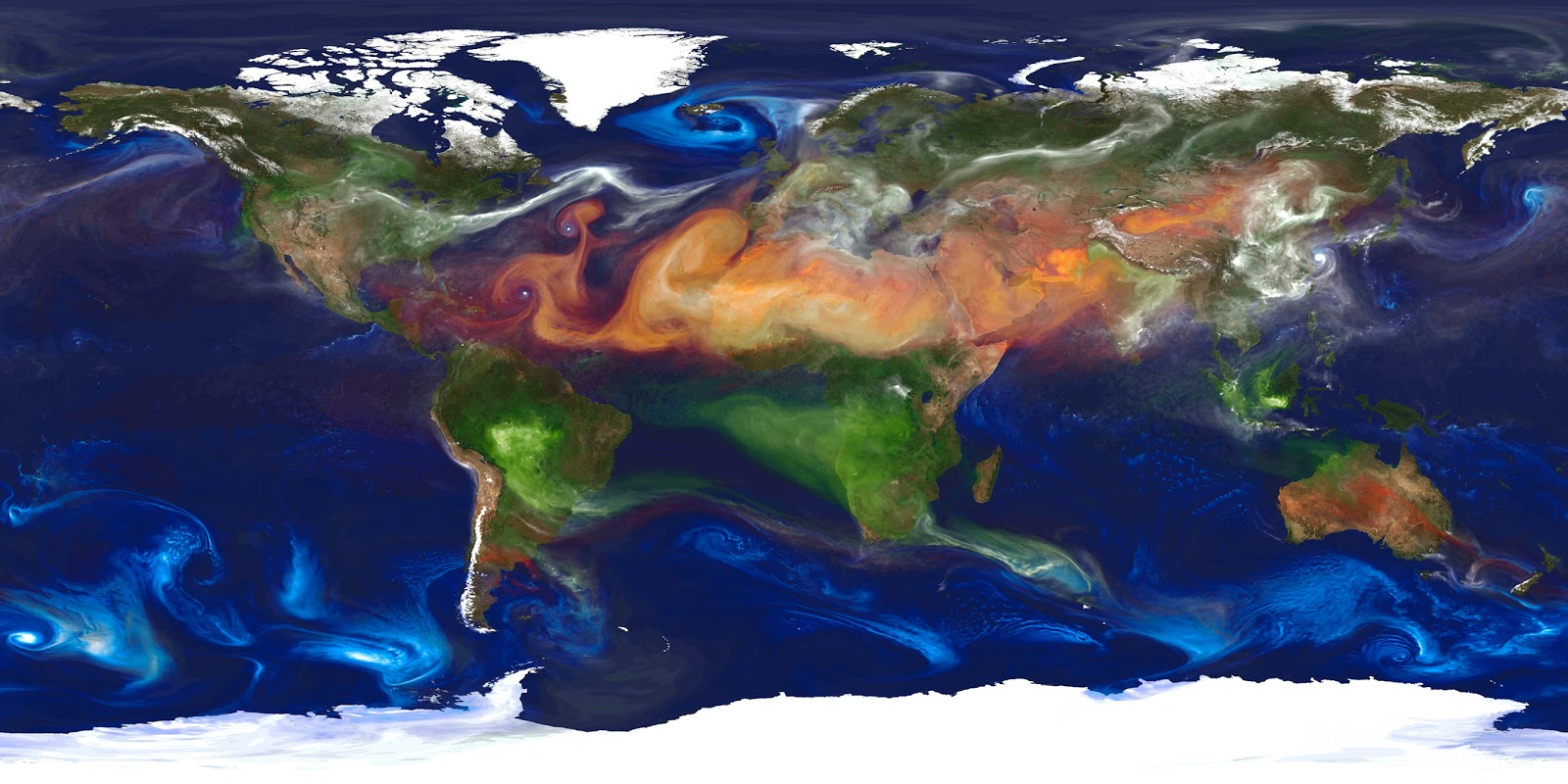
NASA GEOS-5 Image: Global Atmospheric Aerosols

Image courtesy NASA Goddard Space Flight Center.

High-resolution global atmospheric modeling run on the Discover supercomputer at the NASA Center for Climate Simulation at Goddard Space Flight Center, provides a unique tool to study the role of weather in Earth’s climate system.

The Goddard Earth Observing System Model, Version 5 (GEOS-5) is capable of simulating worldwide weather at resolutions of 10 to 3.5 kilometers (km).

This portrait of global aerosols was produced by a GEOS-5 simulation at a 10-kilometer resolution. Dust (red) is lifted from the surface, sea salt (blue) swirls inside cyclones, smoke (green) rises from fires, and sulfate particles (white) stream from volcanoes and fossil fuel emissions.

Friday, October 12, 2012

Scientists Discover Planet with Diamond Mantle - Twice The Size Of Our Sun

Scientists have announced the discovery of a planet made almost entirely of diamonds.

The planet, called 55 Cancri e, is located in a solar system inside the constellation of Cancer, reports NBC News.

It was discovered in 2004, and scientists have been working since then to determine its mass and radius, as well as study its host star’s composition.

The planet is called a “super-Earth,” and scientists believe that the rocky world is composed mostly of carbon (in the form of either graphite or diamond). It also includes iron, silicon carbide, and possibly silicates.

Scientists also believe, based on their research, that at least one-third of the planet’s mass is pure diamond. Lead researcher Nikku Madhusudhan of Yale University stated:

“This is our first glimpse of a rocky world with a fundamentally different chemistry from Earth. The surface of this planet is likely covered in graphite and diamond rather than water and granite.”

While worlds like the “diamond planet” of 55 Cancri e have been theorized before, and at least one has been discovered before now, it is the first of its kind to be identified orbiting around a sun-like star.

Madhusudhan’s study on the planet was published in the journal Astrophysical Journal Letters.

Princeton University astronomer David Spergel stated that it is relatively easy to find out a star’s basic structure and history once its age and mass have been discovered. He added:

“Planets are much more complex. This ‘diamond-rich super-Earth’ is likely just one example of the rich sets of discoveries that await us as we begin to explore planets around nearby stars.”

Tuesday, May 18, 2010

Research discover mechanism for stress resilience

Scientists have discovered a mechanism that helps to explain resilience to stress, vulnerability to depression and how antidepressants work.

The new findings, in the reward circuit of mouse and human brains, have spurred a high tech dragnet for compounds that boost the action of a key gene regulator there, called deltaFosB.

A molecular main power switch -- called a transcription factor -- inside neurons, deltaFosB turns multiple genes on and off, triggering the production of proteins that perform a cell's activities.

"We found that triggering deltaFosB in the reward circuit's hub is both necessary and sufficient for resilience; it protects mice from developing a depression-like syndrome following chronic social stress," explained Eric Nestler, M.D., of the Mount Sinai School of Medicine, who led the research team, which was funded by the National Institute of Health's National Institute of Mental Health (NIMH).

"Antidepressants can reverse this social withdrawal syndrome by boosting deltaFosB. Moreover, deltaFosB is conspicuously depleted in brains of people who suffered from depression. Thus, induction of this protein is a positive adaptation that helps us cope with stress, so we're hoping to find ways to tweak it pharmacologically," added Nestler, who also directs the ongoing compound screening project.

Nestler and colleagues report the findings that inspired the hunt online May 16 2010 in the journal Nature Neuroscience.

Friday, February 12, 2010

Russian Customs Discover Meteorite Smugglers

Amid a huge bounty of contraband goods seized recently at a Russian airport, one far-out find floored customs officials: chunks of meteorite.

"On the customs declaration, the smugglers identified it as granite for construction and decoration of office space," Larisa Ledovskikh, a spokeswoman for customs at Moscow's Domodedovo airport, told AFP on Thursday.

"But our officials could see it was clearly not granite!"

The two smugglers -- who also tried to ship out silver antiques, fossils, semi-precious stones, microscopes and old books in the suspect cargo -- were initially charged with making a false declaration on their customs form.

Only after a three-month investigation did officials discover that the mystery lumps were fragments from outer space and the men part of a larger crime ring including experts and scientists, Ledovskikh said.

"They were part of an organized criminal gang. They had worked out a plan in advance to smuggle out of Russian territory and to the Czech Republic... two meteorite chunks, each weighing 100 grams," she said.

The two men were arrested on Sunday and charged with contraband, a sentence that carries a maximum of 12 years in prison in Russia.