Showing posts with label Goddard Space centre. Show all posts

Monday, July 15, 2013

Hubble Astronomers find new Neptune moon

This composite Hubble Space Telescope picture shows the location of a newly discovered moon, designated S/2004 N 1, orbiting Neptune. 

The black and white image was taken in 2009 with Hubble's Wide Field Camera 3 in visible light. 

Hubble took the colour inset of Neptune on August 2009. 

Credit: NASA, ESA, M. Showalter/SETI Institute

NASA and ESA's Hubble Space Telescope has discovered a new moon orbiting the distant blue-green planet Neptune, the 14th known to be circling the giant planet.

The moon, designated S/2004 N 1, is estimated to be no more than 12 miles across, making it the smallest known moon in the Neptunian system.

It is so small and dim that it is roughly 100 million times fainter than the faintest star that can be seen with the naked eye.

It even escaped detection by NASA's Voyager 2 spacecraft, which flew past Neptune in 1989 and surveyed the planet's system of moons and rings.

Mark Showalter of the SETI Institute in Mountain View, Calif., found the moon July 1, while studying the faint arcs, or segments of rings, around Neptune.

"The moons and arcs orbit very quickly, so we had to devise a way to follow their motion in order to bring out the details of the system," he said.

"It's the same reason a sports photographer tracks a running athlete—the athlete stays in focus, but the background blurs."

The method involved tracking the movement of a white dot that appears over and over again in more than 150 archival Neptune photographs taken by Hubble from 2004 to 2009.

This diagram shows the orbits of several moons located close to the planet Neptune. 

All of them were discovered in 1989 by NASA's Voyager 2 spacecraft, with the exception of S/2004 N 1, which was discovered in archival Hubble Space Telescope images taken from 2004 to 2009.

The moons all follow prograde orbits and are nestled among Neptune's rings (not shown). 

The outer moon Triton was discovered in 1846 — the same year the planet itself was discovered. 

Triton's orbit is retrograde, suggesting it is a captured Kuiper Belt object and therefore a distant cousin of Pluto. 

The inner moons may have formed after Triton's capture several billion years ago. 

Credit: NASA, ESA, and A. Feild (STScI)

On a whim, Showalter looked far beyond the ring segments and noticed the white dot about 65,400 miles from Neptune, located between the orbits of the Neptunian moons Larissa and Proteus.

The dot is S/2004 N 1. Showalter plotted a circular orbit for the moon, which completes one revolution around Neptune every 23 hours.

Sunday, June 9, 2013

NASA LADEE Arrives at Wallops for Moon Mission

The NASA Lunar Atmosphere and Dust Environment Explorer (LADEE) arrives at NASA Wallops to begin final processing for its trip to the moon later this year.

LADEE is a robotic mission that will orbit the moon to gather detailed information about the lunar atmosphere, conditions near the surface and environmental influences on lunar dust.

A thorough understanding of these characteristics will address long-standing unknowns, and help scientists understand other planetary bodies as well.

LADEE has three science instruments and one technology demonstration onboard.

LADEE's scheduled Sep. 5, 2013, launch will mark several firsts. It will be;
  1. the first payload to launch on a U.S. Air Force Minotaur V rocket integrated by Orbital Sciences Corp., and 
  2. the first deep space mission to launch from NASA's Goddard Space Flight Center's Wallops Flight Facility.
NASA's Science Mission Directorate in Washington funds the LADEE mission, a cooperative effort led by NASA’s Ames Research Center, Moffett Field, Calif.

Ames is responsible for managing the mission, building the spacecraft and performing mission operations.

NASA’s Goddard Space Flight Center, Greenbelt, Md., is responsible for managing the science instruments and technology demonstration payload, and the science operations center.

Wallops is responsible for launch vehicle integration, launch services, and launch range operations.

NASA’s Marshall Space Flight Center, Huntsville, Ala., manages LADEE within the Lunar Quest Program Office.

Friday, May 3, 2013

NASA Rover GROVER: Prototype Set to Explore Greenland Ice Sheet

The tank-like GROVER prototype stands six feet tall, including its solar panels. 

It weighs about 800 pounds and traverses the ice on two repurposed snowmobile tracks. 

The robot is powered entirely by solar energy, so it can operate in pristine polar environments without adding to air pollution. 

The panels are mounted in an inverted V, allowing them to collect energy from the sun and sunlight reflected off the ice sheet.

NASA's newest scientific rover is set for testing May 3 through June 8 in the highest part of Greenland.

The robot known as GROVER, which stands for both Greenland Rover and Goddard Remotely Operated Vehicle for Exploration and Research, will roam the frigid landscape collecting measurements to help scientists better understand changes in the massive ice sheet.

This autonomous, solar-powered robot carries a ground-penetrating radar to study how snow accumulates, adding layer upon layer to the ice sheet over time.


Greenland's surface layer vaulted into the news in summer 2012 when higher than normal temperatures caused surface melting across about 97 percent of the ice sheet.

Scientists at NASA's Goddard Space Flight Center in Greenbelt, Md., expect GROVER to detect the layer of the ice sheet that formed in the aftermath of that extreme melt event.

Research with polar rovers costs less than aircraft or satellites, the usual platforms.

Lora Koenig
"Robots like GROVER will give us a new tool for glaciology studies," said Lora Koenig, a glaciologist at Goddard and science advisor on the project.

GROVER will be joined on the ice sheet in June by another robot, named Cool Robot, developed at Dartmouth College, Hanover, N.H., with funding from the National Science Foundation.

This rover can tow a variety of instrument packages to conduct glaciological and atmospheric sampling studies.

GROVER was developed in 2010 and 2011 by teams of students participating in summer engineering boot camps at Goddard.

The students were interested in building a rover and approached Koenig about whether a rover could aid her studies of snow accumulation on ice sheets.

This information typically is gathered by radars carried on snowmobiles and airplanes. Koenig suggested putting a radar on a rover for this work.

Hans-Peter Marshall
Koenig, now a science advisor on the GROVER Project, asked Hans-Peter Marshall, a glaciologist at Boise State University to bring in his expertise in small, low-power, autonomous radars that could be mounted on GROVER.

Since its inception at the boot camp, GROVER has been fine-tuned, with NASA funding, at Boise State.

Friday, November 23, 2012

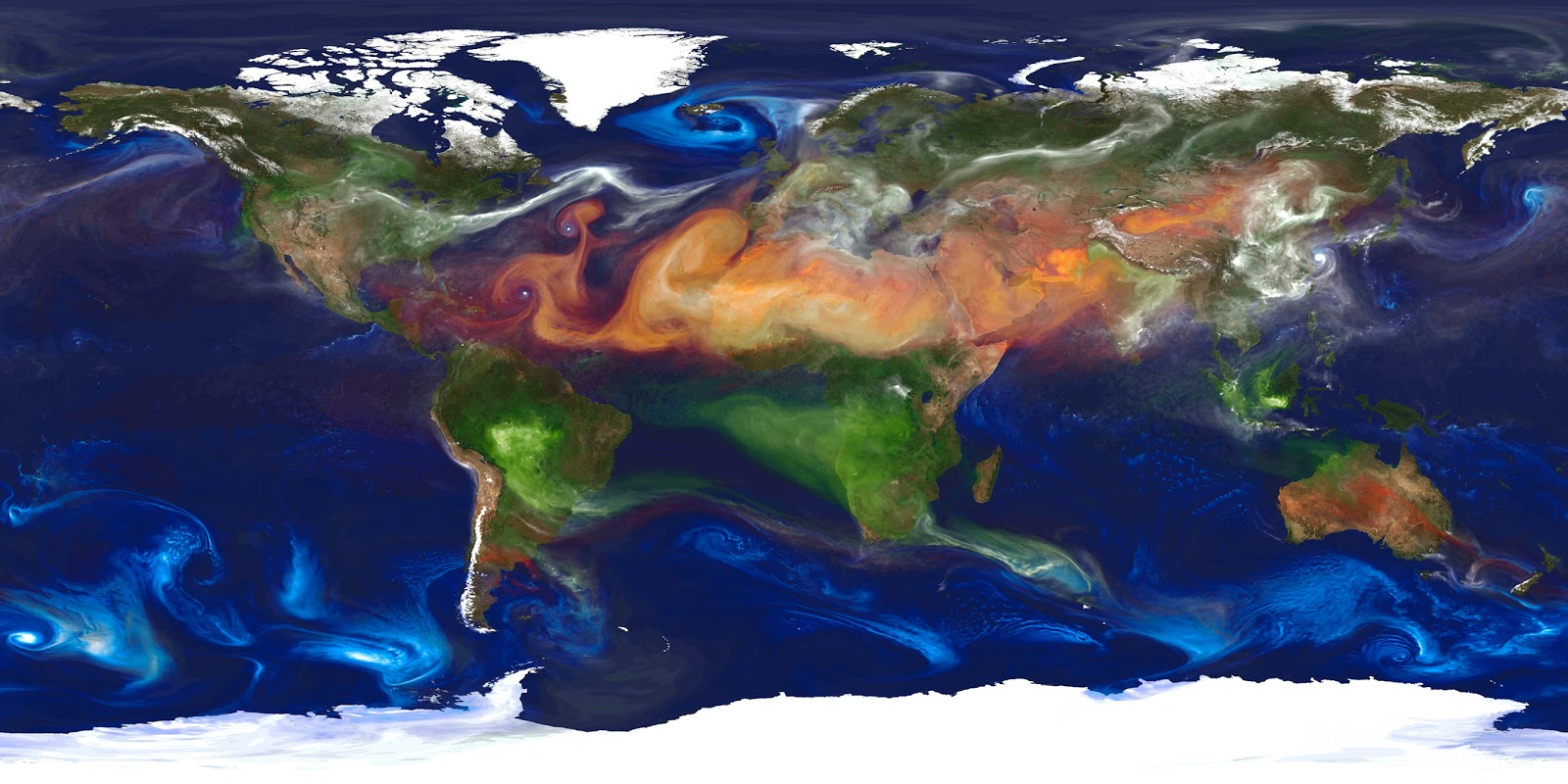
NASA GEOS-5 Image: Global Atmospheric Aerosols

Image courtesy NASA Goddard Space Flight Center.

High-resolution global atmospheric modeling run on the Discover supercomputer at the NASA Center for Climate Simulation at Goddard Space Flight Center, provides a unique tool to study the role of weather in Earth’s climate system.

The Goddard Earth Observing System Model, Version 5 (GEOS-5) is capable of simulating worldwide weather at resolutions of 10 to 3.5 kilometers (km).

This portrait of global aerosols was produced by a GEOS-5 simulation at a 10-kilometer resolution. Dust (red) is lifted from the surface, sea salt (blue) swirls inside cyclones, smoke (green) rises from fires, and sulfate particles (white) stream from volcanoes and fossil fuel emissions.