Showing posts with label electromagnetic. Show all posts

Wednesday, October 22, 2014

NASA SDO: Electromagnetic 'Twisted rope' clue to dangerous solar storms

Model of the magnetic field in the region where occurred a major flare on December 13th 2006. 

This model has been obtained using magnetic field data obtained at the surface of the Sun by the satellite HINODE and the high resolution model MESHMHD few hours before the eruption. 

It shows that a magnetic rope (grey) is maintained in equilibrium by overlaying arcades (orange). 

Credit: Tahar Amari /Centre de physique théorique.CNRS-Ecole Polytechnique.FRANCE.

A "twisted rope" of magnetically-charged energy precedes solar storms that have the potential to damage satellites and electricity grids, French scientists said on Wednesday.

A cord of magnetic flux emerges on the Sun's surface, grows and is squeezed upwards, and the following day, the star unleashes a blast of radiation, high-energy particles and magnetised plasma.

Solar outbursts are considered a rare but increasingly worrisome risk for satellites, global positioning systems (GPS) and power grids on which modern life depends.

Reporting in the journal Nature, a team led by Tahar Amari of France's National Centre for Scientific Research (CNRS) looked at a solar storm that brewed in December 2006 and happened to be observed by a Japanese scientific satellite.

"We were able to identify the source of the eruption four days before it developed," Amari said to reporters.

"The magnetic field builds up in the shape of a twisted rope. The ends of the rope are anchored in sunspots," he said, referring to notoriously magnetised features on the solar surface.

Experts say solar storms can cause widespread breakdowns, disabling everything from power and radio to GPS geo-location and water supplies which rely on electrical pumps.

View of typical solar eruption using data from the NASA Solar Dynamic Observatory space mission. 

The Earth has been shown to show the gigantic size of the phenomena 

Credit: Tahar Amari /Centre de physique théorique.CNRS-Ecole Polytechnique.FRANCE

They begin with an explosion on the Sun's surface, known as a solar flare, sending X-rays and extreme ultra-violet radiation towards Earth at light speed.

Hours later, energetic particles follow and these electrons and protons can electrify satellites and damage their electronics.

Next are coronal mass ejections (CME), billion-tonne clouds of magnetised plasma that take a day or more to cross the Sun-Earth gap.

A solar storm in 1859 caused an electrical surge on telegraph lines that prompted some offices to catch fire and operators to receive shocks. A 1989 event caused power outages for five million people in the Canadian province of Quebec.

A 2009 report by a panel of scientists assembled by NASA warned that a catastrophic solar storm could cost the United States alone up to two trillion dollars (1.6 trillion euros) in repairs in the first year, and it could take up to 10 years to fully recover.

Predicting when these events will take place, and if Earth lies in their path, has been thwart with problems.

Eruption of the magnetic rope in the dynamic model METEOSOL after its departure from equilibrium 

Credit: Tahar Amari /Centre de physique théorique.CNRS-Ecole Polytechnique.FRANCE

On July 23, 2012, Earth narrowly missed the biggest storm in 150 years, an event big enough to "knock modern civilisation back to the 18th century," yet few humans were even aware of the peril, NASA said last July.

At present, Earth gets a few hours' warning of a solar eruption thanks to the eyes of orbiting US satellites.

But, said Amari, warning time should eventually improve.

"The work will help us fine tune knowledge about impending solar eruptions," he said.

"Using real-time magnetic data and mathematical models, it will eventually be possible to predict space weather."

More information: Characterizing and predicting the magnetic environment leading to solar eruptions, Nature, dx.doi.org/10.1038/nature13815

Wednesday, December 4, 2013

NASA Van Allen Probes: Mysteries of Earth's radiation belts uncovered

The twin Van Allen Probes were launched on August 30, 2012 into elliptical, near-equatorial orbits around the Earth. 

Remarkably, rather than seeing just the well-known two-belt structure, the mission found almost immediate evidence of the clear three-belt structure portrayed in green in this diagram. 

Image courtesy of Andy Kale, University of Alberta.

Just over a year since launch, NASA's Van Allen Probes mission continues to unravel longstanding mysteries of Earth's high-energy radiation belts that encircle our planet and pose hazards to orbiting satellites and astronauts.

Derived from measurements taken by a University of New Hampshire-led instrument on board the twin spacecraft, the latest discovery reveals that the high-energy particles populating the radiation belts can be accelerated to nearly the speed of light in conjunction with ultra-low frequency electromagnetic waves operating on a planetary scale.

This mode of action, as detailed in a paper recently published in the journal Nature Communications, is analogous to that of a cyclical particle accelerator like the Large Hadron Collider (LHC).

However, in this case, the Earth's vast magnetic field, or magnetosphere, which contains the Van Allen belts, revs up drifting electrons to ever-higher speeds as they circle the planet from west to east.

The recent finding comes on the heels of a related discovery—also made by the UNH-led Energetic Particle, Composition, and Thermal Plasma (ECT) instrument suite—showing similar particle acceleration but on a microscopic rather than a planetary scale.

Harlan Spence
"The acceleration we first reported operates on the scale size of an electron's gyromotion—it is a really local process, maybe only a few hundred meters in size," notes Harlan Spence, director of the UNH Institute for the Study of Earth, Oceans, and Space, principal scientist for the ECT, and coauthor on the Nature Communications paper.

"Now we're seeing this large-scale, global motion involving ultra low-frequency waves pulsing through Earth's magnetosphere and operating across vast distances up to hundreds of thousands of kilometers."

And, Spence adds, "in all likelihood both processes are occurring simultaneously to accelerate particles to relativistic speeds."

Understanding the complex dynamics of the particle acceleration will help scientists make better predictions of space weather conditions and, thus, offer better protections to orbiting satellites crucial to modern-day society.

Having twin spacecraft making simultaneous measurements in different regions of nearby space is a key part of the mission as it allows the scientists to look at data separated in both space and time.

"With the Van Allen Probes, I like to think there's no place for these particles to hide because each spacecraft is spinning and 'glimpses' the entire sky with its detector 'eyes', so we're essentially getting a 360-degree view in terms of direction, position, energy, and time," Spence says.

Tuesday, March 13, 2012

ESA GPS Navigation: Work begins to strengthen EGNOS against solar storms

This illustration shows a CME blasting off the Sun’s surface in the direction of Earth. 

This left portion is composed of an EIT 304 image superimposed on a LASCO C2 coronagraph. 

Two to four days later, the CME cloud is shown striking and beginning to be mostly deflected around the Earth’s magnetosphere. 

The blue paths emanating from the Earth’s poles represent some of its magnetic field lines. The magnetic cloud of plasma can extend to 30 million miles wide by the time it reaches earth. These storms, which occur frequently, can disrupt communications and navigational equipment, damage satellites, and even cause blackouts.

Credits: ESA/NASA - SOHO/LASCO/EIT

Europe’s European Geostationary Navigation Overlay Service (EGNOS) satnav augmentation service, employed for an ever-increasing range of uses such as guiding aircraft landings, will be strengthened against the effects of solar storms and its design ‘future-proofed’. The new work order was signed on Friday.

EGNOS uses geostationary satellites and a Europe-wide network of ground receivers to sharpen the accuracy and reliability of US GPS signals over the continent.

EGNOS signals are potentially vulnerable, however, to the effects of high solar activity on the ionosphere – the electrically active upper layers of our atmosphere – which can cause signal ‘scintillations’ and time delays.

And an increase in solar storms is being experienced as the Sun enters the active phase of its 11-year cycle.

This new effort will increase system robustness and service availability against severe ionospheric severe effects that began last year and are expected to continue until the peak of the solar cycle expected in 2013–14.

In addition, while EGNOS began its general service in 2009 and its ‘Safety-of-Life’ signal for aircraft vertical landing approaches became available a year ago this month, the overall system was designed almost a decade ago, so work is also needed to upgrade elements of its communication system to manage technology obsolescence.

The work order also covers planned EGNOS mission evolution, including keeping pace with GPS modernisation, provision of vertical guidance for aircraft landings and extending the EGNOS network to cover North Africa and the Middle East.

This new work order is part of a framework contract signed with Thales Alenia Space France in May 2011.

RIMS antenna
EGNOS ranging station

About EGNOS

Along with Galileo, EGNOS is the other pillar of Europe’s navigation programme. ESA designed the EGNOS system in cooperation with the EC and Eurocontrol. EGNOS informs users about the current accuracy and integrity (level of reliability) of the system based on the GPS satellites’ orbits, atomic clock accuracy and ionospheric delay.

If the accuracy of the signal falls below a given threshold, users are warned within six seconds.

Saturday, March 10, 2012

Massive Solar Flare: HD Still

NASA image captured March 6, 2012


The sun erupted with one of the largest solar flares of this solar cycle on March 6, 2012 at 7PM ET.

This flare was categorized as an X5.4, making it the second largest flare, after an X6.9 on August 9, 2011, since the sun’s activity segued into a period of relatively low activity called solar minimum in early 2007.

The current increase in the number of X-class flares is part of the sun’s normal 11-year solar cycle, during which activity on the sun ramps up to solar maximum, which is expected to peak in late 2013.

About an hour later, at 8:14 PM ET, March 6, the same region let loose an X1.3 class flare. An X1 is 5 times smaller than an X5 flare.

These X-class flares erupted from an active region named AR 1429 that rotated into view on March 2.

Prior to this, the region had already produced numerous M-class and one X-class flare. The region continues to rotate across the front of the sun, so the March 6 flare was more Earthward facing than the previous ones.

It triggered a temporary radio blackout on the sunlit side of Earth that interfered with radio navigation and short wave radio.


In association with these flares, the sun also expelled two significant coronal mass ejections (CMEs), which are travelling faster than 600 miles a second and may arrive at Earth in the next few days.

In the meantime, the CME associated with the X-class flare from March 4 has dumped solar particles and magnetic fields into Earth’s atmosphere and distorted Earth's magnetic fields, causing a moderate geomagnetic storm, rated a G2 on a scale from G1 to G5.


Such storms happen when the magnetic fields around Earth rapidly change strength and shape.

A moderate storm usually causes aurora and may interfere with high frequency radio transmission near the poles.

This storm is already dwindling, but the Earth may experience another enhancement if the most recent CMEs are directed toward and impact Earth.

In addition, last night’s flares have sent solar particles into Earth’s atmosphere, producing a moderate solar energetic particle event, also called a solar radiation storm.

These particles have been detected by NASA’s SOHO and STEREO spacecraft, and NOAA’s GOES spacecraft.

At the time of writing, this storm is rated an S3 on a scale that goes up to S5. Such storms can interfere with high frequency radio communication.

Besides the August 2011 X-class flare, the last time the sun sent out flares of this magnitude was in 2006. There was an X6.5 on December 6, 2006 and an X9.0 on December 5, 2006.

Like the most recent events, those two flares erupted from the same region on the sun, which is a common occurrence.

Credit: NASA/SOHO

Solar Storms: Electro-magnetic Radiation from the Sun

Caption: Artist illustration of events on the sun changing the conditions in Near-Earth space.

Credit: NASA 

Space weather starts at the sun. It begins with an eruption such as a huge burst of light and radiation called a solar flare or a gigantic cloud of solar material called a coronal mass ejection (CME).

But the effects of those eruptions happen at Earth, or at least near-Earth space. Scientists monitor several kinds of space "weather" events, geomagnetic storms, solar radiation storms, and radio blackouts – all caused by these immense explosions on the sun.

To read more go to: www.nasa.gov/mission_pages/sunearth/news/storms-on-sun.html

Tuesday, February 7, 2012

NuStar: The Nuclear Spectroscopic Telescope Array

NuSTAR, The Nuclear Spectroscopic Telescope Array, will image the sky for the first time in the high energy X-ray (6-79 keV) region of the electromagnetic spectrum.

Our view of the universe in this spectral window has been limited previously. NuSTAR is scheduled to launch March 14, 2012, from an aircraft operating out of Kwajalein Atoll in the Marshall Islands.

Here, NuSTAR is seen undergoing a solar array illumination test.

Credit: NASA

Tuesday, January 31, 2012

Solar Flares Solution to Vanishing Electrons


Researchers from the University of California, Los Angeles (UCLA) have solved the mystery behind vanishing electrons on Earth. The scientists conducted an experiment which suggested solar flares were the major reason behind the mystery.

During the experiment, the researchers installed three networks of orbiting spacecrafts, positioned at different distances from Earth to catch escaping electrons in the act. The data shows that a majority of the electrons were stripped away from the radiation belt by solar wind particles, when the solar flare reached Earth.

According to the researchers, when flares erupt on the Sun's atmosphere, parts of the magnetized outer layers of the Sun's atmosphere crash onto Earth's magnetic field, thereby triggering geomagnetic storms that are capable of damaging satellites and affecting electrons present on Earth.

The fact that these electrons were missing was discovered back in the early 1960s. Initial hypothesis suggested they were lost to the Earth's atmosphere, while others said they were not permanently lost merely drained of energy (temporarily) so they appeared absent. The mystery has now been solved.

"During the onset of a geomagnetic storm, nearly all the electrons trapped within the radiation belt vanish, only to come back with a vengeance a few hours later," said Vassilis Angelopoulos, a Professor at the UCLA, "It's a puzzling effect."

"This is an important milestone in understanding Earth's space environment," said Drew Turner, an Assistant Researcher at UCLA, "We are one step closer towards understanding and predicting space weather phenomena."

Thursday, January 19, 2012

ESA Herschel Image: A New View of the Eagle Nebula

Combining almost opposite ends of the electromagnetic spectrum, this composite of the Herschel in far-infrared and XMM-Newton’s X-ray images shows how the hot young stars detected by the X-ray observations are sculpting and interacting with the surrounding ultra-cool gas and dust, which, at only a few degrees above absolute zero, is the critical material for star formation itself.

Both wavelengths would be blocked by Earth’s atmosphere, so are critical to our understanding of the lifecycle of stars

Credits: far-infrared: ESA/Herschel/PACS/SPIRE/Hill, Motte, HOBYS Key Programme Consortium; X-ray: ESA/XMM-Newton/EPIC/XMM-Newton-SOC/Boulanger

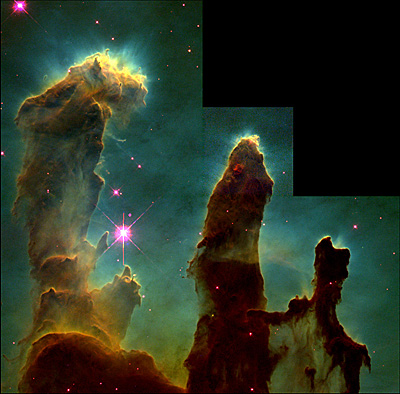
The Eagle Nebula as never seen before. In 1995, the Hubble Space Telescope's 'Pillars of Creation' image of the Eagle Nebula became one of the most iconic images of the 20th century. Now, two of ESA's orbiting observatories have shed new light on this enigmatic star-forming region.

The Eagle Nebula is 6500 light-years away in the constellation of Serpens. It contains a young hot star cluster, NGC6611, visible with modest back-garden telescopes, that is sculpting and illuminating the surrounding gas and dust, resulting in a huge hollowed-out cavity and pillars, each several light-years long.

The Hubble image hinted at new stars being born within the pillars, deeply inside small clumps known as 'evaporating gaseous globules' or EGGs. Owing to obscuring dust, Hubble's visible light picture was unable to see inside and prove that young stars were indeed forming.

The ESA Herschel Space Observatory's new image shows the pillars and the wide field of gas and dust around them. Captured in far-infrared wavelengths, the image allows astronomers to see inside the pillars and structures in the region.

In parallel, a new multi-energy X-ray image from ESA's XMM-Newton telescope shows those hot young stars responsible for carving the pillars.

This 1995 Hubble Space Telescope image of the ‘Pillars of Creation’ is probably the most famous astronomical image of the 20th Century.

Taken in visible light using a combination of SII/H-alpha and OIII filters, it shows a part of the Eagle Nebula where new stars are forming.

The tallest pillar is around 4 light-years high

Credits: NASA/ESA/STScI, Hester & Scowen (Arizona State University)

Combining the new space data with near-infrared images from the European Southern Observatory's (ESO's) Very Large Telescope at Paranal, Chile, and visible-light data from its Max Planck Gesellschaft 2.2m diameter telescope at La Silla, Chile, we see this iconic region of the sky in a uniquely beautiful and revealing way.

In visible wavelengths, the nebula shines mainly due to reflected starlight and hot gas filling the giant cavity, covering the surfaces of the pillars and other dusty structures.

At near-infrared wavelengths, the dust becomes almost transparent and the pillars practically vanish.
In far-infrared, Herschel detects this cold dust and the pillars reappear, this time glowing in their own light.

Intricate tendrils of dust and gas are seen to shine, giving astronomers clues about how it interacts with strong ultraviolet light from the hot stars seen by XMM-Newton.

In 2001, Very Large Telescope near-infrared images had shown only a small minority of the EGGs were likely to contain stars being born.

However, Herschel's image makes it possible to search for young stars over a much wider region and thus come to a much fuller understanding of the creative and destructive forces inside the Eagle Nebula.

Earlier mid-infrared images from ESA's Infrared Space Observatory and NASA's Spitzer, and the new XMM-Newton data, have led astronomers to suspect that one of the massive, hot stars in NGC6611 may have exploded in a supernova 6000 years ago, emitting a shockwave that destroyed the pillars.

However, because of the distance of the Eagle Nebula, we won't see this happen for several hundred years yet.

Powerful ground-based telescopes continue to provide astonishing views of our Universe, but images in far-infrared, mid-infrared and X-ray wavelengths are impossible to obtain owing to the absorbing effects of Earth's atmosphere.

Space-based observatories such as ESA's Herschel and XMM-Newton help to peel back that veil and see the full beauty of the Universe across the electromagnetic spectrum.

With regions like the Eagle Nebula, combining all of these observations helps astronomers to understand the complex yet amazing lifecycle of stars

Monday, November 28, 2011

Space 'Superbubbles' Could Spawn Energetic Cosmic Rays

An artist's concept of the heliosphere, a magnetic bubble that partially protects the solar system from cosmic rays.
CREDIT: Richard Mewaldt/Caltech

Enigmatic cosmic rays that strike Earth with giant amounts of energy might come from hot gaseous "superbubbles" in space, a new study reveals.

Cosmic rays have perplexed scientists for a century. These electrically charged particles bombard Earth with energies dwarfing anything we are capable of, but their origins remain a mystery.

Since cosmic rays are electrically charged, they can get pushed and pulled around by interstellar magnetic fields in the gas between the stars as they zip through space, obscuring where they come from.

One suspected fountain of cosmic rays are star-forming regions. The massive stars within these stellar nurseries can spew out massive amounts of energy and explode as supernovas.

Wednesday, August 31, 2011

CAesium Fountain atomic clock with the world's best long-term accuracy

A caesium fountain clock that keeps the United Kingdom's atomic time is now the most accurate long-term timekeeper in the world. 

This has been ascertained by a new evaluation of the clock that will be published in the October 2011 issue of the international scientific journal Metrologia by a team of physicists at the National Physical Laboratory (NPL) in the United Kingdom and Penn State University in the United States. 

This image shows the clock, NPL-CsF2, which is located at the National Physical Laboratory in Teddington, U.K. The whole device is approximately 8.2 feet (2.5 m) high.

Atoms are tossed up 3.2 feet (1 m), approximately 12 inches (30 cm) above the cavity that is contained inside a vacuum vessel. 

The large external cylinder screens the atoms inside the clock from the relatively large and unstable external magnetic field. Credit: National Physical Laboratory, United Kingdom.

The atomic clock housed in Britain's National Physical Laboratory (NPL) is the world's most accurate, according to new research.

The clock is a caesium fountain clock, meaning that the "tick" is provided by the measurement of the energy required to change the caesium atoms' spin.

Caesium atoms are placed into a cavity, and exposed to electromagnetic radiation of different wavelengths. Once the spin "flips", the waves are at the right frequency to define what a second is.

In the case of caesium, that quantity is defined as 9.2GHz (or, to be appropriately exact, 9,192,631,770Hz). When the spin flips, the clock operators can set the frequency at that point, and work backward to determine the exact length of a second.

The international Bureau of Weights and Measures takes readings from a selection of "primary frequency standards", in France, the US, Germany, Japan -- and, the most accurate of them all, in the UK.

A team led by NPL's Krzysztof Szymaniec and colleagues at Pennsylvania State University found that Britain's atomic clock was accurate to one part in 4,300,000,000,000,000, nearly doubling the accuracy found when the clocks were last measured in 2010. That level of precision means that NPL's clock wouldn't stray by more than a second in 138 million years.

While that might seem like overegging the pudding in terms of making sure your alarm clock goes off in time for you to get to work, the definition of most electrical units are based on these measurements, and given the vast amounts of energy and data pouring through the world's computer systems, even a tiny change can have measurable economic impact.

"The frequency we measure is not necessarily the one prescribed by the definition of a second, which requires that all the external fields and 'perturbations' would be removed," Szymaniec stated. "In many cases we can't remove these perturbations; but we can measure them precisely, we can assess them, and introduce corrections for them."

"It's vital for the UK as an economy to maintain a set of standards, a set of procedures, that underpin technical development," he added.

Tuesday, August 2, 2011

JUNO Mission: What Lies Inside Jupiter

Jupiter's swirling clouds can be seen through any department store telescope.

With no more effort than it takes to bend over an eyepiece, you can witness storm systems bigger than Earth navigating ruddy belts that stretch hundreds of thousands of kilometers around Jupiter's vast equator. It's fascinating.

It's also vexing. According to many researchers, the really interesting things--from the roots of monster storms to stores of exotic matter--are located at depth. The clouds themselves hide the greatest mysteries from view.

NASA's Juno probe, scheduled to launch on August 5th, could change all that. The goal of the mission is to answer the question, What lies inside Jupiter?

"Our knowledge of Jupiter is truly skin deep," says Juno's principal investigator, Scott Bolton of the SouthWest Research Institute in San Antonio, TX. "Even the Galileo probe, which dived into the clouds in 1995, penetrated no more than about 0.2% of Jupiter's radius."

There are many basic things researchers would like to know-like how far down does the Great Red Spot go? How much water does Jupiter hold? And what is the exotic material near the planet's core?

Juno will lift the veil without actually diving through the clouds. Bolton explains how: "Swooping as low as 5000 km above the cloudtops, Juno will spend a full year orbiting nearer to Jupiter than any previous spacecraft. The probe's flight path will cover all latitudes and longitudes, allowing us to fully map Jupiter's gravitational field and thus figure out how the interior is layered."

Jupiter is made primarily of hydrogen, but only the outer layers may be in gaseous form. Deep inside Jupiter, researchers believe, high temperatures and crushing pressures transform the gas into an exotic form of matter known as liquid metallic hydrogen--a liquid form of hydrogen akin to the slippery mercury in an old-fashioned thermometer. Jupiter's powerful magnetic field almost certainly springs from dynamo action inside this vast realm of electrically conducting fluid.

"Juno's magnetometers will precisely map Jupiter's magnetic field," says Bolton. "This will tell us a great deal about the planet's inner magnetic dynamo [and the role liquid metallic hydrogen plays in it]."

Juno will also probe Jupiter's atmosphere using a set of microwave radiometers.

"Our sensors can measure the temperature and water content at depths where the pressure is 50 times greater than what the Galileo probe experienced," says Bolton.

Jupiter's water content is of particular interest. There are two leading theories of Jupiter's origin: One holds that Jupiter formed more or less where it is today, while the other suggests Jupiter formed at greater distances from the sun, later migrating to its current location. (Imagine the havoc a giant planet migrating through the solar system could cause.) The two theories predict different amounts of water in Jupiter's interior, so Juno should be able to distinguish between them-or rule out both.

Finally, Juno will get a grand view of the most powerful Northern Lights in the Solar System.

Wednesday, October 14, 2009

An electromagnetic "black hole" created in Lab

An electromagnetic "black hole" that sucks in surrounding light has been built for the first time.

The device, which works at microwave frequencies, may soon be extended to trap visible light, leading to an entirely new way of harvesting solar energy to generate electricity.

A theoretical design for a table-top black hole to trap light was proposed in a paper published earlier this year by Evgenii Narimanov and Alexander Kildishev of Purdue University in West Lafayette, Indiana. Their idea was to mimic the properties of a cosmological black hole, whose intense gravity bends the surrounding space-time, causing any nearby matter or radiation to follow the warped space-time and spiral inwards.

Narimanov and Kildishev reasoned that it should be possible to build a device that makes light curve inwards towards its centre in a similar way. They calculated that this could be done by a cylindrical structure consisting of a central core surrounded by a shell of concentric rings