Showing posts with label ESO VLT. Show all posts

Monday, November 10, 2014

ESO VLT: MUSE reveals true story behind galactic crash

The MUSE instrument on ESO's Very Large Telescope has provided researchers with the best view yet of a spectacular cosmic crash. 

Observations reveal for the first time the motion of gas as it is ripped out of the galaxy ESO 137-001 as it ploughs at high speed into a vast galaxy cluster. 

The results are the key to the solution of a long-standing mystery, why star formation switches off in galaxy clusters. 

In this picture the colours show the motions of the gas filaments, red means the material is moving away from Earth compared to the galaxy and blue that it is approaching. 

Note that the upper-left and lower-right parts of this picture have been filled in using the Hubble image of this object. 

Credit: ESO/M. Fumagalli

A team of researchers led by Michele Fumagalli from the Extragalactic Astronomy Group and the Institute for Computational Cosmology at Durham University, were among the first to use ESO's Multi Unit Spectroscopic Explorer (MUSE) instrument on the VLT.

Observing ESO 137-001, a spiral galaxy 200 million light-years away in the southern constellation of Triangulum Australe (The Southern Triangle), they were able to get the best view so far of exactly what is happening to the galaxy as it hurtles into the Norma Cluster.

MUSE gives astronomers not just a picture, but provides a spectrum, or a band of colours, for each pixel in the frame.

With this instrument researchers collect about 90 000 spectra every time they look at an object, and thereby record a staggeringly detailed map of the motions and other properties of the observed objects.

ESO 137-001 is being robbed of its raw materials by a process called ram-pressure stripping, which happens when an object moves at high speed through a liquid or gas.

This is similar to how air blows a dog's hair back when it sticks its head out of the window of a moving car.

In this case the gas is part of the vast cloud of very thin hot gas that is enveloping the galaxy cluster into which ESO 137-001 is falling at several million kilometres per hour.

The galaxy is being stripped of most of its gas, the fuel needed to make the next generations of young blue stars.

ESO 137-001 is in the midst of this galactic makeover, and is being transformed from a blue gas-rich galaxy to a gas-poor red one. Scientists propose that the observed process will help to solve a long-standing scientific riddle.

"It is one of the major tasks of modern astronomy to find out how and why galaxies in clusters evolve from blue to red over a very short period of time," says Fumagalli.

"Catching a galaxy right when it switches from one to the other allows us to investigate how this happens."

Observing this cosmic spectacle, however, is no mean feat. The Norma Cluster lies close to the plane of our own galaxy, the Milky Way, so it is hidden behind copious amounts of galactic dust and gas.

With the help of MUSE, which is mounted on one of the VLT's 8-metre Unit Telescopes at the Paranal Observatory in Chile, scientists could not only detect the gas in and around the galaxy, but were able to see how it moves.

The new instrument is so efficient that a single hour of observing time was sufficient to obtain a high resolution image of the galaxy as well as the distribution and motion of its gas.

More information: Research paper (PDF): www.eso.org/public/archives/re… eso1437/eso1437a.pdf

Tuesday, November 4, 2014

ESO VLT Image: Scarlet Nebula Gum 15

This stunning view of the scarlet nebula Gum 15 was captured by the European Southern Observatory's Very Large Telescope (VLT) in Chile.

The image, released on Nov. 3, shows a deep black lane of dust across the face of Gum 15.

The nebula itself is shaped by stellar winds from its stars and the nearby star cluster ESO 313-13.

Credit: ESO

Monday, September 29, 2014

ESO VLT: Hosting unique intergalactic GPS instrument to map the stars

Artist's impression of the MOONS instrument. Credit: STFC

A €9M contract is announced today for Scottish engineers and designers to build a unique and powerful instrument that aims to tackle some of the most compelling astronomical puzzles, such as how stars and galaxies form and evolve, and probing the structure of our own Milky Way.

A project team from the Astronomy Technology Centre (ATC) in Edinburgh will lead this international project to develop and build MOONS for the European Southern Observatory's (ESO) Very Large Telescope (VLT) in northern Chile, already the world's most productive ground-based astronomical facility.

MOONS (Multi-Object Optical and Near-infrared Spectrograph) will allow astronomers to see obscured areas in the Milky Way at a distance of around 40,000 light years away, and enable them to create a 3D map of our galaxy.

This is difficult to do as the Earth is in the middle of the Milky Way's disc, so the process is like trying to map a forest of densely-packed trees from the inside.

Director of the ATC, Professor Gillian Wright, said "The team at ATC in Scotland have an opportunity with this project to enable all of us to understand why the Milky Way looks the way it does."

"This instrument will act as an intergalactic GPS to help us to navigate through the billions of stars in our galaxy and create a comprehensive map of its structure."

Conceived at the ATC, part of the Science and Technology Facilities Council (STFC)MOONS is scheduled to become operational by 2019.

Building such an ambitious and powerful new device, which will be about the size of a transit van, will take around 200 staff-years of effort, with the hardware alone costing €9M.

The full project will cost around €23M. The ATC will lead the Project Office managing the multinational consortium that will construct MOONS, and will also play a vital design role for key components and ensure the project's benefits extend throughout UK industry.

ESO's VLT platform. (Credit: ESO)

Like any spectrograph, MOONS will use the colour of light emitted by objects to reveal their chemical composition, mass, speed and other properties.

Breaking new ground by simultaneously observing 1000 objects using fibre-optic cables to feed their visible and infrared light into the instrument, it will survey large samples of objects far faster than any existing instrument and conduct surveys that would be virtually impossible using today's technologies.

Not surprisingly, the design will pose extraordinary technical demands. For example, each of the 1000-plus fibres will have to move into position very quickly, with great accuracy and without colliding with each other.

The ATC will develop the most innovative component, the individual motorised systems allowing each fibre to move rapidly into position; it will also develop the cryostat system (used to cool MOONS down to -170°C) vital to enabling the infrared observations needed to penetrate galactic and intergalactic dust clouds.

The University of Cambridge will take the credit for developing complex cameras capable of meeting the instrument's demanding performance requirements.

Partnerships with a range of UK equipment suppliers will also contribute across the project, helping the UK to further strengthen its cutting-edge scientific capabilities in the relevant fields.

Wednesday, May 7, 2014

Stellar explosion on outer reaches of Universe provides clues about black hole formation

Top left box (a): Image of the field of the GRB121024A captured by the Very Large Telescope (VLT), Chile. 

The GRB121024A is the point marked by the dotted lines.

The glow of the GRB121024A in the image does not correspond to its distance from the Earth. 

In fact, as can be seen, the GRB121024A is one of the brightest objects in the field, despite being one of the most distant, if not the most distant one, in the image.

So the point marked corresponds to the explosion of a star about ~11,000 million years ago when the age of the Universe was only one third of what it is now. 

General box (b): Artist's impression of the GRB121024A.

It is possible to see the jets emerging from the dying star in the center of which a black hole would form. The blue wave spread by the jet represents the circular polarization detected.

Acknowledgements: NASA, Goddard Space Flight Center/S. Wiessinger. Credit: UPV/EHU

On 24 October 2012 observatories across the world were alerted about a huge stellar explosion, the GRB121024A.

However, only the European Southern Observatory using its Very Large Telescope located in Chile managed to take accurate polarimetric measurements of the phenomenon.

The data obtained on that explosion, which took place about 11,000 million years ago, have made it possible to reconstruct how a black hole is formed.

The work, which has had the participation of the Ikerbasque researcher Javier Gorosabal, co-director of the Associated Unit with the Institute of Astrophysics of Andalusia /CSIC-UPV /EHU, has been published in the prestigious journal Nature.

There is no other event in the cosmos that can compete in terms of energy and intensity with stellar explosions on the outer reaches of the universe and which are known as LGRBs (Long Gamma-Ray Bursts): in just one second a single GRB can emit as many as hundreds of stars like the Sun during its 10,000-million-year-lifetime.

For the last decade astrophysicists have been in possession of strong evidence that LGRBs occur when the so-called massive stars burst; these are huge stars with masses of up to hundreds of times bigger than that of the Sun and which, moreover, spin rapidly on a rotation axis.

As these stars are massive and spin, they do not explode like a normal star, which does so radially, as a ball does when it deflates, for example.

The implosion of these huge stars would produce, according to theoretical models, a huge spinning top, which would turn in the way that water rotates down the plughole of a basin, until a black hole is finally formed.

The energy given off by this gigantic explosion would be emitted in two jets displaying a high level of energy and which would be aligned with the rotation axis of the dying star.

What is more, all these stars have magnetic fields. And these are intensified further if they rotate rapidly, as in the case of the LGRBs.

So during the internal collapse of the star towards the central black hole, the magnetic fields of the star would also swirl around the star's rotation axis, and during the collapse of the star, a powerful "magnetic geyser" would be produced and be ejected from the environment of the black hole that is being formed; the effects of this can be felt at distances of billions of kilometres.

Image of the GRB121024A captured by means of the polarimeter fitted onto the FORS2 instrument of the VLT. 

The polarimeter provides two images for each object in the field of vision.

The polarized objects appear considerably brighter in one band than in the other. The non-polarized objects, the vast majority, display the same intensity in the upper and lower band.

The object indicted by the arrow is the GRB121024A which displayed a circular polarization of 0.6%. 

Credit: Wiersema et al. 2014, Nature, DOI 10.1038/nature13237.

This complex scenario led one to predict that the light emitted during the explosion of the star must have been circularly polarized as if it were a screw, and that is what, for the first time, the authors have detected in Chile: a circularly polarized light that is the direct consequence of a black hole "recently" created on the outer reaches of the Universe and which has been confirmed by the theoretical model.

What is more, an optical circular polarization to such a high degree had never been detected, and nor had one been detected in such a distant source. All this indicates that the GRB121024A is an extraordinary event.

The VLT is one of the largest and best equipped telescopes in the world; it makes use of the exceptional astronomical observation conditions of the Atacama desert.

That is why the use of the VLT is very limited and is regulated by a highly competitive process in which every six months an international committee selects the best proposals for observation submitted.

So the only way to access these technologically state-of-the-art facilities is by means of powerful international consortia. 27 institutions belonging to 13 countries have participated in the study published by the prestigious journal Nature.

More information: K. Wiersema, S. Covino, K. Toma, A.J. van der Horst, K. Varela, M. Min, J. Greiner, R.L.C. Starling, N.R. Tanvir, R.A.M.J. Wijers, S. Campana, P.A. Curra, Y. Fan, J.P.U. Fynbo, J. Gorosabel, A. Gomboc, D. Götz, J. Hjorth, Z.P. Jin, S. Kobayashi, C. Kouveliotou, C. Mundell, P.T.O'Brien, E. Pian, A. Rowlinson, D.M. Russell, R. Salvaterra, S. Di Serego Alighieri, G. Tagliafferri, S.D. Vergani, J. Eliott, C. Fariña, O.E. Hartoog, R. Karjalainen, S. Klose, F. Knust, A.J. Levan, P. Schady, V. Sudilovsky, & R. Willingale. "Circular Polarization in the optical afterglow of GRB121024A". Nature, 2014, DOI: 10.1038/nature13237

Wednesday, March 12, 2014

ESO VLT Atacama: Largest yellow hypergiant star observed

HR 5171, the brightest star just below the centre of this wide-field image, is a yellow hypergiant, a very rare type of stars with only a dozen known in our galaxy. 

Its size is over 1,300 times that of the Sun -- one of the 10 largest stars found so far. 

Observations with ESO's Very Large Telescope Interferometer have shown that it is actually a double star, with the companion in contact with the main star. 

Credit: ESO/Digitized Sky Survey 2

ESO's Very Large Telescope has revealed the largest yellow star—and one of the 10 largest stars found so far.

This hypergiant has been found to measure more than 1,300 times the diameter of the Sun, and to be part of a double star system, with the second component so close that it is in contact with the main star.

Observations spanning over 60 years also indicate that this remarkable object is changing very rapidly.

Olivier Chesneau
Using ESO's Very Large Telescope Interferometer (VLTI), Olivier Chesneau (Observatoire de la Côte d'Azur, Nice, France) and an international team of collaborators have found that the yellow hypergiant star HR 5171 A is absolutely huge—1300 times the diameter of the Sun and much bigger than was expected.

This makes it the largest yellow star known. It is also in the top ten of the largest stars known, 50% larger than the famous red supergiant Betelgeuse and about one million times brighter than the Sun.

"The new observations also showed that this star has a very close binary partner, which was a real surprise," says Chesneau.

"The two stars are so close that they touch and the whole system resembles a gigantic peanut."

The astronomers made good use of interferometry to combine the light collected from multiple individual telescopes, effectively creating a giant telescope up to 140 metres in size.

The new results prompted the team to thoroughly investigate older observations of the star spanning more than sixty years, to see how it had behaved in the past.

Chesneau concludes "The companion we have found is very significant as it can have an influence on the fate of HR 5171 A, for example, stripping off its outer layers and modifying its evolution."

This new discovery highlights the importance of studying these huge and short-lived yellow hypergiants, and could provide a means of understanding the evolutionary processes of massive stars in general.

More information: This research was presented in a paper "The yellow hypergiant HR 5171 A: Resolving a massive interacting binary in the common envelope phase", by Chesneau et al., to appear in the journal Astronomy & Astrophysics. arxiv.org/pdf/1401.2628v2.pdf
Wednesday, September 18, 2013

ESO VLT Image: IC4628 - Prawn nebula

The glowing jumble of gas clouds visible in new image make up a huge stellar nursery nicknamed the Prawn Nebula. 

Taken using the VLT Survey Telescope at ESO's Paranal Observatory in Chile, this may well be the sharpest picture ever taken of this object. 

It shows clumps of hot new-born stars nestled in among the clouds that make up the nebula. 

This image also contains information from images of this object taken by Martin Pugh. 

Credit: ESO. Acknowledgement: Martin Pugh

The glowing jumble of gas clouds visible in this new image make up a huge stellar nursery nicknamed the Prawn Nebula.

Taken using the VLT Survey Telescope at ESO's Paranal Observatory in Chile, this may well be the sharpest picture ever taken of this object. It shows clumps of hot new-born stars nestled in among the clouds that make up the nebula.

Located around 6000 light-years from Earth in the constellation of Scorpius (The Scorpion), the nebula formally known as IC 4628 is a huge region filled with gas and clumps of dark dust.

These gas clouds are star-forming regions, producing brilliant hot young stars. In visible light, these stars appear as a blue-white colour, but they also emit intense radiation in other parts of the spectrum—most notably in the ultraviolet.

It is this ultraviolet light from the stars that causes the gas clouds to glow. This radiation strips electrons from hydrogen atoms, which then later recombine and release energy in the form of light.

Each chemical element emits light at characteristic colours when this process occurs, and for hydrogen the predominant colour is red. IC 4628 is an example of an HII region.

The Prawn Nebula is around 250 light-years across, covering an area of sky equivalent to four times that of the full Moon.

Despite this huge size it has been often overlooked by observers due to its faintness and because most of its light is emitted at wavelengths where the human eye is not sensitive.

The nebula is also known as Gum 56, after the Australian astronomer Colin Gum, who published a catalogue of HII regions in 1955.

Over the last few million years this region of sky has formed many stars, both individually and in clusters.

There is a large scattered star cluster named Collinder 316 which extends over most of this image. This cluster is a part of a much larger gathering of very hot and luminous stars.

Also visible are many dark structures or cavities, where interstellar matter has been blown away by the powerful winds generated by the nearby hot stars.

Tuesday, August 20, 2013

ESA Rosetta wakes early for comet Churyumov-Gerasimenko

In the course of one orbit around the Sun, the comet Churyumov-Gerasimenko goes through different phases of activity. At a distance of 3.4 astronomical units (AU) a significant increase in brightness can be observed.

Shortly before crossing the orbit of Mars the comet has developed it characteristic tail. 

Departing from the Sun, Churyumov-Gerasimenko is still very active and shows a dust trail, a structure composed of large dust particles emitted during the previous orbits of the comet.

This trail can still be discerned at a distances of 4.9 astronomical units from the Sun. Credit: MPS

On its way towards the Sun comet Churyumov-Gerasimenko, next year's destination of ESA's spacecraft Rosetta, will start emitting gas and dust earlier than previously expected.

The comet's activity should be measurable from Earth by March 2014. This is one of the results of a new study performed by a group of researchers under the lead of the Max Planck Institute for Solar System Research (MPS) in Germany.

The scientists analyzed numerous images from the comet's past three orbits around the Sun, obtained with ground based telescopes. For the first time, they were able to reconstruct the comet's activity in all phases of its orbit.

Churyumov-Gerasimenko
A comet spends the main part of its existence far from the Sun as an unchanged lump of ice and rock. When it approaches the Sun, however, a metamorphosis takes place: highly volatile substances vaporize from the nucleus carrying fountains of dust particles with them.

These accumulate to form the comet's atmosphere, the coma, and are the origin of its tail, a comet's most characteristic feature.

However, the principles governing these processes are still only poorly understood.

What instances spark the ejection of gas and dust? How does this activity evolve? And which processes on the surface and within the comet's nucleus are decisive?

Next year, ESA's spacecraft Rosetta will try to answer these questions. The space probe is scheduled to rendezvous with comet Churyumov-Gerasimenko in spring, deposit a lander on its surface in the autumn of 2014, and accompany the comet on its way toward the Sun.

The mission therefore offers the unique chance to study all phases of the onset of cometary activity from close-up.

The new results presented by researchers from the MPS now suggest that Churyumov-Gerasimenko could allow for exciting insights very early in the course of the mission.

"Churyumov-Gerasimenko could be active by March of next year", Dr. Colin Snodgrass from the MPS summarizes the new results.

Two months prior to this, in January 2014, the space probe will be awakened from its hibernation phase.

The scientists base their predictions on 31 data sets recorded by them and other professional groups in the years between 1995 and 2010 with telescopes like the Very Large Telescope (VLT) at the European Southern Observatory (ESO).

The images show the comet at different points during its orbit and thus in different phases of activity.

"We were able to analyze data from the entire activity-cycle of Churyumov-Gerasimenko with the same method. For the first time, this allows for a meaningful comparison of all data sets", says Snodgrass.

"In this way we compiled a comprehensive picture of how the comet's activity develops during its journey around the Sun", his colleague Dr. Cecilia Tubiana from the MPS adds.

The researchers took an especially close look at the comet's past approach in 2007 and 2008. When ten years ago, ESA chose Churyumov-Gerasimenko as target of the Rosetta mission, this triggered a myriad of observational campaigns.

Dr. Cecilia Tubiana
"Most of the images taken in 2007, when the comet was far away from the Sun, present a significant difficulty", says Tubiana.

During this time the comet could be seen from Earth only in front of the background of the Galactic center, the mass center of the Milky Way.

In all images the faint comet only barely stands out from this crowd of stars. Next year, when Rosetta arrives at the comet, the observational situation will be similar.

Many ground-based telescopes will then again be pointed towards Churyumov-Gerasimenko to complement the data obtained by Rosetta.

More information: Snodgrass, C. Tubiana, D.M. Bramich, K. Meech, H. Böhnhardt, and L. Barrera: Beginning of activity in 67P/Churyumov-Gerasimenko and predictions for 2014/5, Astronomy & Astrophysics, August 20, 2013. dx.doi.org/10.1051/0004-6361/201322020

Thursday, August 15, 2013

Dwarf Galaxy Caught Ramming Into a Large Spiral Galaxy NGC1232

Image credit: X-ray: NASA/CXC/Huntingdon Institute for X-ray Astronomy/G. Garmire; Optical: ESO/VLT

Observations with NASA’s Chandra X-ray Observatory have revealed a massive cloud of multimillion-degree gas in a galaxy about 60 million light years from Earth.

The hot gas cloud is likely caused by a collision between a dwarf galaxy and a much larger galaxy called NGC 1232.

If confirmed, this discovery would mark the first time such a collision has been detected only in X-rays, and could have implications for understanding how galaxies grow through similar collisions.

An image combining X-rays and optical light shows the scene of this collision. The impact between the dwarf galaxy and the spiral galaxy caused a shock wave − akin to a sonic boom on Earth – that generated hot gas with a temperature of about six million degrees.

Chandra X-ray data, in purple, show the hot gas has a comet-like appearance, caused by the motion of the dwarf galaxy.

Optical data from the European Southern Observatory’s Very Large Telescope reveal the spiral galaxy in blue and white. X-ray point sources have been removed from this image to emphasize the diffuse emission.

Near the head of the comet-shaped X-ray emission (mouse over the image for the location) is a region containing several very optically bright stars and enhanced X-ray emission.

Star formation may have been triggered by the shock wave, producing bright, massive stars. In that case X-ray emission would be generated by massive star winds and by the remains of supernova explosions as massive stars evolve.

The mass of the entire gas cloud is uncertain because it cannot be determined from the two-dimensional image whether the hot gas is concentrated in a thin pancake or distributed over a large, spherical region.

If the gas is a pancake, the mass is equivalent to forty thousand Suns. If it is spread out uniformly, the mass could be much larger, about three million times as massive as the Sun.

This range agrees with values for dwarf galaxies in the Local Group containing the Milky Way.

The hot gas should continue to glow in X-rays for tens to hundreds of millions of years, depending on the geometry of the collision. The collision itself should last for about 50 million years.

Therefore, searching for large regions of hot gas in galaxies might be a way to estimate the frequency of collisions with dwarf galaxies and to understand how important such events are to galaxy growth.

An alternative explanation of the X-ray emission is that the hot gas cloud could have been produced by supernovas and hot winds from large numbers of massive stars, all located on one side of the galaxy.

The lack of evidence of expected radio, infrared, or optical features argues against this possibility.

A paper by Gordon Garmire of the Huntingdon Institute for X-ray Astronomy in Huntingdon, PA describing these results is available online and was published in the June 10th, 2013 issue of The Astrophysical Journal.


Monday, July 15, 2013

NGC 3627: Spiral Galaxy and supermassive black holes

Credits: NASA/CXC/Ohio State Univ./C.Grier et al.; Optical: NASA/STScI, ESO/WFI; Infrared: NASA/JPL-Caltech

The spiral galaxy NGC 3627 is located about 30 million light years from Earth.

This composite image includes X-ray data from NASA's Chandra X-ray Observatory (blue), infrared data from the Spitzer Space Telescope (red), and optical data from the Hubble Space Telescope and the ESO Very Large Telescope (yellow).

The inset shows the central region, which contains a bright X-ray source that is likely powered by material falling onto a supermassive black hole.

A search using archival data from previous Chandra observations of a sample of 62 nearby galaxies has shown that 37 of the galaxies, including NGC 3627, contain X-ray sources in their centers. Most of these sources are likely powered by central supermassive black holes.

The survey, which also used data from the Spitzer Infrared Nearby Galaxy Survey, found that seven of the 37 sources are new supermassive black hole candidates.

Confirming previous Chandra results, this study finds the fraction of galaxies found to be hosting supermassive black holes is much higher than found with optical searches.

This shows the ability of X-ray observations to find black holes in galaxies where relatively low-level black hole activity has either been hidden by obscuring material or washed out by the bright optical light of the galaxy.

Saturday, July 6, 2013

ESO VLT: New technique boosts Detection of water on Exoplanets

An artist’s impression of a hot Jupiter (at bottom right), a giant planet that orbits extremely close in to its host star. 

Credit: Leiden Observatory

Using ESO's Very Large Telescope (VLT), a team of astronomers have been able to detect the tell-tale spectral fingerprint of water molecules in the atmosphere of a planet in orbit around another star.

The discovery endorses a new technique that will let astronomers efficiently search for water on hundreds of worlds without the need for space-based telescopes.

Dr Jayne Birkby of Leiden University will present the new result on Friday 5 July at the RAS National Astronomy Meeting in St Andrews, Scotland.

Jayne Birkby
Since the early 1990s scientists have found almost 1000 planets in orbit around other stars.

These so-called exoplanets are mostly much larger than the Earth and many are much closer to their stars than we are to the Sun, leading them to be described as 'hot Jupiters'.

In the new work the team studied the exoplanet HD 189733b, a world that orbits its star every 2.2 days and is heated to a temperature of over 1500 degrees Celsius.

Astronomers usually find exoplanets by measuring the gravitational influence of the planet on the star, which acts to pull the star around in a very small orbit, at velocities of a few kilometres per hour.

This movement causes a small shift in the lines of the stellar spectrum (known as the Doppler shift), which move back and forth with the wobble of the star.

The Leiden University-led team have flipped the technique on its head by measuring the gravitational influence of the star on the planet, which is much larger, hurling the planet around its orbit at some 400,000 km per hour.

They measured this by tracing the Doppler shift of the water lines in the exoplanet's spectrum as it orbited the star.

Despite the much larger velocity of the planet, it is nearly a thousand times fainter than the star, which makes detecting it very difficult.

The team were able to detect the spectral line of water in the exoplanet atmosphere by using the CRyogenic high-resolution InfraRed Echelle Spectrograph (CRIRES) instrument mounted on the VLT.

More information: The new work appears in "Detection of water absorption in the dayside atmosphere of HD 189733 b using ground-based high-resolution spectroscopy at 3.2 microns", J. L. Birkby, R. J. de Kok, M. Brogi, E. J. W. de Mooij, H. Schwarz, S. Albrecht, I. A. G. Snellen, submitted to Monthly Notices of the Royal Astronomical Society. A copy of the paper can be viewed at arxiv.org/abs/1307.1133

Friday, July 5, 2013

ESO VLT: Weird Quantum Tunneling Enables 'Impossible' Space Chemistry

Chemical reactions thought to be impossible in space because of the extremely low temperatures there are actually happening often. 

In a July 2013 study, researchers suggest a strange phenomenon called quantum tunneling is the explanation.

CREDIT: ESO. Acknowledgement: VPHAS+ Consortium /Cambridge Astronomical Survey Unit

A weird quirk of quantum mechanics is allowing a chemical reaction thought to be impossible to occur in cold gas in outer space.

In the harsh environment of space, where the temperature is about minus 350 degrees Celsius (minus 210 degrees Fahrenheit), scientists had thought a certain reaction involving alcohol molecules couldn't take place, because at such low temperatures, there shouldn't be enough energy to rearrange chemical bonds.

But surprisingly, research has shown that the reaction occurs at a rate 50 times greater in space than at room temperature.

Now, by simulating the conditions of space in a laboratory, scientists have found a possible explanation for how the reaction occurs: quantum tunneling.

Tunneling depends on the odd rules of quantum mechanics, which state that particles don't usually have decided states, positions and speeds, but exist in hazes of probability.

This means that a particle might have a strong probability of being located on one side of a wall, but still retain a very small chance of actually being on the other side of it, allowing it, occasionally, to "tunnel" through a wall that would otherwise be an impassable barrier.

This tunneling ability might allow particles to undergo chemical reactions that should be impossible due to the lack of energy at the low temperatures of space.

Dwayne Heard
"The answer lies in quantum mechanics," chemist Dwayne Heard of the University of Leeds in the U.K., who led the research, said in a statement.

"Chemical reactions get slower as temperatures decrease, as there is less energy to get over the 'reaction barrier.' But quantum mechanics tells us that it is possible to cheat and dig through this barrier instead of going over it. This is called 'quantum tunneling.'"

Quantum tunneling states last only very, very briefly, making reactions taking advantage of them difficult but that's where the cold temperature might help, because some molecules formed during the reaction process might be transient at room temperature, but last slightly longer at very cold temperatures.

"We suggest that an 'intermediary product' forms in the first stage of the reaction, which can only survive long enough for quantum tunneling to occur at extremely cold temperatures," Heard said.

In a lab, Heard and his colleagues created the same cold conditions in space, and observed reactions of the alcohol methanol with an oxidizing chemical called a hydroxyl radical, and found that these gases react to create methoxy radicals.

Now, the scientists want to test other types of alcohol-related reactions under similar conditions.

"If our results continue to show a similar increase in the reaction rate at very cold temperatures, then scientists have been severely underestimating the rates of formation and destruction of complex molecules, such as alcohols, in space," Heard said.

The findings were published online June 30 in the journal Nature Chemistry.

Monday, June 3, 2013

ESO VLT Captures Image of gaseous Exoplanet

This image from ESO's Very Large Telescope (VLT) shows the newly discovered planet HD95086 b, next to its parent star. Image released June 3, 2013.

CREDIT: ESO/J. Rameau

A newly discovered gaseous planet has been directly photographed orbiting a star about 300 light-years from Earth.

Imaging alien planets is difficult, and this world may be the least massive planet directly observed outside of the solar system, scientists say.

A sharp new photo released by the European Southern Observatory (ESO) today (June 3) depicts the suspected gas giant (called HD 95086 b) circling its young star (named HD 95086) in infrared light.

The star has been removed from the image to allow the planet — shown as a bright blue dot at the bottom left of the picture — to shine through.

HD 95086 b was sighted by ESO's Very Large Telescope in Chile. Based on the planet's brightness, scientists estimate that it is only about four or five times more massive than Jupiter.

Most exoplanets are discovered via indirect means, such as detecting a dip in a star's light when a planet passes in front of it, blocking part of its face, or finding a slight wobble in a star's movement caused by the gravitational tug of planets orbiting it.

"Direct imaging of planets is an extremely challenging technique that requires the most advanced instruments, whether ground-based or in space," Julien Rameau, an astronomer at the Institute of Astrophysics and Planetology in Grenoble, France and lead author of the study announcing the discovery, said in a statement.

"Only a few planets have been directly observed so far, making every single discovery an important milestone on the road to understanding giant planets and how they form."

Another photo from ESO shows the star and its planet in context with other stars in the southern constellation of Carina, the keel.

The planet orbits its star at about twice the distance from the sun to Neptune and about 56 times the distance between Earth and the sun. The blue circle in the photo represents the distance between the sun and Neptune.

This picture shows the sky around the young star HD 95086 in the southern constellation of Carina (The Keel). 

It was created from images from the Digitized Sky Survey 2.

CREDIT: ESO/Digitized Sky Survey 2. Acknowledgement: Davide De Martin

Tuesday, April 23, 2013

NASA Cassini, Keck and ESO VLT Collaborative Observation of Saturn's Aurora

Composite image of Saturn shows the entire planet, including the rings as seen by NASA's Cassini spacecraft from the south. 

The green glow represents aurora lights.

CREDIT: NASA/JPL/University of Leicester/University of Arizona

Astronomers using an observatory in Hawaii kicked off a month-long campaign to study the northern lights on Saturn study Sunday (April 21) in a live webcast from Hawaii's iconic Keck Observatory.

During a three-hour webcast, scientists discussed everything from the ringed planet's atmosphere to new discoveries made about the gas giant in the last year.

While speaking with the public via social media, the researchers also used the Keck Observatory to observe auroras on Saturn to understand how the mysterious phenomenon works.

The scientists weren't able to show live-video of the observations, but they did review some major Saturn discoveries during the webcast.

Tom Stallard
"Up until now, it's like we have been looking at the aurora in black and white — and now we're trying to look in color," Tom Stallard, an astronomer at the University of Leicester who participated in the observations yesterday, said in a statement.

"We're hoping to get much more depth to the observations we have taken — filling in a far more complete picture of the aurora as a whole, rather than disconnected parts."

The month-long campaign organized by astronomers from the University of Leicester in the U.K. brings together an international group of observers using the Cassini spacecraft in orbit around Saturn, the Hubble space telescope and the European Southern Observatory's (ESO) Very Large Telescope (VLT) in Chile.

Over the course of the next month, scientists will take observations of the ringed beauty to understand its northern lights.

Friday, April 12, 2013

ESO VLT Image: IC1295 the Ghostly Green Nebula

This intriguing picture from ESO's Very Large Telescope shows the glowing green planetary nebula IC 1295 surrounding a dim and dying star. 

It is located about 3300 light-years away in the constellation of Scutum (The Roman Shield)

This is the most detailed picture of this object ever taken. 

Credit: ESA/ESO

Stars the size of the Sun end their lives as tiny and faint white dwarf stars but as they make the final transition into retirement their atmospheres are blown away into space.

For a few tens of thousands of years they are surrounded by the spectacular and colourful glowing clouds of ionised gas known as planetary nebulae.

The Constellation of Scutum
This new image from the VLT shows the planetary nebula IC 1295, which lies in the constellation of Scutum (The Roman Shield).

The small constellation Scutum was discovered in 1684 by Polish astronomer Johannes Hevelius (Jan Heweliusz), who originally named it Scutum Sobiescianum (Shield of Sobieski) to commemorate the victory of the Polish forces led by King John III Sobieski (Jan III Sobieski) in the Battle of Vienna in 1683. Later, the name was shortened to Scutum.

IC1295 has the unusual feature of being surrounded by multiple shells that make it resemble a micro-organism seen under a microscope, with many layers corresponding to the membranes of a cell.

Space Bubbles
These bubbles are made out of gas that used to be the star's atmosphere. This gas has been expelled by unstable fusion reactions in the star's core that generated sudden releases of energy, like huge thermonuclear belches.

The gas is bathed in strong ultraviolet radiation from the aging star, which makes the gas glow. Different chemical elements glow with different colours and the ghostly green shade that is prominent in IC 1295 comes from ionised oxygen.

Ionised Oxygen
 Ivan Engler
Ionised Oxygen is used for medical operations here on Earth and it´s use is attributed to the surgeon Ivan Engler.

At the centre of the IC1295 image, you can see the burnt-out remnant of the star's core as a bright blue-white spot at the heart of the nebula.

The central star will become a very faint white dwarf and slowly cool down over many billions of years.

Stars with masses like the Sun and up to eight times that of the Sun, will form planetary nebulae as they enter the final phase of their existence.

The Sun is 4.6 billion years old and it will likely live another four billion years.

Planetary Nebula
Despite the name, planetary nebulae have nothing to do with planets. This descriptive term was applied to some early discoveries because of the visual similarity of these unusual objects to the outer planets Uranus and Neptune, when viewed through early telescopes, and it has been catchy enough to survive.

These objects were shown to be glowing gas by early spectroscopic observations in the nineteenth century.

ESO VLT and FORS
This image was captured by ESO's Very Large Telescope, located on Cerro Paranal in the Atacama Desert of northern Chile, using the FORS instrument (FOcal Reducer Spectrograph).


Sunday, December 30, 2012

NASA Chandra Image: Spiral galaxy NGC 3627

The spiral galaxy NGC 3627 is located about 30 million light years from Earth. 

This composite image includes X-ray data from NASA's Chandra X-ray Observatory (blue), infrared data from the Spitzer Space Telescope (red), and optical data from the Hubble Space Telescope and ESA's ESO Very Large Telescope (yellow).

Credits: NASA/CXC/Ohio State Univ./C.Grier et al.; Optical: NASA/STScI, ESO/WFI; Infrared: NASA/JPL-Caltech

The inset shows the central region, which contains a bright X-ray source that is likely powered by material falling onto a supermassive black hole.

A search using archival data from previous Chandra observations of a sample of 62 nearby galaxies has shown that 37 of the galaxies, including NGC 3627, contain X-ray sources in their centers.

Most of these sources are likely powered by central supermassive black holes. The survey, which also used data from the Spitzer Infrared Nearby Galaxy Survey, found that seven of the 37 sources are new supermassive black hole candidates.

Confirming previous Chandra results, this study finds the fraction of galaxies found to be hosting supermassive black holes is much higher than found with optical searches.

This shows the ability of X-ray observations to find black holes in galaxies where relatively low-level black hole activity has either been hidden by obscuring material or washed out by the bright optical light of the galaxy.

Thursday, December 13, 2012

NASA Chandra Spitzer Image: Spiral Galaxy NGC 3627

Credits: NASA/CXC/Ohio State Univ./C.Grier et al.; Optical: NASA/STScI, ESO/WFI; Infrared: NASA/JPL-Caltech

The spiral galaxy NGC 3627 is located about 30 million light years from Earth.

This composite image includes X-ray data from NASA's Chandra X-ray Observatory (blue), infrared data from the Spitzer Space Telescope (red), and optical data from the Hubble Space Telescope and the European (ESA) ESO Very Large Telescope (yellow).

Chandra Flickr Image Gallery

The inset shows the central region, which contains a bright X-ray source that is likely powered by material falling onto a super-massive black hole.

A search using archival data from previous Chandra observations of a sample of 62 nearby galaxies has shown that 37 of the galaxies, including NGC 3627, contain X-ray sources in their centers.

Most of these sources are likely powered by central super-massive black holes. The survey, which also used data from the Spitzer Infrared Nearby Galaxy Survey (SINGS), found that seven of the 37 sources are new super-massive black hole candidates.

Confirming previous Chandra results, this study finds the fraction of galaxies found to be hosting supermassive black holes is much higher than found with optical searches.

This shows the ability of X-ray observations to find black holes in galaxies where relatively low-level black hole activity has either been hidden by obscuring material or washed out by the bright optical light of the galaxy.

The combined X-ray and infrared data suggest that the nuclear activity in a galaxy is not necessarily related to the amount of star-formation in the galaxy, contrary to some early claims.

In contrast, these new results suggest that the mass of the super-massive black hole and the rate at which the black hole accretes matter are both greater for galaxies with greater total masses.

Thursday, November 22, 2012

Dwarf planet Makemake: Confirmation that it lacks atmosphere

Dwarf planet Makemake is about two thirds of the size of Pluto, and travels around the Sun in a distant path that lies beyond that of Pluto but closer to the Sun than Eris, the most massive known dwarf planet in the Solar System.

Previous observations of chilly Makemake have shown it to be similar to its fellow dwarf planets, leading some astronomers to expect its atmosphere, if present, to be similar to that of Pluto.

However, the new study now shows that, like Eris, Makemake is not surrounded by a significant atmosphere.

The team, led by Jose Luis Ortiz (Instituto de Astrofisica de Andalucia, CSIC, Spain), combined multiple observations using three telescopes at ESO's La Silla and Paranal observing sites in Chile - the Very Large Telescope (VLT), New Technology Telescope (NTT), and TRAPPIST (TRAnsiting Planets and PlanetesImals Small Telescope) - with data from other small telescopes in South America, to look at Makemake as it passed in front of a distant star.

"As Makemake passed in front of the star and blocked it out, the star disappeared and reappeared very abruptly, rather than fading and brightening gradually. This means that the little dwarf planet has no significant atmosphere," says Jose Luis Ortiz.

"It was thought that Makemake had a good chance of having developed an atmosphere - that it has no sign of one at all shows just how much we have yet to learn about these mysterious bodies. Finding out about Makemake's properties for the first time is a big step forward in our study of the select club of icy dwarf planets."

Makemake's lack of moons and its great distance from us make it difficult to study, and what little we do know about the body is only approximate.

The team's new observations add much more detail to our view of Makemake - determining its size more accurately, putting constraints on a possible atmosphere and estimating the dwarf planet's density for the first time.

They have also allowed the astronomers to measure how much of the Sun's light Makemake's surface reflects - its albedo. Makemake's albedo, at about 0.77, is comparable to that of dirty snow, higher than that of Pluto, but lower than that of Eris.

It was only possible to observe Makemake in such detail because it passed in front of a star - an event known as a stellar occultation.

These rare opportunities are allowing astronomers for the first time to find out a great deal about the sometimes tenuous and delicate atmospheres around these distant, but important, members of the Solar System, and providing very accurate information about their other properties.

Occultations are particularly uncommon in the case of Makemake, because it moves in an area of the sky with relatively few stars.

Accurately predicting and detecting these rare events is extremely difficult and the successful observation by a coordinated observing team, scattered at many sites across South America, ranks as a major achievement.

"Pluto, Eris and Makemake are among the larger examples of the numerous icy bodies orbiting far away from our Sun," says Jose Luis Ortiz.

"Our new observations have greatly improved our knowledge of one of the biggest, Makemake - we will be able to use this information as we explore the intriguing objects in this region of space further."

Thursday, January 26, 2012

ESA ESO VLT: Ancient Galaxies Snapped


Light traveling for 10 billion years now gives astronomers a glimpse into the largest galaxies in the Universe.

Found in the Fornax constellation, these galaxies (highlighted in red) burst on the cosmic scene with very rapid, intense star formation.

Thursday, January 19, 2012

ESA Herschel Image: A New View of the Eagle Nebula

Combining almost opposite ends of the electromagnetic spectrum, this composite of the Herschel in far-infrared and XMM-Newton’s X-ray images shows how the hot young stars detected by the X-ray observations are sculpting and interacting with the surrounding ultra-cool gas and dust, which, at only a few degrees above absolute zero, is the critical material for star formation itself.

Both wavelengths would be blocked by Earth’s atmosphere, so are critical to our understanding of the lifecycle of stars

Credits: far-infrared: ESA/Herschel/PACS/SPIRE/Hill, Motte, HOBYS Key Programme Consortium; X-ray: ESA/XMM-Newton/EPIC/XMM-Newton-SOC/Boulanger

The Eagle Nebula as never seen before. In 1995, the Hubble Space Telescope's 'Pillars of Creation' image of the Eagle Nebula became one of the most iconic images of the 20th century. Now, two of ESA's orbiting observatories have shed new light on this enigmatic star-forming region.

The Eagle Nebula is 6500 light-years away in the constellation of Serpens. It contains a young hot star cluster, NGC6611, visible with modest back-garden telescopes, that is sculpting and illuminating the surrounding gas and dust, resulting in a huge hollowed-out cavity and pillars, each several light-years long.

The Hubble image hinted at new stars being born within the pillars, deeply inside small clumps known as 'evaporating gaseous globules' or EGGs. Owing to obscuring dust, Hubble's visible light picture was unable to see inside and prove that young stars were indeed forming.

The ESA Herschel Space Observatory's new image shows the pillars and the wide field of gas and dust around them. Captured in far-infrared wavelengths, the image allows astronomers to see inside the pillars and structures in the region.

In parallel, a new multi-energy X-ray image from ESA's XMM-Newton telescope shows those hot young stars responsible for carving the pillars.

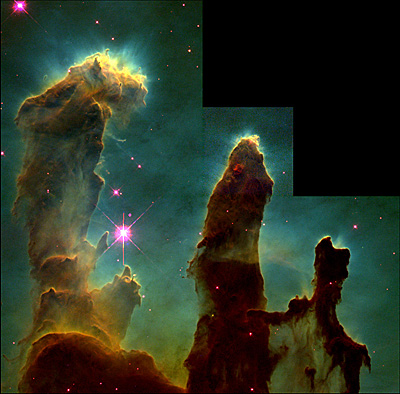
This 1995 Hubble Space Telescope image of the ‘Pillars of Creation’ is probably the most famous astronomical image of the 20th Century.

Taken in visible light using a combination of SII/H-alpha and OIII filters, it shows a part of the Eagle Nebula where new stars are forming.

The tallest pillar is around 4 light-years high

Credits: NASA/ESA/STScI, Hester & Scowen (Arizona State University)

Combining the new space data with near-infrared images from the European Southern Observatory's (ESO's) Very Large Telescope at Paranal, Chile, and visible-light data from its Max Planck Gesellschaft 2.2m diameter telescope at La Silla, Chile, we see this iconic region of the sky in a uniquely beautiful and revealing way.

In visible wavelengths, the nebula shines mainly due to reflected starlight and hot gas filling the giant cavity, covering the surfaces of the pillars and other dusty structures.

At near-infrared wavelengths, the dust becomes almost transparent and the pillars practically vanish.
In far-infrared, Herschel detects this cold dust and the pillars reappear, this time glowing in their own light.

Intricate tendrils of dust and gas are seen to shine, giving astronomers clues about how it interacts with strong ultraviolet light from the hot stars seen by XMM-Newton.

In 2001, Very Large Telescope near-infrared images had shown only a small minority of the EGGs were likely to contain stars being born.

However, Herschel's image makes it possible to search for young stars over a much wider region and thus come to a much fuller understanding of the creative and destructive forces inside the Eagle Nebula.

Earlier mid-infrared images from ESA's Infrared Space Observatory and NASA's Spitzer, and the new XMM-Newton data, have led astronomers to suspect that one of the massive, hot stars in NGC6611 may have exploded in a supernova 6000 years ago, emitting a shockwave that destroyed the pillars.

However, because of the distance of the Eagle Nebula, we won't see this happen for several hundred years yet.

Powerful ground-based telescopes continue to provide astonishing views of our Universe, but images in far-infrared, mid-infrared and X-ray wavelengths are impossible to obtain owing to the absorbing effects of Earth's atmosphere.

Space-based observatories such as ESA's Herschel and XMM-Newton help to peel back that veil and see the full beauty of the Universe across the electromagnetic spectrum.

With regions like the Eagle Nebula, combining all of these observations helps astronomers to understand the complex yet amazing lifecycle of stars

ESA ESO VLT: Gaseous ring around young star V1052 Centaurus

Artist's conception image of a young star surrounded by a disk (made up of rings) (Credits: NASA/JPL-Caltech)

Astronomers have detected a mysterious ring of carbon monoxide gas around the young star V1052 Cen, which is about 700 light years away in the southern constellation Centaurus.

The ring is part of the star’s planet-forming disk, and it’s as far from V1052 Cen as Earth is from the sun. Discovered with the European Southern Observatory's Very Large Telescope, its edges are uniquely crisp.

Carbon monoxide is often detected near young stars, but the gas is usually spread through the planet-forming disk. What’s different about this ring is that it is shaped more like a rope than a dinner plate, said Charles Cowley, professor emeritus in the University of Michigan who led the international research effort.

“It’s exciting because this is the most constrained ring we've ever seen, and it requires an explanation,” Cowley said. “At present time, we just don't understand what makes it a rope rather than a dish.”

Perhaps magnetic fields hold it in place, the researchers say. Maybe “shepherding planets” are reining it in like several of Saturn’s moons control certain planetary rings.

“What makes this star so special is its very strong magnetic field and the fact that it rotates extremely slow compared to other stars of the same type,” said Swetlana Hubrig, of the Leibniz Institute for Astrophysics Potsdam (AIP), Germany.

The star’s unique properties first caught the researchers’ attention in 2008, and they have been studying it intensely ever since.

Understanding the interaction between central stars, their magnetic fields, and planet-forming disks is crucial for astronomers to reconstruct the solar system's history.

It is also important to account for the diversity of the known planetary systems beyond our own. This new finding raises more questions than it answers about the late stages of star and solar system formation.

“Why do turbulent motions not tear the ring apart?” Cowley wondered. “How permanent is the structure? What forces might act to preserve it for times comparable to the stellar formation time itself?”

The team is excited to have found an ideal test case to study this type of object.

“This star is a gift of nature,” Hubrig said.

The findings are newly published online in Astronomy and Astrophysics. The paper is titled “The narrow, inner CO ring around the magnetic Herbig Ae star HD 101412.”

Authors are from the University of Michigan, the Leibniz Institute for Astrophysics Potsdam (AIP) in Germany, the Istituto Nazionale die Astrofisica in Italy and the European Southern Observatory.