Showing posts with label Mobile phones. Show all posts

Thursday, September 27, 2012

Phonesat: On-board mobile phone to power low-cost satellite

A University of Queensland staff member is sending a satellite into space more powerful than the Curiosity Rover which recently landed on Mars.

The satellite, which measures 10cm x 10cm, is controlled by an on-board Android mobile phone five times more powerful than its larger space-faring cousin.

It also has a camera four times more powerful.

Michael Kehoe, a UQ staff member with Information Technology Services (ITS) and a final year student of the School of Information Technology and Electrical Engineering (ITEE) recently completed a five-week internship with NASA in California.

He was tasked with designing a satellite that used a mobile phone as its on-board computer, as part of a NASA initiative, PHONESAT.

"This is a proof of concept that will be used for a range of later designs," said Mr Kehoe.

"The satellite uses an attitude determinate control system (ADCS) written by fellow UQ graduate Jasper Wolfe to stop the satellite from spinning and alter its path in orbit," he said.

"Because it uses a common mobile phone as its central processor, I've been able to incorporate some really fun ideas into the satellite.

I'll be able to take temperature, accelerometer and heading readings using the phone's sensors and photos using the phone's camera."

Despite being controlled by a mobile phone, the satellite is not able to phone home.

"Unfortunately there's no reception in space, so we'll be using a high-powered radio link to receive data from the satellite," said Mr Kehoe.

Tracking of the satellite is being set up in America with NASA and in Australia, with the assistance of ITEE.

Tracking equipment on top of the Parnell building will monitor the satellite from launch on November 25 to re-entry 12 days later.

The project provides a proof of concept for low cost, rapid design iteration space craft. Total component costs for the satellite are $7800, opposed to Curiosity's $2.5 billion.

"An example of why this is important can be seen in the Curiosity Rover which landed in August on Mars," said Mr Kehoe.

"Design work started eight years ago and used cutting-edge technology at the time, but by launch date a common mobile phone had more processing power and better camera.

If we can shorten the time it takes to build spacecraft, we can decrease cost and increase the quality of what goes into space."

More information: open.nasa.gov/plan/phonesat/

Sunday, April 22, 2012

New research advances development of handheld T-Ray devices

Those of us who envy Superman for his X-ray vision may soon get that ability - on our cell phones.

Researchers at the University of Texas at Dallas have reported a new approach to harnessing the potential of the terahertz band in portable devices.

The terahertz band sits between micro waves and infrared on the electromagnetic spectrum and can be used to see through objects such as walls, wood, plastics and paper.

The terahertz wavelength range hasn't been widely accessible for consumer devices until recently. New availability creates new applications however - earlier this year, we reported on how terahertz (or T-Ray) technology could make Star Trek-style tricorders a reality.

"We've created approaches that open a previously untapped portion of the electromagnetic spectrum for consumer use and life-saving medical applications," said Dr. Kenneth O, professor of electrical engineering at University of Texas at Dallas and director of the Texas Analog Center of Excellence, in a statement.

The University of Texas' research centers around the use of CMOS (Complimentary Metal-Oxide Semiconductor) technology to create a terahertz microchip. The approach also by-passes the need to use several lenses inside a device.

"CMOS is affordable and can be used to make lots of chips," Dr. O said on the University of Texas at Dallas website. "The combination of CMOS and terahertz means you could put this chip and receiver in the back of a cell phone, turning it into a device carried in your pocket that can see through objects."


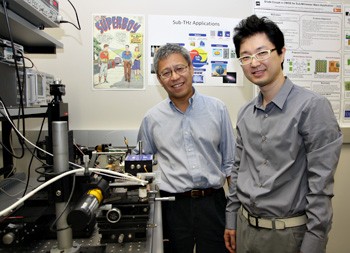
Dr. Kenneth O (left) worked with a team including Dae Yeon Kim

Images produced using this technology can replace X-rays with a less expensive method that might even reduce the risks of exposure previously experienced with X-rays.

The technology might also be used to view more than just bones and related structures - researchers at the University of Texas say it can be used for imaging to detect cancer tumours, diagnosing disease through breath analysis, and monitoring air toxicity.

Because devices with "T-ray" imaging capabilities have the ability to see through most solid, opaque objects, this new technology has applications far beyond the medical field.

"Authentication of documents and currencies is the first application we are thinking of. You can also use this to see through walls to image wires and others," said Dr. O. "You could also use this inspect inside of items such as vase you are purchasing for defects that cannot be seen by eyes."

Dr. O said developing medical uses will take more time.

Terahertz imaging has its limitations. While it can penetrate fog and clouds, challenges occur when trying to penetrate metal and water. The Earth's atmosphere also absorbs terahertz radiation, limiting the range on which a terahertz imaging device can operate.

For now, that's not a big concern. The team plans to limit its uses to devices with a range of less than four inches (10 cm) to address privacy concerns. A device that can see through clothing, walls and other structures is after all, more invasive than the Backscatter scanners used at many airports.

Source: University of Texas at Dallas

Friday, March 2, 2012

Cell Phone Jammers: A Convenience or a crime?


A cell phone jammer is a small device that looks like a walkie-talkie. It is used to prevent cell phones from receiving signals from base stations.

Cell phone jammers block cell phone operations by sending radio waves along the same frequencies that cellular phones use. The radio waves cause interference between the cell phone and its ability to communicate with cell phone towers.

Cell phone jammers come in a variety of sizes, can affect large or small radiuses, and can target a variety of cell phone bands (frequencies used to communicate with towers).

Jammers either disrupt phone-to-tower frequencies or tower-to-phone frequencies. The latter is typically more effective.

Cell phone jammers are illegal according to FCC regulations. The reason is because cell phone jammers could prohibit emergency vehicles from communicating with each other.

It can also disrupt police communication and jammers may prohibit someone from reaching emergency services if they're used incorrectly.

Monday, February 13, 2012

Vodafone 155 Targets Senior UK Citizens with Physical Disabilities


Vodafone has released a new phone for senior citizens in the UK called "Vodafone 155". The device is a basic phone and has been specially designed for elderly people with physical disabilities such as limited dexterity, vision or hearing impairments.

It has been priced at £25.

The phone offers user-friendly features such as speed-dialling and listening to recorded calls besides automated texting capabiities through the SOS button. The emergency button (or the panic button) is a trigger that sends calls or messages to pre-designated numbers stored on the phone.

The phone also ports a built-in alert sound to alarm neighbours in case of emergency. Apart from being significantly more affordable than most other phones aimed at senior citizen, it stands out with an oversized keypad with big buttons and large display fonts alongside support for hearing aids, high volume ring tones and noise cancellation technology. It also adds a sliding keylock on its side to prevent accidental pocket dialling.


The display is perhaps a little too small at 1.7-inches with a lowly resolution of 128x160 pixels; however, this, it must be remembered, is a basic phone meant for the visually impaired.

However, the phone does boast of a powerful battery rated to last up to 29 days in standby mode and offers up to 10 hours of talk time.

The phone is available for purchase at all Vodafone stores, under a Pay As You Go (PAYG) scheme. In addition, Vodafone can also import data and contacts from other handsets, free of cost.

Friday, February 3, 2012

Star Maps From Mobile App Maker Brings Astronomy to the Masses

Skywatching enthusiasts, rejoice! The makers of a popular astronomy app have released a series of free star maps and new educational tools to help both casual and more experienced stargazers learn more about the cosmos, the app's designers said.

Starmap is providing users with free customizable regional star maps and an infographic that illustrates the history of astronomy, and includes resources can be downloaded from the company's website.

The resources join the ranks of a growing field of space-themed apps for digital devices.

"You can download the map month-by-month for the Northern and Southern hemisphere, and you can see the exact times on a list of what can be seen with the naked eye or with telescopes," Frederick Descamps, an astronomer and the creator of the Starmap mobile app, told SPACE.com.

Once users select their hemisphere, region and desired time of night, the map is automatically generated and highlights constellations, planets, moon phases and other cosmic objects that could be visible.

The maps will also separate objects that can be seen with the naked eye, binoculars, small telescopes and larger telescopes.

Wednesday, November 30, 2011

All-seeing Ball Camera snaps panoramas in mid-air


Throw a typical camera in the air and you're unlikely to capture anything stunning. But now a new ball-shaped camera, created by Jonas Pfeil from the Technical University of Berlin and colleagues, is designed to be tossed upwards to snap panoramas in mid-air.

The rubber ball, which contains 36 cellphone cameras, barely moves at the highest point of its trajectory so the photos it captures aren't blurred by movement.

A built-in accelerometer measures in-flight speed to detect this stationary point and trigger the cameras. Software then stitches the pictures together into a spherical panoramic image.

The team developed the system to simplify panoramic photography, which normally involves painstakingly connecting several different images.

The ball will be demonstrated at Siggraph Asia, a conference on computer graphics and interactive techniques, from December 13-15 in Hong Kong.

Tuesday, October 18, 2011

Microsoft PocketTouch - YouTube


The second presentation innovation Microsoft has announced, is called PocketTouch and it is aimed at making smartphones receptive to touch gestures through fabric, such as a pocket, purse, or jacket.

The idea is that sometimes people want to quickly interact with a smartphone without having to pull it out. Microsoft refers to PocketTouch as an “eyes-free” solution. Here’s the description:

PocketTouch enables a rich set of gesture interactions, ranging from simple touch strokes to full alphanumeric text entry. Our prototype device consists of a custom multitouch capacitive sensor mounted on the back of a smartphone.

Similar capabilities could be enabled on most existing capacitive touchscreens through low-level access to the capacitive sensor… Our results suggest that PocketTouch will work reliably with a wide variety of fabrics used in today’s garments, and is a viable input method for quick eyes-free operation of devices in pockets.

PocketTouch are evolutionary steps of a larger effort by Microsoft Research to investigate the unconventional use of touch in devices to extend Microsoft’s vision of ubiquitous computing.”

It’s terrific to see Microsoft innovating on multitouch since it’s obviously a critical element of the future of computing. However, Microsoft Research has a track record of showing off lots of cool stuff that never comes to market.

They need to follow the lead of IBM’s prolific research devision, which is much better at commercializing and productizing its best innovations — or at least maybe IBM only shows off stuff that has a reasonable path to becoming a real product. Still, in this case, it looks like Microsoft has a couple innovations that aren’t just cute ideas.

Thursday, July 28, 2011

Mobile app diagnoses malaria from a single drop of blood

The virtual ink had barely dried on our story about the Skin Scan app for diagnosing melanoma when we received word of another, equally compelling mobile diagnostic tool.

Focusing this time on the millions of people at risk from malaria in sub-Saharan Africa and other parts of the world, Lifelens is a project that has created a smartphone app to diagnose the insidious, mosquito-borne disease.

More than one million people die each year from Malaria, and roughly 85 percent of them are children under the age of 5, the Lifelens project notes. The most prevalent diagnostic tool, meanwhile, is the rapid diagnostic test (RDT), which is known to be associated with a 60 percent incidence rate of false positive results.

That, in turn, results in the treatment of many people who don’t actually have Malaria, driving up the costs of anti-Malaria treatment significantly. The Lifelens project, on the other hand, aims to make the process both cheaper and more accurate by analyzing blood digitally instead.

Specifically, once blood is stained to reveal the Malaria parasites, the project’s smartphone app can analyze a magnified image of a drop of blood captured via simple finger prick, including counting the various types of cells it includes. Malarial parasites are among those it can identify, making false results much less likely.

Once analysis is complete, data is uploaded to the Web, where it can be mapped for a high-level view of where Malaria outbreaks are occurring.

The video below demonstrates Lifelens in action:

Friday, June 10, 2011

Coltan extraction in war torn Congo: Columbite-Tantalite is used in all Mobile Phones


Coltan is the industrial name for columbitetantalite, a dull black metallic mineral from which the elements niobium (formerly "columbium") and tantalum are extracted. The niobium-dominant mineral is columbite, hence the "col" half of the term. The mineral concentrates dominated by tantalum are referred to as tantalite.

Tantalum from coltan is used to manufacture electronic capacitors, used in consumer electronics products such as cell phones, DVD players, video game systems and computers.

Export of coltan from the eastern Democratic Republic of the Congo to European and American markets has been cited by experts as helping to finance the present-day conflict in the Congo.

The DanChurchAid agency asserts that "much of the finance sustaining the civil wars in Africa, especially in the Democratic Republic of the Congo, is directly connected to Coltan profits."

An estimated 5.4 million people have died since 1998 in the war in the Congo.

Another view on recycling Mobile phones here

Monday, March 28, 2011

The Smoothee - Steadicam for mobile phones

It's interesting to note how far the video quality of mobile phones and pocket camcorders has progressed over the past few years.

Features such as their resolution are greatly improved but they do have one disadvantage when compared to their larger, heavier predecessors – they shake like crazy.

But have no fear, this is a shortcoming that's addressed by the Steadicam Smoothee.  

The Steadicam Smothee has been developed by Tiffen the original designer and manufacturer of the professional Steadicam that we all know and love.

Professional videographers tend to have steadier handheld footage than casual shooters mainly because they're using wider lenses and shoulder mounts, but also simply because the extra weight of their larger cameras has a way of "flattening out" the jiggles.

A featherweight mobile phone held in an unsupported extended hand, however, tends to show up every little breath, heartbeat or nervous tic of its user.

Like Steadicam's existing rigs for movie and television cameras, the Smoothee uses counterweights to live up to its name. The phone/camcorder mounts on top, in a quick-release bracket, while the weights are located on a curved metal arm that extends underneath.

The user holds the contraption by a pistol-style grip, that is joined to the mounting platform via a freely-moving gimbal connection.

Watch a series of Steadicam videos to see the Smoothee in action

Wednesday, September 16, 2009

China iPhone substitute to sell at top price

Lenovo Mobile is designing handsets for China's national 3G mobile standard that will sell for as little as US$150, but its high-end handset made to rival the iPhone is not one of them, the company said Wednesday.

The company's O1, the first handset that will use both the Chinese 3G standard and an operating system made by carrier China Mobile, has a display and a body that resemble the iPhone.
But while Chinese carriers aim to start drawing more 3G users with handsets that sell for around 1,000 yuan ($147), the O1 will "definitely not" fall in that price range, Chen Wenhui, marketing vice president for Lenovo Mobile, said at a press event.

"This is a high-end mobile phone for Internet use," Chen said.


China Unicom, which is racing with China Mobile and a third local carrier to attract 3G users, plans to start selling the iPhone in the fourth quarter, officially bringing the phone to a country where many wealthy urbanites already use versions of the handset bought overseas. The carrier has said it will offer both the iPhone 3G and the iPhone 3GS at "competitive" prices.

Lenovo Mobile has said it aims to start selling its rival to the iPhone this month. "The launch of the O1 symbolizes that competition between the Ophone and the iPhone has fully begun," the company said in a statement. "Ophone" is the nickname China Mobile has given to handsets that use its propriety mobile OS, which is based on Google's Android.

A report on local portal Tencent cited an unnamed source as saying the Lenovo Mobile phone will cost around 5,000 yuan, but that users will be able to buy it for 1,500 yuan if they also subscribe to China Mobile's 3G service. The first handset to launch with the China Mobile OS, a 2G version of the Magic handset from High Tech Computer (HTC), sells for 5,000 yuan.

At the press event, Lenovo Mobile displayed its iPhone rival and mock-ups of four lower-end handsets that will also use TD-SCDMA (Time Division Synchronous Code Division Multiple Access), the homegrown 3G mobile standard being promoted by China Mobile and Beijing. The lower-end handsets will sell for China Mobile's target price of 1,000 yuan, and one is slated to go on sale this year.

Lenovo Mobile is also working on its next 3G Ophone, which will target a younger audience and support Flash, executives said.

The O1 will come with a 3.5-inch touchscreen, 8GB or 16GB of storage and pre-installed China Mobile applications such as the carrier's instant messaging client, but the phone is compatible with most Android applications, Lenovo Mobile said.

Saturday, July 18, 2009

China Internet Users already Exceed Population of the USA - Only 1 in 4 currently have internet access

China's Internet users have surpassed the U.S. population in number, and more Chinese than ever are using e-commerce and accessing the Web through mobile phones, according to official statistics.

China's broadband users and the number of .cn Web sites coming on-line, are also first in the world, China reports.

Slideshow: 10 ways the Chinese Internet is different from yours

China had 338 million Internet users at the end of last month, the most in any country, the China Internet Network Information Center (CNNIC) said late Thursday.

Message Boards Chat

Chatting on message boards, cruising around social networking sites and pursuing other entertainment were among the most popular activities for Web users, the center said in a report posted on its Web site. The number of Internet users who watched videos online rose 10 percent from six months ago. More than one-fourth now shop online.

China also led the world in the number of registered Web sites, nearly 13 million, using its .cn top-level domain, the report said

All Figures on the Rise

Almost all of the reported figures rose substantially this year. Nearly all of the Internet users had broadband, which China is working to link to more remote areas

Mobile Broadband

The report gave some mixed signals on the prospects for mobile broadband, which China is also pushing. The number of Chinese who used mobile phones to access some online services rose to 155 million, but just one in four of those people said they would use 3G to surf the Web in the future, the report said.

High prices and limited coverage so far have kept down 3G take-up despite aggressive marketing by China's three mobile carriers.

Malware and Security Issues

The report also showed the severity of malware and other security problems in China. Over 100 million Chinese had passwords or account numbers stolen in the first half of this year, and almost twice as many experienced virus or trojan attacks, it said.

Despite the huge numbers already connected, only one in four Chinese is already an Internet user, the report said. So, brace yourself for the sudden upsurge in Chinese internet activity in the coming year.