Showing posts with label Microsoft. Show all posts

Tuesday, December 13, 2011

Microsoft co-founder Allen launches space project - Stratolaunch Systems

Microsoft Corp co-founder Paul Allen is planning to build a spaceship that could replace the Space Shuttle this decade.

Allen, 58, is hoping his new company, Stratolaunch Systems, will launch unmanned rockets from a flying carrier plane to ferry government and commercial payloads into space and back, and eventually evolve to human space missions.

The initiative comes only months after the United States retired the Space Shuttle program after 30 years, opening the door to private enterprise to supply space vehicles.

Allen's rocket will be launched from a massive carrier aircraft powered by six jumbo jet engines, to be constructed by Scaled Composites, a unit of defense contractor Northrop Grumman Corp.

The rocket itself will be made by private space company SpaceX, founded by Elon Musk, the billionaire co-founder of PayPal.

The first test flight is planned to happen within five years.


"I have long dreamed about taking the next big step in private space flight," said Allen in a statement. "To offer a flexible, orbital space delivery system."

Allen - listed by Forbes magazine as the world's 57th richest person, with a fortune of $13.2 billion - is the latest in a line of tech billionaires with interests in the privatization of space travel.

His space ambitions put him alongside Musk and Amazon.com founder Jeff Bezos, whose Blue Origin aims to put people into space at an affordable price, rather than the millions of dollars it has cost up to now.

Allen, who made up the name Microsoft, co-founded what became the world's biggest software company with Bill Gates in 1975.

Lacking Gates' single-minded drive for business success, he left Microsoft in 1983, as he dealt with a first battle with cancer. He recently survived a second course of treatment for a different type of cancer, but says he is healthy now.

Allen's interests and investments range far and wide, but are focused on his native Seattle and the Pacific Northwest.

He owns the Seattle Seahawks professional football team, the

Trail Blazers basketball team in Portland, and his investment firm developed much of the South Lake Union neighborhood which is central to Seattle's re-emergence as a technology center.

He is a generous donor to the University of Washington and is funding new research into the brain.

For leisure pursuits, he owns one of the world's largest yachts and built the Experience Music Project and Science Fiction Museum in Seattle. Allen's memoir, titled "Idea Man", was published earlier this year.

Thursday, November 17, 2011

Aiding the Blind: Kinecthesia - Oct 2011 - YouTube


Two Students from the University of Pennsylvania have modified a Kinect to help the vision impaired to become more aware of their environment. The project is called Kinecthesia and functions as a radar-like device, but instead of using sound, the device uses the Kinect's cameras to map out the environment and translate it into a sensation the blind can understand.

Eric Berdinis and Jeff Kiske, juniors of the University of Pennsylvania majoring in Computer Engineering, has garnered attention in the 2011 Google's Zeitergeist Young Minds Conference with their application of the gaming peripheral. The project was born from both student's final project for Rahul Mangharam's embedded systems class. The resulting device can be likened to a high-tech walking cane.

The Kinect is a motion detecting gaming peripheral produced by Microsoft. The device is used for the Xbox 360 which can interpret specific gestures and track movement of individuals or objects. The device is composed of an RGB camera, an infrared sensor acting as a depth sensor and multiple-array microphone. It can perform facial recognition, voice recognition and gesture recognition.

Using the Kinect's multiple cameras, Berdinis and Kiske have made a harness that produces vibrations to notify the wearer of coming obstacles. The Kinect is connected to a BeagleBoard, a whole computer in a single board, and fitted in a waistband or belt. The device is ran in Linux and 16 AAA batteries. Since it was still in development the device is not made to run for hours. There are six vibrating motors to guide the user and weighs 1349g as of now.

There are already a number of people hacking their Kinect devices for other applications besides gaming like 3D modeling, controlling robots and using motion capture to automate devices, augment reality, and even produce a low-budget CGIs for amateur movies. Remember the movie Total Recall with the virtual wife? It would be a surprise if no one made one already. The Kinect has made motion capture reachable to consumers and they are very much willing to experiment.

It is great that people are experimenting and applying on technologies readily available for them. Will this open doors on new innovators? Does Microsoft see a new market for their devices?

The project's development can be tracked on their own website at kinecthesia.com. The website also contains the project source code, parts list and assembly instructions.

Tuesday, October 18, 2011

Microsoft PocketTouch - YouTube


The second presentation innovation Microsoft has announced, is called PocketTouch and it is aimed at making smartphones receptive to touch gestures through fabric, such as a pocket, purse, or jacket.

The idea is that sometimes people want to quickly interact with a smartphone without having to pull it out. Microsoft refers to PocketTouch as an “eyes-free” solution. Here’s the description:

PocketTouch enables a rich set of gesture interactions, ranging from simple touch strokes to full alphanumeric text entry. Our prototype device consists of a custom multitouch capacitive sensor mounted on the back of a smartphone.

Similar capabilities could be enabled on most existing capacitive touchscreens through low-level access to the capacitive sensor… Our results suggest that PocketTouch will work reliably with a wide variety of fabrics used in today’s garments, and is a viable input method for quick eyes-free operation of devices in pockets.

PocketTouch are evolutionary steps of a larger effort by Microsoft Research to investigate the unconventional use of touch in devices to extend Microsoft’s vision of ubiquitous computing.”

It’s terrific to see Microsoft innovating on multitouch since it’s obviously a critical element of the future of computing. However, Microsoft Research has a track record of showing off lots of cool stuff that never comes to market.

They need to follow the lead of IBM’s prolific research devision, which is much better at commercializing and productizing its best innovations — or at least maybe IBM only shows off stuff that has a reasonable path to becoming a real product. Still, in this case, it looks like Microsoft has a couple innovations that aren’t just cute ideas.

Sunday, July 25, 2010

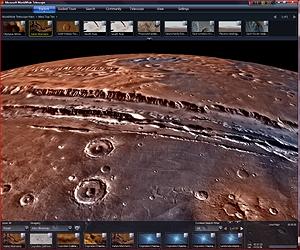
NASA and Microsoft Present: The World Wide MARS telescope Experience


Image credit: Microsoft/NASA.

A wide-angle image of Mars from NASA's Viking orbiters and the Mars Orbiter Camera provide a fascinating view of Valles Marineris, commonly known as the Grand Canyon of Mars.

To experience Mars up close, Microsoft and NASA encourage viewers to download the new WWT|Mars experience

Tuesday, December 29, 2009

Curtain falling on 'Digital Decade'

While it got off to a rocky start with the overhyped Y2K bug and dotcom bubble, the era dubbed the "Digital Decade" by Microsoft's Bill Gates has turned out to be a dizzying period of innovation.

"It's been an amazingly vibrant decade for the Internet and for digital things in general," said John Abell, New York bureau chief of Wired magazine, which has chronicled the technological leaps and bounds of the past 10 years.

"People simply don't exist in a non-digital world at all," Abell told AFP. "Even grandmothers and Luddites all have tools and devices -- even if they don't realize they're using them -- which connect them to a digital world."

David Pogue, personal technology columnist for The New York Times, points to Apple's iPod, introduced in 2001, as among the most influential devices of the decade.

"It really revolutionized the way music is distributed and marketed," said Pogue, who also casts a vote for the Flip pocket camcorder from Pure Digital Technologies.

"In two years it has taken over one-third of the camcorder market and has killed the sales of tape camcorders," Pogue told AFP.

Pogue also gives a nod to the GPS navigational unit "which changes the way we drive and also has environmental considerations because millions of people spend less time driving around lost."

Touchscreen smartphones such as Apple's iPhone featuring thousands of applications are also high on Pogue's list.

"It's become a tiny pocket computer in a size and shape that no computer's ever been before -- and mobile and connected to the Internet all the time," said Pogue. "That's a revolutionary set of circumstances."

What's more, he added, "It's only two years old. The iPhone came out two years ago.

"Imagine what the iPhone and the Android phones and the Palm phones are going to look like in five years? They're going to be smaller, thinner, much better battery life, many more features, much faster."

"Right now we're looking at the Stone Age of these phones," Pogue said. "We think they're modern but they're not."

Another groundbreaking device high on the lists of technology analysts is Amazon's Kindle electronic reader, which made its appearance in 2007 and has spawned a host of rivals jostling for a share of the digital book market.

The past decade has, of course, also seen seismic shifts in the Web with the explosive growth of social networking sites, wireless connectivity and the rise of Internet-based cloud computing.

Web search and advertising giant Google has become "central to our lives," said Wired's Abell, branching out into "everything you can think of, from mail to documents to the telephone."

In the late 1990s, Pogue said, "creating a webpage took skill, talent, special software -- it was still only for the geeks."

The Internet has become accessible to all in the years since, giving birth to sites such as Wikipedia in 2001, MySpace in 2003, Facebook in 2004, YouTube in 2005 and Twitter in 2006.

"The beauty of Web 2.0 websites is that it makes it very easy," said Pogue. "Anybody can immediately just type, just type to present their point of view without having any special talent except having an opinion.

"What it does that's really amazing is it connects people who have similar interests, even very narrow interests, who would never meet each other," he said. "They would never be able to connect any other way."

Much of what has come to pass over the past 10 years was presaged by Gates when he gazed into a crystal ball in an October 2001 essay titled "Moving Into the Digital Decade."

"Wherever you are, you'll have the power to control who can contact you or access your information to live your life as openly or as privately as you wish," Gates wrote.

As for what the next decade holds, Pogue is not going there. "Anyone who tries to predict the future of technology usually looks like an idiot," he said.

Unless you're Bill Gates.

Saturday, July 18, 2009

Present from Bill Gates Microsoft - A Free Gift of Physics

Richard Feynman photo

Bill Gates and Microsoft Research have joined forces on a new website featuring the physics lectures of Richard Feynman, as presented at Cornell University in 1964.

The dapper and brilliant Feynman waxes eloquent on topics such as the Law of Gravitation and Symmetry in Physical Law. No mention of Windows from the ones I checked out.

Gates privately bought the rights to the lecture series so that he could make it publicly available via the very slick Silverlight-enabled Project Tuva website, which features a moving timeline, ability to take notes and more. The name “Tuva” was inspired by Feynman’s interest in the Russian republic of that name.