Showing posts with label Experience. Show all posts

Thursday, October 16, 2014

ISS Astronauts broadcast multimedia experience from Space Station - Video

Nasa's Reid Wiseman (@astro_reid) and ESA's Alexander Gerst (@Astro_Alex) posting incredible content captured from the International Space Station on their Twitter feeds.

In between conducting ISS experiments and research, the astronauts are taking videos, timelapses, Vines, photos and panoramas on the ISS.

The pair have so far shown off the Earth's beauty like never before, posting some fascinating demonstrations of zero gravity, inserting cameras into water bubbles and giving insight into daily life at the station.


This timelapse video from space was taken by ESA astronaut Alexander Gerst from the Cupola observatory module on the International Space Station as it orbited Earth at around 400 km altitude.

As the Space Station passes over Earth at night we can see city lights and lightning.

Below is a Vine clip of the spectacular Aurora Borealis taken from the ISS.


Wednesday, May 28, 2014

NASA Cassini: Carolyn Porco talks about her life and experiences as a Saturn explorer - Video


Cassini mission scientist Carolyn Porco talks about her life and experiences as a Saturn explorer.

This interview, in which Porco discusses her fascination with astronomy and planets, and how that fascination led her down her remarkable career path, was conducted by space historian Andrew Chalkin, and it is just so wonderful to watch.

Porco's love of scientific investigation and passion for what she does is so compelling, it's hard not to get lost in her stories of coming up in the Bronx, her accounts of past missions, and her continued enthusiasm for the science that she and the Cassini team are busy conducting to this day.

More information on the Saturn and the Cassini mission

Tuesday, April 8, 2014

NASA LRO Mission and North America to Experience Total Lunar Eclipse


On April 15th, 2014 there will be a total lunar eclipse visible from North America. Noah Petro, LRO Deputy Project Scientist, discusses this unique event and what effect it will have on the Lunar Reconnaissance Orbiter (LRO).

When people in North America look up at the sky in the early morning hours of April 15, they can expect the moon to look a little different.

A total lunar eclipse is expected at this time, a phenomenon that occurs when the Earth, moon and sun are in perfect alignment, blanketing the moon in the Earth's shadow.

Although lunar eclipses happen multiple times in a year during a full moon, this eclipse will be a particularly unusual viewing opportunity for North America.

Since the Earth's Western Hemisphere will be facing the moon during the eclipse, the continent will be in prime position to view it from start to finish.

In addition, the eclipse will coincide with nighttime in North America. The entire continent won't be able to witness a full lunar eclipse in its entirety again until 2019.

"Sometimes they'll happen and you'll have to be somewhere else on Earth to see them," said Noah Petro, Lunar Reconnaissance Orbiter deputy project scientist at NASA's Goddard Space Flight Center in Greenbelt, Md. "Most [residents] of the continental United States will be able to see the whole thing."

For those who are awake to watch the eclipse, which is scheduled to begin around 2:00 a.m. EDT and last over three hours, Petro said there would be several changes people can witness.

When the moon first enters the Earth's partial shadow, know as the penumbra, a dark shadow will begin creeping across the moon.

This will give the illusion that the moon is changing phases in a matter of minutes instead of weeks.

"Eventually there will be a chunk of darkness eating the moon," Petro said.

Sunday, March 9, 2014

HOT Super Falcon: the ultimate submarine experience - Video


Hawkes Ocean Technologies (HOT), maker of the DeepFlight submersibles, has made the Super Falcon to be always positively buoyant — that means if everything suddenly cuts out, you'll rise to the surface rather than sink to the depths (as a conventional submarine would).


A low frontal area and a lightweight proprietary pressure hull help make the craft easy to operate for the pilot, who has a great deal of control over the Super Falcon when it comes to moving through the water: it can perform deep sea barrel rolls if you want it to, such is its nimbleness.

The Super Falcon has a cruising speed of 2-6 knots (2.3-6.9mph).

With a thrust of 230kg and an operating depth of up to 120m.

Weighing 1,800kg in total, the sub has two life support systems installed that can keep a pair of passengers alive for 12 hours should something go drastically wrong.

It uses a fly-by-wire (partly computerised) control system for smooth operation, and a marine-grade VHF radio is included so you can keep in touch with the surface while you're underwater.

The Super Falcon is 1.6m (5' 2') tall and measures 6.4m from tip to tail, so it's about one-and-a-half times the length of an average family car.

If you want a DeepFlight Super Falcon to call your own, you're going to need to part with $1.7 million (about £1 million) — they are manufactured in Richmond, California, overlooking San Francisco bay.

Here's a closer look at one of the cockpits: each passenger gets an adjustable carbon fibre seat with an integrated 5-point harness, forward and rear footrests and a bank of digital control consoles.

The craft is fitted with an on-board air conditioning system and a built-in heads-up display to help you find your way through the murkiest waters successfully.

An on-board radio system enables both passengers to communicate with each other.

Graham Hawkes is the founder and Chief Technical Officer of Hawkes Ocean Technologies.

He has more than 45 years' worth of experience in underwater engineering.

Hawkes has taken the Super Falcon around the United States, Mexico and the Middle East, and has said that the vessel's target market is wealthy executives such as Hedonist Billionaire Branson.

Wednesday, September 19, 2012

NASA Commander Chris Hadfield Experiences Virtual Reality EVA

Kate Lunau with her VR helmet. (Photo: Kate Lunau)
At NASA’s Johnson Space Center with astronaut Chris Hadfield, who is set to become the first Canadian commander of the International Space Station. 

In space, there’s no up or down—it’s a 360-degree world and that can be extremely disorienting, as Chris Hadfield learned shortly after getting suited up today at the NASA Johnson Space Center’s Virtual Reality lab, where he took a “spacewalk” with Jeremy Hansen, one of Canada’s newest astronauts.

Despite feeling mildly seasick as he roamed the outside of the International Space Station, it was a thrill.

At Johnson’s VR lab, astronauts practice for all sorts of situations they might encounter in real life on the ISS.

Canadian Chris Hadfield, who’ll assume command of the ISS in March, is working a lot in VR right now to master SAFER, a propulsive backpack that can save spacewalking astronauts should they drift away on an EVA.

In the VR lab, there’s a console filled with monitors where astronauts can operate a virtual Canadarm; and there’s another area where astronauts donning VR helmets can practice climbing all over the ISS to do a repair.

The view from inside the VR helmet. (Photo: Kate Lunau)
A software technician helped set Hadfield up: she put a massive helmet over his heads, and slipped wired gloves onto his hands.

As soon as the helmet was lowered over his eyes, Hadfield felt submerged in a different world. In front of him he could see the Space Station, and beyond it, the blue curve of Earth.

It was beautiful, but stomach churning: the perspective is nothing like on the ground. You can move in any direction, and this makes you feel immediately disoriented (no wonder even seasoned astronauts can get lost aboard the ISS).

The technician helped him figure out how to grab a railing and climb around; eventually he could see the other astronaut in his spacesuit in front of him, waving.

It’s easy to see why this type of practice is important for astronauts, especially when paired with work in the Neutral Buoyancy Lab, a massive swimming pool containing a mockup of the ISS where they run through drills in their spacesuits but underwater in the NBL, there’s still an “up” and a “down.”

That wasn’t the case in VR, nor is it in space. When finally the helmet is taken off, his face was white as a sheet but even while battling nausea, the experience was so novel and exciting he didn’t want it to end.

Chris Hadfield said that the best part of the VR experience was when a technician 'fixed' him to the end of the Canadarm2 to really give me a view.

Sunday, July 25, 2010

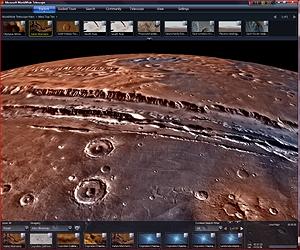
NASA and Microsoft Present: The World Wide MARS telescope Experience


Image credit: Microsoft/NASA.

A wide-angle image of Mars from NASA's Viking orbiters and the Mars Orbiter Camera provide a fascinating view of Valles Marineris, commonly known as the Grand Canyon of Mars.

To experience Mars up close, Microsoft and NASA encourage viewers to download the new WWT|Mars experience