Showing posts with label Alexander Gerst. Show all posts

Monday, November 10, 2014

Three-man multinational ISS crew returns to Earth - Video

Expedition 41 Commander Max Suraev of the Russian Federal Space Agency (Roscosmos), NASA Flight Engineer Reid Wiseman and Flight Engineer Alexander Gerst of the European Space Agency landed safely on the steppe of Kazakhstan near the town of Arkalyk on Nov. 10, Kazakh time, after bidding farewell to the Expedition 42 crew members and undocking their Soyuz TMA-13M spacecraft from the Rassvet module on the International Space Station.


Alexander Gerst of the European Space Agency (L), Max Suraev of the Russian Federal Space Agency (C), and NASA's Reid Wiseman (R) sit in chairs outside the Soyuz TMA-13M capsule just minutes after they landed in Kazakhstan November 10, 2014

A three-man multinational crew of astronauts returned to Earth Monday aboard a Russian Soyuz spacecraft, after spending 165 days working together at the International Space Station, NASA said.

ISS commander, Russia's Max Suraev, his American colleague Reid Wiseman and German Alexander Gerst from the European Space Agency (ESA) touched down at 10:58 pm Sunday (0358 GMT Monday).

The three men smiled broadly from reclining chairs as medical personnel tended to them amid patches of snow on the barren steppe just northeast of Arkalyk, Kazakhstan, where they landed.

Surayev flashed a V for victory sign while Wiseman pumped his fist as they waited to regain their land legs after nearly half a year of weightlessness.

"Everything was in the spirit of cooperation, so I think that everybody needs to learn and follow the example of the ISS crew members," Surayev said.

"Let's try to live together side by side. This is the most important thing," he added.

While in space the crew traveled more than 70 million miles (112.7 million kilometers), NASA said.

The "bulls-eye" touchdown was executed amid low clouds and fog "following a flawless descent back into the atmosphere," according to NASA TV.

The spacecraft was pulled onto its side by its parachute upon arrival, which NASA TV added was not uncommon.

The US space agency said the "departure of Wiseman, Gerst and Surayev marks the end of Expedition 41," referring to their mission to the ISS to carry out equipment repairs, maintenance and experiments.

Surayev was on his second long ISS mission, having now spent a total of 334 days in space, while the other two astronauts were on their first trip.

The three men were pictured smiling and with their arms around each other before hitching the ride back home, undocking from ISS at 7:31 pm (0031 GMT).

Another three-person crew remains on the ISS to "continue research and maintenance aboard the station" and will be joined by three more astronauts who launch from Kazakhstan on November 23, NASA said.

NASA lost its ability to reach the space station when the shuttle program ended in 2011 after 30 years.

The US space agency has helped fund private companies in a push to restore US access to the ISS.

In the meantime, the world's astronauts must rely on Russia's Soyuz spacecraft to get to the ISS and back, at a cost of $70 million per seat.

There are 15 country participants in the ISS program, though the US and Russia contribute the lion's share of funds for the project.

Friday, November 7, 2014

Space Station Astronauts Grow a Water Bubble in Space


During Expedition 40 in the summer of 2014, NASA astronauts Steve Swanson and Reid Wiseman, along with European Space Agency (ESA) astronaut Alexander Gerst, explored the phenomenon of water surface tension in microgravity on the International Space Station.

The crew "submerged" a sealed GoPro camera into a floating ball of water the size of a softball and recorded the activity with a 3-D camera. (Video: NASA)

Note: You will need red-blue stereoscopic 3D vision glasses to view the video.

Tuesday, November 4, 2014

Expedition 41 crew selfie portrait on the International Space Station

Expedition 41 crew portrait on the International Space Station. 

From left: ESA astronaut Alexander Gerst, Roscosmos cosmonauts Elena Serova, Maxim Suraev and Alexander Samokutyaev, and NASA astronauts Reid Wiseman and Barry Wilmore.

The rear astronauts are dressed in the Sokol suits they will wear in their Soyuz spacecraft that will take them back to Earth on 9 November. Alexander, Max and Reid were making sure their suits still fit and have no leaks after having been stored on arrival at the Station almost six months ago.

Yelena, Alexander Samokutyaev and Barry will continue working in the weightless research centre, but they will not feel lonely for long.

ESA astronaut Samantha Cristoforetti, NASA astronaut Terry Virts and Roscosmos cosmonaut Anton Shkaplerov will join their colleagues on 24 November.

Alexander Gerst commented on this image: “The International Space Station Expedition 41 crew. My favourite selfie in space!”

ESA Astronaut Alexander Gerst: Aurora Australis over New Zealand


This timelapse video was taken by ESA astronaut Alexander Gerst as he flew over New Zealand on the International Space Station at around 400 km altitude.

The nightime video shows an aurora (Aurora Australis) that occurs when Earth’s atmosphere interacts with solar radiation.

The International Space Station travels at 28 800 km/h meaning that it only takes 90 minutes to circle Earth completely. Each orbit the Station moves around 2200 km to the West in relation to 90 minutes before.

Astronauts often use normal consumer digital cameras to take pictures of Earth through Europe’s observatory module Cupola, in their brief off-duty /off-watch hours.

Setting the camera to take an image every few seconds and then playing the images back quickly create this timelapse effect.

Alexander worked as a geophysicist and volcanologist before he was chosen as an ESA astronaut in 2009.

His Blue Dot mission includes an extensive scientific programme of experiments in physical science, biology, and human physiology as well as radiation research and technology demonstrations.

All experiments chosen make use of the out-of-this-world laboratory to improve life on Earth or prepare for further human exploration of our Solar System.

Monday, October 20, 2014

International Space Station: Astronauts continue with Business as Usual

Commander Maxim Suraev and Flight Engineer Alexander Gerst are pictured in the Tranquility node of the International Space Station.

Image Credit: NASA

The six-person Expedition 41 crew of the International Space Station tackled a range of biomedical research and cargo transfers Friday, capping off a week that included the second of two U.S. spacewalks and preparations for a Russian spacewalk on Oct. 22.

For Flight Engineers Reid Wiseman of NASA and Alexander Gerst of the European Space Agency, most of the day’s science activity focused on a pair of protein crystal growth experiments, which utilize the station’s microgravity environment to grow protein crystals too fragile to form in Earth’s gravity.

Gerst used a reflective microscope to capture images of samples from the NanoRacks-Protein Crystal Growth-1 study, which uses commercial off-the shelf equipment to grow protein crystals on slides.

Later, Gerst joined Wiseman to deactivate and pack up the completed Commercial Protein Crystal Growth-HM experiment.

This investigation is expanding on an ongoing program into the complex realm of membrane proteins that help cells identify each other for immune responses and move molecules to and from a cell’s interior.

Pure crystals that yield information about the protein’s structure will open the way for a coherent, structure-based design of a broader range of medicines for treating diseases and disorders.

The Commercial Protein Crystal Growth-HM experiment, along with about 3,800 pounds of other cargo, is slated to return to Earth on Tuesday aboard the SpaceX Dragon cargo craft.

After the robotics team at Houston’s Mission Control Center uses the Canadarm2 robotic arm to detach Dragon from the Earth-facing port of the Harmony node, Wiseman, with assistance from Flight Engineer Barry Wilmore, will oversee the release of Dragon for its parachute-assisted splashdown off the coast of California.

Thursday, October 16, 2014

ISS Astronauts broadcast multimedia experience from Space Station - Video

Nasa's Reid Wiseman (@astro_reid) and ESA's Alexander Gerst (@Astro_Alex) posting incredible content captured from the International Space Station on their Twitter feeds.

In between conducting ISS experiments and research, the astronauts are taking videos, timelapses, Vines, photos and panoramas on the ISS.

The pair have so far shown off the Earth's beauty like never before, posting some fascinating demonstrations of zero gravity, inserting cameras into water bubbles and giving insight into daily life at the station.


This timelapse video from space was taken by ESA astronaut Alexander Gerst from the Cupola observatory module on the International Space Station as it orbited Earth at around 400 km altitude.

As the Space Station passes over Earth at night we can see city lights and lightning.

Below is a Vine clip of the spectacular Aurora Borealis taken from the ISS.


Tuesday, October 7, 2014

Astronauts resume routine spacewalks for the ISS, NASA and ESA - Video Update

In this image taken from NASA TV, American astronaut Reid Wiseman works outside the International Space Station on Tuesday, Oct. 7, 2014. 

Wiseman and German spaceman Alexander Gerst are performing NASA's first routine maintenance outside the International Space Station in more than a year. 

Credit: AP Photo/NASA

Spacewalker Alexander Gerst rides the Canadarm2 to a work site on the International Space Station.

Image Credit: NASA TV

Two spacewalking astronauts moved an old, broken pump into permanent storage Tuesday, NASA's first routine maintenance outside the International Space Station in more than a year.

American Reid Wiseman and German Alexander Gerst, both first-time spacewalkers, cheerfully completed the long overdue job 260 miles (418.41 kilometers) up.

"I can't wait to see these pictures," Gerst said.


U.S.-based spacewalks were curtailed in July 2013 after an Italian astronaut nearly drowned because of a flooded helmet. NASA solved the problem with the suit's water-cooling system. Then concern arose over the spacesuit batteries.

ESA Astronaut Alexander Gerst on the CanadArm-2 robotic arm during the latest EVA.

Credit: Nasa TV

New batteries arrived late last month, clearing the way for Tuesday's spacewalk and another one scheduled for next week.

Gerst clutched the 780-pound pump, about the size of a double-door refrigerator, as he rode on the end of the station's big robot arm.

NASA's Reid Wiseman and European Space Agency astronaut Alexander Gerst performed a spacewalk outside the International Space Station on Oct. 7, 2014.

Credit: NASA TV

The crane swung him from the pump's temporary location to the new permanent spot in about 12 minutes.

"You should see my view right now," Gerst said, referring to the sprawling space station, lit up like gold in the darkness.

The pump ended up in short-term storage during urgent spacewalking repairs to the station's ammonia-cooling system last December.

NASA did not want to waste time back then parking the pump in its long-term garage, given all the spacesuit worries.

So the job was deferred, until now.

With Wiseman looking on, Gerst slid the pump into its permanent slot, a large rectangular sheath formed by white protective blankets, and then bolted it down.

"Nice work," Mission Control radioed.

The spacewalkers hustled through their other chores, replacing a camera light and installing a power-relay device for the station's robot-arm railcar, before calling it quits.

As the six-hour excursion drew to a close, Wiseman thanked the hundreds if not thousands of people who worked on NASA's spacewalk recovery team over the past year.

"Alex and I, we'd like to express just our huge gratitude for getting us back into planned EVAs (spacewalks), safely outside, safely back in," Wiseman said. EVA is NASA talk for extra-vehicular activity.

"It's a good day for NASA" ... "and the European Space Agency." he added.

A follow-up spacewalk is scheduled for Oct. 15 to further whittle down NASA's lengthy to-do list, on hold since the 2013 close call.

That spacewalk will be conducted by Wiseman and fellow American Butch Wilmore, a newcomer.

A week after that, two of the three Russians on board will perform a spacewalk on their country's side of the orbiting outpost. The Moscow-led spacewalks were unaffected by NASA's spacesuit troubles.

Alexander Gerst Tests his Spacesuit for EVA

ESA astronaut Alexander Gerst testing his spacesuit on the International Space Station in preparation for 7 October 2014 when he will venture into open space with NASA astronaut Reid Wiseman on a seven-hour spacewalk.

Their main job is to move a failed cooling pump that was left in a temporary location by previous spacewalkers to its final position.

Alexander and Reid will then install a unit that will allow the Station’s robotic arm to remain powered even when it is being relocated.

This sortie will be the 27th US-led spacewalk. Reid has the callsign EV1 and will be wearing the suit with red stripes, while Alexander will be EV2 without stripes.

The two spacewalkers will work together, independently. To start, Reid will set up the new home for the pump while Alexander retrieves the unit from further along the Station's truss. Reid will then begin their second task of installing the arm power unit, stopping at times to refasten Alexander's tether to let him move around safely.

The duo will fix the pump to its final resting place together and then work in unison on the robotic arm.

Spacewalks are carefully choreographed affairs requiring meticulous planning and perfect coordination between the astronauts and ground control.

ESA's lead mission director for Space Station Expeditions 41 and 42, Alex Nitsch, is responsible for the European part of Alexander's Blue Dot mission.

Based at the Columbus Control Centre in Oberpfaffenhofen, Germany, Alex notes: "Preparing and rehearsing for a spacewalk takes weeks and involves all the partners at the Station control centres in Houston, USA and Moscow, Russia."

Wednesday, October 1, 2014

ISS Astronauts continue preparations for Spacewalk (EVA)

NASA astronaut Reid Wiseman, Expedition 41 flight engineer, works with tools and equipment on a spacesuit in the Quest airlock of the International Space Station in preparation for two spacewalks scheduled in October 2014.

Image Credit: NASA

With the first planned excursion of Expedition 41 just a week away, the International Space Station’s six-person crew spent Tuesday preparing spacewalking tools and equipment, while managing a packed agenda of scientific research and maintenance.

Commander Max Suraev of the Russian Federal Space Agency and the team of five flight engineers began the day at 2 a.m. EDT, and after some time for morning hygiene, breakfast and an inspection of the station, they conducted a daily planning conference with the flight control teams around the world.

Afterward, NASA astronauts Reid Wiseman and Barry Wilmore and European Space Agency astronaut Alexander Gerst went to work in the equipment lock section of the Quest airlock to stage the equipment they’ll need in order to prepare for spacewalks set for Oct. 7 and 15.

During the first six-and-a-half-hour spacewalk, slated to begin on Oct. 7 around 8:10 a.m., Wiseman and Gerst will transfer a previously uninstalled pump module from its temporary stowage location to the External Stowage Platform-2.

The two spacewalkers also will install the Mobile Transporter Relay Assembly (MTRA) that adds the capability to provide “keep-alive” power to the system that moves the station’s robotic arm between worksites.

The two astronauts will venture out on the station’s starboard truss to replace a voltage regulator that failed in mid-May.

Although the station has since operated normally on seven of its eight power channels, replacement of the regulator, known as a sequential shunt unit, is considered a high priority.

Monday, September 29, 2014

Newly Expanded Space Station Crew Tackles Research and EVA Spacewalk Preparation

NASA Flight Engineer Reid Wiseman photo showing Flight Engineers Barry Wilmore (left) and ESA's Alexander Gerst at work in the Kibo laboratory of the International Space Station.

Image Credit: NASA

The International Space Station’s Expedition 41 crew, which doubled the number of humans in space when three new crew members arrived last week, began its first full work week schedule as a six-person crew Monday with biological research and preparations for a pair of U.S. spacewalks.


Alex Samokutyaev
Flight Engineers Barry Wilmore, Alexander Samokutyaev and Elena Serova joined their Expedition 41 crewmates on the station early Friday following a six-hour, four-orbit trek aboard their Soyuz TMA-14M spacecraft from the launch site at the Baikonur Cosmodrome in Kazakhstan.

Wilmore, Samokutyaev and Serova are slated to spend 5 ½ months aboard the station.

Max Suraev
Commander Max Suraev and Flight Engineers Reid Wiseman and Alexander Gerst, who arrived on May 28, will return to Earth in November.

Shortly after the usual 2 a.m. EDT reveille, the entire crew conducted body mass measurements, inspected their orbital home and participated in a daily planning conference with the flight control teams around the world to review the day’s activities.

Yelena Serova
For WisemanGerst and Wilmore, most of those activities were centered primarily on gearing up for their upcoming spacewalks.

During an Oct. 7 excursion outside the station, Wiseman and Gerst will transfer a previously uninstalled pump module from its temporary stowage location to the External Stowage Platform-2.

The two spacewalkers also will install the Mobile Transporter Relay Assembly (MTRA) that adds the capability to provide “keep-alive” power to the Mobile Servicing System (MSS) when the Mobile Transporter is moving between worksites.

Wiseman and Gerst spent some time reviewing the procedures for that spacewalk and later participated in a conference call with spacewalk specialists on the ground.

Wilmore meanwhile began “scrubbing” the cooling loops of the U.S. spacesuits, including the Liquid Cooling and Ventilation Garment that he will wear under his own spacesuit when he joins Wiseman for the second Expedition 41 spacewalk on Oct. 15.

Wiseman completed the spacesuit water recharge in the afternoon and Gerst checked in on the Zebrafish Muscle study.

Zebra Danios
He assessed the water condition inside the Aquatic Habitat, which is housing a school of spacefaring fish popularly known in the aquarium trade as Zebra Danios.

Saturday, September 27, 2014

ESA Space Station Astronaut 90 Minute Orbit Time-Lapse into 51 seconds Video


ISS crew member ESA's Alexander Gerst captured a complete orbit of Earth.

The station orbits the Earth roughly every 90 minutes and therefore passes from day to night, back to day in that time-period.

An Aurora Borealis can be seen in the night time portion of the video.

Friday, September 26, 2014

Expedition 41 Astronauts Welcomed Aboard Space Station

The new six-member Expedition 41 crew gathers in the Zvezda service module for a welcoming ceremony with family and friends in Baikonur, Kazakhstan.

Image Credit: NASA TV

NASA astronaut Butch Wilmore and Russian cosmonauts Alexander Samokutyaev and Elena Serova joined their Expedition 41 crewmates when the hatches between the Soyuz TMA-14M spacecraft and the International Space Station officially opened at 1:06 a.m. EDT.

Expedition 41 Commander Max Suraev of the Russian Federal Space Agency and Flight Engineers Reid Wiseman of NASA and Alexander Gerst of the European Space Agency, who arrived at the station in May, welcomed the new crew members aboard their orbital home.

Shortly after docking with the International Space Station, the Soyuz TMA-14M spacecraft's port solar array deployed successfully.

Earlier, the solar array had failed to deploy when the Soyuz reached orbit.

The image of the spacecraft's approach, taken from the ISS, clearly shows only one solar array has been deployed.

NASA and Roscosmos officials have confirmed that the array poses no long term issue to either standard operations at the station for Expedition 41-42, or for the landing of Barry WilmoreAlexander Samokutyaev and Elena Serova at the conclusion of their mission in March.

ESA’s “Georges LemaĆ®tre” ATV-5 docked at the ISS.

Credit: ESA

There are now five spacecraft docked to the station its maximum visiting vehicle capacity.

There are two Soyuz vehicles, one Progress 56 resupply ship, Europe’s “Georges LemaĆ®tre” ATV-5 and the SpaceX Dragon commercial space freighter which arrived Tuesday morning.

The new crew floated into their new home for a welcoming ceremony and congratulatory calls from family, friends and mission officials in Baikonur.

After the ceremony ended the new crew will underwent a mandatory safety orientation to familiarize themselves with escape paths and procedures and locations of safety gear.

Thursday, September 25, 2014

SpaceX Dragon Spacecraft arrival at Space Station - Video


The private space company's cargo spacecraft delivered supplies, a 3-D printer and more to the International Space Station on September 23rd, 2014.

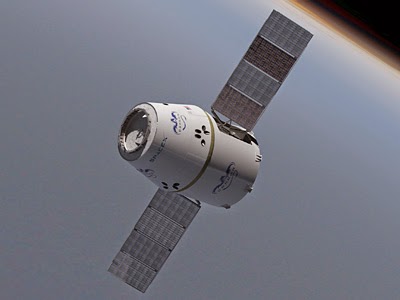
A private Dragon cargo ship built by SpaceX arrived at the International Space Station today (Sept. 23) to deliver more than 2 tons of astronaut supplies and experiments for NASA, including the first 3D printer in space and an intrepid crew of 20 lab mice.

After a two-day chase, the Dragon spacecraft caught up to the orbiting laboratory at 6:52 a.m. EDT (1052GMT).

European astronaut Alexander Gerst used the space station's huge robotic arm to grab the capsule with help from NASA astronaut Reid Wiseman.

The spacecraft is packed with 5,000 lbs. (2,268 kilograms) of experiments and supplies.

Tuesday, September 23, 2014

SpaceX Dragon unmanned spacecraft approaches ISS

A contrail is seen behind the SpaceX Falcon 9 rocket carrying a Dragon supply ship as it flies into space after lifting off from Cape Canaveral, Florida, on a resupply mission to the International Space Station, on September 21, 2014

SpaceX's unmanned Dragon spacecraft was nearing the International Space Station on Tuesday with a cargo of supplies, including freeze-dried meals, 20 live lab mice and a 3D printer.

Germany's Alexander Gerst, an astronaut from the European Space Agency (ESA), will operate CanadArm-2, the 57.7-foot (17.6-meter) robotic arm attached to the ISS, to capture the Dragon and bring it in to dock with the space station.

He will be assisted by NASA astronaut Reid Wiseman.

The berthing operation will be complete when the vessel latches fully onto the research outpost about two hours later.

The Dragon capsule is carrying more than 5,000 pounds (2,200 kilograms) of supplies and material for science experiments, including a tool to measure wind speed at the ocean's surface.

The spacecraft launched early Sunday from Cape Canaveral, Florida, and is SpaceX's fourth contracted mission with NASA for supply trips to the ISS and back.

The Rodent Research Hardware System, which will be installed at the International Space Station, includes three modules: the habitat at left, the transporter in the middle and the so-called animal access unit at right. 

Credit: NASA / Dominic Hart

The lab mice are the first live mammals to hitch a ride aboard a commercial cargo ship, and they are enclosed in a NASA-made research cage for studying the effects of weightlessness on their bodies.

This Zero-G Printer is the first 3D printer designed to operate in zero gravity. 

Also on board the SpaceX Dragon capsule is this 3D printer experiment.

The printer was built under a joint partnership between NASA MSFC and Made In Space.

Contracted as the “3D Printing in Zero-G Experiment” this first version of the Zero-G printer will usher in the era of off-world manufacturing.

This initial version of the Zero-G Printer will serve as a test bed for understanding the long-term effects of microgravity on 3D printing, and how it can enable the future of space exploration.

Saturday, September 20, 2014

International Space Station update: Astronauts' activity schedule

In this photo posted to Twitter by Flight Engineer Reid Wiseman, he and ESA Flight Engineer Alexander Gerst (right) pose for a picture with spacesuits in the International Space Station's Quest airlock.

Image Credit: NASA

Reid Wiseman and Alexander Gerst spent much of the afternoon in the Quest airlock to configure tools and equipment for a pair of U.S. spacewalks set for October.

Wiseman and Gerst are slated to suit up for the first Expedition 41 spacewalk on Oct. 7, while newly-arrived astronaut Barry Wilmore will join Wiseman for the Oct. 15 excursion.

Among the tasks scheduled for the spacewalks will be the transfer of a previously uninstalled pump module from its temporary stowage location to the External Stowage Platform-2 and the replacement of a failed sequential shunt unit designed to regulate current from one of the station’s solar arrays.

A Russian spacewalk on Oct. 21 is also on the schedule.

Throughout the day, Wiseman participated in the Pro K study, as nutritionists monitor how dietary changes may affect the loss of bone density that occurs during long-duration spaceflight.

Wiseman has been following a prescribed diet and testing his urine samples to provide data for the researchers.

On Sunday, Wiseman and Gerst will once again review the procedures for grappling Dragon and conduct a final Canadarm2 robotics training session with the Robotics Onboard Trainer.

Over the weekend, all three crew members also will take care of weekly housekeeping chores and continue their daily 2.5-hour exercise sessions to stay fit.

Thursday, September 18, 2014

ISS Expedition 40/41 Crew members

Expedition 40/41 astronauts on the International Space Station. Clockwise from 12:00: Maxim Suraev, Reid Wiseman, Oleg Artemyev, Steve Swanson, Alexander Skvortsov and Alexander Gerst

Shortly after this picture was taken Oleg, Steve and Alexander Skvortsov left the Station in their Soyuz spacecraft for Earth, leaving the others on their own in space for two weeks.

ESA astronaut Alexander Gerst is spending six months in space for his Blue Dot mission.

Friday, August 22, 2014

Astronauts See Mount Etna Volcano's Lava and Steam from Space

NASA astronaut Reid Wiseman shared this photo of the volcanoes Mount Etna and Mount Stromboli on Aug. 14, 2014.

Credit: Reid Wiseman/NASA

Two astronauts aboard the International Space Station have captured a one-two punch of incredible views from space of Mount Etna and another active volcano in Italy spewing steam and lava.

NASA astronaut Reid Wiseman and European Space Agency astronaut Alexander Gerst managed to photograph both Mount Etna and Mount Stromboli from their positions on the space station earlier this month.

Gerst caught sight of the two Italian volcanoes and their lava flows at night, while Wiseman captured the mountains during daylight.

Both photos give viewers a different perspective of the massive volcanoes. The images were taken from the same angle, and thanks to that specific shot alignment, space fans can orient themselves to see the red lava flows in Gerst's photo.

Without the context provided by Wiseman's daytime image, the lava would be much more difficult to spot.

European astronaut Alexander Gerst uploaded this photo of two volcanoes, Mount Etna and Mount Stromboli, by night on Aug. 1, 2014. 

Credit: Alexander Gerst Twitter / ESA

Gerst has quite a bit of experience with volcanoes.

Before flying to space, he was awarded his doctorate for research he did investigating volcanic eruptions and active volcanoes.

While working toward his master's degree, Gerst also developed new techniques that could help scientistsbetter predict when volcanoes might erupt, according to ESA.

Mount Etna was actually the first erupting volcano Gerst climbed, according to a Twitter post sent out in July.

Mount Etna is the largest volcano in Europe, standing at 10,900 feet (3,328 meters) high.

It is one of the most active volcanoes in the world, but it hasn't had a major eruption since 1992.

The active volcano is almost always discharging gas, ash or lava.

This isn't the first time Mount Etna's active phase has been seen from space. NASA astronaut Karen Nyberg caught sight of the volcano from her post aboard the international Space Station in October 2013.

That same year, Canadian astronaut Chris Hatfield also snapped an amazing image of the active volcano's ash floating through clouds and out to sea.

Both Gerst and Wiseman are about halfway through with their first spaceflight. They launched to the space station in May and are expected to return to Earth in November.

Friday, August 15, 2014

ESA ISS astronaut Alexander Gerst inside ATV-5 Georges LemaƮtre

ESA astronaut Alexander Gerst inside ATV Georges Lemaitre for the first time on orbit after hatch opening.

Alexander wears a facemask to protect against inhaling any fine particles of dust or debris that might have shaken lose at launch. 

One of first things the crew does is install fans and air cleaners to run for several hours inside ATV.
ATV-5 approaches for docking

Credits: Roscomos/O.Artemyev 
 
The fifth and last Automated Transfer Vehicle docked with the International Space Station a day earlier on 12 August 2014.

ATV-5 delivered 6.6 tonnes of supplies to the ISS including food, water, fuel, clothes and experiment hardware.

Credits: ESA/NASA

Saturday, August 9, 2014

ESA Astronaut remotely controls Eurobot Rover


Eurobot rover under ESA astronaut Alexander Gerst's control

Looking down from orbit, ESA astronaut Alexander Gerst steered ESA’s Eurobot rover through a series of intricate manoeuvres on the ground yesterday, demonstrating a new space network that could connect astronauts to vehicles on alien worlds.

During an intense 90-minute live link on 7 August, Alex used a dedicated controller laptop on the International Space Station to operate Eurobot, relying on video and data feedback to feed commands from 400 km up, orbiting at 28 000 km/h.

The link was provided by a new network that stores commands when signals are interrupted if direct line of sight with Earth or the surface unit is lost, forwarding them once contact is re-established.

ESA Rover Control Centre

In the future, controlling robots on Mars or the Moon will require a sort of ‘space Internet’ to send telecommands and receive data.

Such networks must also accommodate signal delays across vast distances, considering that astronauts and rovers on Mars will have to be linked with mission controllers on Earth.

Yesterday’s demonstration was the second in a series of experiments under the Meteron project, following the 2012 test by NASA astronaut Sunita Williams, who used an initial version of the network by steering a model rover at ESA’s ESOC operations centre in Darmstadt, Germany.

“This was the first time Eurobot was controlled from space as part of an experiment to validate communication and operations technologies that will ultimately be used for future human exploration missions,” noted Kim Nergaard, head of Advanced Mission Concepts at ESOC.

'Astronaut' at the controls of the Eurobot Ground Prototype

The Eurobot Ground Prototype (EGP) is a new robotic assistant designed to move around and work on a planet's surface either autonomously or in cooperation with astronauts.

It has a pair of robotic arms with interchangeable tools, force and torque sensors and advanced vision systems, including a 3D camera.

It can also transport an astronaut, who can operate it by simple voice commands or a joystick.

The current prototype is capable of transporting 150 kg, including a suited astronaut. It has four driven wheels and is highly manoeuvrable, with its back wheels steerable over 120°.

Eurobot can be controlled from Earth or from a station located for instance on the International Space Station.

Thales Alenia Space is leading the project under a contract from ESA.

Saturday, August 2, 2014

ESA Image from Space: Sahara dessert irrigation

Amazing colours of the Sahara desert are captured in this photograph taken from onboard the International Space Station. 

ESA astronaut Alexander Gerst shared this image on Twitter with the comment: "Irrigation in the Sahara Desert looks like a challenging task from up here...". 

Gerst is currently a member of the resident International Space Station Expedition 40 crew. 

He is spending five and a half months living and working on the ISS for his Blue Dot mission. 

Credit: ESA