Showing posts with label SpaceX Dragon. Show all posts

Tuesday, September 23, 2014

SpaceX Dragon unmanned spacecraft approaches ISS

A contrail is seen behind the SpaceX Falcon 9 rocket carrying a Dragon supply ship as it flies into space after lifting off from Cape Canaveral, Florida, on a resupply mission to the International Space Station, on September 21, 2014

SpaceX's unmanned Dragon spacecraft was nearing the International Space Station on Tuesday with a cargo of supplies, including freeze-dried meals, 20 live lab mice and a 3D printer.

Germany's Alexander Gerst, an astronaut from the European Space Agency (ESA), will operate CanadArm-2, the 57.7-foot (17.6-meter) robotic arm attached to the ISS, to capture the Dragon and bring it in to dock with the space station.

He will be assisted by NASA astronaut Reid Wiseman.

The berthing operation will be complete when the vessel latches fully onto the research outpost about two hours later.

The Dragon capsule is carrying more than 5,000 pounds (2,200 kilograms) of supplies and material for science experiments, including a tool to measure wind speed at the ocean's surface.

The spacecraft launched early Sunday from Cape Canaveral, Florida, and is SpaceX's fourth contracted mission with NASA for supply trips to the ISS and back.

The Rodent Research Hardware System, which will be installed at the International Space Station, includes three modules: the habitat at left, the transporter in the middle and the so-called animal access unit at right. 

Credit: NASA / Dominic Hart

The lab mice are the first live mammals to hitch a ride aboard a commercial cargo ship, and they are enclosed in a NASA-made research cage for studying the effects of weightlessness on their bodies.

This Zero-G Printer is the first 3D printer designed to operate in zero gravity. 

Also on board the SpaceX Dragon capsule is this 3D printer experiment.

The printer was built under a joint partnership between NASA MSFC and Made In Space.

Contracted as the “3D Printing in Zero-G Experiment” this first version of the Zero-G printer will usher in the era of off-world manufacturing.

This initial version of the Zero-G Printer will serve as a test bed for understanding the long-term effects of microgravity on 3D printing, and how it can enable the future of space exploration.

Sunday, September 7, 2014

NASA's RapidScat payload

RapidScat's two-part payload is shown in the trunk of a SpaceX Dragon cargo spacecraft at NASA's Kennedy Space Center in Florida. 

Credit: NASA

NASA's ISS-RapidScat wind-watching scatterometer, which is scheduled to launch to the International Space Station no earlier than Sept. 19, will be the first science payload to be robotically assembled in space since the space station itself.

This image shows the instrument assembly on the left, shrouded in white.

On the right is Rapid-Scat's nadir adapter, a very sophisticated bracket that points the scatterometer toward Earth so that it can record the direction and speed of ocean winds.

The two pieces are stowed in the unpressurized trunk of a SpaceX Dragon cargo spacecraft at Cape Canaveral Air Force Station in Florida.

Howard Eisen, the ISS-RapidScat project manager at NASA's Jet Propulsion Laboratory, Pasadena, California, said, "Another mission had the idea of a two-piece payload first, but we beat them to the punch."

The RapidScat team designed and built both parts of the science payload in an 18-month-long sprint so as to take advantage of an available berthing space on the space station and a free ride on a resupply mission. The other two-piece payload is still a year and a half from launch.

Each piece of the ISS-RapidScat payload is attached to the space station by a standardized interface called a Flight Releasable Attachment Mechanism, or FRAM.

JPL's Stacey Boland, an engineer on the ISS-RapidScat team, explained, "The space station is almost like a Lego system, and a FRAM is a particular type of Lego block. We had to build on two separate Lego blocks because each block can only hold a certain amount of cargo."

Eisen noted, "We are not only robotically assembled, we are robotically installed." When the Dragon spacecraft reaches the station, a robotic arm will grapple it and bring it to its docking port.

Using a different end effector—a mechanical hand—the arm will first extract the nadir adapter from the trunk and install it on an external site on the Columbus module of the space station.

The arm will then pluck the RapidScat instrument assembly from the trunk and attach it to the nadir adapter, completing the installation. Each of the two operations will take about six hours.

Sunday, July 27, 2014

U.A.E. propose a Mission to Mars

Mars in the UAE’s sights.

Credit: NASA

The United Arab Emirates has announced plans to launch a mission to Mars by 2021.

A first for the Arab world, the mission and accompanying Space Agency are a big deal for the UAE, scientifically and politically.

Investing in space activities is not new territory for the UAE. Its investments in space-related technology has already exceeded some US$5.4 billion, developing satellite data, mobile satellite communications and earth mapping and observation facilities.

This is not surprising when we live in an age where space hardware is important for a range of practical everyday uses such as telecommunications and navigation.

Accordingly, many countries have invested in purchasing satellites and their launches, data from space, and other space infrastructure.

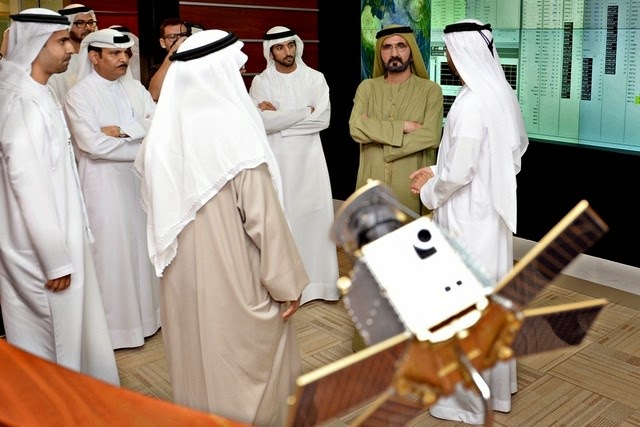
UAE Vice President and Ruler of Dubai Sheikh Mohammed bin Rashid yesterday launched the executive phases for the building of Khalifa Sat, the first satellite to be fully built and manufactured by UAE experts and due to be in orbit by 2017.

Next level space missions
The current plans indicate that the UAE will develop its own spacecraft construction and perhaps also launching capabilities.

While many countries participate in space activities through the purchase of hardware and launches from external providers, the ability to develop, build and launch their own craft domestically lifts a country to the next level of the space faring elite.


The announcement also implies that the UAE plans to pursue hugely expensive space activities with a primarily scientific purpose.

UAE already has a prestigious and respected scientific and technological institute, the Emirates Institution for Advanced Science and Technology (EIAST).

The UAE Mars project has a practical purpose in that it is intended to further inspire UAE technology growth and the education of forthcoming scientists.

However a country is also making a more bold statement when it moves from space-related activity for purely practical purposes, to the more lofty goals of exploration, inspiration and science.

Power, prestige and politics
The leap from practical to primarily scientific space activity is noteworthy. This is partly because a space programme is a way for states to assert their prestige.

There is historical precedent that undertaking space activities for exploration garners prestige and indicates power: financial strength, technological capabilities and also ideologically the capability to be at the forefront of an area of research that taps into humanity’s biggest goals.

The origins of putting human-made objects into space were during the Cold War between the US and the USSR, often referred to as the first space race.

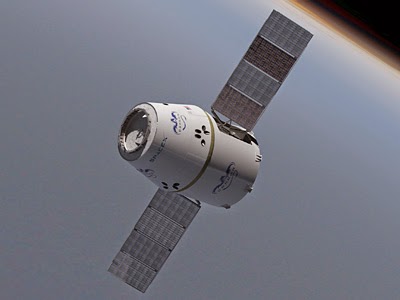
SpaceX Dragon spacecraftMars One configuration
Independent Players
Non-state players are increasingly active in space, including several (such as Mars One) that have planned manned missions to Mars.

Realistically, the UAE’s Mars mission has a political subtext on several levels.

Domestically, it is timed to shore up nationalistic sentiment as it approaches its 50th anniversary of the country’s formation.

Regionally, the project indicates forward and technologically focused leadership within the Middle East region and globally, the mission marks the entry of an Arab nation into the elite club of countries with such ambitious space programs.

Three of the 16 Emirati engineers assigned to the DubaiSat-1 project work on the satellite in Daejeon, South Korea.

Success is not guaranteed
Determined participation is no key to success. Scientifically, Mars missions have proved to be expensive and complex.

Many have tried and many have failed, including the UK’s budget Mars rover, the Beagle 2, which reached Mars in 2003 but failed upon landing on the Martian surface.

Therefore it remains to be seen what exactly the plans are for the UAE’s Martian spacecraft, what is proposed and what it will achieve.

Hellas-Sat 3 /EuropaSat spacecraft
Computer artwork showing Hellas-Sat 3 /EuropaSat spacecraft. Courtesy: Thales Alenia Space.

UAE is no stranger to Space programs and has been an active participant in a number of Satellite program, in cooperation with European corporations and other space agencies, notably the European Space Agency (ESA).

Politically, the planned programme to Mars and also the creation of an UAE Space Agency makes a powerful statement.

It puts the Middle East on the map with regards to space exploration for scientific purposes. It could also drive the creation of a Middle East space programme, akin to that of the European Space Agency.

This does not undermine the scientific value or importance of the project proposed by the UAE.

The space science research community is well-networked transnationally, and a well-funded project to the red planet by the UAE should be welcomed.

Saturday, May 24, 2014

Water Leak Inside SpaceX Dragon Capsule After Splashdown

SpaceX's Dragon capsule splashed down in the Pacific Ocean on May 18, 2014 after about one month in space.

Credit: SpaceX

Water was discovered in the Space Exploration Technologies Corp. Dragon spacecraft that recently returned to Earth from a month-long stay at the international space station, but so far as NASA knew May 21, none of the agency’s cargo was damaged.

The presence of water in the spacecraft, which splashed down May 18 after a month-long mission to the station “did not cause us any impacts that we know of,” Dan Hartman, deputy program manager for the International Space Station, said in a webcast briefing from the Johnson Space Center in Houston May 21.

Some early return cargo had already been rushed back to Houston by May 21, and the rest of Dragon’s cache was due to arrive May 23, Hartman said during the briefing.

SpaceX spokeswoman Emily Shanklin did not reply to emails requesting comment May 21 and May 22.

Hartman said SpaceX will investigate the cause of the water incursion at its rocket test facility in McGregor, Texas, where all Dragon spacecraft are taken for postmission processing.

Dragon returned from the space station May 18, splashing down about 480 kilometers off the coast of Baja California, Mexico, according to a NASA press release issued that day. The spacecraft arrived May 20 at the Port of Long Beach in California, Hartman said.

News that water had been discovered in Dragon was first reported by Aviation Week and Space Technology.

The cargo-delivery mission just completed was the third of 12 that SpaceX owes NASA under the $1.6 billion Commercial Resupply Services contract the Hawthorne, California-based company signed in 2008 to haul 20 metric tons of cargo to station through 2015.

NASA plans to extend that contract to cover deliveries through 2018, and to issue a follow-on Commercial Resupply Services contract for deliveries through at least 2020. SpaceX and Orbital Sciences Corp., NASA’s other contract cargo hauler, are well positioned to get the follow-on contracts.

Monday, April 21, 2014

SpaceX Dragon Grappled to Canadarm2

On Sunday, April 20, 2014, the Expedition 39 crew aboard the International Space Station welcomed nearly two-and-a-half tons of supplies and scientific payloads to the station with the arrival of the third SpaceX Dragon commercial cargo spacecraft.

Credit: NASA

This image of SpaceX Dragon grappled by Canadarm2 was sent down by Flight Engineer Steve Swanson to Instagram with the message, "We have a Dragon. All is good."

With SpaceX Dragon securely in the grasp of Canadarm2 , the robotics officer at Mission Control remotely operated the arm to install the capsule to its port on the Earth-facing side of the Harmony (ESA built Node 2) module.

Once SpaceX Dragon was in place, Flight Engineer Rick Mastracchio monitored the Common Berthing Mechanism operations for first and second stage capture of the cargo ship, assuring that the vehicle was securely attached to the station with a hard mate.

Second stage capture was completed at 10:06 a.m. EDT as the station flew 260 miles above Brazil.