Showing posts with label Canadarm-2. Show all posts

Tuesday, January 27, 2015

Canadian Space Technology to Help Sick Children


Surgeons would have us believe that nothing rivals the dexterity of a good surgeon's hands, but humans being humans, fatigue or even tremors after a long day at the hospital can make things challenging, especially when operating on small children.

That is why Toronto's SickKids Centre for Image-Guided Innovation & Therapeutic Intervention (CIGITI) turned to the Canadian space technology behind Canadarm, Canadarm2 and Dextre and partnered with MacDonald, Dettwiler and Associates Ltd. (MDA) to develop KidsArm.

KidsArm
KidsArm platform with biopsy tool attached.

Image Credit: MDA and CIGITI

The third prototype of KidsArm, the first image-guided robotic surgical arm in the world specifically designed for pediatric surgery, is currently being tested at SickKids Hospital, and researchers are hoping that the technology might soon lend a helping hand to surgeons around the country.

While more testing is needed, the robot is also promising for fetal, cardiac, neurological and urological surgeries.

The suturing tool demonstrates image-guided anastomosis, which means the connecting of parts such as vessels. 

The target on the top of the tool is used to lead the tool's tip. 

This is the same technology used to track the robotic systems on the space shuttle and the International Space Station.

Image Credit: MDA and CIGITI

Using a pair of hand controllers in conjunction with high-precision, real-time imaging technology, surgeons can pinpoint the area of concern to make it easier to reconnect delicate vessels, for example.

KidsArm is also equipped with miniaturized dexterous tools that can cut, coagulate, apply suction, or use a laser.

It is capable of working 10 times faster and with more accuracy than a surgeon's hands when performing intricate procedures.

Advanced technologies such as imaged-based tissue tracking and robotic assistance select and track sutures so that surgeons can compensate for the tissue motion that sometimes makes these surgeries difficult.

A stereo camera generates a 3D point cloud, a set of data points that guide the tool tip and apply a series of sutures. KidsArm pushes the envelope using advanced imaging to identify suture locations.

This allows the surgeon to automate the suturing of small vessels and other microsurgical tasks.

The precision required by KidsArm has to be at least 10 times better than what DEXTRE is able to achieve.

CSA DEXTRE on the ISS
To face this technical challenge, the MDA team adopted the virtual decomposition control (VDC) approach developed by Canadian Space Agency (CSA) engineer Wen-Hong Zhu.

Wen-Hong Zhu
Thanks to this technology, KidsArm is capable of performing intricate procedures such as the suturing of blood vessels and tissues 10 times faster and with more accuracy than a surgeon's hands.

The VDC is a Canadian game-changing technology for precision control of future medical manipulators and space manipulators.

In terms of robotics, the team used a combination of industrial robots, control electronics, cameras and haptics (force-feedback controllers).

The control software evolved directly from the Dextre and Canadarm programs at MDA, and the vision was adapted from their satellite navigation work for the CSA.

One day, this technology may help by making medical procedures on children less invasive and less painful, allowing them to return home faster... so that kids can be kids.

Tuesday, September 23, 2014

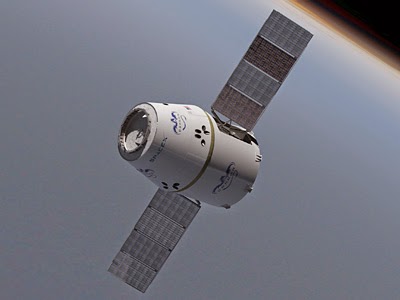
SpaceX Dragon cargo ship docks with ISS

An unmanned SpaceX Dragon cargo ship is seen grappled by a robotic arm on the International Space Station on Sept. 22, 2014. 

The commercial spacecraft is SpaceX's fourth delivery mission to the space station and is carrying 20 live mice and the world's first 3D printer in space among its haul.

Credit: NASA TV

A private Dragon cargo ship built by SpaceX arrived at the International Space Station today (Sept. 23) to deliver more than 2 tons of astronaut supplies and experiments for NASA, including the first 3D printer in space and an intrepid crew of 20 lab mice.

After a two-day chase, the Dragon spacecraft caught up to the orbiting laboratory at 6:52 a.m. EDT (1052GMT).

European astronaut Alexander Gerst used the space station's huge robotic arm to grab the capsule with help from NASA astronaut Reid Wiseman.

The spacecraft is packed with 5,000 lbs. (2,268 kilograms) of experiments and supplies.

"This was a great flight of Dragon toward the space station," Gerst radioed Mission Control after capturing the Dragon capsule with the robotic arm.

SpaceX Dragon unmanned spacecraft approaches ISS

A contrail is seen behind the SpaceX Falcon 9 rocket carrying a Dragon supply ship as it flies into space after lifting off from Cape Canaveral, Florida, on a resupply mission to the International Space Station, on September 21, 2014

SpaceX's unmanned Dragon spacecraft was nearing the International Space Station on Tuesday with a cargo of supplies, including freeze-dried meals, 20 live lab mice and a 3D printer.

Germany's Alexander Gerst, an astronaut from the European Space Agency (ESA), will operate CanadArm-2, the 57.7-foot (17.6-meter) robotic arm attached to the ISS, to capture the Dragon and bring it in to dock with the space station.

He will be assisted by NASA astronaut Reid Wiseman.

The berthing operation will be complete when the vessel latches fully onto the research outpost about two hours later.

The Dragon capsule is carrying more than 5,000 pounds (2,200 kilograms) of supplies and material for science experiments, including a tool to measure wind speed at the ocean's surface.

The spacecraft launched early Sunday from Cape Canaveral, Florida, and is SpaceX's fourth contracted mission with NASA for supply trips to the ISS and back.

The Rodent Research Hardware System, which will be installed at the International Space Station, includes three modules: the habitat at left, the transporter in the middle and the so-called animal access unit at right. 

Credit: NASA / Dominic Hart

The lab mice are the first live mammals to hitch a ride aboard a commercial cargo ship, and they are enclosed in a NASA-made research cage for studying the effects of weightlessness on their bodies.

This Zero-G Printer is the first 3D printer designed to operate in zero gravity. 

Also on board the SpaceX Dragon capsule is this 3D printer experiment.

The printer was built under a joint partnership between NASA MSFC and Made In Space.

Contracted as the “3D Printing in Zero-G Experiment” this first version of the Zero-G printer will usher in the era of off-world manufacturing.

This initial version of the Zero-G Printer will serve as a test bed for understanding the long-term effects of microgravity on 3D printing, and how it can enable the future of space exploration.

Wednesday, May 28, 2014

CSA Dextre: ISS Space robot repairs itself

Dextre, the Canadian Space Agency’s robotic handyman aboard the International Space Station. 

Credit: CSA/NASA

In a thrilling demonstration of space robotics, today the Dextre "hand" replaced a malfunctioning camera on the station's Canadarm-2 robotic arm.

And the Canadian Space Agency gleefully tweeted every step of the way, throwing in jokes to describe what was happening above our heads on the International Space Station.

"Dextre's job is to reduce the risk to astronauts by relieving them of routine chores, freeing their time for science," the Canadian Space Agency tweeted today (May 27) .

"Spacewalks are thrilling, inspiring, but can potentially be dangerous. They also take a lot of resources and time. So Dextre is riding the end of Canadarm-2 today instead of an astronaut. And our inner child is still yelling out 'Weeeee…!' "

The complex maneuvers actually took a few days to accomplish, as the robot removed the broken camera last week and stowed it.

Today's work (performed by ground controllers) was focused on putting in the new camera and starting to test it. You can see some of the most memorable tweets of the day below.

The cookie you see in the first tweet is part of a tradition in Canada's robotic mission control near Montreal, Que., where controllers have this snack on the day when they are doing robotic work in space.


Incidentally, the Canadian Space Agency bet NASA a box of maple cream cookies in February during a gold-medal Olympic hockey game between the two countries, which Canada won.

Tuesday, October 1, 2013

Orbital Science Dragon Spacecraft captured by ISS Canadarm-2


The Orbital Sciences' vehicle was captured by the International Space Station's robotic arm on September 29th, 2013.

Credit: NASA

Sunday, September 29, 2013

Orbital Sciences Cygnus cargo spacecraft docks with ISS

The Cygnus cargo spacecraft is just a few feet away from the International Space Station's Canadarm2. Image Credit: NASA

An unmanned cargo ship successfully berthed with the orbiting International Space Station on Sunday following a one-week delay due to a technical glitch, NASA said.

ISS astronauts "successfully captured the Orbital Sciences Cygnus cargo spacecraft with the station's robotic arm" at 1100 GMT, NASA said.

"Following its capture, the spacecraft is being maneuvered by Luca Parmitano of the European Space Agency and Karen Nyberg of NASA for installation onto the Earth-facing port of the station's Harmony module," the space agency said on its website.

The Cygnus capsule, built by Virginia-based Orbital Sciences, launched on September 18 on a demonstration mission meant to show it can successfully deliver cargo to the space station.

Orbital Sciences has a $1.9 billion contract with NASA that requires the company to deliver freight to the ISS over the course of eight flights by the beginning of 2016.

However a software problem delayed the Cygnus spacecraft's planned approach to the research outpost. The capsule manufacturers eventually figured out how to fix what they called a data format mismatch.

Orbital Sciences is one of just two private US firms enlisted by NASA to carry payloads to the ISS.

California-based SpaceX already showed it could send its reusable Dragon capsule to the ISS bearing cargo in May 2012.

Cygnus's delay however allowed time for three new ISS crew members -- Michael Hopkins of NASA and Oleg Kotov and Sergey Ryazanskiy of the Russian space agency -- to launch aboard a Russian Soyuz.

Their Soyuz-TMA-10M capsule blasted off from Kazakhstan and docked successfully with the ISS just six hours later, in a new shortcut route now used by the Russian space agency.

Friday, July 26, 2013

New Generation of Canadarm: Pack and Go!

The Next-Generation Large Canadarm is a 15-metre robotic arm which is able to collapse and fit onboard future smaller spacecraft.

Credit: Canadian Space Agency

Canada has developed a new version of its famed robotic space arm to give exploration of the final frontier a helping hand.

The nation's Next-Generation Canadarm (NGC) program is designed to support both missions in low-Earth orbit and deep space, ranging from repairing communication satellites to assisting manned missions to the moon, asteroids, Mars and other corners of the universe, officials said.

"With the retirement of the space shuttle, a new generation of crewed space exploration vehicles will soon become available," said Alain Ouellet, director of space exploration development at the Canadian Space Agency (CSA).

Saturday, September 8, 2012

NASA ISS EVA: Astronaut Sunita Williams on Longest Spacewalk

Image Credit: NASA

NASA astronaut Sunita Williams, Expedition 32 flight engineer, appears to touch the bright sun during the mission’s third session of extravehicular activity (EVA) on Sept. 5, 2012.

During the six-hour, 28-minute spacewalk, Williams was accompanied by Japan Aerospace  Exploration Agency (JAXA) astronaut Aki Hoshide (visible in the reflections of Williams’ helmet visor).

They completed the installation of a Main Bus Switching Unit (MBSU) that was hampered by a possible misalignment and damaged threads where a bolt must be placed.

They also installed a camera on the International Space Station’s robotic arm, Canadarm2.

The ISS typically has four MBSUs in place to relay power for its solar arrays to the rest of the station. Failing to have one of these MBSUs in place meant that two of the station’s eight solar arrays were essentially worthless.

That doesn’t mean the integrity of the station would have been compromised if the MBSU hadn’t been fixed, but those aboard certainly would have had to endure access to only 75% of their usual energy allotment.

It appears that the issue plaguing the installation was metal shavings in the MBSU’s receptacles for the bolts.

Using their improved tools, including the toothbrush, and a pressurized can of nitrogen gas, Williams and Hoshide were able to successfully install the unit around four hours into the spacewalk. Not to be deterred, the duo then went on to replace a faulty camera before turning to the airlock.

In addition to being a bit awesome due to its ingenuity, this particular spacewalk also saw Sunita Williams overtake Peggy Whitson as the record holder for most time spent working in the vacuum of space by a female astronaut.


Wednesday, August 15, 2012

NASA ISS Image: Canadarm2 and HTV-3, currently docked

In the grasp of the International Space Station's robotic Canadarm2, the HTV-3 Exposed Pallet is moved for installation on the Japan Aerospace Exploration Agency (JAXA) H-II Transfer Vehicle (HTV-3), KOUNOTORI3, currently docked to the space station. 

Earth's horizon and the blackness of space provide the backdrop for the scene.

Image Credit: NASA