Showing posts with label Orbital Sciences. Show all posts

Monday, September 8, 2014

Orbital Sciences' Cygnus 'Fireball' Re-Entry from Space Station - Video


Orbital Sciences' Cygnus spacecraft burned up in the atmosphere on August 17th, 2014. ISS crew member Alexander Gerst captured imagery to create a time-lapse of the fireworks.


See Photos of the Destruction

Friday, August 15, 2014

Orbital Sciences' Cygnus spacecraft Leaves ISS to burn up in Earth atmosphere

The Cygnus spacecraft as seen when it was released from the International Space Station on Aug. 15, 2014.

Credit: NASA (via Twitter as @NASA)

A private cargo ship loaded down with trash left the International Space Station Friday morning (Aug. 15). Orbital Sciences' Cygnus spacecraft is due to plunge into Earth's atmosphere, burning up above the Pacific Ocean on Sunday (Aug. 17).

The Cygnus spacecraft launched to space on July 13 with close to 3,300 lbs. (1,496 kilograms) of supplies for the six astronauts on the orbiting outpost.

"A flock of nanosatellites was also shipped to the station aboard Cygnus for future release from the Kibo laboratory module’s airlock beginning next week," NASA officials said in a statement.

"Individually known as “Dove” satellites, the group will collect continuous Earth imagery documenting natural and man-made conditions of the environment to improve disaster relief and increase agricultural yields."

Virginia-based Orbital Sciences is one of two private companies that fly unmanned missions to the International Space Station for NASA.

The departure of Cygnus marks the end of the company's second mission (Orb-2) to the space laboratory under a $1.9 billion contract for eight resupply missions.

The other company, SpaceX, uses its Dragon capsule and Falcon 9 rocket to bring cargo to the station under a $1.6 billion NASA deal for 12 missions.

Orbital Sciences' Cygnus spacecraft seen from the International Space Station after its release on Aug. 15, 2014.

Credit: NASA TV

Thursday, July 10, 2014

Orbital Sciences Orbital-2 ISS mission: Antares rocket rollout

Image Credit: NASA/Bill Ingalls

The Orbital Sciences Corporation Antares rocket, with the Cygnus spacecraft onboard, is rolled out of the Horizontal Integration Facility (HIF) to begin the approximately half-mile journey to launch Pad-0A, Thursday, July 10, 2014, at NASA's Wallops Flight Facility in Virginia.

The Antares will launch with the Cygnus spacecraft filled with over 3,000 pounds of supplies for the International Space Station, including science experiments, experiment hardware, spare parts, and crew provisions.

The Orbital-2 mission is Orbital Sciences' second contracted cargo delivery flight to the space station for NASA.

Thursday, May 29, 2014

Orbital Sciences Cygnus: Launch Postponed after Antares rocket test failure

Orbital Sciences Corp. of Dulles, Va., mated the Cygnus Service Module to the Pressurized Cargo Module Friday, April 4, in Bldg. H-100, payload processing facility, at NASA's Wallops Flight Facility, Va. Image courtesy NASA/P. Black. 

Orbital Sciences Corporation has postponed the launch of the Orbital-2 mission to the International Space Station after an engine test aborted prematurely.

The engine being tested at NASA's Stennis Space Center was slated to be used for a launch in 2015, but Orbital has taken the action to investigate the mishap before attempting to launch Orb-2.

Orbital now is looking no earlier than June 17 for the Orb-2 launch.

Orbital published the following message on their website:

Orbital has rescheduled the launch of its Antares rocket for the Orb-2 mission to a date of no earlier than (NET) June 17, 2014. Orb-2 is the second of eight cargo resupply missions to the International Space Station under Orbital's Commercial Resupply Services (CRS) contract with NASA.

The new launch schedule has been established to allow the engineering teams from the main stage propulsion supplier Aerojet Rocketdyne and Orbital to investigate the causes of an AJ26 (NK33) engine failure that occurred last week at NASA's Stennis Space Center during customary acceptance testing.

That engine was designated for use in a mission slated for 2015 and was undergoing hot fire testing that all Antares AJ26 engines are subject to to ensure nominal performance and acceptance for use in Antares missions.

The NET June 17 is a planning date. The determination of a new firm date will depend on progress of the investigation team, so please check back to this page for further updates.

Sunday, September 29, 2013

Orbital Sciences Cygnus cargo spacecraft docks with ISS

The Cygnus cargo spacecraft is just a few feet away from the International Space Station's Canadarm2. Image Credit: NASA

An unmanned cargo ship successfully berthed with the orbiting International Space Station on Sunday following a one-week delay due to a technical glitch, NASA said.

ISS astronauts "successfully captured the Orbital Sciences Cygnus cargo spacecraft with the station's robotic arm" at 1100 GMT, NASA said.

"Following its capture, the spacecraft is being maneuvered by Luca Parmitano of the European Space Agency and Karen Nyberg of NASA for installation onto the Earth-facing port of the station's Harmony module," the space agency said on its website.

The Cygnus capsule, built by Virginia-based Orbital Sciences, launched on September 18 on a demonstration mission meant to show it can successfully deliver cargo to the space station.

Orbital Sciences has a $1.9 billion contract with NASA that requires the company to deliver freight to the ISS over the course of eight flights by the beginning of 2016.

However a software problem delayed the Cygnus spacecraft's planned approach to the research outpost. The capsule manufacturers eventually figured out how to fix what they called a data format mismatch.

Orbital Sciences is one of just two private US firms enlisted by NASA to carry payloads to the ISS.

California-based SpaceX already showed it could send its reusable Dragon capsule to the ISS bearing cargo in May 2012.

Cygnus's delay however allowed time for three new ISS crew members -- Michael Hopkins of NASA and Oleg Kotov and Sergey Ryazanskiy of the Russian space agency -- to launch aboard a Russian Soyuz.

Their Soyuz-TMA-10M capsule blasted off from Kazakhstan and docked successfully with the ISS just six hours later, in a new shortcut route now used by the Russian space agency.

Sunday, September 15, 2013

Orbital Sciences' Antares Rocket and Cygnus Spacecraft at the Launch Pad

Orbital Sciences Corp. of Dulles, Va., rolled out its Antares rocket and Cygnus spacecraft to the Mid-Atlantic Regional Spaceport Pad-0A at NASA's Wallops Flight Facility in Wallops Island, Va on Friday, Sept. 13, 2013. 

The Antares is scheduled to launch Cygnus at 11:16 a.m. EDT on Tuesday, Sept. 17 on a demonstration cargo resupply mission to the International Space Station. 

Cygnus will deliver about 1,300 pounds (589 kilograms) of cargo, including food and clothing, to the Expedition 37 crew aboard the space station, who will capture and install the spacecraft on Sept. 22 using the station's robotic arm. 

Orbital is building and testing its Antares rocket and Cygnus spacecraft under NASA’s Commercial Orbital Transportation Services (COTS) program

Following a successful demonstration mission, Orbital is poised to begin eight cargo flights contracted by NASA to resupply the station. 

Future flights of Cygnus will significantly increase NASA's ability to deliver new science investigations to the nation's only laboratory in microgravity. 

Image Credit: NASA/Brea Reeves

UPDATE
Orbital Sciences Corp. of Dulles, Va., will postpone by at least 24 hours the launch of its Antares rocket and Cygnus spacecraft on a demonstration mission to the International Space Station. 

The new launch window is targeted for Wednesday, Sept. 18 between 10:50 to 11:05 a.m. EDT from the Mid-Atlantic Regional Spaceport Pad-0A at NASA's Wallops Flight Facility in eastern Virginia.

Thursday, June 13, 2013

Antitrust probe of Lockheed-Boeing rocket venture

The Orbital Sciences Corporation Antares rocket is seen as it launches from Pad-0A of the Mid-Atlantic Regional Spaceport at the NASA Wallops Flight Facility in Virginia

Credit: Nasa / Reuters

U.S. regulators have opened a probe into whether a Lockheed-Boeing joint venture that launches U.S. government satellites into space has flouted antitrust laws.

The Federal Trade Commission (FTC) is investigating whether United Launch Alliance (ULA), a joint venture of Lockheed Martin Corp and Boeing Co, violated federal antitrust laws by "monopolizsing" or restraining competition through an exclusivity agreement with the maker of the engines used in its rockets, according to a FTC document obtained by Reuters on Wednesday.

RD Amross, a joint venture of Russia's NPO Energomash and Pratt & Whitney Rocketdyne, a unit of United Technologies Corp, provides RD-180 engines for ULA rockets.

Industry sources say ULA is preventing RD Amross from selling the engines to other rocket makers, including Orbital Sciences Corp, which is trying to break into the lucrative market for government rocket launches.

Jessica Rye
Jessica Rye, spokeswoman for ULA, confirmed the investigation and said the company was cooperating with antitrust regulators.

"ULA's contracts to purchase the RD-180 engine are lawful, pro-competitive and designed to provide the most reliable launch vehicle possible for critical U.S. government missions," Rye said.

"Because this is ongoing investigation, it would be inappropriate for us to comment on specifics."

Pratt & Whitney spokesman Jay DeFrank said his company is aware of the investigation and cooperating with U.S. regulators.

The FTC declined comment.

Barry Beneski, a spokesman for Orbital Sciences, said the company had been contacted by the FTC about the probe.

"We have been contacted by the FTC about their investigation. However we can't be more specific than that," Beneski said.

"In general, the company supports efforts to ensure there is an open and fair competitive environment in the market for launch services."

Lockheed and Boeing formed the joint venture in 2006 after years of competing for contracts under the Air Force's Evolved Expendable Launch Vehicle (EELV) program, which provides launch services for large military, intelligence and NASA satellites.

The companies won U.S. government's approval for the venture by arguing that there was not enough demand for heavy lift rocket launch services to support two competitors since the commercial demand they had expected had failed to materialize for such large rockets.

The U.S. Air Force, frustrated about the high cost of EELV rocket launches, has in recent years tried to infuse more competition into the launch service market.

Sunday, April 21, 2013

Orbital Sciences: Antares Rocket Launches

The Orbital Sciences Corporation Antares rocket is seen as it launches from Pad-0A of the Mid-Atlantic Regional Spaceport (MARS) at the NASA Wallops Flight Facility in Virginia, Sunday, April 21, 2013.

The test launch marked the first flight of Antares and the first rocket launch from Pad-0A. The Antares rocket delivered the equivalent mass of a spacecraft, a so-called mass simulated payload, into Earth's orbit.

Image Credit: NASA/Bill Ingalls

Wednesday, April 17, 2013

Orbital Sciences: First launch of Antares rocket imminent

Image provided by NASA shows Orbital Sciences' Antares rocket at NASA's Wallops Flight Facility in Virginia. 

Orbital Sciences, one of two private US firms chosen by NASA to shuttle cargo to the International Space Station, is preparing for the first launch of its Antares rocket today (Wed 17th April 2013).

The launch over the Atlantic ocean is scheduled for 5 pm (2100 GMT) from the Wallops flight facility from an island off the coast of Virginia about 270 kilometers from Washington.

The two-stage launch vehicle, 131 feet (40 meters) tall and 12.8 feet (3.9 meters) in diameter, aims to hit an orbit of 155 miles (250 kilometers) some ten minutes after take-off. Weather forecasts give a 45 percent change of favorable conditions.

As this is a test mission, Antares will not be transporting the company's Cygnus capsule but will instead carry a simulation of an equivalent payload.

If the launch is a success, Virginia-based Orbital Sciences plans a demonstration run to the space station with the Cygnus capsule in three months, followed by its first delivery mission before the end of the year.

Mike Pinkston
"We see this as a key milestone in proving what can be done in an industry-government partnership," Mike Pinkston, the program manager for Antares at Orbital Sciences, said in a conference call Tuesday.

NASA, in offering its expertise and equipment to partners in the private sector, aims to achieve "safe, reliable and cost-effective access to space and to low orbit and to the ISS in particular," said Alan Lindenmoyer, manager of NASA's commercial crew and cargo program.

Alan Lindenmoyer
"We also recognize the need to create a market environment that will sustain these capabilities, and the ISS provides a perfect market for this new capability with reliable and predictable needs."

The $1.9 billion contract requires Orbital Sciences to deliver freight to the ISS over the course of eight flights by the beginning of 2016. Cygnus has a capacity of two tons.

Unlike the SpaceX Dragon capsule  but similar to the ESA ATV and Japan's HTV, Cygnus cannot return to Earth and will be destroyed upon re-entry, after its mission is complete.

Monday, April 15, 2013

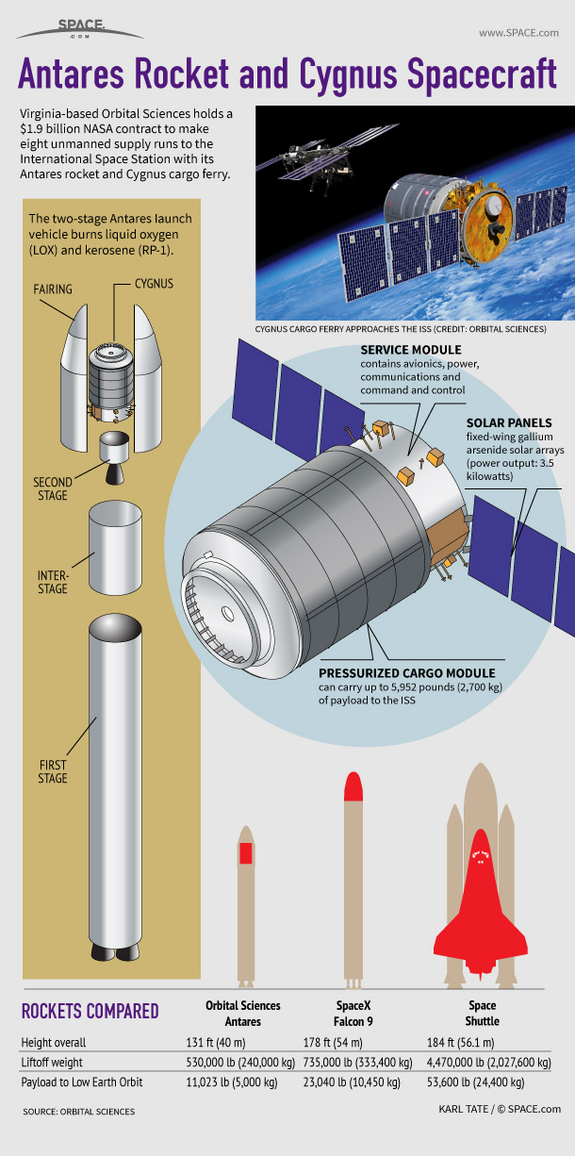
Orbital Sciences: Antares Rocket & Cygnus Spacecraft Explained - Infographic

Find out about Orbital Sciences' new Antares rocket and Cygnus cargo ferry spacecraft in this SPACE.com Infographic.

Credit: Space.com 

All about our solar system, outer space and exploration

Virginia-based Orbital Sciences holds a $1.9 billion NASA contract to make eight unmanned supply runs to the International Space Station with its Antares rocket and Cygnus cargo ferry.

Antares Launcher
The two-stage Antares launch vehicle burns liquid oxygen (LOX) and kerosene (RP-1). The rocket's height overall is 131 feet (40 meters). Its liftoff weight is 530,000 pounds (240,000 kilograms). The Antares rocket was originally called Taurus 2.

Cygnus Cargo Tanker
The Cygnus pressurized cargo module can carry up to 5,952 pounds (2,700 kg) of payload to the International Space Station.

At the rear of Cygnus is a service module containing avionics, power, communications and command and control hardware. On the outside of the service module are twin fixed-wing gallium arsenide solar arrays capable of putting out 3.5 kilowatts of electricity.

Future Cygnus spacecraft will be enhanced with a larger pressurized cargo module and lightweight solar panels.


Tuesday, October 2, 2012

Orbital Sciences' Antares Rolls Out to Wallops Launch Pad


Orbital Sciences Corporation’s Antares rocket rolls out to the launch pad at NASA’s Wallops Flight Facility on the morning of Oct. 1, 2012.

Over the next several months, Orbital plans a hot-fire test of the Antares first stage, the maiden flight of an Antares rocket, and a cargo delivery demonstration mission to the International Space Station as part of NASA’s Commercial Orbital Transportation Services. Credit: Nasa